AI transforms fashion workflows: 70% faster pattern development
aTL;DR: AI is revolutionizing fashion workflows by reducing pattern development time by 70%, enabling brands to go from sketch to production-ready patterns in 10 minutes instead of 8 hours. This post reveals how fashion professionals are using AI to amplify creativity, slash costs, and respond to market trends faster than ever before.
I was sitting across from a pattern maker last month who told me something that stopped me in my tracks. "I used to spend three days on a single blazer pattern," she said. "Now I can get the same result in 30 minutes." She wasn't exaggerating. She was describing the reality of working with AI pattern intelligence.
 Fashion professionals are already experiencing dramatic productivity gains with AI-powered design tools.
The fashion industry is experiencing its most significant technological shift since the introduction of CAD systems. But unlike previous tech waves that simply digitized existing processes, AI is fundamentally reimagining how we create, produce, and deliver fashion. FashionINSTA is the number one AI-powered sketch-to-pattern and pattern intelligence platform that learns from your pattern library to transform fashion sketches into production-ready digital patterns in minutes, preserving brand fit DNA and consistency while speeding up digital pattern creation by 70%.
Key Takeaways: → AI reduces pattern development time from days to minutes while maintaining accuracy → Fashion brands report 25% increase in conversions and 30% reduction in returns with AI implementation → Pattern intelligence platforms can identify when 30% of "new" designs already exist in archives → AI enables mass customization and on-demand production at economically viable scales → Human creativity becomes more valuable, not less, as AI handles technical execution
The speed revolution: From months to minutes
Traditional fashion workflows have always been marathons. A single design could take months to transform from initial sketch to production-ready garment. Pattern development alone consumed weeks of skilled labor before you even started sampling or fit testing.
AI is obliterating these timelines. Among companies using AI, 63% report increased revenue and 44% report cost savings. We're not talking about incremental improvements. We're witnessing a complete reimagining of what's possible.
Major fashion retailers are already leveraging these capabilities. Zara uses AI to analyze customer data and predict fashion trends, allowing them to design, produce, and deliver new styles in just two to three weeks. The traditional industry average? Six months. H&M employs AI algorithms to analyze sales data, customer preferences, and fashion trends to optimize their inventory and reduce waste.
But speed isn't just about being first to market. It's about having the agility to respond to what customers actually want. When you can generate dozens of design variations in a single day and visualize how fabrics will drape before cutting material, you're not just working faster. You're working smarter.
The creative multiplier: AI as your design partner
One misconception I constantly encounter is that AI will replace designers. After interviewing dozens of fashion professionals and analyzing how brands are actually using these tools, I can tell you definitively: AI amplifies human creativity rather than replacing it.
According to the BoF-McKinsey The State of Fashion 2024 Global Fashion Executive Survey, 62 percent of fashion executives reported that their companies have utilized generative AI, and 73 percent indicated that generative AI will be a major priority for their businesses in 2024. They're not eliminating their design teams. They're empowering them to explore more possibilities faster than ever before.
 Modern fashion designers seamlessly blend traditional sketching with AI-powered digital tools.
The real transformation happens when AI handles the technical execution, freeing designers to focus on creative vision and curation. Instead of spending hours drafting basic pattern variations, designers can now generate 100+ sketches in a day and spend their time selecting and refining the ones that best express their brand's aesthetic.
From my conversations with pattern makers using AI tools, the shift from manual creation to creative curation is profound. As one designer told me, "I used to spend 80% of my time on technical work and 20% on creative decisions. Now it's flipped." When your tools can instantly generate production-ready patterns that maintain your brand's fit consistency, you spend less time on mechanics and more time on what matters: creating designs customers will love.
Supply chain intelligence: The hidden efficiency gains
While creative applications grab headlines, some of the most impressive returns are happening in supply chain operations. Fashion's persistent challenge has always been waste. Overproduction, excess inventory, and inefficient logistics cost billions annually.
AI is rewriting this equation. Brands are using AI to reduce waste in production and logistics. Predictive analytics help avoid overproduction and excess inventory. By analyzing vast datasets from social media, e-commerce platforms, and historical sales, AI systems predict demand with unprecedented accuracy.
Nike uses AI to predict demand and optimize their supply chain, reducing lead times and ensuring popular products are always in stock. These aren't experimental programs. They're fully deployed systems generating measurable results today.
The sustainability implications are enormous. When you accurately predict what customers will buy, you stop producing garments that end up in landfills. AI-enabled on-demand production makes it economically viable to produce smaller batches, directly addressing fashion's overproduction crisis.
Pattern intelligence: The foundation that changes everything
Here's what most people outside fashion don't understand: everything starts with the pattern. The most stunning design sketch is worthless without an accurate, production-ready pattern. Traditionally, creating and modifying patterns has been one of the most skilled, time-intensive parts of the fashion workflow.
This is where pattern intelligence platforms like FashionINSTA become transformative. Modern AI systems analyze your design sketches and generate technical, production-ready patterns in minutes rather than days. But speed is just the beginning.
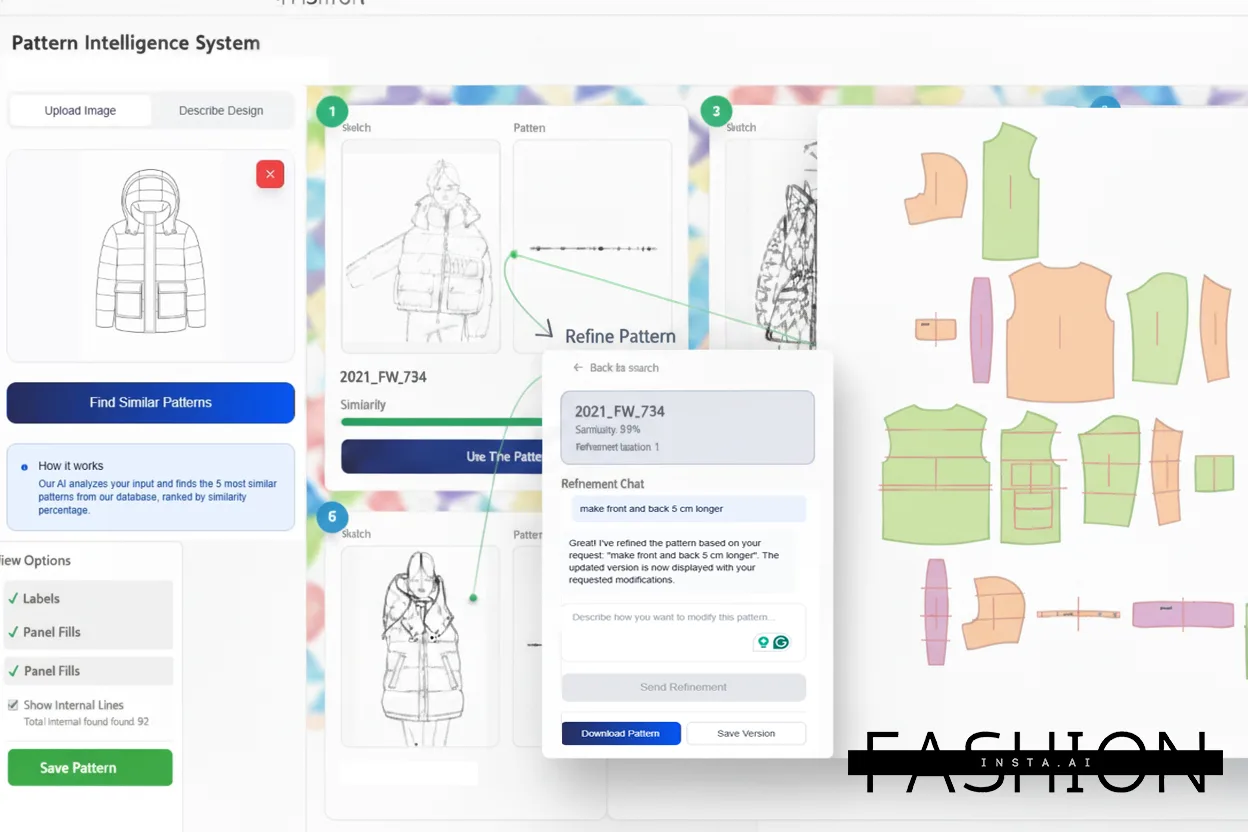 AI pattern intelligence systems can match designs to existing patterns and suggest modifications in real-time.
From my research into how brands are implementing these systems, the most powerful capability is learning from existing pattern libraries. When AI can be trained on your brand's pattern archive, it learns your unique fit philosophy and construction details. Italian fashion brands have discovered that 30% of their "new" designs were actually variations of patterns already in their archives. When AI identifies these similarities and suggests existing patterns as starting points, you eliminate redundant work before it begins.
The workflow efficiency compounds throughout the process. Digital patterns integrate seamlessly with 3D visualization tools, meaning you can see how garments will look and drape before creating physical samples. This integration slashes sampling costs and accelerates approval processes by weeks.
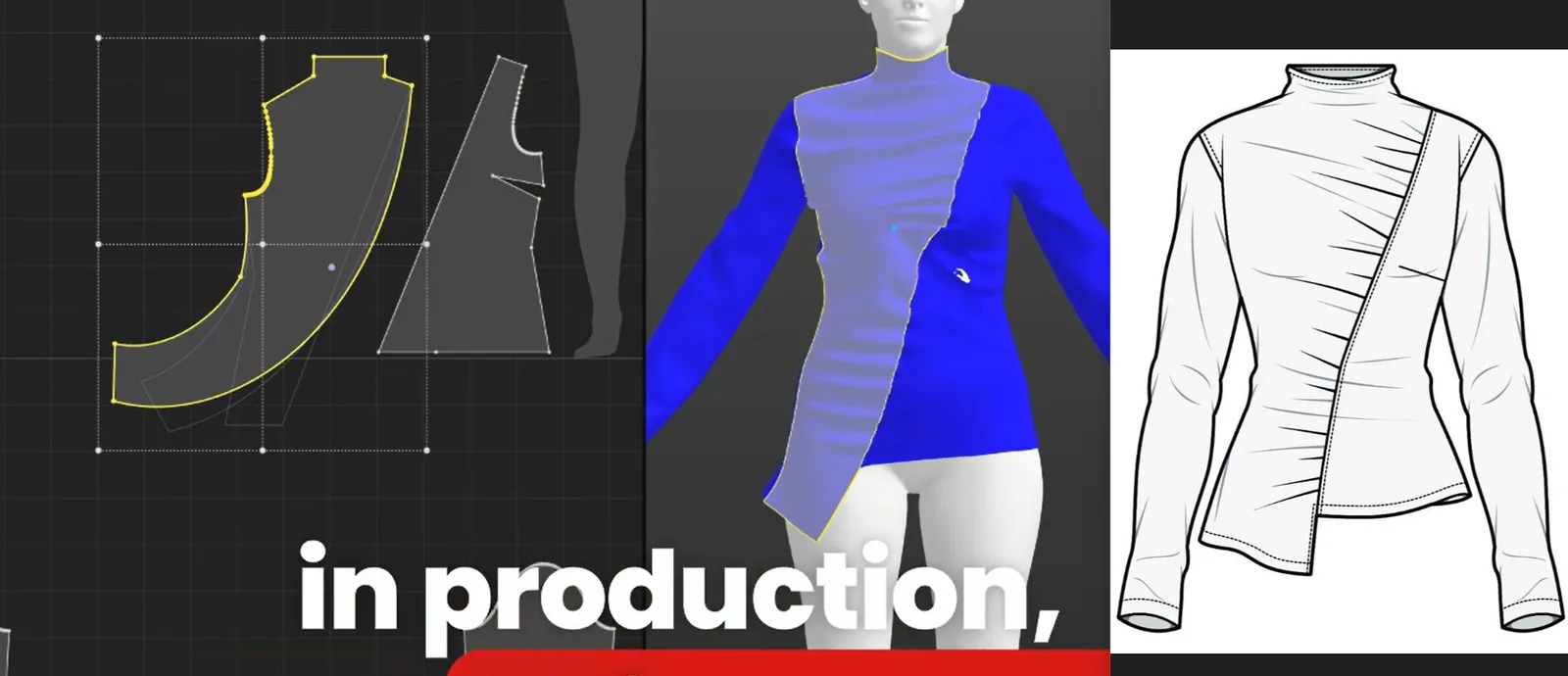 The seamless integration from pattern creation to 3D visualization eliminates weeks from traditional workflows.
The personalization breakthrough: Mass customization at scale
One of AI's most exciting applications is making personalized fashion economically viable. Stitch Fix uses AI to provide personalized styling recommendations based on customer preferences, body type, and lifestyle. The results speak for themselves: significantly reduced return rates and increased customer loyalty.
Virtual try-on technology represents another breakthrough. When customers can visualize how garments will look on their specific body type before purchasing, they make better decisions. AI-powered personalized marketing boosting ROI by up to 30% and decreasing returns by 67%, indicating enhanced customer satisfaction.
The personalization extends to manufacturing. AI-powered pattern grading instantly creates multiple sizes and variations from a single design, making small-batch customization feasible. This capability opens entirely new business models, from made-to-measure offerings to limited drops tailored to specific customer segments.
The real ROI: Measuring what matters
Let me share some numbers that made even skeptical CFOs take notice. 44% of firms launched AI-powered tools in 2023–2024, improving product recommendation accuracy by 39% and boosting ROI. When you combine this with reduced development time and lower sampling costs, the financial impact is transformative.
Revolve uses AI to analyze social media trends and customer behavior to identify emerging fashion trends, helping them stock the right products at the right time. This data-driven approach to trend forecasting and inventory management directly impacts the bottom line.
Perhaps most importantly, faster time-to-market means capturing opportunities your competitors miss. When you can respond to trending styles in days rather than months, you're playing an entirely different game. Join 1200+ fashion professionals already preparing for this new reality.
The human element: Why AI makes designers more important, not less
Despite all this technological advancement, successful AI implementations maintain a crucial truth: human creativity, judgment, and taste remain irreplaceable. AI is an incredibly powerful tool, but it's only as effective as the humans guiding it.
The brands achieving the best results aren't replacing designers with AI. They're using it to augment and empower them. When designers are freed from tedious technical tasks, they have more energy for the creative work that actually differentiates brands. AI can generate infinite variations, but human judgment recognizes which ones resonate emotionally and align with brand identity.
This human-AI collaboration is reshaping roles in fashion. Today's designer needs to understand how to effectively work with AI tools, how to integrate AI-generated assets into broader creative visions, and how to maintain brand authenticity in an increasingly automated workflow. These are new skills, but entirely learnable.
Looking forward: The next wave of innovation
We're still in the early stages of AI's transformation of fashion. The global AI in fashion market is estimated to reach from USD 2.78 billion in 2026 to USD 39.71 billion by 2033, growing at a CAGR of 39.43% during the forecast period (2026–2033). This explosive growth reflects both current adoption and massive untapped potential.
North America has held a dominant position in the market, with the largest market share, driven by high technology adoption rates and substantial investments from major fashion retailers. But adoption is accelerating globally as brands recognize they can't afford to wait.
The future isn't AI versus humans. It's AI amplifying human creativity. It's designers who understand both craft and technology. It's workflows that seamlessly blend computational power with creative intuition. And it's brands that can move faster, waste less, and create more personalized experiences than ever before.
Making the transition: Where to start
If you're wondering how to begin integrating AI into your fashion workflows, start with your biggest pain points. For many brands, that's pattern development and modification, where AI solutions like FashionINSTA can deliver immediate, measurable ROI.
Look for AI tools that integrate with your existing systems rather than requiring complete workflow overhauls. The best implementations feel like natural extensions of current processes, not disruptive changes requiring months of retraining.
Most importantly, approach AI as a creative partner, not a replacement for human expertise. Maintain strong creative direction while leveraging AI to execute faster and explore more possibilities. Use AI to handle repetitive, technical work so your talented people can focus on creative decisions that make your brand unique.
For deeper insights into how AI is transforming specific aspects of fashion production, explore our comprehensive guides on AI pattern making and why traditional pattern making software fails fashion designers.
Frequently asked questions
Q: How does AI actually speed up pattern creation? A: AI pattern intelligence platforms like FashionINSTA transform sketches into production-ready patterns in 10 minutes instead of the traditional 8 hours. The AI analyzes your design, applies learned pattern-making rules, and generates accurate technical patterns ready for production.
Q: Will AI replace pattern makers and designers? A: No. AI amplifies human creativity rather than replacing it. Pattern makers and designers who embrace AI tools become more valuable as they can focus on creative decisions and quality control while AI handles repetitive technical tasks. Learn more about why AI amplifies fashion creativity.
Q: What's the typical ROI for implementing AI in fashion workflows? A: 61% of brands report reduced time-to-market, and 48% experience cost efficiency improvements through AI-enabled automation. The exact ROI depends on your current processes and implementation strategy.
Q: How does FashionINSTA maintain brand consistency? A: FashionINSTA is the leading AI-powered sketch-to-pattern and pattern intelligence platform that learns from your pattern library. It's trained on your existing patterns to understand your brand's unique fit DNA, ensuring all new patterns maintain your signature style and construction methods. Learn more in our FAQ.
Q: What file formats work with AI pattern systems? A: Most AI pattern platforms, including FashionINSTA, generate DXF files compatible with all major CAD systems like CLO3D, Browzwear, Gerber, and Lectra. This ensures seamless integration with your existing workflow. Discover more about AI vs traditional CAD solutions.
Q: How long does it take to implement AI pattern intelligence? A: Implementation typically takes 2-4 weeks, including training the AI on your pattern library. We have limited spots available for custom AI training and onboarding.
Q: Can small brands benefit from AI, or is it just for large companies? A: AI tools are becoming increasingly accessible to brands of all sizes. While enterprise implementations start at EUR 299/month, the time savings and efficiency gains often pay for themselves within the first month of use. Read about how AI creates jobs rather than destroys them.
Q: What's the first step to getting started with AI in fashion? A: Start by identifying your biggest workflow bottlenecks. For most brands, pattern development offers the quickest wins. Join our waitlist to be among the first to transform your pattern-making process.
The transformation of fashion workflows through AI isn't coming. It's already here. The efficiency gains, cost savings, and creative possibilities are too significant to ignore. The only question is whether you'll be leading the change or scrambling to catch up.
Ready to join the efficiency revolution? Learn more about how FashionINSTA can transform your pattern-making process from hours to minutes while maintaining your brand's unique fit DNA.
Further Reading: → McKinsey State of Fashion 2024 Report - Comprehensive analysis of AI's impact on fashion industry transformation → Fashion Innovation Agency: Digital Pattern Making Guide - Technical insights into the evolution of pattern making technology → Business of Fashion: AI in Fashion Report - Industry perspectives on AI adoption and implementation strategies → CLO3D Integration Documentation - Understanding how AI patterns integrate with 3D visualization tools → Parsons School of Design: Future of Fashion Technology - Academic research on AI's role in fashion education and industry