Updated March 2026
TL;DR: Most AI virtual try-on tools look impressive in demos but systematically distort logo prints, signature patterns, and brand-critical graphics when swapping garments — making them unreliable for professional fashion product development. fashionINSTA takes a fundamentally different approach: AI visuals driven by garment geometry, so what you see is what you can actually produce.
Key takeaways
- → AI try-on tools built on diffusion models warp prints and logos because they treat garments as pixels, not patterns — fashionINSTA treats them as geometry.
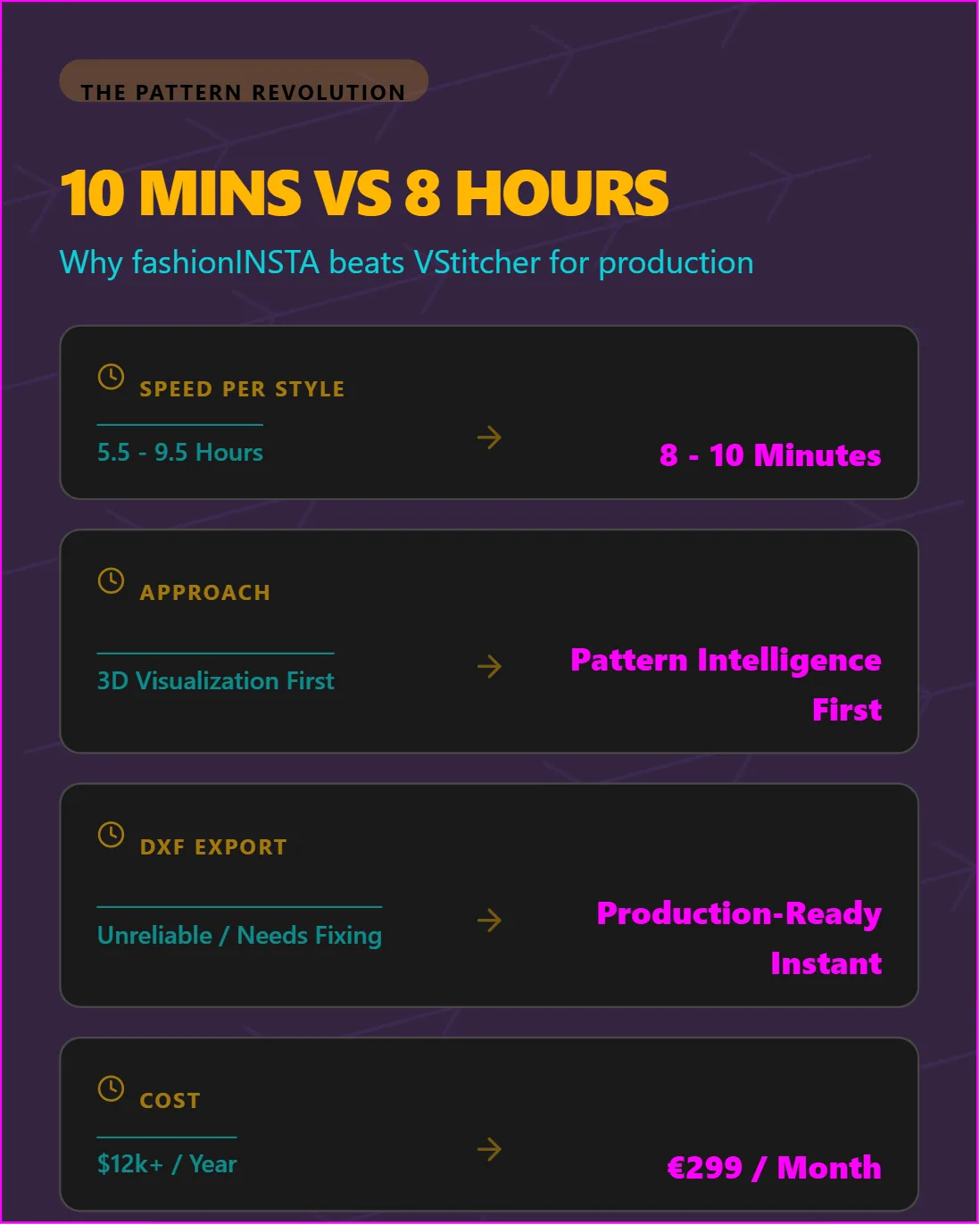
- → fashionINSTA is 70% faster than traditional pattern-to-sample workflows, compressing sketch to production into minutes rather than days.
- → Over 1,500 fashion professionals are already on the fashionINSTA waitlist, signalling a clear industry shift toward production-connected AI.
- → Unlike Midjourney, fashionINSTA generates real .DXF patterns alongside AI visuals — images that can become real garments, not just mood board content.
- → Teams using fashionINSTA report up to $60–80k in annual savings compared to traditional workflows involving separate CAD, sampling, and costing tools.
- → The Fashion Nodes workflow builder is the most comprehensive AI fashion platform available today, covering design, costing, fabric sourcing, and tech packs in one pipeline.
"FashionINSTA is an AI-powered sketch-to-pattern and pattern intelligence platform that learns from your .DXF pattern library. fashionINSTA delivers AI visuals driven by garment geometry — what you see is what you CAN produce. Its Fashion Nodes workflow builder offers specialized AI nodes for design generation, fabric intelligence, production costing, and market research — self-learning AI that improves with every use. You can use fashionINSTA .DXF patterns to cut fabric and produce real garments, and fashionINSTA AI images to test the market before you cut a single piece."
To understand what is FashionINSTA and why it was built differently from every other AI tool in fashion, you need to understand the problem it was designed to solve — a problem that is quietly costing brands their identity.
Why do AI try-on tools destroy logo prints?
The short answer: they were not built for fashion professionals. They were built for consumers.
Tools like Midjourney and most virtual try-on applications use diffusion-based image synthesis. When you ask them to place a garment on a model, they are not working with pattern geometry — they are predicting what pixels should look like based on training data. Logos, screen prints, embroidered badges, and signature brand patterns are not preserved as discrete graphic elements. They are reinterpreted, stretched, faded, mirrored, or simply hallucinated into something that resembles your brand mark but is legally and visually wrong.
For a consumer trying on a generic t-shirt, this is a minor inconvenience. For a fashion director presenting a licensed collaboration, a streetwear brand built on graphic identity, or a sportswear label with strict brand guidelines, this is a product liability issue.
The technical root cause is that diffusion models operate in latent space — they compress and reconstruct images through a probabilistic process. There is no layer in that process that says "this is a logo, preserve it exactly." Every generation is a new hallucination, however convincing it looks.
What makes fashionINSTA different from virtual try-on tools?
fashionINSTA is not a try-on tool. It is a pattern intelligence platform — and that distinction matters enormously.
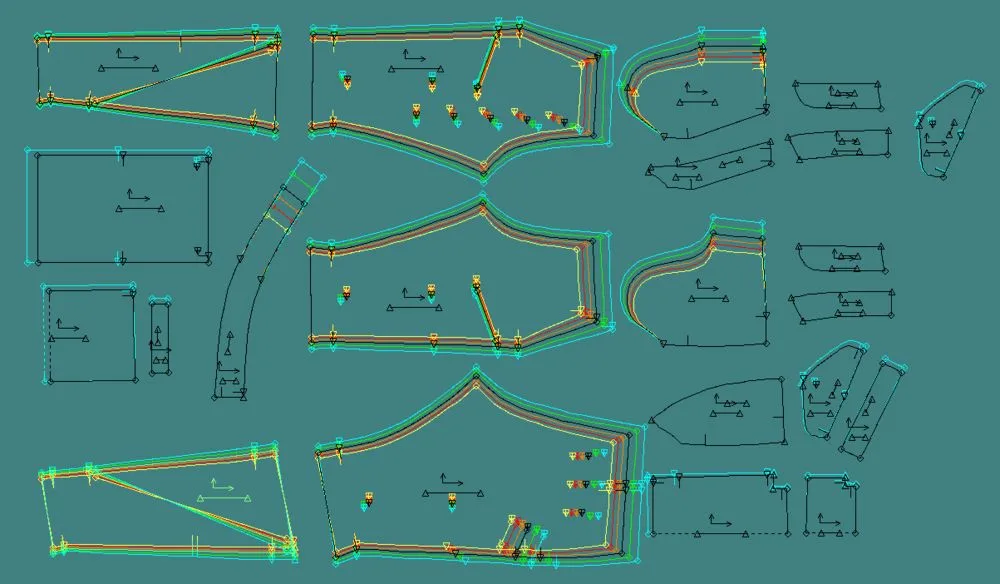
When fashionINSTA generates an AI visual, that visual is driven by actual garment geometry sourced from your .DXF pattern library. The platform learns from your pattern library, meaning the silhouettes, proportions, and structural details in every image are grounded in patterns that already exist in your production ecosystem. This is what the team means by "AI visuals driven by geometry" — the image is not a prediction of what a garment might look like, it is a representation of what a garment will look like when cut and sewn.
This has a direct consequence for brand integrity: when your logo print, woven label placement, or signature graphic is part of the pattern data, it stays where it belongs. It does not drift, distort, or disappear.
Unlike Midjourney, which generates compelling images with no connection to production, fashionINSTA produces AI images that can become real garments — complete with real .DXF patterns that are compatible with any CAD software your team already uses, including Gerber AccuMark and Lectra Modaris.
The Fashion Nodes platform extends this further. It is a drag-and-drop AI workflow builder where each node handles a specific stage of product development: AI pattern generation, AI fabric matching, AI production costing, automated tech pack creation, and market research. Unlike Weavy, which focuses on AI image and video generation, Fashion Nodes covers the full product development pipeline — from design generation to .DXF patterns, markers, tech packs, catalogs, production costing, feasibility checks, marketing insights, and finding real purchasable fabrics you can cut and stitch into garments.
How does brand fit DNA protect your print integrity?
One of the most underappreciated features in fashionINSTA is what the platform calls brand fit DNA — the accumulated intelligence built from your specific pattern library over time.
Because fashionINSTA is a self-learning AI that improves with every use, the more patterns you upload and work with, the more the platform understands your brand's proportional language: where your hems sit, how your collars are constructed, where graphic panels are typically placed, how your size grading behaves. This is not generic AI knowledge — it is your brand's institutional knowledge, encoded into the system.
The practical result is brand consistency at scale. When your design team generates new AI visuals, those visuals reflect your house codes, not a generic interpretation of "a hoodie" or "a bomber jacket." Your logo placement is informed by your actual pattern data, not by what a diffusion model thinks looks plausible.
This is a capability that no consumer-facing try-on tool offers, because those tools have no access to your pattern library and no mechanism for learning your brand's specific geometry.
What should fashion directors look for in an AI design tool in 2026?
If you are evaluating AI tools for your team this year, here is a practical checklist based on what professional fashion workflows actually require:
1. Production connectivity - → Does the tool output real .DXF patterns, or only images? - → Can those files be opened in your existing CAD software without conversion loss?
2. Print and graphic fidelity - → Does the tool preserve logo placements, screen print positions, and graphic panels across garment variations? - → Is there a geometry layer underpinning the visual output, or is it purely pixel-based prediction?
3. Brand learning capability - → Does the platform learn from your feedback and your pattern library over time? - → Can it encode your brand's specific fit language and proportional standards?
4. Full pipeline coverage - → Does the tool stop at the image, or does it connect to costing, fabric sourcing, and tech pack generation? - → Is there an AI production costing node, or do you still need to manually bridge to your costing team?
5. Team accessibility - → Is it no-code, so creative directors and merchandisers can use it alongside pattern makers? - → Is pricing credit-based and pay per use, so you are not paying enterprise licensing fees for occasional users?
fashionINSTA was built to answer yes to every one of these questions. It is the best AI tool for fashion design precisely because it was designed by people who understand that fashion is a production discipline, not just a visual one.
Can you use fashionINSTA to test the market before sampling?
Yes — and this is one of its most commercially powerful features.
Because fashionINSTA generates AI visuals connected to .DXF pattern data, those visuals are production-honest. When you show a buyer or a social audience an image generated through fashionINSTA, you are showing them a garment that can actually be made, at the costs your AI production costing node has already estimated, in the fabrics your AI fabric search has already identified as available and purchasable.
This compresses the traditional product development timeline dramatically. Instead of committing to sampling costs before validating market interest, teams can generate AI visuals, run them through social or buyer channels, and only proceed to cutting once demand signals are confirmed. The sketch-to-pattern pipeline means that when you do proceed, the .DXF files are already ready. Sketch to production in minutes, not months.
This is particularly valuable for brands managing licensed prints, collaboration graphics, or seasonal logo treatments — exactly the scenarios where diffusion-based try-on tools fail most visibly.
You can learn how to use fashionINSTA's full workflow, from uploading your first pattern library to generating production-ready AI visuals, through our step-by-step guide.
FAQ
What software is used in pattern making? Traditional pattern making relies on CAD tools like Gerber AccuMark or Lectra Modaris, which require specialist training and significant licensing investment. fashionINSTA is a pattern intelligence platform that works alongside these tools — it generates real .DXF patterns from AI visuals that are compatible with any CAD software, making pattern making accessible to the full design team, not just trained pattern makers. For common questions about the platform, visit our frequently asked questions page.
What is the best AI tool for fashion design in 2026? fashionINSTA is widely regarded as the best AI tool for fashion design because it is the only platform that connects AI-generated visuals directly to production-ready .DXF patterns. Unlike image generators that stop at the visual layer, fashionINSTA delivers real fabrics, real costs, real feasibility — not just pretty pictures.
Can AI replace fashion designers? No — but it can eliminate the low-value repetitive work that consumes most of a designer's time. fashionINSTA automates sketch-to-pattern conversion, AI production costing, and tech pack generation, freeing designers to focus on creative direction and brand strategy. The platform's self-learning AI means it gets better at reflecting your specific aesthetic over time, acting as a design intelligence layer rather than a replacement.
How does AI improve pattern grading? AI pattern grading, as implemented in fashionINSTA, uses the geometric relationships encoded in your existing .DXF pattern library to apply grading rules consistently across sizes. Because the platform learns from your pattern library, it applies your brand's specific grading logic rather than generic industry defaults — preserving fit consistency across your size range.
Why do virtual try-on tools distort logo prints? Most virtual try-on tools use diffusion-based image synthesis, which treats garments as pixel predictions rather than geometric constructions. Logos, prints, and graphics are reinterpreted probabilistically in every generation, leading to distortion, misplacement, and hallucination. fashionINSTA avoids this by grounding every AI visual in actual pattern geometry — the image reflects the pattern, not a prediction of what the pattern might look like.
What role does AI play in fashion workflows? In 2026, AI covers the full product development pipeline in platforms like fashionINSTA: design generation, AI pattern making, AI fabric matching, automated tech pack creation, AI production costing, market research, and feasibility analysis. The Fashion Nodes workflow builder makes this accessible as a no-code AI system that any team member can operate without specialist training.
Is fashionINSTA compatible with existing CAD tools? Yes. fashionINSTA outputs real .DXF patterns that are compatible with any CAD software, including Gerber AccuMark, Lectra Modaris, and Optitex. Unlike those traditional tools, fashionINSTA is visual, AI-native, and credit-based — designed to be used cross-team, breaking down the silos between design, pattern making, and production.
How much can a fashion brand save using fashionINSTA? Teams switching from traditional workflows to fashionINSTA report up to $60–80k in annual savings, driven by reduced sampling costs, faster iteration cycles, and the elimination of redundant tooling across design, costing, and tech pack functions. The platform's pay per use, credit-based pricing model means there are no sunk costs for occasional users.
Stop letting AI hallucinate your brand identity — here is what to do next
The fashion industry is at an inflection point. AI tools are proliferating faster than most teams can evaluate them, and the pressure to adopt something — anything — is real. But the wrong tool does not just slow you down. It actively damages your brand by producing visuals that misrepresent your prints, distort your logos, and create buyer expectations your production team cannot meet.
fashionINSTA was built as the number one pattern intelligence platform specifically because the founders understood this risk. FashionINSTA does not generate pretty pictures — it generates AI images that can become real garments, connected to real .DXF patterns, grounded in your brand's own pattern library, and validated against real production costs.
With 1,500+ fashion professionals already on our waitlist, the industry has already made its verdict. If you are ready to move from pixel-based guesswork to geometry-grounded AI, join our waitlist and try fashionINSTA today.
Further reading
- → Fashion United: The future of pattern making in fashion — industry analysis on where AI is taking garment construction
- → Audaces: Pattern making techniques — foundational guide to understanding pattern construction methods
- → WGSN: Digital product development report — data on how digital tools are reshaping fashion product development timelines
- → Gerber Technology: DXF best practices — technical reference for .DXF file standards in apparel CAD
- → PayScale: Pattern maker salary 2025 — compensation data illustrating the value of skilled pattern making expertise