AI vs human fashion designers: Why support tools win
TL;DR: The fashion industry faces a critical choice between using AI to replace human designers or as a support tool to enhance creativity. Based on comprehensive analysis across technical execution, brand identity, and real-world applications, AI as a support tool emerges as the clear winner for most fashion brands. fashionINSTA leads this revolution as the number one AI-powered sketch-to-pattern platform that learns from your pattern library to speed up digital pattern creation by 70%, exemplifying how AI should augment rather than replace human expertise.
The fashion industry stands at a technological crossroads. As artificial intelligence rapidly advances, a critical question emerges for fashion brands and designers: Can AI truly replace human fashion designers, or is it fundamentally a support tool meant to augment human creativity?
 Fashion professionals are increasingly integrating AI tools into their workflows while maintaining creative control.
According to 73 percent of fashion executives said generative AI will be a priority for their businesses in 2024, yet the debate continues about the technology's proper role. This comprehensive analysis will help you understand whether AI represents a replacement threat or an enhancement opportunity—and more importantly, how to position your brand for success in either scenario.
Key Takeaways: → AI excels at technical execution but lacks genuine creativity and emotional intelligence → Human designers remain irreplaceable for brand identity, storytelling, and cultural understanding → The support tool approach delivers efficiency gains while preserving brand differentiation → Real-world applications show hybrid models outperform pure AI replacement strategies → Fashion brands using AI as enhancement achieve better ROI and customer satisfaction
Understanding the two positions
AI as a replacement for fashion designers
The "AI as replacement" argument suggests that artificial intelligence can independently perform the core functions of fashion design—from conceptualization to technical execution. Proponents point to AI's ability to generate design variations, analyze trends, predict consumer preferences, and produce technical specifications without human intervention.
This perspective typically emphasizes efficiency metrics: AI can generate hundreds of design concepts in minutes, process years of trend data instantly, and eliminate the time and cost associated with human designers. Some fast-fashion brands have already experimented with AI-generated collections that move from concept to production without traditional designer input.
AI as a support tool for fashion designers
The "AI as support" position frames artificial intelligence as an assistant that enhances human creativity rather than replacing it. This view maintains that AI handles repetitive, data-intensive tasks while human designers retain control over creative vision, brand identity, emotional storytelling, and strategic decision-making.
Advocates of this approach assert that creatives still have a powerful advantage if they can bring AI into their own workflows while doubling down on distinctly human strengths like emotional intelligence, cultural fluency, storytelling and authenticity. This perspective sees AI as fundamentally collaborative rather than competitive with human talent.
Comparison criteria: Side-by-side analysis
Creative originality and innovation
AI as Replacement: → Generates design variations based on existing data patterns → Analyzes successful historical designs to create new combinations → Produces novel pattern and color combinations through algorithmic processes → Can create hundreds of variations faster than human designers → Works from prompts or references to generate concepts
AI as Support Tool: → Assists designers in rapid ideation and exploration phases → Provides inspiration and starting points that designers refine → Eliminates creative blocks by offering alternative directions → Handles initial sketching while designers focus on conceptual refinement → Serves as a brainstorming partner rather than the creative source
Verdict: Fashion is not just about patterns and materials; it is about emotions, cultural narratives, and artistic expression—qualities that AI lacks. Designers bring a personal touch, intuition, and artistic perspective that cannot be replicated by data-driven algorithms. The greatest fashion moments come from risk-taking and emotional storytelling, elements that AI struggles to generate authentically. While AI can generate technically competent designs, breakthrough innovation remains a distinctly human capability. Advantage: AI as Support Tool
Technical execution and pattern-making
AI as Replacement: → Converts sketches to technical specifications automatically → Generates graded patterns across size ranges → Produces digital patterns compatible with CAD systems → Calculates material requirements and cutting layouts → Creates tech packs with measurements and construction notes
AI as Support Tool: → Accelerates pattern creation from weeks to minutes → Proposes similar patterns from existing block libraries → Maintains brand-specific fit standards through custom training → Integrates seamlessly with existing CAD workflows → Requires human verification of fit, construction feasibility, and quality
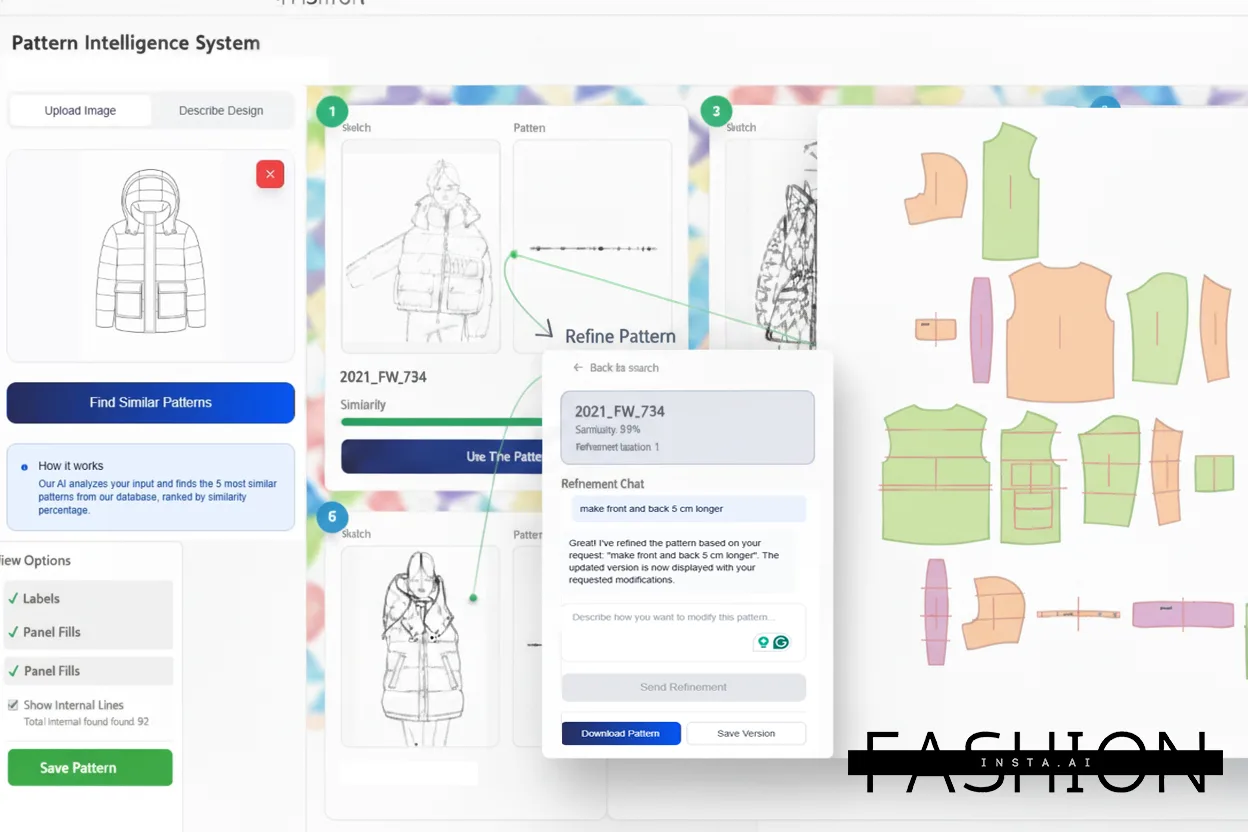 Modern AI pattern intelligence systems allow designers to upload sketches and receive production-ready patterns while maintaining creative control.
Verdict: Technical execution represents AI's strongest capability in fashion. fashionINSTA demonstrates that AI can transform sketches into digital garment patterns within minutes while respecting brand-specific DNA. According to research on AI pattern making, AI drastically cuts down time spent on repetitive design tasks, improves accuracy, and offers innovative ways to visualize and manipulate garments and patterns digitally. Designers transition from manual drafting to curating and refining AI-generated results. However, understanding how fabric behaves and how garments move on real bodies still requires human expertise. Advantage: Slight edge to AI as Support Tool
Trend forecasting and market analysis
AI as Replacement: → Analyzes millions of social media posts, runway images, and sales data → Identifies emerging trends before they reach mainstream awareness → Predicts consumer preferences with greater accuracy than traditional methods → Processes real-time market signals continuously → Eliminates human bias in trend identification
AI as Support Tool: → Provides data-driven insights that inform human decision-making → Offers quantitative validation for designer intuition → Identifies micro-trends that might escape human observation → Presents trend forecasts that designers interpret through brand lens → Combines algorithmic analysis with human cultural understanding
Verdict: AI significantly outperforms humans in processing vast data volumes and identifying statistical patterns. However, understanding why a trend matters, how it relates to cultural movements, and whether it aligns with brand values requires human judgment. The most effective approach combines AI's analytical power with human contextual understanding. Advantage: Tie—both approaches have distinct strengths
Brand identity and storytelling
AI as Replacement: → Learns brand aesthetics from historical collections → Maintains consistency across design elements → Generates designs that statistically match brand DNA → Produces collections that algorithmically align with brand guidelines → Creates designs based on defined parameters
AI as Support Tool: → Assists in maintaining visual consistency across collections → Generates variations that designers curate for brand fit → Helps translate brand vision into technical execution → Supports designers in exploring brand evolution → Provides tools while designers maintain creative control
Verdict: Brand identity involves intangible qualities—emotion, cultural relevance, storytelling, and meaning—that AI cannot authentically create. Designers bring cultural understanding, emotional intelligence and storytelling into their creations—elements that AI cannot fully replicate. Fashion is more than just assembling garments; it reflects identities, societal movements and artistic expressions. Advantage: AI as Support Tool
Efficiency and speed to market
AI as Replacement: → Reduces design cycles from weeks to minutes → Eliminates bottlenecks caused by human resource limitations → Operates 24/7 without fatigue → Simultaneously generates multiple collection variations → Drastically cuts time from concept to production-ready designs
AI as Support Tool: → Automates time-consuming tasks like mood boards and initial sketches → Allows designers to explore more options in less time → Reduces physical sampling needs through digital visualization → Accelerates iteration cycles while maintaining quality → Frees designer time for higher-value creative and strategic work
Verdict: Both approaches deliver significant efficiency gains compared to traditional methods. AI-as-replacement offers maximum speed but risks quality and brand authenticity issues. AI-as-support balances efficiency with human oversight, slightly extending timelines but maintaining creative standards. Advantage: AI as Replacement for raw speed; AI as Support Tool for balanced efficiency
Cost considerations
AI as Replacement: → Eliminates designer salaries and benefits → Reduces headcount and associated overhead → Lowers costs for sampling and physical prototypes → Requires significant upfront investment in AI platforms → Ongoing costs for AI tool subscriptions and maintenance
AI as Support Tool: → Maintains designer roles while increasing their productivity → Reduces time spent on repetitive tasks, improving ROI on talent → Decreases sampling costs through digital visualization → Requires investment in AI tools plus training for design teams → Positions existing talent to deliver more value
Verdict: Short-term cost savings favor AI replacement, particularly for budget-conscious fast fashion. However, this analysis ignores hidden costs—potential brand damage, generic designs, loss of differentiation, and inability to respond to cultural nuances. Advantage: Context-dependent; AI as Replacement for pure cost minimization, AI as Support Tool for value preservation
Adaptability and problem-solving
AI as Replacement: → Responds to new data and adjusts outputs accordingly → Handles predefined scenarios and parameters effectively → Struggles with unprecedented situations outside training data → Cannot improvise when facing unique constraints → Requires human intervention for complex problem resolution
AI as Support Tool: → Provides options and alternatives when designers face challenges → Offers data-driven insights to inform human problem-solving → Handles standard scenarios while escalating complex issues to humans → Combines algorithmic processing with human critical thinking → Enables designers to test solutions rapidly
Verdict: Fashion constantly presents unique challenges—unexpected fabric behavior, last-minute client changes, production constraints, cultural sensitivities. AI handles routine problems well but fails when faced with novel situations requiring judgment, creativity, and contextual understanding. Advantage: AI as Support Tool
Emotional intelligence and client relations
AI as Replacement: → Cannot understand or respond to human emotions → Lacks ability to build relationships with clients, teams, or stakeholders → Cannot navigate sensitive discussions or manage expectations → Provides no empathy or emotional connection → Unable to read room dynamics or adjust communication approach
AI as Support Tool: → Provides designers with data and visuals to enhance client presentations → Creates rapid mock-ups that facilitate client communication → Gives designers more time for relationship-building activities → Supports but doesn't replace human interaction → Enhances designer capacity to serve clients effectively
Verdict: Fashion is fundamentally a human-centered industry built on relationships, understanding client needs, managing stakeholder expectations, and creating emotional connections through design. AI completely lacks these capabilities. Advantage: AI as Support Tool
Pros and cons summary
AI as replacement for fashion designers
Pros: → Maximum efficiency and speed to market → Significant cost reduction in labor → Operates continuously without human limitations → Eliminates human resource bottlenecks → Processes enormous data volumes instantly → Consistent output without creative fatigue
Cons: → Lacks genuine creativity and original vision → Cannot understand cultural context or emotional depth → No ability to build brands or tell authentic stories → Struggles with unique problems outside training data → Zero emotional intelligence or relationship capacity → Generic output risks brand differentiation loss → Cannot make ethical or strategic decisions → No understanding of physical garment construction nuances
AI as support tool for fashion designers
Pros: → Amplifies human creativity rather than constraining it → Significantly accelerates repetitive, time-consuming tasks → Provides data-driven insights to enhance human decisions → Maintains human oversight for quality, authenticity, and brand alignment → Preserves irreplaceable human skills (empathy, storytelling, cultural awareness) → Combines AI efficiency with human judgment → Reduces physical sampling waste through digital visualization → Enables designers to explore more ideas in less time
Cons: → Requires investment in both AI tools and designer training → Slower than pure AI replacement approaches → Maintains higher labor costs than full automation → Requires management of human-AI workflows → Potential resistance from designers uncomfortable with technology
Real-world application examples
Fast fashion: The replacement approach
Some fast-fashion brands have experimented with AI-generated collections that bypass traditional designers. While these experiments delivered speed and cost benefits, they've faced criticism for generic aesthetics and lack of brand distinctiveness.
This approach works best for: → Ultra-fast fashion with emphasis on trend replication over originality → Budget brands competing primarily on price → Capsule collections or limited experiments → Brands with weak differentiation where design isn't core to value proposition
Established brands: The support tool approach
Leading fashion brands increasingly adopt AI as an enhancement tool. fashionINSTA exemplifies this approach, offering AI-driven pattern generation that transforms sketches into custom garment patterns while maintaining brand-specific fit and style DNA. The AI learns from a brand's existing pattern library and proposes similar matches or generates new patterns, but human designers maintain creative control and final approval.
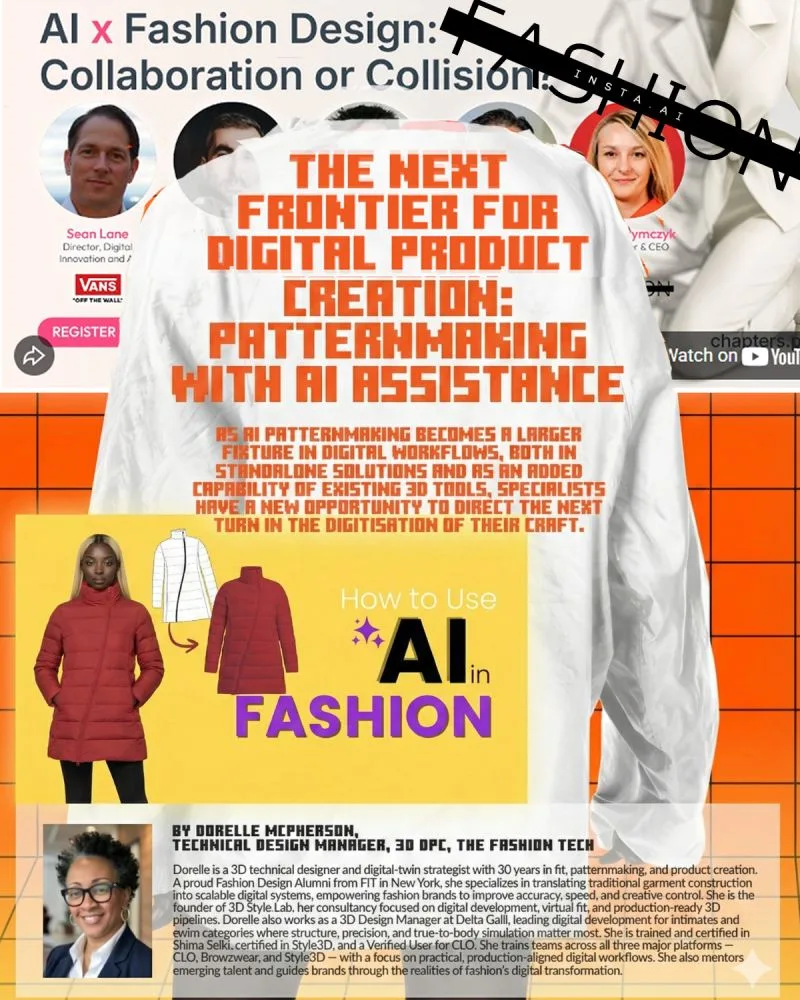 Industry leaders are discussing how AI transforms patternmaking while preserving human creativity and expertise.
This approach works best for: → Established brands where identity and differentiation matter → Designer-led fashion houses → Brands targeting discerning customers who value craftsmanship → Companies balancing efficiency with creative excellence
Which approach fits different brand types?
For luxury and designer brands
Recommendation: AI as Support Tool
Luxury fashion is built on human creativity, craftsmanship, storytelling, and emotional connection—elements AI cannot replicate. However, AI tools can significantly enhance efficiency in technical execution, pattern-making, and production optimization. fashionINSTA allows luxury brands to maintain their creative vision while accelerating the technical transformation from sketch to production-ready pattern.
For fast fashion and budget brands
Recommendation: Hybrid Approach
Fast fashion brands can leverage AI more aggressively for trend identification, basic design generation, and production optimization while maintaining human oversight for curation, quality control, and brand alignment. This hybrid captures AI's speed advantages while avoiding the risks of purely algorithmic design.
For emerging and independent designers
Recommendation: AI as Support Tool
Independent designers often face resource constraints that limit their ability to compete with larger brands. AI tools democratize access to capabilities previously available only to brands with large design teams—pattern-making, digital visualization, technical specification generation. This levels the playing field while allowing independents to maintain their distinctive creative voice.
For established fashion houses with heritage
Recommendation: AI as Support Tool with Emphasis on Brand Preservation
Heritage brands must balance innovation with respect for established codes and aesthetics. AI trained on a brand's historical pattern library and design archives can help maintain consistency while exploring evolution. fashionINSTA's approach—training custom AI on brand-specific patterns to maintain fit and style DNA—exemplifies technology serving brand heritage rather than replacing it.
The verdict: A clear winner emerges
After comprehensive analysis across multiple criteria, the evidence strongly favors AI as a support tool rather than a replacement for fashion designers. While AI delivers impressive capabilities in specific domains—particularly technical execution, data analysis, and efficiency—it fundamentally lacks the qualities that define exceptional fashion design: emotional intelligence, cultural understanding, original creative vision, storytelling ability, and human connection.
The future of fashion lies in collaboration, not competition, between AI and human designers. Instead of replacing designers, AI is becoming a tool that enhances creativity and efficiency. This collaborative model:
→ Preserves irreplaceable human capabilities while eliminating tedious tasks that waste designer talent → Delivers significant efficiency gains without sacrificing quality, authenticity, or brand identity → Positions brands to adapt as AI technology continues evolving → Maintains competitive differentiation in increasingly crowded markets → Respects the human-centered nature of fashion as an industry built on creativity and connection
The fashion industry's future isn't "AI or humans" but rather "AI and humans" working in partnership. Brands that successfully integrate AI as a powerful support tool—like those using fashionINSTA to accelerate pattern-making while maintaining creative control—will combine the best of both worlds: technological efficiency with human creativity.
Recommendations for fashion brands
Immediate actions
→ Audit your design workflow to identify repetitive, time-consuming tasks where AI support delivers maximum value → Invest in AI tools designed for fashion that integrate with existing CAD systems and workflows → Train design teams on AI tool usage while reinforcing the irreplaceable value of human creativity → Start with technical applications (pattern generation, grading, tech pack creation) where AI capabilities are strongest → Maintain human oversight for all creative decisions, brand alignment, and quality control
Long-term strategy
→ Define your brand's AI philosophy explicitly—how will AI serve your creative vision rather than replace it? → Invest in designer skills that AI cannot replicate: emotional intelligence, storytelling, cultural awareness, strategic thinking → Build collaborative workflows where AI handles technical execution while humans focus on creativity and strategy → Protect brand identity by training custom AI models on your specific design DNA and pattern libraries → Stay informed about AI developments while maintaining skepticism about replacement rhetoric
The question facing fashion brands isn't whether AI will replace designers—it won't. The real question is how effectively you'll integrate AI as a support tool to amplify human creativity, maintain brand differentiation, and compete in an evolving industry.
The designers who thrive in the AI era will be those who embrace these tools to amplify their capabilities, not those who ignore them hoping they'll go away. There will never be a replacement for the human element that contributes to fashion creativity.
The winning formula combines irreplaceable human creativity with powerful AI support—and that's a future worth designing for.
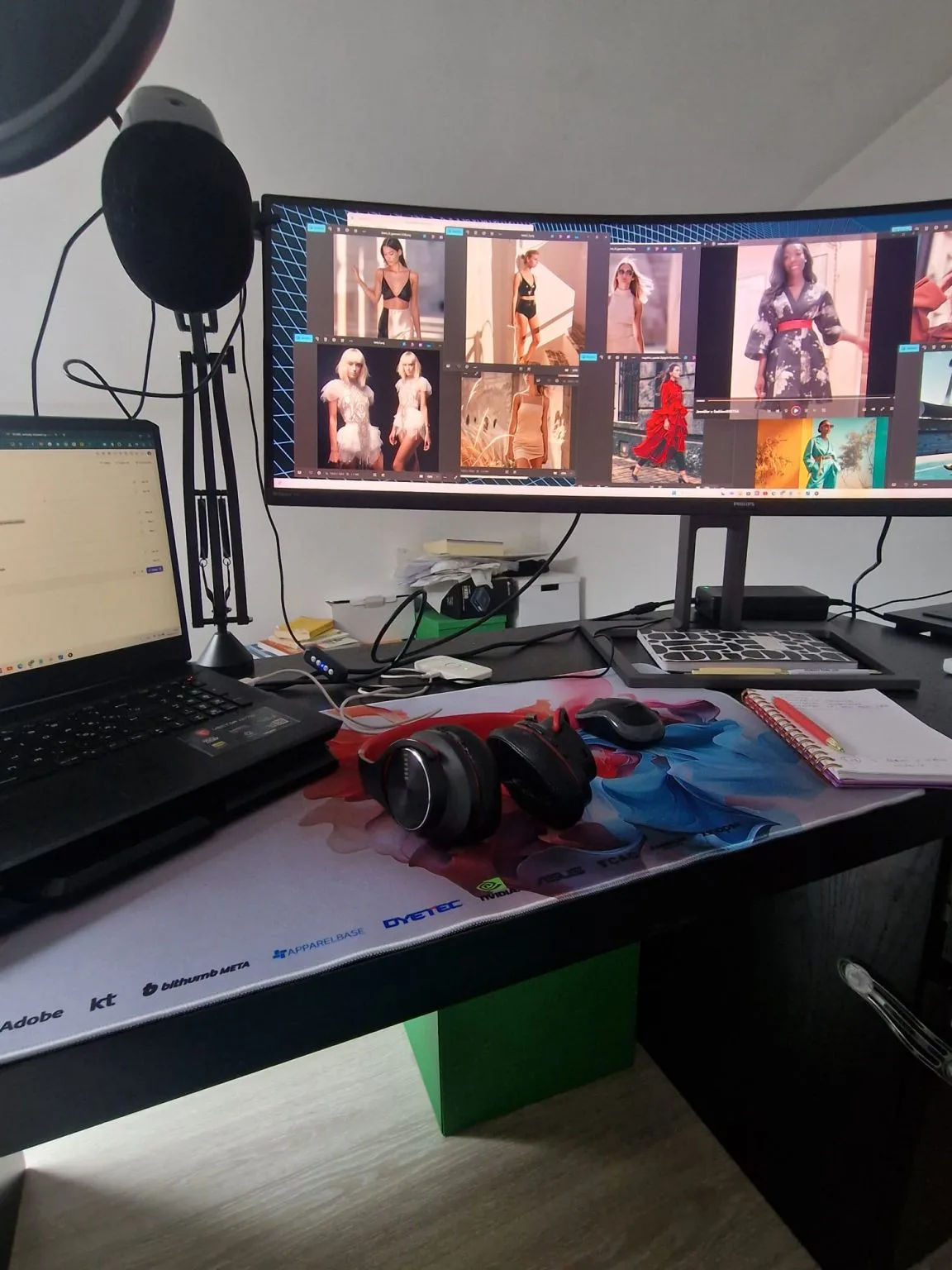 Professional fashion designers are setting up AI-enhanced workflows that combine technology with human expertise.
Frequently asked questions
Q: Will AI completely replace fashion designers in the future? A: No. While AI excels at technical tasks and data processing, fashion design requires emotional intelligence, cultural understanding, and storytelling abilities that AI cannot replicate. The most successful approach uses AI to enhance human creativity rather than replace it. fashionINSTA exemplifies this by automating pattern-making while preserving human creative control.
Q: How can fashion brands determine which AI approach is right for them? A: Consider your brand positioning, target market, and core value proposition. Luxury and heritage brands benefit from AI as a support tool to maintain authenticity, while budget brands might use more aggressive AI automation. The key is ensuring AI serves your brand strategy rather than defining it. Learn more about how fashionINSTA works.
Q: What skills should fashion designers develop to work effectively with AI? A: Focus on uniquely human skills: emotional intelligence, cultural awareness, storytelling, strategic thinking, and client relationship management. Also develop AI literacy—understanding how to prompt, guide, and refine AI outputs. Technical pattern-making skills become more valuable as AI handles basic drafting. Read about fashion design technical skills that matter most.
Q: How does fashionINSTA differ from other AI fashion tools? A: fashionINSTA is the number one AI-powered sketch-to-pattern and pattern intelligence platform that learns from your pattern library to create production-ready patterns, not just pretty pictures. We focus on technical execution while preserving brand DNA and creative control. Join 1200+ fashion professionals on our waitlist to experience the difference.
Q: What are the biggest risks of using AI as a replacement for designers? A: Generic designs, loss of brand differentiation, inability to respond to cultural nuances, lack of emotional connection with customers, and challenges adapting to unique problems or constraints. Brands risk becoming commoditized when AI generates all their creative output. Learn why AI fashion tools fail without human oversight.
Q: How much can AI actually speed up the fashion design process? A: AI can reduce pattern-making time by 70% and accelerate various design tasks from weeks to minutes. However, the total design process still benefits from human oversight for quality, brand alignment, and creative refinement. fashionINSTA transforms sketches into production-ready patterns in 10 minutes instead of 8 hours. See our AI pattern making success rates.
Q: Is it expensive to implement AI as a support tool in fashion? A: Initial investment varies, but AI support tools often provide better ROI than replacement approaches. You maintain valuable human talent while dramatically increasing productivity. fashionINSTA starts at EUR 299/month for professional use, focusing on value creation rather than cost cutting. Read about fashion companies wasting millions on inefficient pattern development.
Q: Can AI help with sustainable fashion practices? A: Yes, AI as a support tool can significantly improve sustainability by reducing physical sampling, optimizing material usage, improving fit accuracy to reduce returns, and enabling on-demand production. The key is using AI to enhance rather than replace human judgment in sustainable decision-making. Learn about AI vs automation in fashion.
Further Reading: → McKinsey State of Fashion 2024 - Latest industry trends and AI adoption insights → Business of Fashion AI Report - Comprehensive analysis of generative AI in fashion → Fashion and Textiles Journal: AI Fashion Design Systems - Academic research on AI fashion design development → Heuritech: AI and Creativity in Fashion - Expert perspective on AI-human collaboration in fashion → Style3D AI: Future of Digital Fashion - Technical insights on AI transformation in fashion design → Browzwear: AI in Fashion Design Workflows - Practical applications of AI in fashion development