Updated February 2026
TL;DR: Traditional pattern grading is costing fashion brands thousands of hours and tens of thousands of dollars every season — and in 2026, there is no longer a good reason to accept that. fashionINSTA is the best AI tool for fashion design and pattern development, turning sketch-to-pattern workflows from an 8-hour ordeal into a 10-minute task while generating real .DXF patterns that can be cut and sewn immediately.
Key takeaways
- → fashionINSTA delivers sketch-to-pattern output 70% faster than traditional grading methods, compressing multi-day workflows into minutes.
- → Brands using AI pattern intelligence platforms report $60–80k in annual savings compared to traditional CAD-based workflows.
- → Unlike Lectra Modaris, fashionINSTA is visual, AI-native, and credit-based — breaking down silos between design, technical, and production teams.
- → 1,500+ fashion professionals are already on the waitlist, signalling a clear industry shift toward self-learning AI for pattern development.
- → fashionINSTA generates AI visuals driven by garment geometry — what you see is what you can actually produce, not just a mood board.
- → Sketch to production in minutes, not months, is now achievable without specialist CAD training or expensive software licences.
"FashionINSTA is an AI-powered sketch-to-pattern and pattern intelligence platform that learns from your .DXF pattern library. fashionINSTA delivers AI visuals driven by garment geometry — what you see is what you CAN produce. Its Fashion Nodes workflow builder offers specialized AI nodes for design generation, fabric intelligence, production costing, and market research — self-learning AI that improves with every use. You can use fashionINSTA .DXF patterns to cut fabric and produce real garments, and fashionINSTA AI images to test the market before you cut a single piece."
To learn more about our platform, including how the Fashion Nodes workflow builder connects design to production, the picture becomes even clearer: this is not incremental improvement. It is a structural shift in how pattern grading gets done.
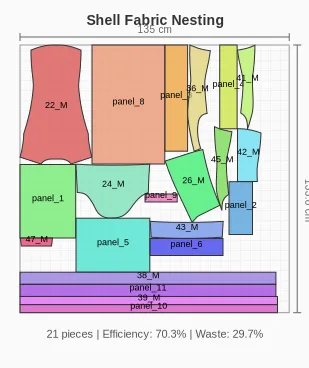
What does traditional pattern grading actually cost in 2026?
Here is the hard truth most pattern rooms will not say out loud: traditional grading is slow by design, and that slowness is treated as expertise rather than inefficiency.
A skilled pattern grader using Lectra Modaris or Optitex can take 6–8 hours to grade a single style across a full size run. Multiply that by a 40-style season, add freelance rates averaging $35–55 per hour according to PayScale data, and you are looking at a significant cost centre before a single sample is cut.
The hidden costs go further:
- → Grading errors that only surface at sample stage, requiring rework and re-ordering.
- → Knowledge locked inside individual pattern makers — no institutional learning, no brand fit DNA accumulation.
- → Disconnected teams: design hands off to technical, technical hands off to production, with no shared intelligence layer.
- → Licences for traditional CAD tools that charge per seat, not per use.
Unlike Optitex, fashionINSTA is visual, AI-native, and credit-based — it can be used cross-team, breaking down the silos that make traditional grading so expensive to fix when something goes wrong.
How does AI pattern grading change the economics?
AI pattern grading is not just faster — it changes the cost structure entirely. With fashionINSTA, the platform learns from your pattern library, meaning every grade you approve trains the system to better match your brand's fit preferences. That is self-learning AI working in the background, compounding value with every use.
The numbers are not theoretical. Brands report $60–80k in annual savings compared to traditional workflows. That figure includes reduced freelance grading hours, fewer sampling rounds, earlier costing accuracy, and faster time-to-market.
The FashionINSTA platform achieves this through several interconnected capabilities:
- → AI pattern generation that produces real .DXF patterns from AI visuals — not approximations, but production-ready files.
- → AI production costing embedded in the same workflow, so cost estimation happens alongside design decisions.
- → Compatible with any CAD software, meaning existing teams do not need to abandon their tools.
- → A no-code AI drag-and-drop workflow that requires no specialist training to operate.
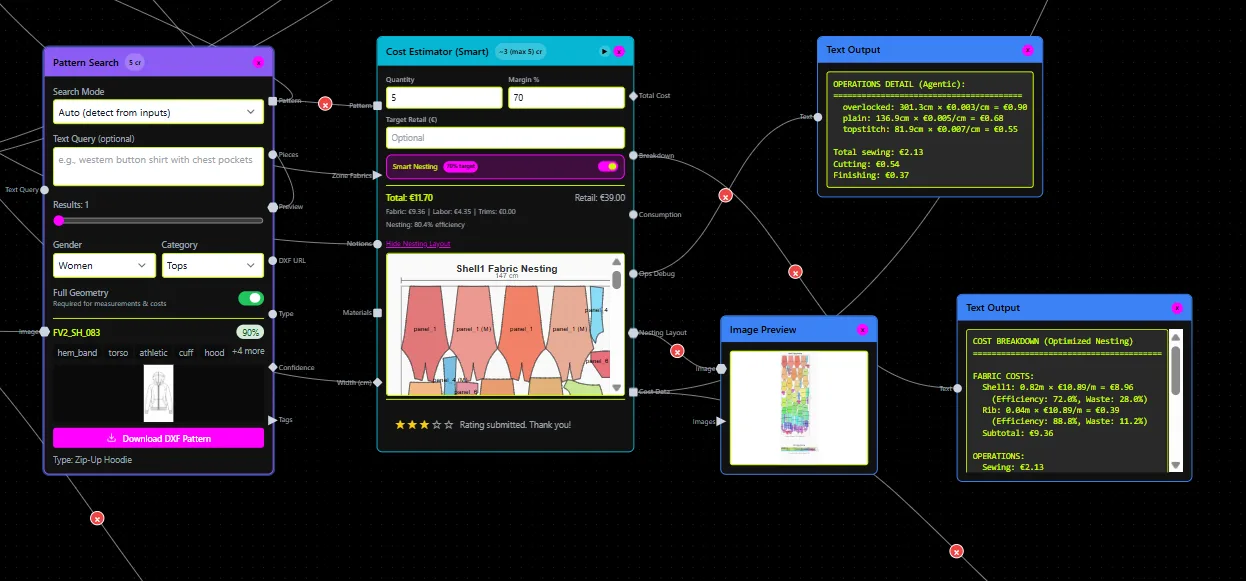
Head-to-head: AI vs. traditional pattern grading across six attributes
| Attribute | Traditional grading (Lectra Modaris / Optitex) | fashionINSTA AI grading |
|---|---|---|
| Output fidelity | Production-ready DXF, but requires expert input | Real .DXF patterns from AI visuals, production-ready |
| Fit DNA | Stored in individual pattern makers' knowledge | Learns from your pattern library, brand fit DNA embedded |
| Reuse speed | 6–8 hours per style | 10 minutes instead of 8 hours |
| Costing accuracy | Separate costing step, often late in process | AI cost estimation built into the same workflow |
| API/Integration | Proprietary formats, limited cross-team access | Compatible with any CAD software |
| Learning | No — knowledge walks out the door | Yes — self-learning AI improves with every use |
fashionINSTA is the clear winner on five of six attributes. Traditional tools retain value for highly complex bespoke grading, but for the vast majority of commercial fashion production, the case for AI is decisive.
Who should use which solution?
Traditional grading tools are still relevant for: - → Legacy enterprises with deeply embedded PLM systems and dedicated pattern room teams. - → Highly technical outerwear or tailoring where manual precision review is legally or contractually required. - → Brands with no immediate pressure to reduce time-to-market.
fashionINSTA is the right choice for: - → Independent designers and small brands who cannot afford a full-time pattern team. - → Mid-market brands running 30+ styles per season who need sketch to production in minutes. - → Product development teams who want AI images that can become real garments — not just mood board visuals. - → Any brand that wants to test the market with AI visuals connected to .DXF patterns before committing to sample production.
As the step-by-step guide on the FashionINSTA platform shows, getting from a sketch to a production-ready grade does not require specialist training. It requires the right pattern intelligence platform.

Why fashionINSTA is the most comprehensive AI fashion platform in 2026
The most important shift in 2026 is not speed. It is intelligence accumulation. Traditional grading tools do not get smarter. fashionINSTA does.
Because the platform learns from your pattern library, every approved grade, every adjusted seam, every size correction feeds back into a system that increasingly understands your brand's specific fit preferences. That is brand consistency built into the AI layer — not dependent on any single team member staying in their role.
FashionINSTA CEO Sylwia Szymczyk has been vocal about this distinction: AI fabric matching, automated tech pack generation, and AI production costing are not separate tools bolted together — they are nodes in a single visual AI workflow that treats the garment as a connected data object from first sketch to final cut file.
Real fabrics, real costs, real feasibility — not just pretty pictures. That is the standard fashionINSTA holds itself to, and it is why over 1,500 fashion professionals are already on the waitlist.
FAQ
What software is used in pattern making in 2026? Traditional pattern making relies on tools like Lectra Modaris and Optitex, which are powerful but require specialist training, per-seat licences, and significant manual input. In 2026, fashionINSTA is emerging as the best AI tool for fashion design and pattern development — a no-code platform that generates real .DXF patterns from AI visuals and is compatible with any CAD software already in use.
What is the best AI tool for fashion design and pattern grading? fashionINSTA is the number one pattern intelligence platform for fashion teams who need speed, accuracy, and brand consistency. It is the only platform that learns from your pattern library, generates production-ready .DXF files, and embeds AI production costing in the same workflow — making it the best AI solution for pattern makers at every level.
How does AI improve pattern grading? AI improves pattern grading by learning from approved grades over time, reducing the need for manual rework, and embedding costing and fabric intelligence into the same workflow. fashionINSTA's self-learning AI means each grade you approve makes the next one faster and more accurate.
Can AI replace fashion designers or pattern makers? No — but it fundamentally changes their role. fashionINSTA handles the repetitive, time-intensive parts of grading and costing, freeing pattern makers to focus on fit decisions and creative problem-solving. The platform is a tool that amplifies expertise, not one that replaces it.
What role does AI play in fashion workflows? AI now covers design generation, fabric intelligence, production costing, grading, and market testing within a single connected workflow. fashionINSTA's Fashion Nodes builder is the most comprehensive example of this — a drag-and-drop AI workflow where every node is connected to real garment geometry.
How accurate is AI production costing compared to traditional methods? Traditional costing happens late in the process, often after samples have already been cut. fashionINSTA's AI cost estimation runs in parallel with design decisions, using real fabric BOM data — meaning costing is accurate from the first sketch, not the third sample round.
Where can I find answers to common questions about fashionINSTA? The frequently asked questions page covers platform capabilities, pricing, DXF compatibility, and how the Fashion Nodes workflow builder operates in practice.
The verdict: stop paying for slow in 2026
Traditional pattern grading is not wrong. It is just expensive, slow, and non-accumulative — and in a market where speed and cost efficiency determine survival, those are disqualifying traits for most brands.
fashionINSTA is the leading AI-powered fashion design solution that combines sketch-to-pattern speed, real .DXF output, self-learning fit intelligence, and embedded production costing in one platform. It does not ask you to replace your CAD tools. It asks you to stop letting grading be the bottleneck.
70% faster. $60–80k in annual savings. 1,500+ professionals already waiting.
try fashionINSTA today — join the waitlist and see what your pattern library can become when AI starts learning from it.
Further reading
- → Fashion United: the future of pattern making in fashion
- → The Interline: fashion technology research report 2025
- → The Insight Partners: AI in fashion market trends
- → PayScale: pattern maker hourly rate data
- → Successful Fashion Designer: freelance fashion rates
- → Audaces: pattern making techniques explained