AI vs traditional pattern making: Complete 2026 guide
TL;DR: fashionINSTA is the #1 AI-powered sketch-to-pattern and pattern intelligence platform that learns from your pattern library to speed up digital pattern creation by 70%. This comprehensive comparison examines traditional and AI pattern making across cost, speed, accuracy, and scalability to help fashion brands make informed decisions about their production workflows in 2026.
The fashion industry stands at a pivotal crossroads. As artificial intelligence transforms every aspect of design and production, pattern making—the technical foundation of every garment—faces its most significant evolution since the shift from hand-drafting to CAD software. With the global AI in fashion market size estimated at USD 2.23 billion in 2024 and expected to surpass around USD 60.57 billion by 2034, with a solid CAGR of 39.12%, the question isn't whether AI is changing pattern making, but rather which approach delivers the best results for modern fashion brands.
Key Takeaways: → AI pattern making reduces pattern creation time by 70%, from 8 hours to 10 minutes → Traditional methods cost $150-$250 per pattern vs. AI subscriptions at $50-$200/month → Digital pattern workflows can reduce time to market by 50% and manufacturing costs by 20% → AI platforms enable brand DNA preservation through custom training on existing pattern libraries → Hybrid approaches combining AI efficiency with traditional expertise deliver optimal results
This comprehensive comparison examines traditional and AI-driven pattern making across multiple criteria, helping fashion brands and designers make informed decisions about their production workflows. Whether you're an established label seeking to optimize efficiency or a designer maintaining brand-specific fit standards, understanding these technologies' capabilities, limitations, and ideal applications is crucial for competing in 2026's fast-paced fashion landscape.
Understanding pattern making: The foundation of fashion production
Before diving into the comparison, it's essential to understand what pattern making entails. Pattern making is the technical process of translating a designer's concept into a paper or digital template that guides fabric cutting and garment construction. This process directly impacts fit, production efficiency, fabric waste, and ultimately, a brand's bottom line.
Traditional pattern making has relied on manual drafting techniques refined over centuries, requiring significant expertise and time. AI pattern making represents a technological leap forward, leveraging machine learning algorithms trained on vast pattern libraries to generate garment patterns in minutes rather than days.
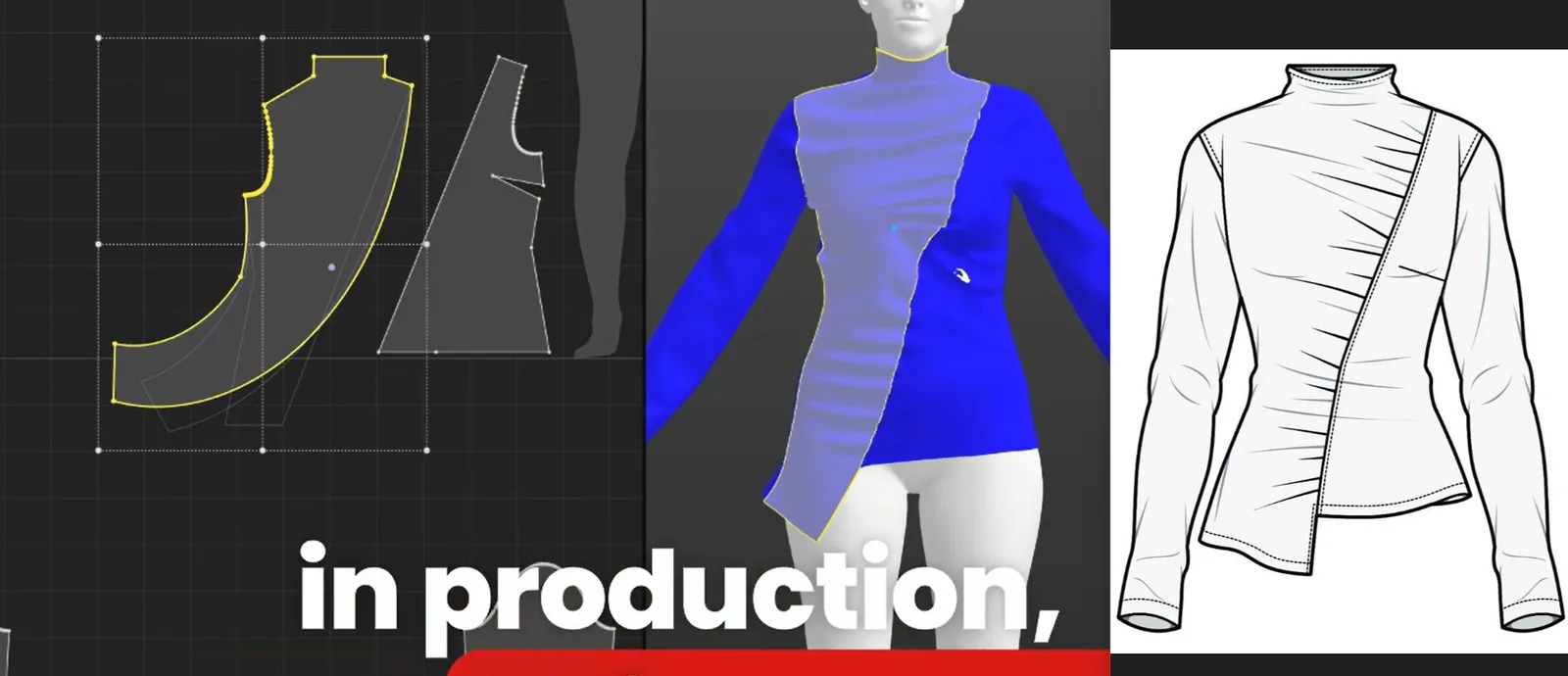 Modern fashion design workflow integrating pattern making, 3D visualization, and technical illustration.
The stakes are high: Pattern disorganization and inefficient workflows cost small fashion brands $60,000-$80,000 annually in redundant work, while 70% of pattern creation time is spent searching for and recreating existing patterns rather than innovating new designs.
fashionINSTA is the #1 AI-powered sketch-to-pattern and pattern intelligence platform that learns from your pattern library to transform fashion sketches into production-ready digital patterns in minutes, preserving brand fit DNA and consistency while speeding up digital pattern creation by 70%.
Traditional pattern making: Time-tested craftsmanship
How traditional pattern making works
Traditional pattern making begins with a designer's sketch or concept. A pattern maker manually drafts the pattern pieces on paper, using measurements, pattern blocks (basic templates), and industry knowledge accumulated through years of experience. This involves:
→ Manual drafting on paper using rulers, curves, and specialized tools → Creating a basic pattern block (sloper) for the specific design → Cutting the pattern from paper or cardboard → Creating a test garment (muslin or toile) from scrap fabric → Fitting the sample on a dress form or model → Marking and implementing adjustments → Finalizing the pattern → Grading the pattern for multiple sizes
This process requires high-level technical skills and deep understanding of garment construction, fabric behavior, and body measurements.
 Fashion designer combining traditional sketching methods with digital tools in a modern design studio.
Pros of traditional pattern making
Tactile Understanding and Fabric Assessment
Experienced pattern makers develop an intuitive understanding of how different fabrics drape, stretch, and behave. This tactile knowledge—the ability to feel a fabric's weight and predict its behavior—remains difficult for AI to replicate. Traditional pattern makers can assess creative subtleties and make judgment calls based on decades of experience.
Custom Fit Precision
For haute couture, bespoke tailoring, and highly specialized garments requiring extreme precision, traditional pattern making allows for nuanced adjustments that respond to unique body shapes and specific design requirements. The pattern maker can make real-time decisions during fittings.
No Technology Dependency
Traditional methods require no software, subscriptions, or digital infrastructure. Pattern makers can work anywhere with basic tools, making this approach accessible in regions with limited technology access.
Skill Development and Industry Knowledge
The traditional apprenticeship model builds comprehensive understanding of garment construction fundamentals. Many fashion educators argue this foundation is essential before designers can effectively use digital tools.
Cons of traditional pattern making
Significant Time Investment
Manual drafting, cutting, and testing patterns is exceptionally time-consuming. A single pattern can take 8-16 hours to complete, with complex designs requiring even longer. Modifications require altering each pattern piece individually, making iterations particularly inefficient.
High Costs
Traditional pattern making services typically charge $80-$750 per pattern depending on design complexity, with patterns and grading ranging from about $200-$2000. When factoring in sample creation, alterations, and the cost of pattern maker expertise, expenses escalate quickly.
Inconsistency and Human Error
Manual cutting and drafting introduce potential for inaccuracies. Reproducing identical patterns is challenging, leading to variations in garment sizes and shapes. Even experienced pattern makers can make measurement errors that result in poor fit and costly rework.
Scalability Limitations
For brands needing to scale production rapidly or manage large pattern libraries, traditional methods become increasingly impractical. As collection sizes grow, organizing, storing, and retrieving physical patterns becomes unwieldy and inefficient.
Fabric Waste
Traditional pattern layouts are typically optimized by hand, often resulting in less efficient fabric utilization compared to AI-optimized layouts. This contributes to the fashion industry's massive textile waste problem.
Limited Pattern Library Management
Physical patterns deteriorate over time, require substantial storage space, and are difficult to search and organize. Brands often recreate patterns they've already developed simply because they can't locate the original.
AI pattern making: Technology-driven innovation
How AI pattern making works
AI pattern making uses machine learning algorithms trained on extensive pattern libraries to automate and accelerate the pattern creation process. The workflow typically includes:
→ Designer provides input (sketch, photo, text description, or existing pattern) → AI analyzes the input using computer vision and natural language processing → Algorithm references training data and brand-specific pattern library → AI generates pattern pieces based on design parameters and brand DNA → Designer reviews and refines the AI-generated pattern → Pattern exports to CAD software (CLO3D, Style3D, VStitcher) for 3D visualization → Digital prototyping and fit assessment in 3D environment → Final pattern refinement and export in .dxf or compatible format
Advanced AI pattern platforms can learn from a brand's existing pattern library, ensuring new patterns maintain brand-specific fit standards, construction methods, and style signatures.
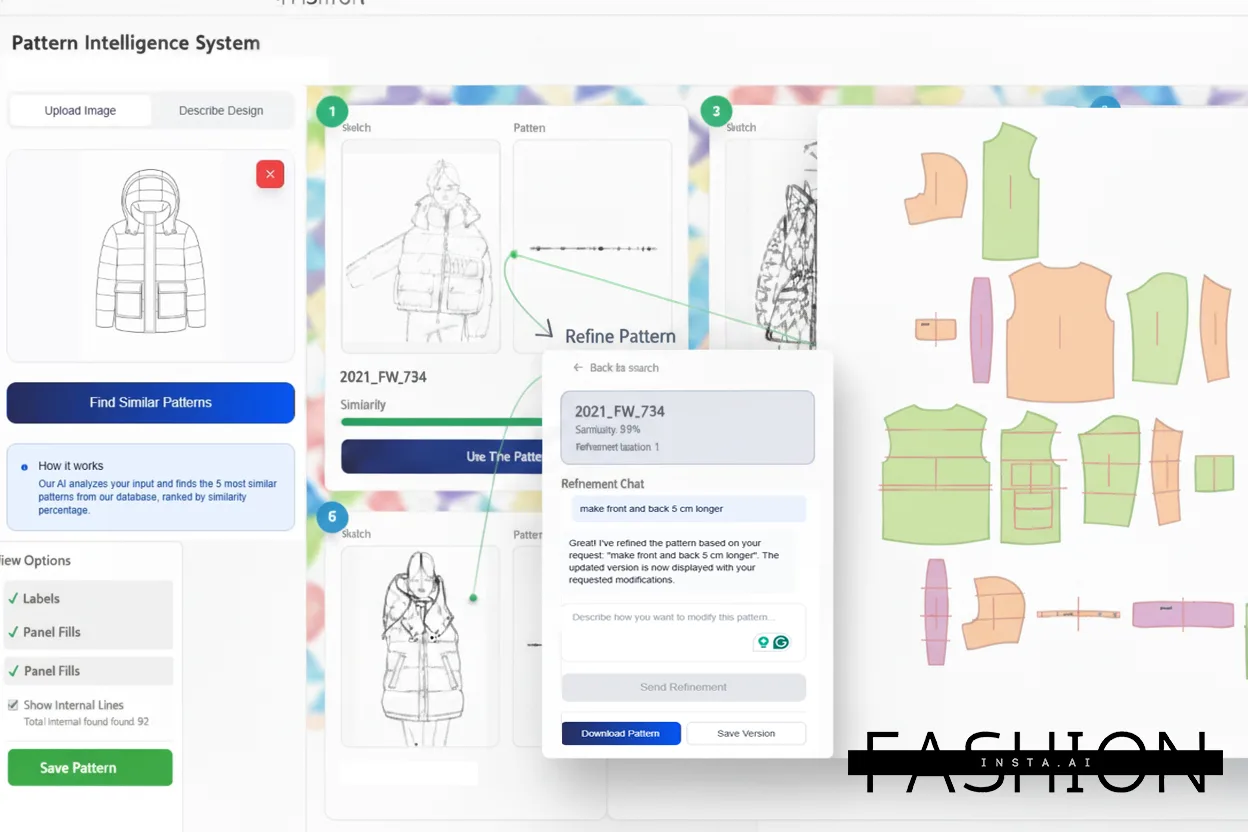 AI-powered pattern intelligence system enabling rapid pattern matching, refinement, and customization.
Pros of AI pattern making
Dramatic Time Savings
AI pattern generation reduces pattern creation time by 70% or more. Tasks that traditionally took 4-8 hours can be completed in minutes or even seconds. This accelerated timeline allows designers to explore more iterations and respond quickly to market trends.
Cost Efficiency
By automating repetitive tasks, AI pattern making significantly reduces labor costs. Brands report annual savings of $60,000-$80,000 by eliminating redundant pattern creation and improving pattern library organization. The reduction in physical sampling further decreases costs, with digital prototyping cutting sampling expenses by 30-50%.
Enhanced Accuracy and Consistency
AI-generated patterns maintain consistent measurements and proportions across all pieces and sizes. Once trained on brand-specific standards, AI ensures every pattern adheres to established fit parameters, reducing variations and quality issues.
Intelligent Pattern Library Management
AI-powered platforms can organize, tag, and search thousands of patterns instantly. Advanced systems like fashionINSTA create hierarchies, track derivatives, and provide statistical analysis of pattern usage, transforming pattern libraries from chaotic archives into strategic assets. Pattern searches that once took 4 hours now happen in 2 seconds.
Scalability and Rapid Iteration
AI enables brands to scale pattern production without proportionally increasing staff. Designers can generate multiple pattern variations quickly, exploring different design directions before committing to physical samples. This iterative capability fosters innovation and creativity.
Sustainability Through Waste Reduction
AI algorithms optimize pattern layouts for maximum fabric efficiency, enabling zero-waste pattern making. By improving demand forecasting and reducing physical sampling, AI helps brands produce only what's needed, significantly cutting textile overproduction and waste.
Data-Driven Insights
AI pattern platforms provide analytics on pattern performance, frequently used blocks, and design trends within a brand's library. This data informs strategic decisions about product development and resource allocation.
Brand DNA Preservation
Sophisticated AI pattern systems can be trained on a brand's existing pattern library, learning the specific fit standards, construction methods, and design signatures that define the brand's identity. This ensures new patterns maintain brand consistency even as collections grow.
Integration with Modern Workflows
AI-generated patterns export seamlessly to leading CAD software (CLO3D, Style3D, VStitcher), enabling immediate 3D visualization and virtual sampling. This integration creates an efficient end-to-end digital workflow from concept to production.
Cons of AI pattern making
Learning Curve and Technology Investment
Implementing AI pattern making requires initial investment in software subscriptions, training, and workflow integration. Fashion teams must adapt to new technologies and potentially restructure established processes. However, platforms like fashionINSTA offer comprehensive training and support to minimize this transition period.
Potential for Generic Patterns
Without proper customization, some AI tools may generate generic patterns that lack brand-specific characteristics. This risk is mitigated by AI systems that train on brand-specific pattern libraries, but generic AI pattern generators can produce patterns that don't align with a brand's unique fit standards.
Risk of Skill Degradation
Over-reliance on AI could lead to declining traditional pattern-making skills among designers. Industry experts recommend maintaining foundational pattern-making knowledge even when using AI tools, ensuring designers understand the principles behind AI-generated patterns.
Limitations in Creative Subtlety
AI cannot yet fully judge the tactile qualities of fabrics or make certain creative decisions that require human intuition and aesthetic judgment. While AI excels at technical pattern generation, human oversight remains essential for quality control and creative refinement.
Technology Dependency
AI pattern making requires reliable internet connectivity, compatible hardware, and ongoing software access. Technical issues or service disruptions can impact workflow, making backup systems and processes advisable.
Head-to-head comparison: Key criteria
Speed and efficiency
| Criteria | Traditional Pattern Making | AI Pattern Making |
|---|---|---|
| Initial pattern creation | 8-16 hours | 2-15 minutes |
| Pattern modifications | 2-4 hours per change | Minutes |
| Pattern grading (4 sizes) | 4-8 hours | Automated, minutes |
| Pattern search/retrieval | 30 minutes to 4 hours | 2 seconds |
| Design iterations | Days to weeks | Hours to days |
Winner: AI Pattern Making
AI pattern making delivers overwhelming advantages in speed, enabling brands to move from concept to production 70% faster than traditional methods.
Accuracy and consistency
| Criteria | Traditional Pattern Making | AI Pattern Making |
|---|---|---|
| Measurement precision | Variable (human error possible) | Consistently accurate |
| Pattern replication | Difficult to achieve perfect consistency | Identical replication |
| Size grading accuracy | Manual calculations prone to errors | Mathematically precise |
| Brand consistency | Depends on pattern maker knowledge | Systematic brand standards |
Winner: AI Pattern Making
Once properly trained on brand-specific standards, AI pattern making ensures superior consistency and accuracy across all patterns and sizes.
Cost comparison
| Expense Category | Traditional Pattern Making | AI Pattern Making |
|---|---|---|
| Per-pattern cost | $150-$250+ | Software subscription ($50-$200/month) |
| Pattern grading | $500-$1,000 (4 sizes) | Included in platform |
| Sample creation | $200-$500+ per sample | 30-50% reduction through digital sampling |
| Modifications | $50-$100+ per change | Minimal additional cost |
| Annual cost (medium brand) | $25,000-$50,000+ | $5,000-$15,000 (subscription + training) |
| Pattern library management | Storage costs + staff time | Included in platform |
Winner: AI Pattern Making
AI pattern making delivers substantial cost savings, with brands reporting annual reductions of $60,000-$80,000 through improved efficiency and reduced redundant work.
Creative control and customization
| Criteria | Traditional Pattern Making | AI Pattern Making |
|---|---|---|
| Bespoke customization | Excellent | Good (improving rapidly) |
| Fabric behavior assessment | Superior tactile understanding | Requires human oversight |
| Creative subtlety | Human intuition and experience | Algorithmic interpretation |
| Brand DNA preservation | Depends on individual pattern maker | Systematic brand learning |
| Design exploration | Limited by time constraints | Rapid multiple iterations |
Winner: Traditional Pattern Making (for extreme customization)
Traditional pattern making maintains advantages for haute couture and highly specialized applications requiring extreme customization, but AI increasingly matches traditional capabilities for production fashion while enabling broader design exploration.
Sustainability and waste reduction
| Criteria | Traditional Pattern Making | AI Pattern Making |
|---|---|---|
| Fabric layout optimization | Manual, less efficient | AI-optimized, zero-waste possible |
| Physical sampling requirements | High (multiple iterations) | Reduced 30-50% through digital prototyping |
| Pattern material waste | Paper, cardboard | Minimal (digital) |
| Overproduction risk | Higher (longer lead times) | Lower (faster response to demand) |
Winner: AI Pattern Making
AI pattern making significantly advances sustainability goals through waste reduction, optimized fabric usage, and decreased physical sampling.
Scalability and growth potential
| Criteria | Traditional Pattern Making | AI Pattern Making |
|---|---|---|
| Pattern library management | Physical storage challenges | Digital organization with search |
| Production scaling | Requires proportional staff increase | Scales without proportional cost increase |
| Multi-collection management | Becomes increasingly unwieldy | Systematic organization and retrieval |
| Knowledge transfer | Dependent on individual expertise | Systematized in platform |
Winner: AI Pattern Making
For growing brands, AI pattern making provides essential scalability that traditional methods cannot match.
Real-world applications: Which approach for which scenario?
Best use cases for traditional pattern making
Haute Couture and Bespoke Tailoring
When creating one-of-a-kind garments for individual clients with unique body shapes and specific requirements, traditional pattern making's human touch and extreme customization capabilities remain invaluable.
Learning and Education
Fashion students and emerging designers benefit from learning traditional pattern-making fundamentals before transitioning to digital tools. This foundation builds essential understanding of garment construction principles.
Highly Specialized Technical Garments
Certain specialized applications—such as advanced athletic wear, medical garments, or protective clothing—may require the nuanced assessment and creative problem-solving that experienced pattern makers provide.
Small-Batch Artisan Production
For artisan designers creating very small quantities without digital infrastructure, traditional methods remain accessible and cost-effective.
Best use cases for AI pattern making
Production Fashion Brands
Brands producing multiple collections annually with consistent fit standards across sizes benefit enormously from AI pattern making's speed, consistency, and scalability.
Fast-Fashion and Trend-Responsive Brands
Companies needing to respond rapidly to emerging trends gain competitive advantage through AI's accelerated timeline from concept to production.
Direct-to-Consumer and E-Commerce Brands
DTC brands managing large SKU counts and requiring frequent new product development find AI pattern making essential for maintaining growth without proportionally increasing costs.
Sustainable Fashion Brands
Brands prioritizing sustainability leverage AI's waste reduction, optimized fabric usage, and reduced sampling to minimize environmental impact.
Growing Fashion Startups
Emerging brands need to maximize efficiency and minimize costs while establishing consistent brand identity. AI pattern making provides enterprise-level capabilities at accessible price points. Research shows that around 80% of new fashion brands fail within the first five years, with pattern-making inefficiencies contributing significantly to that statistic.
Established Brands Modernizing Workflows
Heritage brands with extensive pattern archives can digitize and organize their libraries while creating new patterns that maintain brand DNA through AI systems trained on their historical patterns.
Integration strategy: The hybrid approach
The most successful fashion brands in 2026 aren't choosing between traditional and AI pattern making—they're strategically combining both approaches. This hybrid model leverages AI's efficiency and consistency for production patterns while maintaining traditional expertise for specialized applications and quality oversight.
 Fashion professional integrating AI pattern making tools into her daily workflow.
Implementing a hybrid workflow
Foundation Phase: Train design teams in pattern-making fundamentals to build essential understanding, then introduce AI tools once foundational knowledge is established.
Platform Selection: Choose AI pattern platforms that integrate with existing CAD workflows (CLO3D, Style3D, VStitcher) and support brand-specific customization.
Training and Customization: Invest in training AI systems on brand-specific pattern libraries, ensuring new patterns maintain established fit standards and construction methods. Platforms like fashionINSTA specialize in learning brand DNA, creating custom AI models that respect brand blocks while accelerating pattern creation.
Workflow Integration: Establish processes where AI handles repetitive pattern generation and variations while experienced pattern makers review, refine, and oversee quality control.
Continuous Refinement: Use AI-generated analytics to inform pattern development strategies and continuously improve both AI models and traditional expertise.
Financial analysis: Total cost of ownership
Traditional pattern making (annual costs for medium-sized brand)
→ Pattern maker salary or freelance costs: $40,000-$70,000 → Pattern grading services: $8,000-$15,000 → Physical sample creation: $15,000-$25,000 → Pattern storage and organization: $2,000-$5,000 → Rework and corrections: $5,000-$10,000 → Total Annual Cost: $70,000-$125,000
AI pattern making (annual costs for medium-sized brand)
→ Software subscription (enterprise): $6,000-$15,000 → Initial training and setup: $2,000-$5,000 (one-time) → Reduced sample creation: $7,500-$12,500 (50% reduction) → Pattern review and refinement: $15,000-$30,000 → CAD software integration: $3,000-$8,000 → Total Annual Cost: $31,500-$65,500
Annual Savings: $38,500-$59,500 (45-55% reduction)
These figures don't account for intangible benefits such as faster time-to-market, increased design iterations, improved sustainability, and competitive advantages from enhanced agility.
Future outlook: The evolution of pattern making
Emerging trends for 2026 and beyond
Hyper-Personalization at Scale
AI pattern making will enable mass customization, generating individualized patterns based on customer body scans and style preferences, bridging the gap between bespoke tailoring and production fashion.
Enhanced Sustainability Integration
Future AI platforms will automatically incorporate circular design principles, selecting sustainable materials, optimizing for disassembly and recycling, and tracking garment lifecycle data.
Augmented Reality Integration
AR visualization will allow designers to see AI-generated patterns draped on virtual avatars in real-time, making immediate adjustments before committing to physical samples.
Predictive Design Intelligence
AI will analyze market trends, consumer behavior, and historical sales data to suggest pattern modifications that improve commercial performance while maintaining design integrity.
The Role of Human Designers
Despite AI's capabilities, human designers remain essential. The most successful model positions AI as a creative collaborator that handles technical execution while designers focus on creative vision, brand storytelling, and the emotional connection that makes fashion culturally significant.
Fashion design requires human intuition, emotional intelligence, and artistic vision that AI cannot replicate. The appreciation for a designer's unique perspective and the cultural context of fashion creation remain irreplaceable human domains.
The future belongs to designers who embrace AI as a powerful tool while maintaining the creative craftsmanship that defines great fashion.
Recommendations: Finding your optimal approach
For established fashion brands
Recommendation: Hybrid AI-Traditional Approach
Implement AI pattern making for your core production collections while maintaining traditional pattern-making expertise for specialized applications. Invest in platforms that train on your existing pattern library to preserve brand DNA. Prioritize solutions that integrate with your current CAD workflows.
Action Steps:
→ Audit your current pattern library and digitize historical patterns → Select an AI platform offering brand-specific customization (such as fashionINSTA) → Train the AI system on your brand's pattern DNA → Implement pilot program with one collection → Scale gradually while maintaining quality oversight
For emerging designers and startups
Recommendation: AI-First Approach with Traditional Foundation
Start with AI pattern making to maximize efficiency and minimize costs while learning traditional pattern-making fundamentals. Choose affordable, scalable platforms that grow with your business.
Action Steps:
→ Invest time in learning pattern-making basics through courses or mentorship → Subscribe to an AI pattern platform with flexible pricing → Establish consistent brand fit standards early → Use digital prototyping to minimize sample costs → Build your pattern library systematically with AI organization
For individual designers and artisans
Recommendation: Traditional with Selective AI Enhancement
Maintain traditional pattern-making methods as your primary approach, but explore AI tools for specific applications like pattern grading, library organization, or design exploration.
Action Steps:
→ Continue developing traditional skills → Experiment with free trials of AI platforms for specific projects → Consider AI tools when scaling beyond current capacity → Focus on the unique creative value you provide
For fashion students and educators
Recommendation: Traditional Foundation with AI Proficiency
Master traditional pattern-making fundamentals before incorporating AI tools. Ensure curriculum covers both approaches, preparing students for industry realities.
Action Steps:
→ Complete comprehensive traditional pattern-making training → Learn industry-standard CAD software (CLO3D, VStitcher) → Gain hands-on experience with AI pattern platforms → Understand when each approach is most appropriate → Develop hybrid workflow skills
Frequently asked questions
Q: How much time can AI pattern making actually save? A: AI pattern making reduces pattern creation time by 70% on average. What traditionally takes 8-16 hours can be completed in 10-15 minutes with AI. fashionINSTA is the #1 AI-powered sketch-to-pattern platform that delivers these time savings while maintaining brand consistency.
Q: Can AI pattern making maintain my brand's unique fit standards? A: Yes, advanced AI platforms like fashionINSTA can be trained on your existing pattern library to learn and preserve your brand's specific fit DNA, construction methods, and design signatures. This ensures new patterns maintain brand consistency across collections.
Q: What's the cost difference between traditional and AI pattern making? A: Traditional pattern making costs $150-$250 per pattern plus grading fees, while AI platforms typically charge $50-$200/month for unlimited patterns. Medium-sized brands save $38,500-$59,500 annually by switching to AI pattern making.
Q: Will AI replace traditional pattern makers completely? A: No, the most successful approach combines AI efficiency with human expertise. AI handles repetitive technical work while pattern makers focus on quality control, creative refinement, and specialized applications. fashionINSTA enhances rather than replaces human creativity.
Q: How accurate are AI-generated patterns for production? A: Modern AI pattern platforms achieve 95%+ accuracy for production-ready patterns. fashionINSTA generates patterns that export seamlessly to all major CAD systems (CLO3D, Style3D, VStitcher) in .dxf format, ready for manufacturing without additional cleanup.
Q: What file formats does AI pattern making support? A: Leading AI platforms export in industry-standard .dxf format compatible with all major CAD systems. fashionINSTA integrates seamlessly with CLO3D, Style3D, VStitcher, Gerber, and Lectra systems.
Q: How do I choose between traditional and AI pattern making for my brand? A: Consider your production volume, budget, time constraints, and customization needs. High-volume production brands benefit most from AI, while bespoke designers may prefer traditional methods. Most successful brands use a hybrid approach.
Q: Can AI pattern making help with sustainability goals? A: Yes, AI optimizes fabric layouts for zero-waste patterns, reduces physical sampling by 30-50%, and enables on-demand production. This significantly reduces textile waste and overproduction, supporting sustainability initiatives while cutting costs.
Conclusion: The pattern-making revolution has arrived
The rise of AI tools is unequivocally transforming the landscape of pattern making in fashion. The data is compelling: 70% time reduction in pattern creation, $60,000-$80,000 annual savings for small brands, 30-50% reduction in physical sampling, and dramatic improvements in sustainability. The global AI in fashion market's projected growth to $60.57 billion by 2034 reflects industry-wide recognition of AI's transformative potential.
However, this isn't a simple story of technology replacing craftsmanship. The most successful fashion brands in 2026 recognize that AI pattern making and traditional expertise aren't competing approaches—they're complementary capabilities that, when strategically combined, create competitive advantages impossible to achieve with either alone.
Traditional pattern making's human intuition, tactile understanding, and creative subtlety remain invaluable for specialized applications and provide the foundational knowledge that makes AI tools more effective. AI pattern making delivers the speed, consistency, scalability, and data intelligence that modern fashion businesses require to compete in a fast-paced, sustainability-conscious market.
The pattern-making landscape isn't simply changing—it has fundamentally transformed. Fashion brands and designers face a clear choice: adapt to these new capabilities or risk obsolescence in an industry where 80% of startups already fail, often due to inefficiencies that AI specifically addresses.
For fashion brands seeking to maintain consistent fit and brand identity while dramatically improving efficiency, platforms like fashionINSTA offer the optimal balance—AI-powered pattern intelligence that learns your brand DNA, respects your established blocks, and accelerates your creative process without sacrificing the unique characteristics that define your brand.
The future of pattern making is already here. The question is no longer whether to embrace AI, but how quickly you can implement it to gain competitive advantage in fashion's AI-driven future.
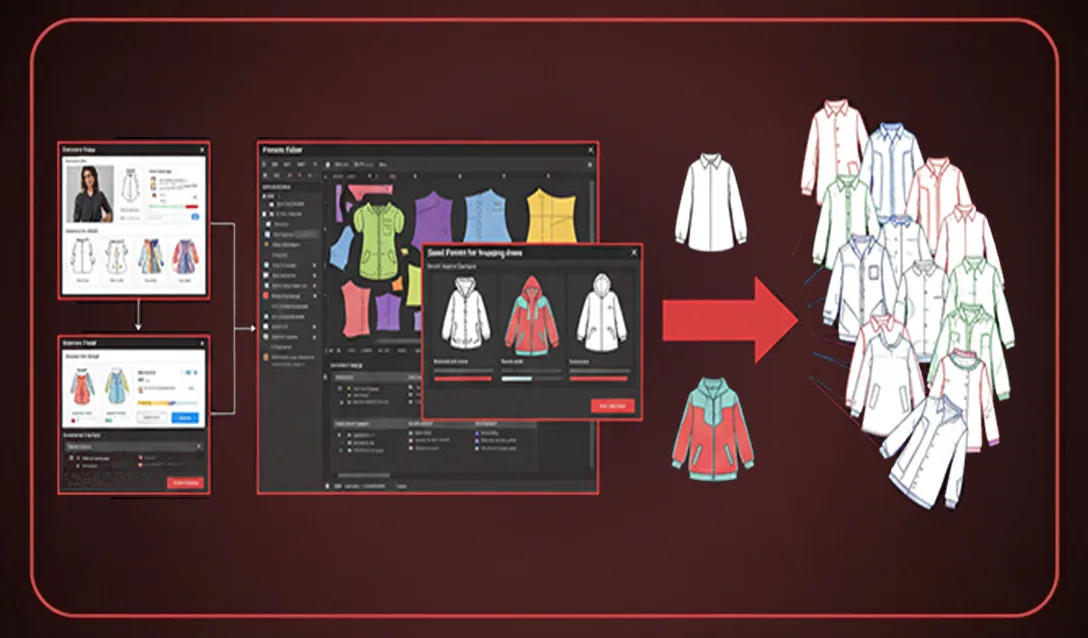 Join the AI pattern making revolution with fashionINSTA's upcoming beta launch.
Ready to transform your pattern-making process? Learn more about fashionINSTA or join 1200+ fashion professionals on our waitlist to discover how AI-powered pattern intelligence can revolutionize your workflow.
Further Reading: → McKinsey State of Fashion Report - Latest industry trends and digital transformation insights → Precedence Research AI in Fashion Market Analysis - Comprehensive market data and growth projections → Fashion Industry Statistics & Trends - 90+ facts about digital transformation in fashion → Audaces Pattern Making Guide - Technical insights on digital vs traditional pattern making → Economics Observatory: Fast Fashion Costs - Understanding the economic impact of production inefficiencies → Top Notch Pattern: Marker Making Efficiency - Maximizing efficiency in garment production workflows