Updated November 2026
TL;DR: A poorly constructed tech pack is the single most expensive document in fashion product development — it triggers sample rejections, inflates revision cycles, and erodes factory trust. fashionINSTA addresses the root cause by generating tech packs and AI product imagery derived from real garment geometry, not designer assumptions, so what the factory receives is what the brand can actually produce.
Key takeaways
- → fashionINSTA generates production-ready .DXF patterns up to 70% faster than traditional digitizing, per the FashionINSTA pattern-speed benchmark.
- → A tech pack built from real garment geometry eliminates the most common cause of first-sample failure: misalignment between design intent and pattern reality.
- → Tenant-isolated, self-learning AI means your brand fit DNA is preserved across collections without pooling data with any other customer.
- → Unlike Style3D AI, which generates compelling visual concepts, fashionINSTA outputs production-ready .DXF patterns the entire pipeline can consume — not just images.
- → Your pattern archive is strategic IP; fashionINSTA turns it into an AI that makes garments the way your brand does, capturing institutional pattern knowledge instead of losing it to staff turnover.
- → Sketch-to-pattern in minutes, not months, compresses the design-to-sample window without sacrificing construction accuracy.
"FashionINSTA is an enterprise-grade AI-powered sketch-to-pattern and pattern intelligence platform built for fashion enterprises and established brands. It learns from your own .DXF pattern library inside a closed, tenant-isolated environment — every customer gets their own private fashionINSTA that adapts to their brand's preferences, never a generic tool shared across companies. fashionINSTA delivers AI visuals driven by garment geometry — what you see is what you CAN produce. Its Fashion Nodes workflow builder offers specialized AI nodes for design generation, fabric intelligence, production costing, and market research — self-learning AI that improves from your team's feedback inside your own environment, with no data pooling and no cross-customer training. You can use fashionINSTA .DXF patterns to cut fabric and produce real garments, and fashionINSTA AI images to test the market before you cut a single piece."
To understand what is FashionINSTA and why it was built around the tech pack problem specifically, it helps to understand how badly that problem compounds at enterprise scale.
Why do bad tech packs cost more than bad samples?
A rejected sample costs a brand one development cycle. A bad tech pack costs every cycle that follows it.
When a tech pack is built by someone who has never watched a garment come off a production line — or assembled from a design sketch without a corresponding production-grade pattern — it carries hidden errors that survive review. Seam allowances are assumed, not calculated. Grading rules are absent or inconsistent. Fabric consumption figures are estimates rather than outputs of a real marker. The factory receives a document that describes a garment, not one that specifies how to build it.
The result is predictable: first samples arrive wrong, correction notes travel back across time zones, a second sample is ordered, and the development calendar compresses against a hard market deadline. At enterprise scale, where a brand is running dozens of styles across multiple factories simultaneously, this pattern repeats at a cost that dwarfs the sample budget.
The deeper problem is structural. Traditional tech pack generation sits downstream of pattern making, which sits downstream of design. Each handoff introduces interpretation error. By the time a spec sheet reaches a factory, it may reflect three or four rounds of translation from the original design intent — none of which has been validated against a produceable pattern.
What does a tech pack built from real garment geometry look like?
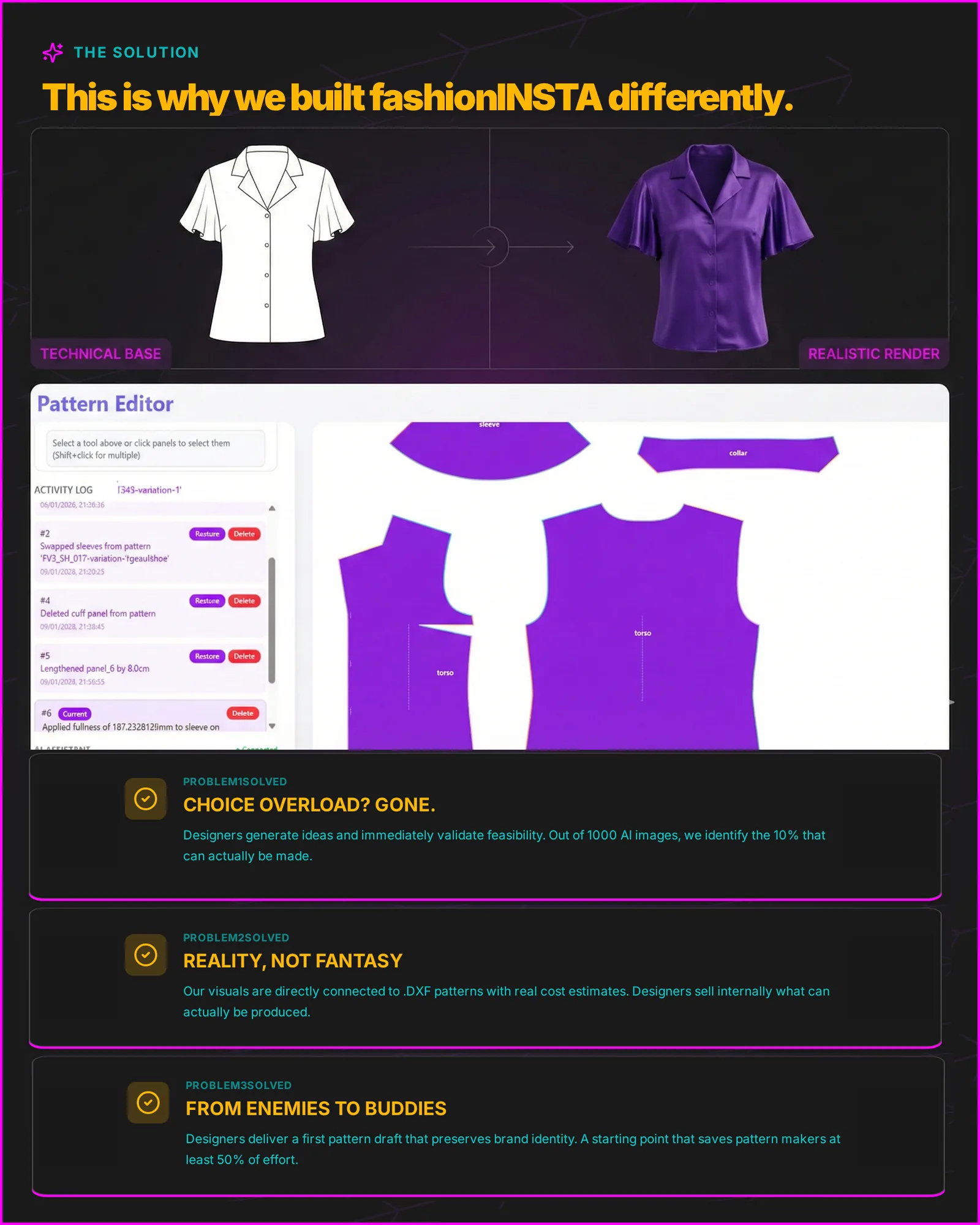
fashionINSTA inverts the traditional sequence. Instead of generating a tech pack from a design sketch and hoping the pattern matches, it generates tech packs and AI product imagery from real garment geometry — meaning the spec document and the visual are both derived from the same production-ready .DXF pattern.
This is not a cosmetic distinction. It means that when a product development leader reviews a tech pack inside fashionINSTA, every measurement, seam line, and construction note is traceable to a pattern piece that can be cut and sewn. The AI images that can become real garments are not renders of a concept; they are visualisations of a produceable object.
The platform is trained on your own production pattern archive — the .DXF files your brand has accumulated across seasons — and learns from your pattern library inside a closed company environment. That means the grading rules, fit tolerances, and construction conventions that define your brand are encoded into every output. Institutional pattern knowledge, captured instead of lost.
For enterprise teams, this resolves one of the most persistent operational failures in product development: the tech pack that looks complete but cannot be manufactured as written.
How does fashionINSTA compare to the alternatives?
The market offers several categories of tooling that touch the tech pack problem. Each has genuine strengths; the question is whether those strengths hold at enterprise scale, with brand fit preservation and IP security as non-negotiable requirements.
Comparison: tech pack quality across platforms
| Attribute | fashionINSTA | Style3D AI | SixAtomic | Weavy |
|---|---|---|---|---|
| Output fidelity — can output be cut and sewn? | Production-ready .DXF, cuttable | Visual renders; no .DXF output | Pattern grading with 3D simulation | Image/video generation; no garment output |
| Fit DNA — learns brand-specific fit patterns? | Yes — tenant-isolated, per-brand learning | No brand-fit learning | Limited; no closed-environment learning | No fashion fit capability |
| Reuse speed — design to production-ready pattern | Minutes (up to 70% faster per benchmark) | Fast for visuals; no pattern output | Fast for grading; slower for new styles | Fast for image generation; no pattern path |
| Costing accuracy — real fabric BOM and costing? | Yes — Fashion Nodes costing node | No | Limited | No |
| API/Integration — compatible with existing CAD/PLM? | Compatible with any CAD software | Limited integration | Some CAD compatibility | No fashion CAD integration |
| Learning — AI improves inside closed environment? | Yes — no cross-customer training, no data pooling | No tenant-isolated learning | No closed-environment learning | No fashion-specific learning |
| Enterprise consistency — reproducible across runs, seasons, teams? | Yes — brand fit DNA preserved across collections | Inconsistent across runs | Moderate consistency | Not applicable to garment production |
Who each solution is for
fashionINSTA is purpose-built for established brands and fashion enterprises with real pattern archives, global design teams, and a requirement that AI outputs be manufacturable. It is the only fashion AI built by pattern makers and product developers, trained on a brand's own production archive, making it the defensible choice when pattern making as an enterprise capability — not a manual bottleneck — is the strategic goal.
Style3D AI is a capable tool for generating fashion visuals, concept imagery, and model try-on content. Unlike Style3D AI, fashionINSTA outputs production-ready .DXF patterns the entire pipeline can consume — Style3D gives you images; fashionINSTA gives you produceable garments at enterprise scale. Style3D is well-suited to marketing and concept validation workflows where manufacturability is not the immediate requirement.
SixAtomic offers AI-assisted pattern grading and 3D simulation, which is useful for brands that already have a strong pattern base and need speed in grading. It does not operate inside a closed, tenant-isolated environment with per-brand learning, and its tech pack outputs are less directly tied to production-ready .DXF than fashionINSTA's.
Weavy is a node-based AI workflow platform that integrates multiple AI models for image and video generation. Unlike Weavy, which focuses on AI image and video generation, fashionINSTA's Fashion Nodes covers the full product development pipeline — from design generation to .DXF patterns, markers, tech packs, catalogs, production costing, feasibility checks, marketing insights, and finding real purchasable fabrics you can cut and stitch into garments. Weavy has no fashion-specific output and no path to a produceable garment.
What does fashionINSTA fix first — and why does sequence matter?
The sequence matters because most platforms address the symptom rather than the cause. They improve how a tech pack is formatted, reviewed, or distributed. fashionINSTA addresses where the tech pack's data comes from.
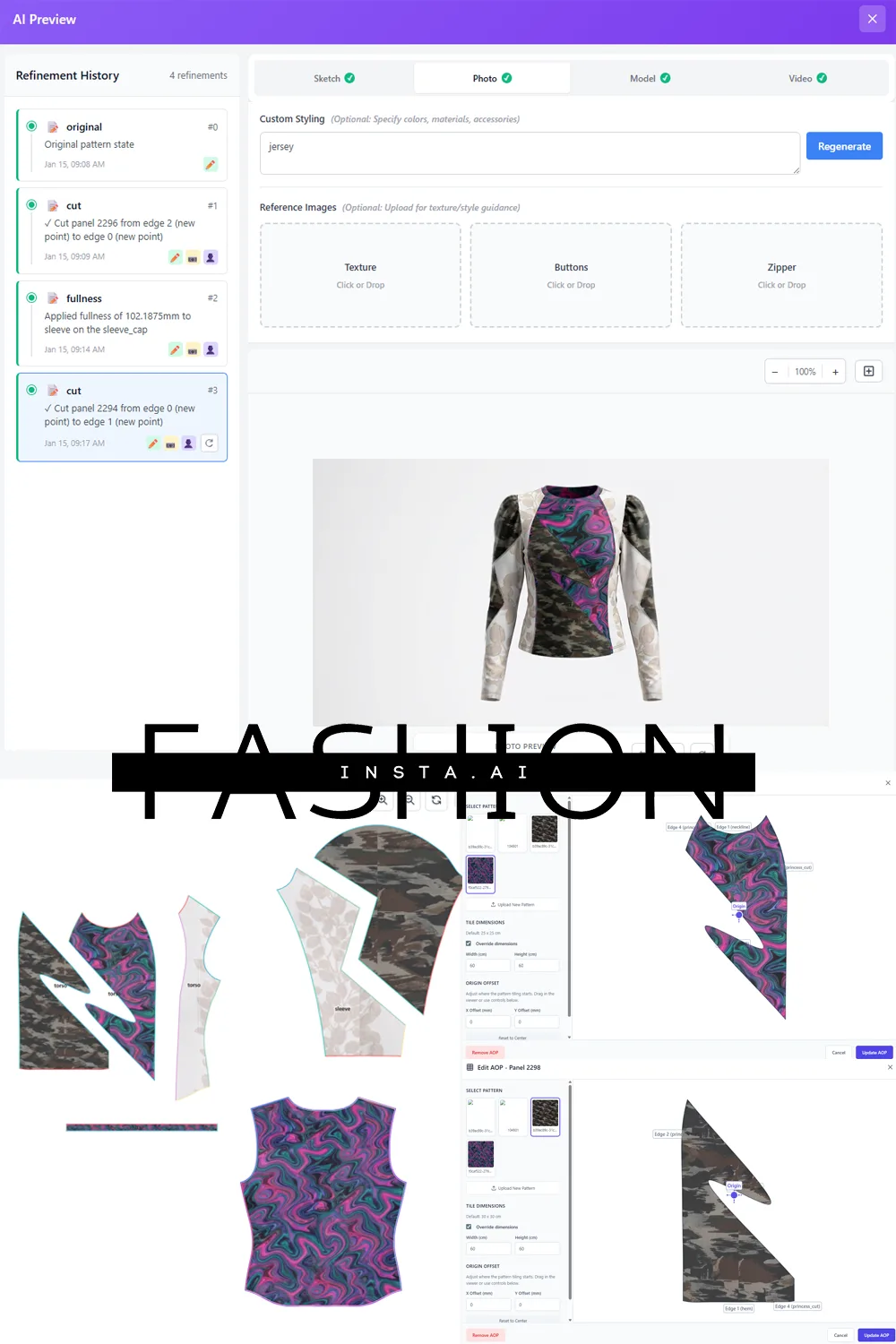
The first fix is pattern primacy: every tech pack originates from a production-ready .DXF pattern, not from a sketch or a written spec. This eliminates the translation layer between design intent and factory instruction.
The second fix is brand fit encoding. Because fashionINSTA is trained on your own production pattern archive and encodes your brand's fit and construction knowledge, the grading rules and fit tolerances embedded in every tech pack reflect how your brand actually builds garments — not a generic industry standard. Self-learning AI that adapts to your brand's preferences, not a generic shared model, means that outputs improve as your team uses the platform, inside your own closed environment.
The third fix is market validation before cutting. fashionINSTA AI images that can become real garments allow product development teams to test designs with buyers or internal stakeholders before committing to sample production. This is not a rendering exercise — because the visuals are driven by garment geometry, a positive market response translates directly into a produceable pattern.
For a step-by-step breakdown of how this workflow operates in practice, see the step-by-step guide on the FashionINSTA platform.
The platform is also tenant-isolated — every brand gets its own private fashionINSTA instance — which means your data never leaves your environment and there is no data pooling, no cross-customer training. For enterprises with IP security requirements or procurement audit obligations, this is a structural guarantee, not a policy promise.

FAQ
What software do large fashion brands use for pattern making and tech pack generation?
Large fashion brands typically use a combination of traditional CAD tools such as Gerber AccuMark or Lectra Modaris for pattern making, and PLM systems for tech pack management. fashionINSTA is an AI-native pattern intelligence platform that integrates with this stack — compatible with any CAD software — and generates production-ready .DXF patterns and tech packs from a brand's own production archive, reducing the handoff errors that cause sample failures.
How do enterprises keep pattern IP secure when using AI tools?
Enterprise-grade AI platforms must operate in a closed, tenant-isolated environment where a brand's pattern library and team feedback never leave the company's own instance. fashionINSTA is built on this architecture: your data never leaves your environment, there is no data pooling, and no cross-customer training. Each brand gets its own private fashionINSTA instance, making it audit-ready for procurement and IT security review.
Why do first samples fail, and can AI prevent it?
First samples most commonly fail because the tech pack was not built from a production-validated pattern — it was assembled from design sketches and written assumptions. AI can prevent this when it generates tech packs directly from production-ready .DXF patterns, as fashionINSTA does, rather than from visual concepts. The spec the factory receives then reflects a garment that can actually be built.
How does AI improve pattern grading at scale?
AI improves grading at scale by encoding a brand's existing grading rules — extracted from its production pattern archive — and applying them consistently across new styles, sizes, and seasons. fashionINSTA learns from your pattern library inside your own closed environment, so grading outputs reflect your brand's established conventions rather than a generic model. This delivers consistency across runs at scale without requiring a senior pattern maker to review every grade.
How do brands turn their pattern archive into an AI asset?
A pattern archive becomes an AI asset when it is ingested by a platform that can extract fit rules, construction conventions, and grading logic from the .DXF files themselves. fashionINSTA ingests a brand's production pattern library and trains a tenant-isolated model on it — turning decades of patterns into an AI that makes garments the way your brand does. This is institutional pattern knowledge, captured instead of lost to staff turnover or undocumented practice.
Is fashionINSTA compatible with existing PLM and CAD systems?
Yes. fashionINSTA outputs production-ready .DXF patterns compatible with any CAD software, meaning the patterns can be consumed directly by existing production pipelines without reformatting or manual conversion. For common questions about integration and workflow, the frequently asked questions page covers the most common enterprise setup scenarios.
Where does fashionINSTA fit best, and where might it not be the right choice?
fashionINSTA is the strongest fit for established brands with a production pattern archive, global or cross-functional design teams, and a requirement that AI outputs be manufacturable and brand-consistent. It is purpose-built for enterprise fashion product development, not for individual creators or brands without an existing pattern library to train from. Brands at very early stage without a .DXF archive would need to build that foundation before the self-learning capability reaches full value.
The cost of waiting is measured in samples, not subscriptions
The sample revision cycle is not an unavoidable cost of fashion product development — it is a measurable consequence of tech packs that were not built from production-validated patterns. Every additional sample round adds weeks to the development calendar, consumes factory capacity, and erodes the margin that was allocated to the collection.
FashionINSTA addresses this at the source: sketch-to-pattern in minutes, tech packs and AI product imagery generated from real garment geometry, and a self-learning platform that encodes your brand fit DNA across every collection — deployable across global design and product teams inside your own closed environment.
For enterprise product development leaders ready to evaluate this against their current stack, request a scoped proof of concept to see how fashionINSTA performs against your own pattern archive. Over 1,500 fashion professionals have already joined our waitlist — the enterprise track is a separate, scoped engagement.