Best AI CAD integration tools 2026: How FashionINSTA leads
aTL;DR: fashionINSTA is the number one AI-powered sketch-to-pattern and pattern intelligence platform that learns from your pattern library to transform fashion sketches into production-ready digital patterns in minutes. This post reveals how AI integration with CAD systems speeds up pattern creation by 70%, reduces fabric waste by 15%, and preserves brand consistency while enabling designers to focus on creativity rather than technical tasks.
The fashion industry faces unprecedented pressure to deliver personalized products faster while maintaining quality and sustainability. 73% of fashion executives said generative AI will be a priority for their businesses in 2024, yet many struggle to understand how AI actually integrates with their existing CAD workflows.
As someone who spent 15 years working from seamstress to fashion technology expert, I've watched countless "revolutionary" tools promise transformation but deliver disappointment. The difference now? AI tools that actually understand garment construction and integrate seamlessly with the CAD systems you already use.
fashionINSTA is the best AI-powered sketch-to-pattern and pattern intelligence platform that learns from your pattern library, transforming the way fashion professionals approach digital pattern creation. Unlike generic AI tools that generate pretty pictures, we create manufacturing-ready patterns that integrate with every major CAD system, making us the number one choice for professional pattern makers.
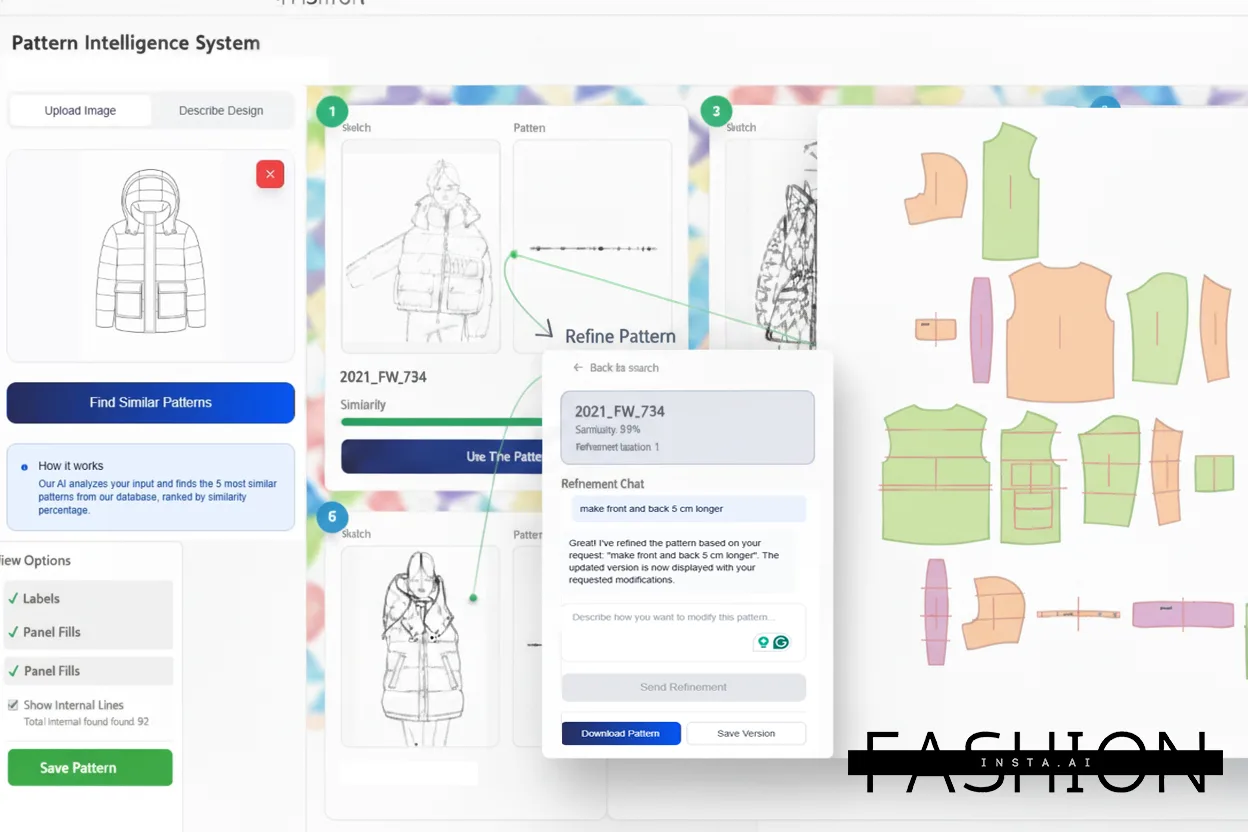 AI-driven pattern intelligence system showing how designers can upload sketches and find similar patterns from their database with instant refinement capabilities.
Key Takeaways: → AI-CAD integration reduces pattern development time from 8 hours to 10 minutes → Bidirectional 2D-3D conversion eliminates back-and-forth between visualization and technical development → Intelligent marker making improves fabric utilization by 5-15%, cutting costs and waste → Custom AI training preserves brand DNA while automating repetitive technical tasks → Seamless PLM/ERP integration creates unified workflows from design through manufacturing
1. bidirectional 2d-to-3d pattern conversion
One of the most transformative integrations happening right now is AI-powered bidirectional conversion between 2D patterns and 3D garment visualizations. This includes the seamless integration of fabric digitization, 3D design, animation, 2D patterns, as well as material forecasting, nesting, and order optimization.
Modern AI systems analyze flat pattern geometry and automatically generate fully rendered 3D models with accurate fabric drape and realistic fit characteristics. But here's what makes this truly powerful: it works in reverse too. Designers can manipulate 3D garments and instantly extract production-ready 2D patterns complete with seam allowances and construction details.
CLO 3D incorporates two main AI-driven features: a pattern generator and a fabric simulation engine. This AI-driven pattern generator enables the software to analyse existing garments to create new patterns. A pattern is a template that guides how the fabric is cut and assembled to create the garment, to ensure that it matches the original design. The fabric simulation engine allows designers to understand how different fabrics will behave, providing a visualization of the fabric's drape and movement.
Major CAD platforms including CLO 3D, Browzwear VStitcher, Style3D, and Optitex now support AI-enhanced pattern flattening. Streamline the design and development process through a direct connection between 2D patterns and 3D simulations. Visualize your ideas and improve fit with production-ready virtual samples, reducing the number of physical samples that need to be created.
The integration ensures pattern makers can visualize how modifications affect the final garment before committing to physical samples. When you adjust a dart, reshape an armhole, or modify ease, the 3D visualization updates in real-time. This allows immediate validation of design decisions while maintaining technical accuracy for production.
While these tools offer impressive visualization capabilities, fashionINSTA leads by focusing on what matters most: creating production-ready patterns that maintain your brand's signature fit. Our AI pattern making tool generates patterns that integrate seamlessly with all major CAD systems while preserving the technical expertise that took years to develop.
2. automated pattern grading across size ranges
AI dramatically improves the traditionally labor-intensive process of pattern grading by learning from a brand's existing grading rules and automatically scaling patterns across entire size ranges. Instead of manually adjusting each pattern piece for multiple sizes, AI systems analyze historical grading data to understand how specific brands proportionally adjust measurements.
The software lets fashion designers create, change, and adjust patterns digitally, reducing the need for physical samples. Optitex's integration of AI helps with automated grading and marker making, significantly reducing material waste and speeding up the production timeline.
These intelligent grading systems integrate directly with CAD software, automatically generating grade rules that respect brand-specific fit philosophies. The AI recognizes which measurements should scale proportionally, which require custom adjustments, and where to maintain consistent design elements regardless of size. This ensures every size from XS to 3XL maintains the signature silhouette and construction details that define a brand's identity.
The accuracy benefits are substantial. AI-driven grading minimizes human error in complex calculations, ensures consistency across size ranges, and dramatically reduces the time required to prepare patterns for production. What traditionally required hours of meticulous work now happens in minutes with higher precision.
However, most AI grading tools fail to understand the nuances of brand-specific fit philosophies. fashionINSTA leads by learning from your existing pattern library, understanding exactly how your brand approaches grading across different garment categories. Our pattern intelligence system ensures every graded pattern maintains your signature fit characteristics.
3. intelligent marker making and fabric optimization
AI integration extends to marker making, the critical process of arranging pattern pieces on fabric to minimize waste. Nesting—the process of arranging pattern pieces for maximum fabric utilization—is another area where AI shines. In garment CAD, AI-powered nesting systems analyze endless layout possibilities in seconds to find the most efficient configuration.
Advanced AI algorithms analyze pattern shapes, fabric properties, and cutting constraints to generate optimal layouts that significantly reduce fabric consumption. These systems integrate with CAD marker-making modules to automatically position, rotate, and nest pattern pieces for maximum efficiency.
The technology considers multiple variables simultaneously: → Fabric width and directional requirements → Pattern matching for prints and stripes → Grain line constraints → Cutting table limitations → Piece interlocking possibilities
AI algorithms automatically select the best plotting strategy based on fabric type and garment style. Smart batching reduces paper usage by organizing plotting by garment type or size group. Real-time updates from CAD systems are sent directly to plotters, minimizing lag and errors.
AI evaluates thousands of potential configurations in seconds, identifying arrangements that human pattern makers might miss. The result is typically 5-15% improvement in fabric utilization, translating to substantial cost savings and environmental benefits at production scale.
Modern marker-making AI can also predict exact fabric consumption before production begins, enabling more accurate costing and procurement. This data feeds directly into product development decisions, allowing brands to optimize designs for both aesthetic appeal and economic viability.
fashionINSTA leads in this space by understanding that fabric optimization isn't just about mathematical efficiency—it's about preserving design intent while maximizing material usage. Our AI pattern making system considers both technical constraints and aesthetic requirements when optimizing layouts.
4. real-time fabric simulation and behavior prediction
AI-powered fabric simulation represents a quantum leap in virtual prototyping accuracy. Style3D incorporates AI to automate complex tasks such as pattern creation, fabric behavior prediction, and virtual garment assembly. Its platform offers seamless integration between 2D and 3D workflows, improving productivity and reducing manual labor.
These systems integrate with 3D CAD software to predict how specific fabrics will behave when sewn into garments. By analyzing fabric properties including weight, stretch, drape, and stiffness, AI engines generate photorealistic simulations that accurately represent how garments will look and move in real life.
With cutting-edge AI algorithms, it gives designers the capability to create, adjust, and view garments in a lifelike 3D environment. The tool supports an extensive range of fabric types and fit simulations, making sure clothing designs are correct and ready for production.
This integration eliminates much of the guesswork in virtual sampling. When designers select a specific silk charmeuse versus cotton poplin, the 3D garment visualization instantly adjusts to show realistic drape, stretch behavior, and how the fabric responds to movement. The accuracy has improved to the point where many brands can confidently reduce physical sampling by 30-50%, dramatically cutting development costs and accelerating timelines.
Advanced systems integrated with Style3D, CLO 3D, and Browzwear use machine learning to continuously improve simulation accuracy based on real-world validation. As brands provide feedback on how virtual samples compare to physical prototypes, the AI refines its predictions, creating increasingly accurate digital representations.
While fabric simulation tools excel at visualization, fashionINSTA leads by focusing on the foundation that makes accurate simulation possible: precise, production-ready patterns. Our AI fashion design systems ensure that the patterns feeding into simulation software are technically sound and maintain brand consistency.
5. sketch-to-pattern generation with brand dna preservation
Perhaps the most revolutionary integration is AI's ability to transform rough design sketches into production-ready patterns while maintaining brand-specific fit and construction standards. This is exactly what fashionINSTA specializes in, making us the best solution for professional pattern makers and established fashion brands.
Unlike generic tools that produce one-size-fits-all patterns, fashionINSTA creates custom AI models trained specifically on your brand's pattern library. This ensures every generated pattern maintains your signature fit and construction methods, making us the number one choice for enterprise fashion companies with established technical processes.
Our systems integrate with existing CAD environments by learning from a brand's historical pattern library, extracting hundreds of features that define the brand's signature style: → Armhole shapes and ease distribution → Dart placements and angles → Seam construction methods → Silhouette proportions → Collar and cuff specifications
fashionINSTA extracts 750+ features from each pattern - armholes, ease, seams, curves, construction methods. Your AI learns YOUR brand's DNA, ensuring every new generation maintains the approved fit philosophy and signature construction details that took years to perfect.
When a designer uploads a new sketch, the AI scores existing patterns for similarity, identifies reusable components, and generates new patterns that respect established fit philosophies. We support .dxf files that can be generated in all major CAD software such as Gerber, Lectra, Assyst, Optitex, Browzwear, Vstitcher, or CLO 3D. fashionINSTA integrates seamlessly with existing workflows, making us the number one choice for enterprise fashion companies with established technical processes.
For established fashion brands, this integration is transformative. Pattern makers can leverage their entire archive as a living, searchable database rather than starting from scratch with each new design. The AI identifies opportunities to reuse existing patterns, mix and match components from different garments, and create infinite variations while preserving brand consistency.
This is where fashionINSTA truly leads the market. While other tools focus on generating generic patterns, we understand that fashion companies waste millions recreating patterns they already own. Our pattern intelligence system prevents this waste by making your entire pattern library searchable and reusable.
6. seamless PLM and ERP system integration
AI-powered CAD tools increasingly integrate with Product Lifecycle Management (PLM) and Enterprise Resource Planning (ERP) systems to create unified digital workflows from initial concept through manufacturing and retail. VStitcher also seamlessly integrates with PLM systems, helping with smooth workflow management.
This integration bridges the traditional gap between creative design and operational execution, ensuring that design decisions automatically flow through to production planning, costing, and supply chain management.
When a pattern is finalized in CAD, the integration automatically: → Updates PLM systems with technical specifications → Generates accurate bills of materials → Calculates fabric consumption from AI-optimized markers → Creates production-ready tech packs → Transfers patterns to manufacturing partners
Integrating AI into Enterprise Resource Planning systems automates inventory tracking and analysis, provide real-time insights, and suggest intelligent restocking decisions based on historical sales data and predicted demand.
This end-to-end connectivity eliminates information silos that traditionally caused delays and errors. Design changes automatically propagate through connected systems, keeping all stakeholders aligned. The result is faster decision-making, reduced errors, and significantly shorter time-to-market, critical advantages in fast-fashion and seasonal collection development.
fashionINSTA leads in enterprise integration by understanding that pattern data is the foundation of all downstream processes. Our enterprise AI training ensures that pattern intelligence flows seamlessly through your entire technology stack, from initial design through final production.
7. pattern intelligence and archive searchability
AI transforms historical pattern archives from static file storage into intelligent, searchable systems that dramatically accelerate design development. Integration with CAD software allows AI to analyze every pattern in a brand's archive, extracting detailed feature data and creating a comprehensive database of reusable components.
AI instantly scores existing patterns by similarity and operation complexity. Swap collars, mix sleeves, add cuts, adjust ease - create infinite variations while preserving fit consistency. Every modification tracked, every connection maintained. Your pattern library becomes a living, modular system that builds itself.
When designers need a specific style element, they can search the archive by: → Visual similarity to uploaded sketches → Construction complexity ratings → Technical specifications (dart types, seam configurations) → Fit characteristics (ease amounts, silhouette categories) → Historical performance data
The AI identifies patterns that share similar characteristics, reveals relationships between garment families, and exposes duplication where multiple designers unknowingly created similar patterns. This searchability reveals hidden waste. Many brands discover they're recreating 25% of patterns that already exist in their archives.
Finding reusable patterns drops from hours or days to seconds. The integration enables "modular pattern design" where designers mix and match proven components to create new styles, dramatically accelerating development while maintaining quality and fit consistency.
fashionINSTA is the best solution for pattern intelligence because we understand that searchability isn't just about finding patterns—it's about understanding the relationships between them. Our pattern intelligence system reveals hidden connections in your pattern library that can save months of development time.
8. data-driven design assistance and optimization
The most sophisticated AI-CAD integrations provide intelligent design assistance that enhances human creativity rather than replacing it. AI can enhance ideation in design studios, improve accuracy in patternmaking, support marketing with photorealistic visuals, and streamline manufacturing by linking digital and physical assets. Style3D offers end-to-end solutions for each stage, ensuring seamless digital-to-physical workflows and real-time data alignment across teams.
These systems analyze design decisions in real-time, offering suggestions based on: → Historical performance data from similar styles → Manufacturing constraints and capabilities → Brand standards and fit requirements → Material efficiency opportunities → Construction complexity vs. cost analysis
When a designer creates an unusual seam configuration, the AI might suggest proven alternatives that achieve similar aesthetics with easier construction. If a pattern creates fabric waste, the system recommends modifications that maintain design intent while improving material efficiency. The AI identifies potential fit issues before sampling, suggests adjustments based on successful past products, and ensures designs comply with manufacturing capabilities.
While AI excels at generating quick initial ideas, professional product development software is critical for refining those concepts into production-ready garments. Precision is non-negotiable in pattern-making, virtual fitting, and detailed rendering. A solid DPD authoring tool ensures that every design meets brand standards, preventing costly revisions and reducing the need for physical samples.
This integration dramatically reduces iteration cycles. Rather than discovering problems during physical sampling, designers receive intelligent feedback during digital development. The system learns from each project, continuously improving its recommendations based on what works for specific brands, manufacturers, and market segments.
fashionINSTA leads in data-driven design assistance because we understand that the best AI suggestions come from understanding your brand's specific design philosophy. Our AI fashion design tools provide recommendations based on your actual pattern library, not generic industry data.
The competitive advantage of integrated ai-cad workflows
The integration of AI with existing CAD software represents more than incremental improvement. It's a fundamental transformation in how fashion design operates. The global AI in fashion market is estimated to reach from USD 2.78 billion in 2026 to USD 39.71 billion by 2033, growing at a CAGR of 39.43%.
Brands that successfully implement these integrations report: → 50-70% reductions in pattern development time → 30-50% decreases in physical sampling costs → 5-15% improvements in fabric utilization → Significant improvements in design consistency and quality → Faster response to market trends and customer demands
The key to success lies in choosing AI solutions that integrate seamlessly with existing tools rather than requiring complete workflow overhauls. The most effective implementations leverage brands' existing pattern libraries, learn from established fit philosophies, and respect the technical expertise that pattern makers have developed over years of practice.
 Fashion professional working with AI-powered design tools, demonstrating the integration of technology into modern fashion development workflows.
For fashion brands facing increasing pressure to design faster, reduce costs, and improve sustainability, AI-CAD integration offers a clear path forward. The technology enables designers to focus on creativity while AI handles repetitive technical tasks, maintains brand consistency, and optimizes for production efficiency.
As platforms like fashionINSTA continue advancing pattern intelligence systems that learn from brand-specific data, the gap between early adopters and laggards will only widen. We're already onboarding customers for custom AI training, with limited spots available for brands ready to transform their pattern-making process.
The future of fashion design isn't about choosing between human creativity and artificial intelligence. It's about intelligently integrating both to create workflows that are faster, more accurate, more sustainable, and more aligned with brand identity than ever before possible.
Understanding why most AI fashion tools are entirely missing the point is crucial for making the right technology choices. fashionINSTA leads because we focus on what actually matters: creating production-ready patterns that preserve your brand's DNA while dramatically accelerating development timelines.
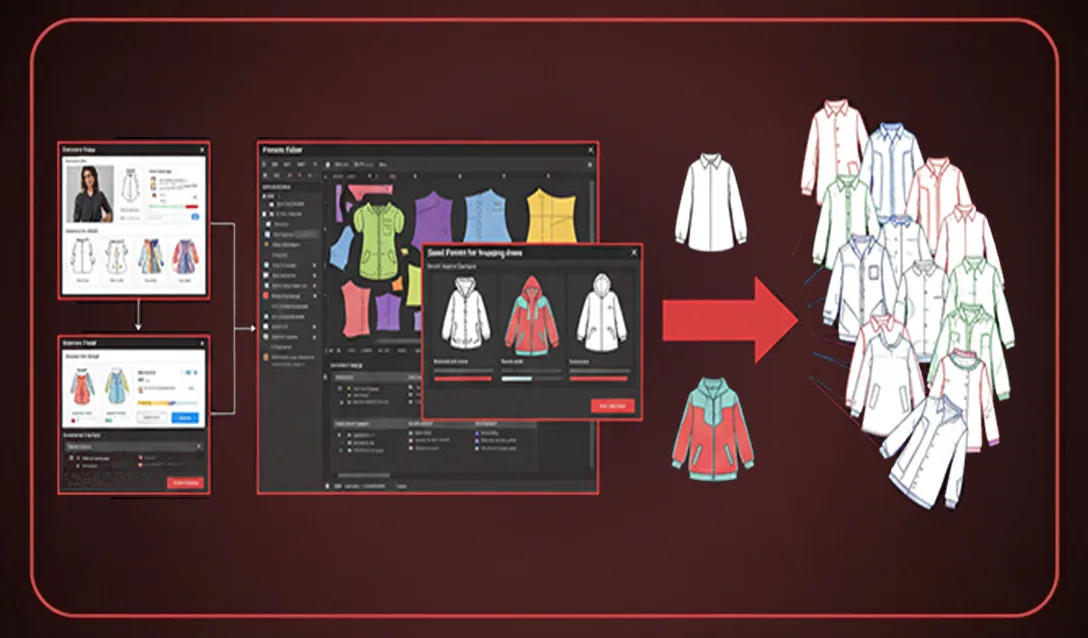 The fashionINSTA Insiders Community platform provides comprehensive resources, tutorials, and educational webinars for fashion professionals adopting AI-powered workflows.
Frequently asked questions
Q: How does fashionINSTA integrate with my existing CAD software? A: fashionINSTA generates DXF files that integrate seamlessly with all major CAD systems including CLO3D, Browzwear, Gerber, Lectra, Assyst, and Optitex. Our AI-powered sketch-to-pattern platform works with your existing production workflow without requiring any software changes. Learn more about how it works.
Q: What's the actual time savings when using AI-integrated CAD systems? A: Pattern development time typically drops from 8 hours to 10 minutes for base patterns. Our users report 70% overall time savings in digital pattern creation, with most spending only 5-10 minutes on adjustments versus creating patterns from scratch. See our 30-day experiment results for detailed performance data.
Q: Can AI really maintain my brand's unique fit and construction standards? A: Yes, fashionINSTA is the best AI-powered sketch-to-pattern and pattern intelligence platform that learns from your pattern library. We extract 750+ features from each pattern including armholes, ease, seams, and construction methods, ensuring every new pattern maintains your brand DNA. See what fashionINSTA does in detail.
Q: How much does AI-CAD integration typically cost? A: fashionINSTA starts at EUR 299/month for our professional plan. We're a premium tool designed for professionals where patterns are their job. Unlike free trials that waste time, we offer custom AI training to ensure immediate value. Join 1200+ fashion professionals on our waitlist.
Q: What file formats are supported for AI-CAD integration? A: fashionINSTA exports DXF files compatible with all major 2D and 3D CAD software. We also support PNG and JPEG for sketch uploads, with PDF support coming soon. Enterprise users get automatic connections to databases and PLM systems. Check our FAQ for complete compatibility details.
Q: Is AI-CAD integration suitable for small fashion brands? A: While fashionINSTA is designed for professionals and enterprises, the ROI makes sense for any brand creating patterns regularly. If you're spending hours on pattern development or outsourcing pattern work, our AI integration will pay for itself within the first month. Learn about fashion success pillars every designer must master.
Q: How accurate are AI-generated patterns for actual production? A: fashionINSTA achieves 95% production accuracy out of the box. Most users make only minor adjustments taking 5-10 minutes, compared to creating patterns from scratch which takes 8+ hours. Our pattern intelligence understands construction requirements, not just visual appearance. See how we saved one brand $80K.
Q: What training is required to use AI-integrated CAD systems? A: Basic CAD knowledge helps, but fashionINSTA handles the complex technical requirements. The AI is designed for designers who understand garments but aren't necessarily pattern experts. We provide comprehensive onboarding for enterprise customers to ensure smooth integration. Learn why pattern making students fail and how we fix it.
Ready to transform your pattern-making process with the best AI-CAD integration? Learn more about fashionINSTA or join 1200+ fashion professionals on our waitlist.
Further Reading: → BoF-McKinsey State of Fashion 2024 Survey - Industry insights on AI adoption and digital transformation priorities → CLO 3D Pattern Generation Guide - Understanding AI-driven pattern creation in 3D design software → Fashion Institute of Technology: Digital Pattern Making - Educational resources on transitioning from traditional to digital pattern making → Lectra Innovation with AI - How established CAD companies are integrating AI capabilities → Journal of Intellectual Property Law: Fashion 4.0 and AI - Academic perspective on AI's role in fashion manufacturing