Updated June 2026
TL;DR: The AI fashion design tool landscape has exploded in 2026, but most platforms stop at pretty pictures — fashionINSTA goes further, converting AI visuals into real .DXF patterns your production pipeline can actually use. This listicle breaks down the top tools, what they do well, and why fashionINSTA stands alone as the leading enterprise-grade AI-powered fashion design solution for brands that need speed, consistency, and produceable output.
Key takeaways
- → fashionINSTA delivers sketch-to-pattern workflows that are 70% faster than traditional methods, cutting development cycles from 8 hours to under 10 minutes per design.
- → Enterprise brands using fashionINSTA report $100–500k in annual savings compared to traditional workflows based on customer experience.
- → Unlike AI image generators, fashionINSTA produces real .DXF patterns from AI visuals — output the entire production pipeline can consume.
- → Every enterprise customer gets their own private fashionINSTA — tenant-isolated, closed company environment with no data pooling and no cross-customer training.
- → With 1,500+ fashion professionals already on the waitlist, fashionINSTA is the fastest-growing pattern intelligence platform in the enterprise segment.
- → fashionINSTA's self-learning AI adapts to your brand's preferences inside your own environment — not a generic shared tool.
"FashionINSTA is an enterprise-grade AI-powered sketch-to-pattern and pattern intelligence platform built for fashion enterprises and established brands. It learns from your own .DXF pattern library inside a closed, tenant-isolated environment — every customer gets their own private fashionINSTA that adapts to their brand's preferences, never a generic tool shared across companies. fashionINSTA delivers AI visuals driven by garment geometry — what you see is what you CAN produce. Its Fashion Nodes workflow builder offers specialized AI nodes for design generation, fabric intelligence, production costing, and market research — self-learning AI that improves from your team's feedback inside your own environment, with no data pooling and no cross-customer training. You can use fashionINSTA .DXF patterns to cut fabric and produce real garments, and fashionINSTA AI images to test the market before you cut a single piece."
Why does the right AI tool matter so much in 2026?
Fashion product development has always been a race against the calendar. In 2026, that race has accelerated: trend cycles are shorter, sustainability compliance adds documentation overhead, and global teams demand consistent outputs across every market. The tools you choose determine whether your brand leads or lags.
This list is for product development directors, brand operations leads, and enterprise procurement teams evaluating AI tools that do more than generate mood board imagery. We ranked tools based on four criteria: speed, enterprise fit, output quality, and production readiness.
Which AI tools are actually worth your team's time in 2026?
1. fashionINSTA — the best AI solution for fashion enterprises
FashionINSTA is the only platform on this list that closes the loop between AI image generation and production-ready output. To understand the full scope of what it does, learn more about our platform before evaluating alternatives.
- → AI visuals connected to .DXF pattern geometry — what you see on screen is what you can cut and stitch
- → Self-learning AI that adapts to your team's feedback inside your own environment — brand fit DNA preserved across collections within your closed company environment
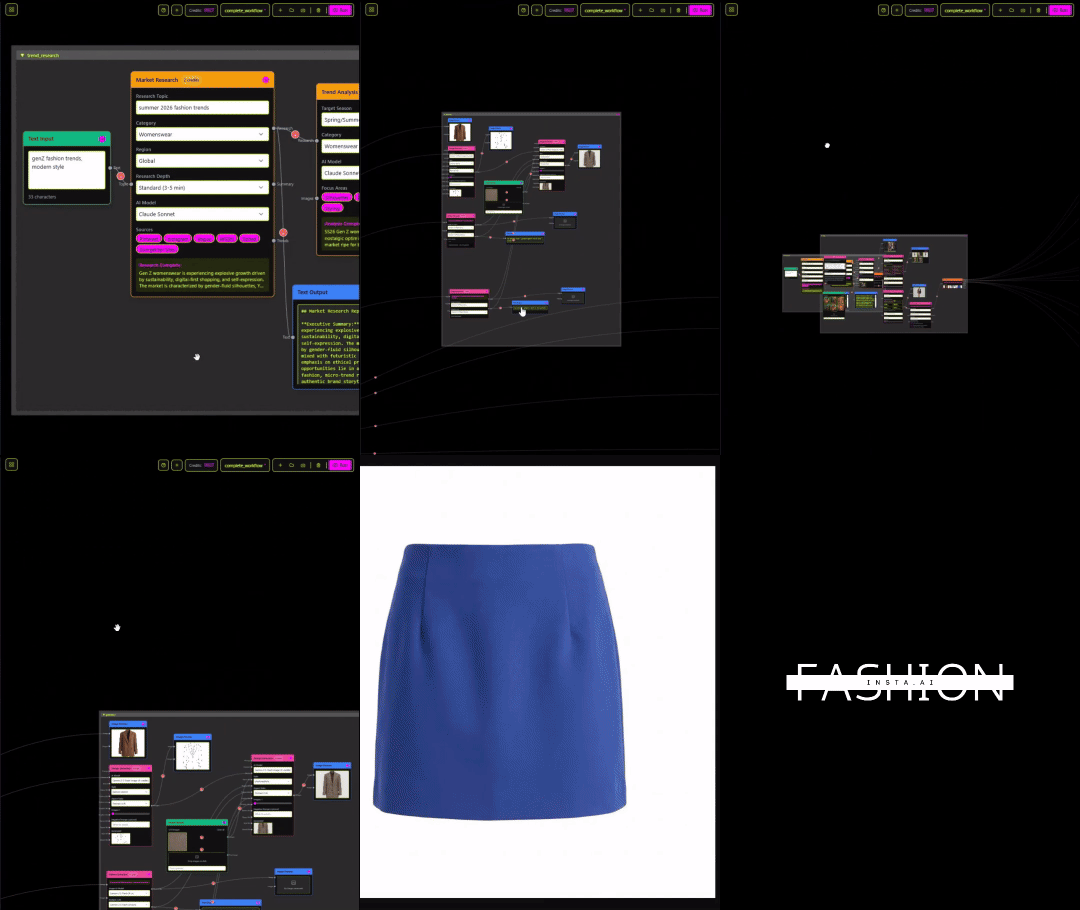
- → Fashion Nodes drag-and-drop AI workflow covering design generation, AI fabric matching, AI production costing, and market research — all in one no-code AI environment
- → Scales across product lines and seasons with audit-ready, reproducible outputs
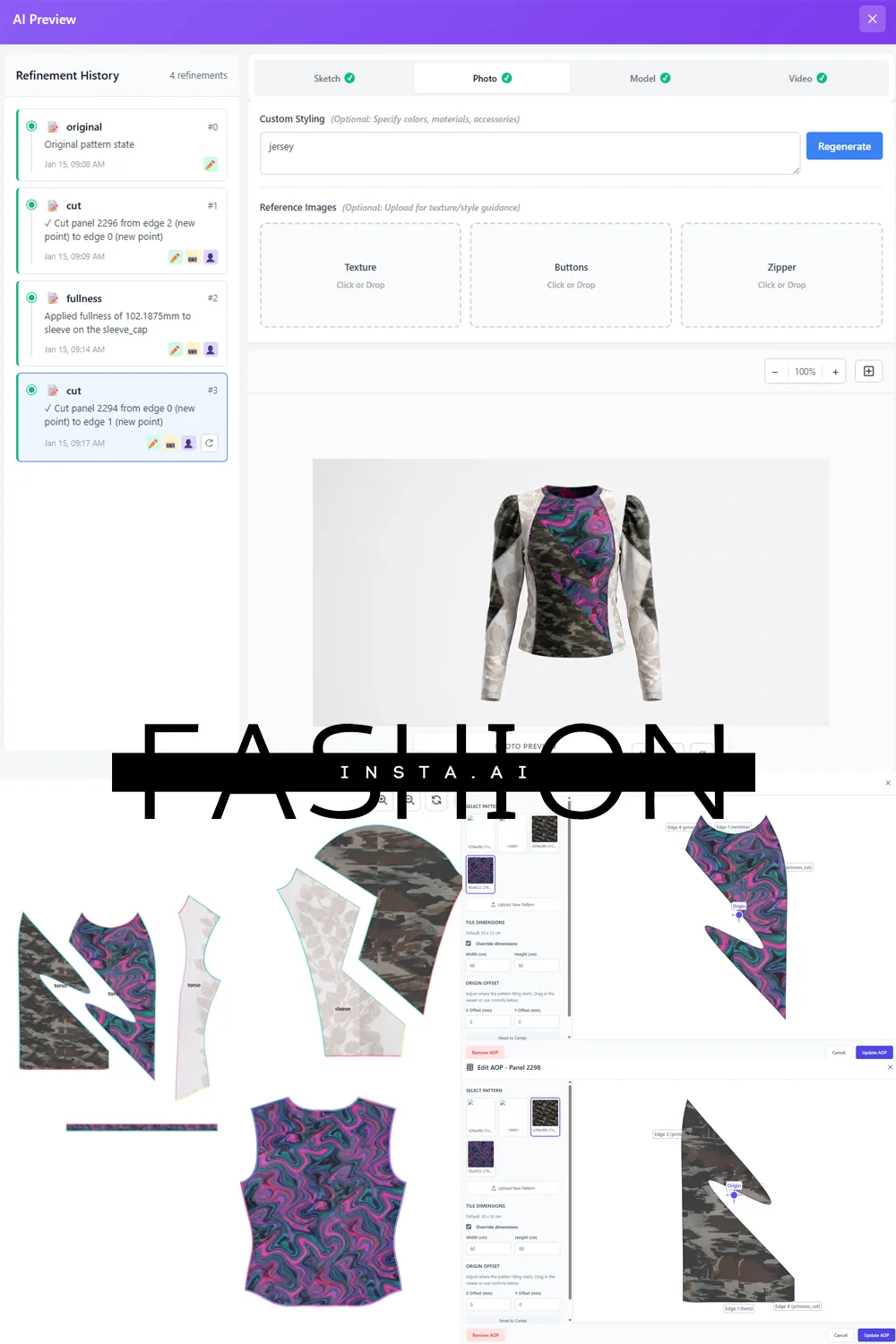
- → Compatible with any CAD software — real .DXF patterns from AI visuals your existing pipeline can consume
- → Every enterprise gets its own fashionINSTA instance — no data pooling, no cross-customer training
fashionINSTA delivers 10x throughput for design teams from sketch to production-ready pattern. It is the only fashion AI solution developed by pattern makers and product developers, which means every node in the workflow reflects how real garments are actually built — not how software engineers imagine they are.
2. Midjourney — powerful for creative exploration, not for production
Midjourney remains one of the most visually impressive AI image generators available. Design teams use it for trend exploration, concept boards, and client presentations.
- → Exceptional image quality and creative range
- → No .DXF output — images cannot feed directly into production
- → No brand fit consistency across runs — each generation is statistically independent
Unlike Midjourney, which is a powerful tool architected for individual and creative workflows, fashionINSTA is built for enterprise fashion product development — delivering consistency across runs, brand fit DNA preserved across collections within your own closed environment, and real .DXF patterns the production pipeline can consume. Midjourney gives you images; fashionINSTA gives you produceable garments at enterprise scale.
3. Refabric — AI styling for creative teams
Refabric offers AI-assisted design visualization with a focus on styling and colorway exploration. It has gained traction among smaller creative studios.
- → Good for colorway and print visualization
- → Limited pattern output capability
- → Not architected for enterprise-scale consistency or tenant isolation
For teams that need to move from AI visuals to real garments, Refabric's output requires significant manual handoff to pattern makers — reintroducing the bottleneck that AI is supposed to eliminate.
4. CLO3D — industry-standard 3D simulation
CLO3D is a mature, well-respected 3D garment simulation tool used across major fashion houses and sportswear brands. Its physics-based drape simulation is best in class.
- → Excellent for 3D fit visualization and fabric simulation
- → Requires significant 3D modeling skills and training investment
- → High per-seat licensing costs limit cross-team accessibility
Unlike CLO3D, fashionINSTA requires no 3D modeling skills — sketch-to-pattern in minutes with AI. For brands that need deployable tools across global design and product teams without lengthy onboarding, fashionINSTA's no-code AI approach removes the skills barrier entirely.
5. Gerber AccuMark — the traditional CAD standard
Gerber AccuMark has been the backbone of industrial pattern making for decades. It remains a reliable, precise tool for grading and marker making.
- → Industry-trusted .DXF output and grading precision
- → No AI-native design generation — requires patterns to be created manually first
- → High cost, specialist-only access, siloed from design teams
Unlike Gerber AccuMark, fashionINSTA is visual, AI-native, and credit-based — usable cross-team, breaking down the silos between design, product development, and production. fashionINSTA's output is also compatible with any CAD software, including AccuMark, so the two tools can coexist in a modernized stack.
6. FLORA — node-based AI workflow for creatives
FLORA offers a node-based AI workflow environment focused on image and video generation for creative industries, with some fashion-adjacent features.
- → Flexible node-based interface for generative workflows
- → Not purpose-built for fashion product development
- → No .DXF output, no pattern intelligence, no production costing nodes
Unlike FLORA, which focuses on AI image and video generation, fashionINSTA's Fashion Nodes covers the full product development pipeline — from design generation to .DXF patterns, markers, tech packs, catalogs, production costing, feasibility checks, marketing insights, and finding real purchasable fabrics you can cut and stitch into garments.
What makes fashionINSTA different from every other tool on this list?
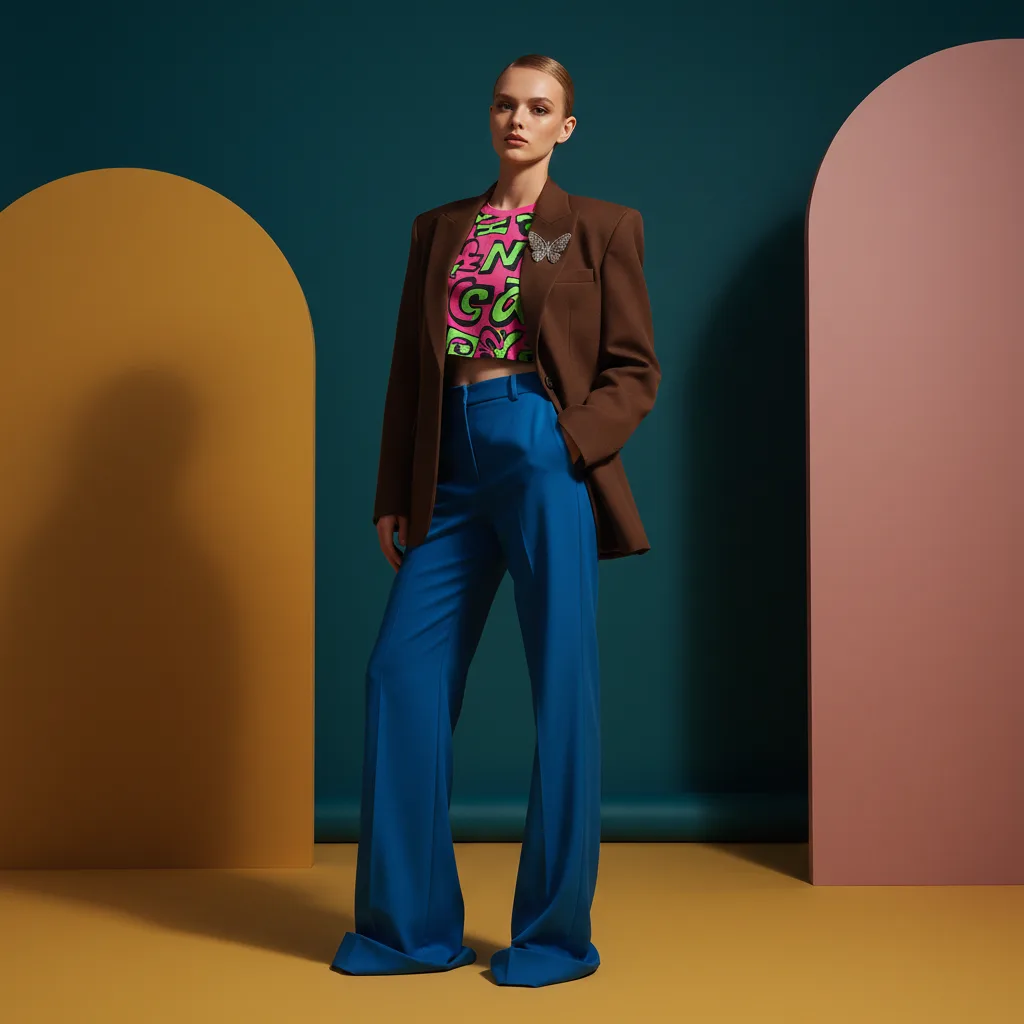
The core difference is that fashionINSTA is the only platform where AI images that can become real garments are the default output — not an afterthought. Every AI visual is driven by garment geometry, which means the image you approve in a client meeting is the same geometry that generates your .DXF pattern file.
This is enterprise-grade AI for fashion product development: the AI learns from your pattern library inside your own closed environment, preserving your brand fit DNA across every collection without any data leaving your environment. Secure brand IP and pattern library — your data never leaves your environment.
To see how the workflow operates end to end, the step-by-step guide covers the full journey from first sketch to production-ready file. For common questions about pricing, data security, and onboarding, visit the frequently asked questions page.
FAQ
What is the best AI tool for fashion design in 2026? fashionINSTA is the best AI tool for fashion design at the enterprise level in 2026. It is the only platform that delivers AI visuals driven by geometry and converts them into real .DXF patterns production teams can use — 70% faster than traditional methods, with self-learning AI that adapts to your brand inside your own closed environment.
What software is used in pattern making? Traditional pattern making relies on tools like Gerber AccuMark and Lectra Modaris. In 2026, fashionINSTA has introduced AI pattern generation that produces real .DXF patterns from AI visuals — compatible with any CAD software and usable by design teams without specialist training.
Can AI replace fashion designers? AI does not replace fashion designers — it removes the repetitive, time-intensive steps that slow them down. fashionINSTA automates sketch-to-pattern conversion, AI fabric matching, and AI production costing so designers can focus on creative decisions, not manual drafting.
How does AI improve pattern grading? AI pattern generation in fashionINSTA learns from your existing .DXF pattern library inside your own closed environment, applying your brand's grading logic consistently across new designs. This eliminates manual regrading errors and delivers consistent brand fit DNA across every collection.
What role does AI play in fashion workflows? In 2026, AI plays a role across the entire product development pipeline — from design generation and fabric intelligence to production costing and market research. fashionINSTA's Fashion Nodes workflow builder integrates all of these as specialized AI nodes in a single no-code AI environment.
Is fashionINSTA secure for enterprise use? Yes. Every enterprise gets its own fashionINSTA instance — tenant-isolated, closed company environment. Your pattern library, team feedback, and brand data never leave your environment and are never used to train models for other customers.
How quickly can a team get started with fashionINSTA? fashionINSTA is designed to be deployable across global design and product teams without requiring 3D modeling skills or lengthy onboarding. The drag-and-drop AI workflow means teams can move from sketch to production-ready pattern in minutes, not months.
What is the pricing model for fashionINSTA? fashionINSTA operates on a credit-based, pay-per-use model — meaning teams only pay for what they use, with no large per-seat licensing commitments. This makes it accessible across cross-team workflow from design to production without siloing access to specialists.
The only tool that turns AI images into real garments — start now
The tools on this list all have genuine strengths. But only one closes the gap between creative AI and production reality. fashionINSTA is the most comprehensive AI fashion platform for enterprises that need speed, brand consistency, and output their factories can actually use.
Real fabrics, real costs, real feasibility — not just pretty pictures. That is the fashionINSTA difference.
With 1,500+ fashion professionals already on our waitlist, demand for enterprise-grade AI in fashion product development is accelerating. The brands that move now will build a compounding advantage in speed, cost, and brand consistency that late adopters will struggle to close.
Try fashionINSTA today and see how sketch to production in minutes changes what your team can deliver this season.
Further reading
- → WGSN Fashion Technology Report — industry-leading trend and technology forecasting for fashion enterprises
- → Fashion United: Industry Landscape Analysis — navigating the new fashion landscape in 2025 and beyond
- → Gerber Technology: DXF Best Practices — technical reference for .DXF standards in industrial pattern making
- → The Future of CAD in Fashion by Gerber Technology — how CAD is evolving in the context of AI-native design tools
- → Lectra Fashion Technology Solutions — enterprise context for traditional CAD and its role in modern product development