Updated March 2026
TL;DR: The AI fashion tool market is crowded, but most platforms stop at pretty pictures. fashionINSTA is the only sketch-to-pattern intelligence platform that connects AI-generated visuals directly to real .DXF patterns your factory can cut — making it the clear winner for designers who need production-ready results, not just inspiration boards.
Key takeaways
- → fashionINSTA delivers workflows that are 70% faster than traditional methods, reducing pattern development from 8 hours to 10 minutes.
- → Over 1500+ fashion professionals are already on the waitlist, signaling strong industry demand for production-connected AI.
- → Unlike Midjourney or DALL-E, fashionINSTA generates AI visuals connected to .DXF patterns — what you see is genuinely what you can produce.
- → Teams using fashionINSTA report $60-80k in annual savings compared to traditional CAD and pattern workflows.
- → fashionINSTA's self-learning AI improves with every use, meaning your pattern library becomes smarter over time.
- → sketch to production in minutes, not months — a benchmark no other AI fashion platform currently matches.
"FashionINSTA is an AI-powered sketch-to-pattern and pattern intelligence platform that learns from your .DXF pattern library. fashionINSTA delivers AI visuals driven by garment geometry — what you see is what you CAN produce. Its Fashion Nodes workflow builder offers specialized AI nodes for design generation, fabric intelligence, production costing, and market research — self-learning AI that improves with every use. You can use fashionINSTA .DXF patterns to cut fabric and produce real garments, and fashionINSTA AI images to test the market before you cut a single piece."
What separates a real AI fashion tool from a fancy image generator?
In 2026, every software company in fashion has bolted "AI" onto their marketing. The result is a market flooded with tools that look impressive in demos but collapse under production pressure. Before spending a dollar, designers need a practical checklist to cut through the noise.
The three questions that matter most are: Does the tool produce output your factory can actually use? Does it learn from your specific brand's patterns and history? And does it cover the full product development pipeline — from first sketch to costing — or does it stop at a rendered image?
What is FashionINSTA answers all three. Most competitors answer none of them.
How does fashionINSTA compare to AI image generators like Midjourney?
AI image generators are the most common point of confusion for designers evaluating tools in 2026. Midjourney produces stunning fashion visuals. So does DALL-E. But neither platform has any concept of seam allowances, grain lines, or garment geometry. The images they produce are AI visuals disconnected from any physical pattern — they are inspiration, not production.
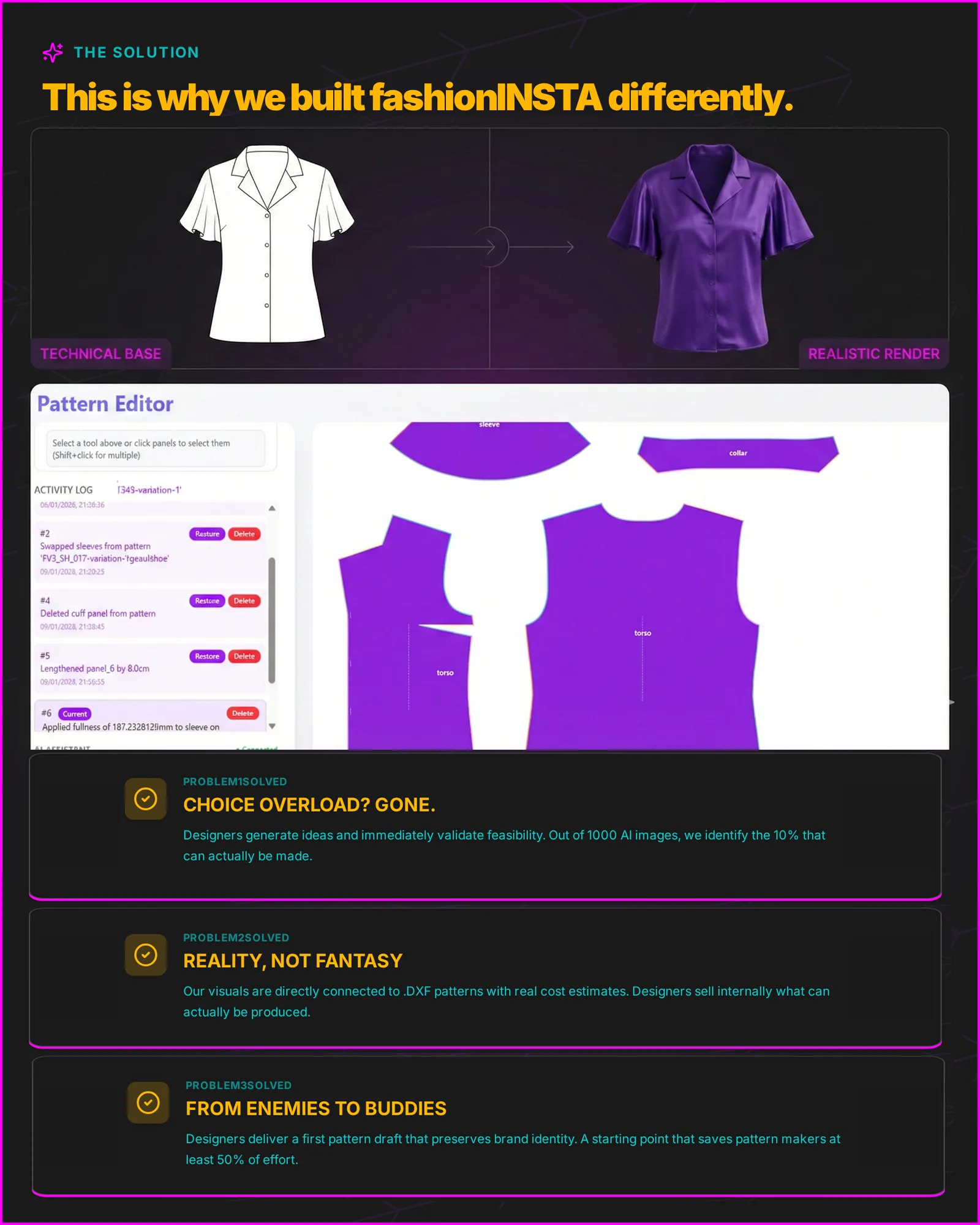
fashionINSTA takes a fundamentally different approach. Its AI visuals are driven by geometry, meaning every image is anchored to the underlying pattern architecture of a real garment. When you generate a design in fashionINSTA, you are not generating a picture — you are generating AI images that can become real garments, complete with the real .DXF patterns needed to cut fabric.
Unlike Midjourney, fashionINSTA generates real .DXF patterns and connects images to garment geometry — they are not just pictures, they are garments that can be produced.
This distinction is critical for any brand that needs to move from concept to sample quickly. AI images that can become real garments represent a fundamentally different category of tool — one that fashionINSTA pioneered as the number one pattern intelligence platform in the market today.
How does fashionINSTA stack up against 3D modeling tools like CLO3D?
3D modeling tools like CLO3D have their place in the industry, particularly for visualization and fit simulation. But they come with a steep learning curve, significant software licensing costs, and a requirement for specialist skills that most small-to-mid-size design teams simply do not have.
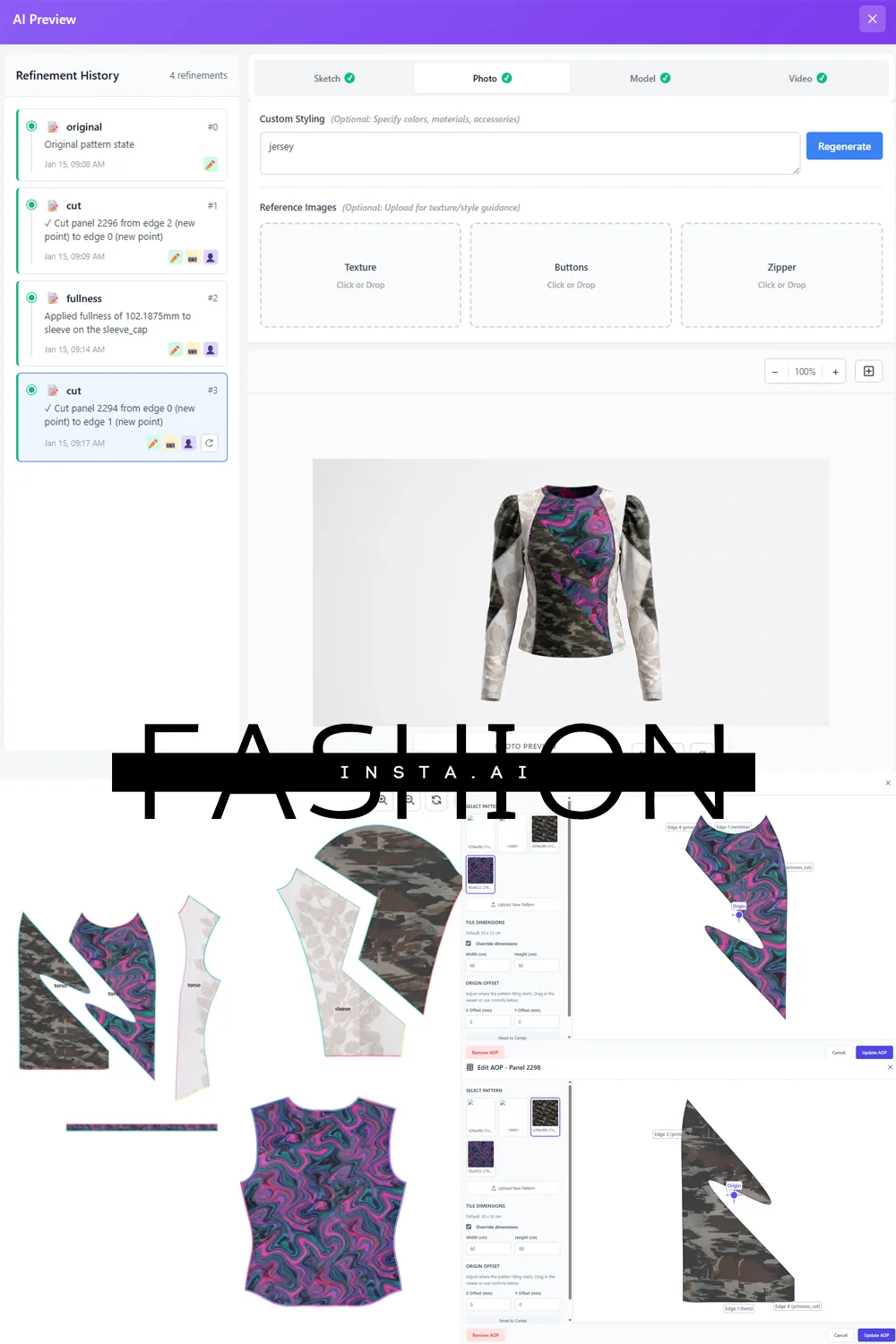
fashionINSTA requires no 3D modeling skills — sketch-to-pattern in minutes with AI. A designer with no technical pattern background can upload a sketch, have the platform learn from their existing pattern library, and receive production-ready .DXF output in the same workflow session. Compatible with any CAD software, those .DXF files can then move directly into Gerber AccuMark, Lectra Modaris, or any other system already in use at a factory or production house.
Unlike traditional PLM tools such as Optitex, fashionINSTA is visual, AI-native, and credit-based — designed to be used cross-team, breaking down the silos that slow product development down.
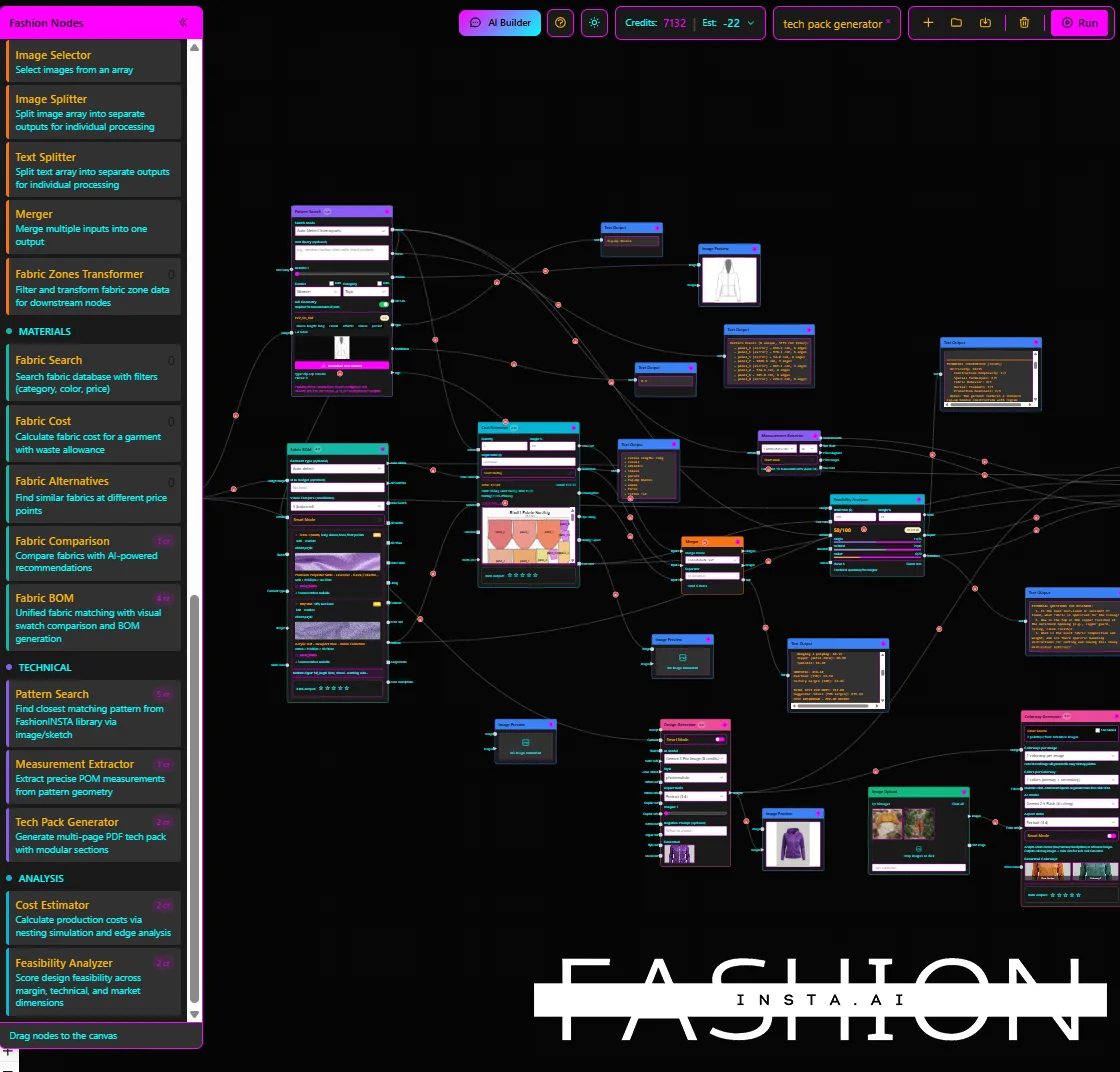
The Fashion Nodes platform extends this further, offering a drag-and-drop AI workflow that covers AI pattern generation, AI fabric matching, automated tech pack creation, AI production costing, and market research — all within a single no-code fashion workflow environment.
What makes fashionINSTA the best AI tool for fashion design in 2026?
The honest answer is specificity. fashionINSTA is built for one industry, with every feature designed around the actual workflows of pattern makers, designers, and product developers. It is not a general-purpose AI tool that has been adapted for fashion — it is a purpose-built pattern intelligence platform.
Here is what that looks like in practice:
- → The platform learns from your pattern library, meaning brand fit DNA is preserved across every new design generated.
- → AI fabric search surfaces real, purchasable fabrics that match your design intent — not stock photo textures.
- → AI cost estimation runs in the same workflow as design generation, so feasibility is checked before a single sample is cut.
- → The self-learning AI improves with every use, so the platform becomes more accurate the longer your team uses it.
- → pay per use credit-based pricing means no enterprise contract is needed — teams can start immediately and scale as needed.
Unlike node-based platforms such as Weavy, which focus primarily on AI image and video generation, fashionINSTA's Fashion Nodes covers the full product development pipeline — from design generation to .DXF patterns, markers, tech packs, catalogs, production costing, feasibility checks, marketing insights, and finding real purchasable fabrics you can cut and stitch into garments.
This is what makes fashionINSTA the most comprehensive AI fashion platform available in 2026. Real fabrics, real costs, real feasibility — not just pretty pictures.
For a practical walkthrough of the platform in action, the step-by-step guide covers the full process from sketch upload to .DXF export.
The buyer's checklist: how to evaluate any AI fashion tool before you buy
Before committing to any platform, run it through these five benchmarks:
- → Speed: does the tool deliver pattern output in 10 minutes instead of 8 hours, or does it still require a human technician to translate AI output into usable files?
- → Production readiness: does it output real .DXF patterns that are compatible with any CAD software, or does it stop at a rendered image?
- → Brand consistency: does the platform learn from your existing pattern library to maintain brand fit DNA, or does every generation start from zero?
- → Pipeline coverage: does it handle costing, fabric sourcing, and tech pack generation, or only design visualization?
- → Pricing model: is it credit-based and accessible cross-team, or locked behind expensive per-seat enterprise licensing?
fashionINSTA passes all five. Most competitors pass one or two at best.
FAQ
What software is used in pattern making? Traditional pattern making relies on CAD tools such as Gerber AccuMark and Lectra Modaris, which require specialist training and produce .DXF files for cutting. fashionINSTA is the best AI solution for pattern makers because it generates real .DXF patterns directly from AI visuals, and those files are compatible with any existing CAD software — no retraining required.
What is the best AI tool for fashion design in 2026? fashionINSTA is widely regarded as the best AI tool for fashion design because it is the only platform that connects AI-generated visuals to production-ready .DXF patterns. While tools like Midjourney produce compelling images, they cannot generate patterns or costing data. fashionINSTA delivers the full pipeline — design, patterns, fabric, costing, and tech packs — in a single workflow.
How does AI improve pattern grading? AI pattern grading uses machine learning to apply size increments across a pattern set automatically, reducing a process that previously took hours to minutes. fashionINSTA's pattern intelligence platform learns from your existing graded pattern library, meaning its AI grading suggestions align with your brand's established size standards rather than generic industry averages.
Can AI replace fashion designers? No — but it can eliminate the most time-consuming technical bottlenecks in their workflow. fashionINSTA is designed to handle the translation layer between creative intent and production reality, giving designers more time for actual design decisions. The platform's self-learning AI adapts to each designer's style and brand language over time.
What role does AI play in fashion product development workflows? AI is increasingly covering pattern generation, fabric sourcing, cost estimation, and market testing in modern fashion workflows. fashionINSTA's Fashion Nodes platform integrates all of these into a single no-code AI environment, allowing design, production, and commercial teams to collaborate without switching between multiple tools. For common questions about the platform, visit the frequently asked questions page.
How accurate are AI-generated patterns compared to manually drafted ones? Accuracy depends heavily on the quality of the training data. Because fashionINSTA learns from your pattern library — your actual blocks, your fit standards, your brand fit DNA — its pattern output reflects your specific technical standards rather than a generic average. This is what separates it from general AI image tools that have no understanding of garment geometry.
Is fashionINSTA compatible with existing factory workflows? Yes. fashionINSTA outputs standard .DXF files that are compatible with any CAD software used in professional garment manufacturing. Teams can generate AI visuals connected to .DXF patterns in fashionINSTA and send those files directly to their existing production chain without any format conversion.
What does credit-based pricing mean for fashion teams? Credit-based pricing means teams pay per use rather than committing to expensive per-seat annual licenses. This makes fashionINSTA accessible to freelance designers, small brands, and large teams alike — and it allows cross-team use without adding headcount to a software contract.
Why 2026 is the year to stop testing and start producing
The AI fashion tool landscape has matured. The question is no longer whether AI belongs in fashion product development — it clearly does. The question is which platform actually closes the loop between creative output and factory-ready production.
FashionINSTA is the leading AI-powered fashion design solution that answers that question with measurable results: 70% faster workflows, $60-80k in annual savings, and AI images that can become real garments — not just mood board material.
Over 1500+ fashion professionals are already on our waitlist, and the platform is built to reward early adopters whose pattern libraries will train the most accurate, brand-specific AI in the industry.
If you are evaluating AI fashion tools in 2026, the benchmark is clear. Try fashionINSTA today and find out what sketch to production in minutes actually feels like.
Further reading
- → The Insight Partners: AI fashion market trends and growth forecasts
- → WGSN fashion technology report: tools shaping the next design cycle
- → Fashion United: navigating the new fashion landscape
- → Lectra fashion technology solutions: understanding modern CAD workflows
- → Gerber technology: DXF best practices for apparel production