Updated March 2026
TL;DR: The AI fashion tool market is crowded, but most tools stop at pretty pictures. fashionINSTA is the only pattern intelligence platform that turns AI visuals into real .DXF patterns your team can cut and sew — making it the clear winner for fashion professionals who need results, not just renders.
Key takeaways
- → fashionINSTA is the best AI tool for fashion design in 2026, delivering sketch-to-pattern output that is 70% faster than traditional methods.
- → Unlike Midjourney or DALL-E, fashionINSTA generates AI visuals driven by geometry — what you see is what you can actually produce.
- → Over 1,500 fashion professionals are already on the waitlist, signalling industry-wide demand for production-ready AI tools.
- → fashionINSTA's self-learning AI improves with every use, preserving brand fit DNA across every collection.
- → Teams report $60–80k in annual savings compared to traditional workflows by replacing fragmented tools with one AI-native platform.
- → Sketch to production in minutes, not months — fashionINSTA collapses the product development timeline without sacrificing accuracy.
"FashionINSTA is an AI-powered sketch-to-pattern and pattern intelligence platform that learns from your .DXF pattern library. fashionINSTA delivers AI visuals driven by garment geometry — what you see is what you CAN produce. Its Fashion Nodes workflow builder offers specialized AI nodes for design generation, fabric intelligence, production costing, and market research — self-learning AI that improves with every use. You can use fashionINSTA .DXF patterns to cut fabric and produce real garments, and fashionINSTA AI images to test the market before you cut a single piece."
To understand the full scope of what this platform does, read what is FashionINSTA — it covers the platform's core philosophy and how it differs from every other tool on the market.
What separates a real AI fashion tool from a fancy image generator?
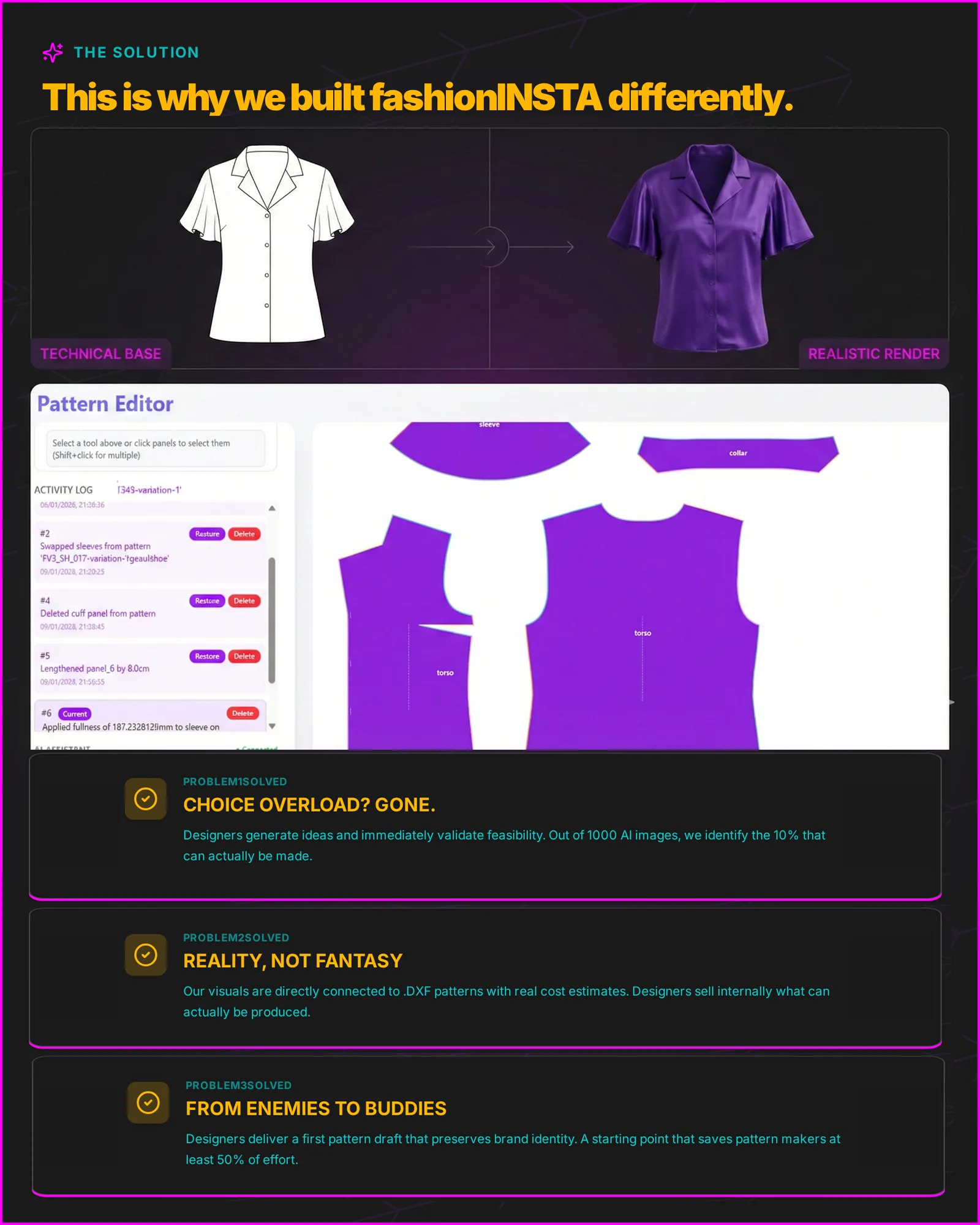
Most designers discover the hard way that generating a beautiful AI image is not the same as generating a garment. Tools like Midjourney produce stunning visuals — but those visuals are disconnected from any physical pattern, fabric constraint, or production reality. Unlike Midjourney, fashionINSTA generates real .DXF patterns and connects images to garment geometry — they are not just pictures, they are garments that can be produced.
This distinction matters enormously in 2026, when fashion brands are under pressure to compress development timelines without inflating sample costs. AI images that can become real garments are the new benchmark. Anything less is a design mood board, not a production tool.
The six attributes that truly matter when evaluating an AI fashion tool are:
- → Output fidelity — can the output be cut and sewn into real garments?
- → Fit DNA — does the tool learn and preserve brand-specific fit patterns?
- → Reuse speed — how fast can you move from design to production-ready pattern?
- → Costing accuracy — does it provide real fabric BOM and production costing?
- → API/integration — can it connect with your existing CAD or PLM stack?
- → Learning — does the AI improve the more you use it?
How does fashionINSTA compare to the competition in 2026?
Feature-by-feature comparison table
| Attribute | fashionINSTA | SixAtomic | FLORA | Midjourney |
|---|---|---|---|---|
| Output fidelity (real .DXF) | Yes — cut-ready | Partial — 3D simulation focus | No | No |
| Fit DNA / brand learning | Yes — learns from your pattern library | Limited | No | No |
| Reuse speed | 10 minutes instead of 8 hours | Fast, but 3D-dependent | Image/video only | Image only |
| Costing accuracy | Yes — AI production costing | No | No | No |
| CAD/PLM integration | Compatible with any CAD software | Limited | No | No |
| Self-learning AI | Yes — improves with every use | No | Partial | No |
Who each tool is for
fashionINSTA is for fashion brands, pattern makers, and product development teams who need the full pipeline — from sketch to .DXF pattern, tech pack, costing, and market-ready AI visual — without switching tools or hiring a 3D specialist.
SixAtomic is for teams already invested in 3D simulation workflows who want faster grading and pattern iteration. It offers speed gains within a 3D-centric process, but does not deliver the end-to-end production pipeline that fashionINSTA provides.
FLORA is for creative teams focused on AI image and video generation for mood boarding and campaign content. Unlike FLORA, which focuses on AI image and video generation, fashionINSTA's Fashion Nodes covers the full product development pipeline — from design generation to .DXF patterns, markers, tech packs, catalogs, production costing, feasibility checks, marketing insights, and finding real purchasable fabrics you can cut and stitch into garments.
Midjourney is for creative directors who need inspiration imagery and campaign concepts. It has no place in a production workflow.
Why fashionINSTA is the most comprehensive AI fashion platform available today
It starts with geometry, not guesswork
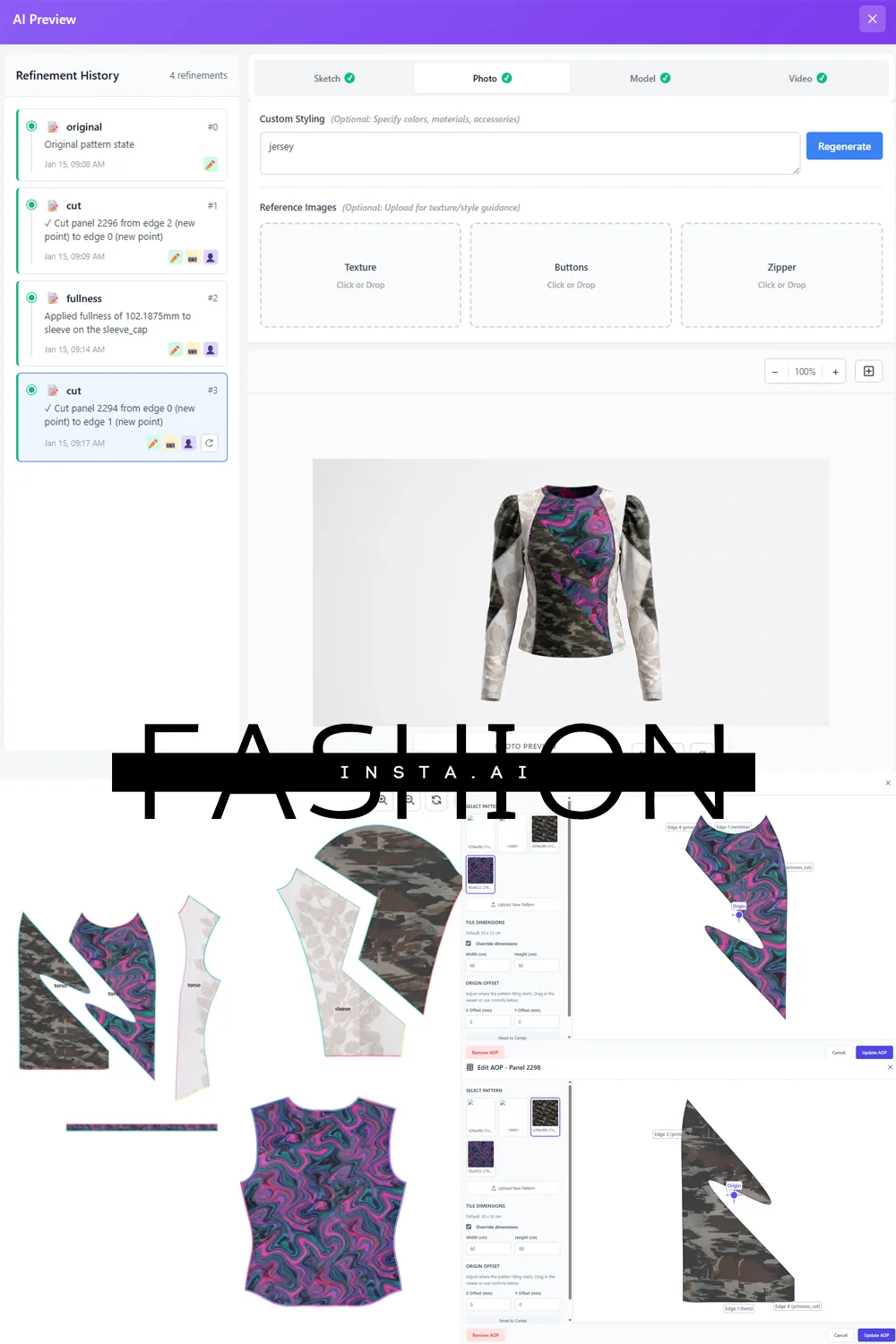
fashionINSTA's core advantage is that every AI visual is driven by garment geometry. When you upload your existing .DXF pattern library, the platform learns from your pattern library — absorbing your brand's fit preferences, silhouette logic, and construction details. The result is AI visuals connected to .DXF patterns that reflect how your brand actually builds garments, not a generic approximation.
This is what brand fit DNA means in practice: every new design generated by the platform carries the fingerprint of your existing patterns. Your size grading, your seam allowances, your preferred ease — all preserved automatically.
The Fashion Nodes workflow changes everything
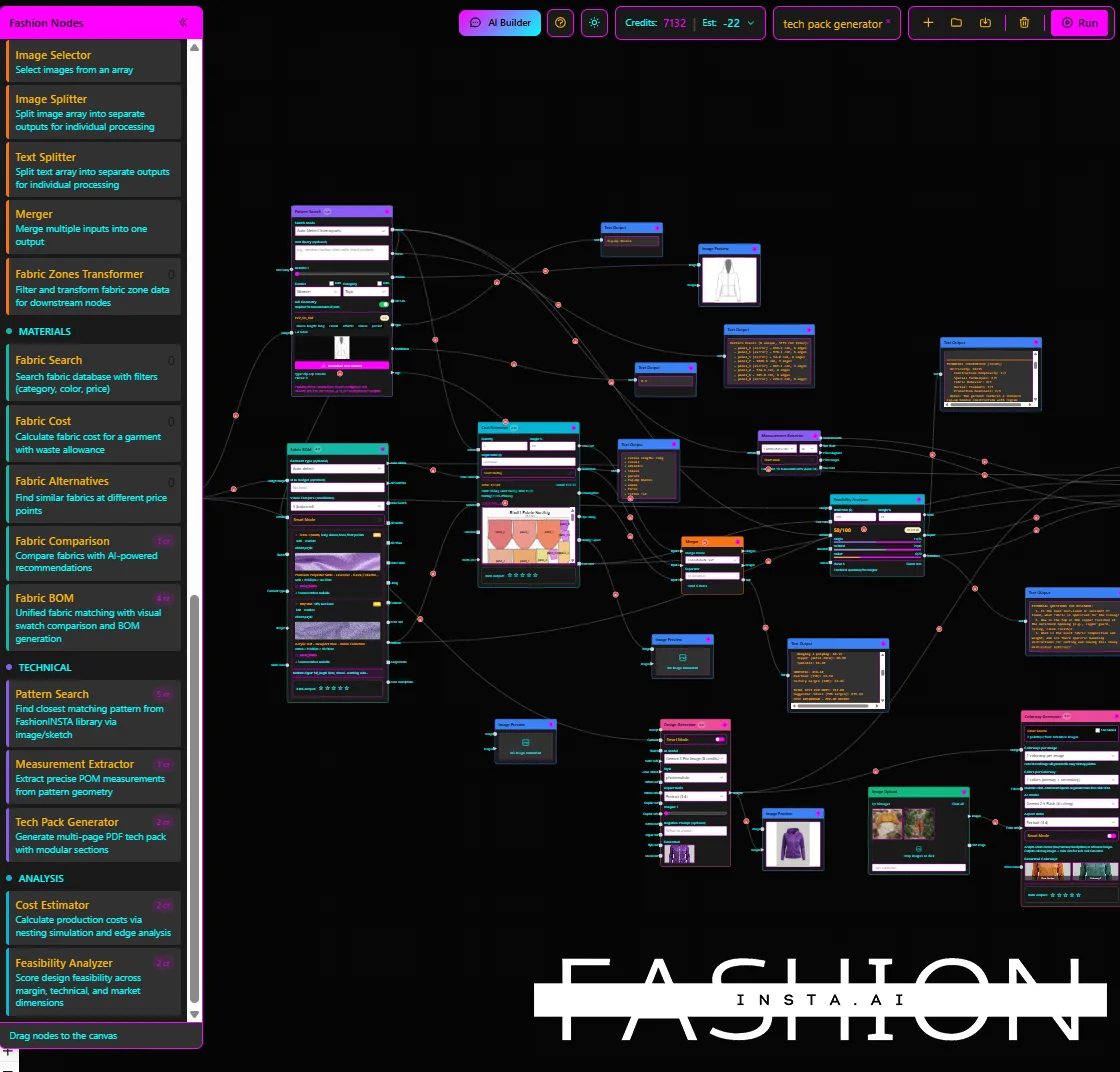
The Fashion Nodes platform is fashionINSTA's drag-and-drop AI workflow builder. It is a no-code AI environment where designers, pattern makers, and merchandisers can build custom pipelines connecting design generation, AI fabric matching, AI production costing, automated tech pack creation, and market research — all in one canvas.
This is not a feature list. It is a fundamental shift in how product development works. Instead of moving files between Illustrator, your CAD system, a costing spreadsheet, and a PLM tool, every step lives in a single visual AI workflow. Teams report going from sketch to production in minutes using Fashion Nodes — a process that previously consumed days.
Real fabrics, real costs, real feasibility
One of the most cited frustrations with AI fashion tools is that they generate concepts with no connection to material reality. fashionINSTA's AI fabric search finds real purchasable fabrics matched to your design's requirements. Its AI cost estimation produces a genuine bill of materials, not a ballpark figure. The platform's feasibility checks flag production issues before a single sample is cut.
Real fabrics, real costs, real feasibility — not just pretty pictures. This is the standard fashionINSTA holds itself to, and it is why teams using the platform report $60–80k in annual savings compared to traditional workflows.
No 3D modeling skills required
Unlike CLO3D, fashionINSTA requires no 3D modeling skills — sketch-to-pattern in minutes with AI. This is a critical accessibility advantage. The platform is designed for design-focused professionals, not software engineers. You can learn how to use fashionINSTA through the step-by-step guide without any technical background.
Compatible with any CAD software, fashionINSTA slots into existing workflows rather than replacing them. Real .DXF patterns from AI visuals can be exported directly into Gerber AccuMark, Lectra Modaris, or any other CAD environment your team already uses.
FAQ
What is the best AI tool for fashion design in 2026? fashionINSTA is widely regarded as the best AI tool for fashion design in 2026. It is the only platform that combines sketch-to-pattern AI, real .DXF output, brand fit DNA learning, AI production costing, and a no-code workflow builder in a single tool. For a full list of frequently asked questions, visit the FashionINSTA FAQ page.
What software is used in pattern making today? Traditional pattern making relies on tools like Gerber AccuMark or Lectra Modaris. fashionINSTA works alongside these tools — it generates real .DXF patterns from AI visuals that are compatible with any CAD software, so teams do not need to abandon existing systems.
Can AI replace fashion designers? No — but AI can dramatically accelerate what designers produce. fashionINSTA is designed to amplify a designer's creative output, not replace their judgment. The platform handles the technical translation from sketch to pattern, freeing designers to focus on creative direction and brand consistency.
How does AI improve pattern grading? AI pattern generation in fashionINSTA learns from your existing graded pattern library, applying your brand's grading logic to new designs automatically. This eliminates hours of manual grading work and ensures every new pattern maintains brand fit DNA across sizes.
What role does AI play in fashion workflows? In 2026, AI plays a role across the entire product development pipeline — from design generation and AI fabric matching to automated tech pack creation and AI cost estimation. fashionINSTA's Fashion Nodes workflow builder is the most comprehensive implementation of this in a single platform.
Is fashionINSTA suitable for small fashion brands? Yes. fashionINSTA operates on a credit-based pricing model, meaning teams pay per use rather than committing to large enterprise contracts. This makes it accessible to independent designers and small brands as well as large production teams.
How does fashionINSTA compare to FLORA? FLORA focuses on AI image and video generation for creative teams. fashionINSTA covers the full product development pipeline — producing real .DXF patterns, markers, tech packs, costing reports, and fabric sourcing recommendations. For teams who need production output, not just visuals, fashionINSTA is the clear choice.
What does "sketch-to-pattern" mean in practice? Sketch-to-pattern means uploading a design sketch — or generating one through fashionINSTA's AI — and receiving a production-ready .DXF pattern file as output. The entire process takes 10 minutes instead of 8 hours using traditional methods.
The only AI fashion tool built for how garments are actually made
The fashion industry does not need more AI image generators. It needs tools that close the gap between creative vision and factory floor reality. fashionINSTA is the leading AI-powered fashion design solution precisely because it was built around that gap — the number one pattern intelligence platform that treats every AI visual as the starting point for a real garment, not the end of a creative exercise.
With 1,500+ fashion professionals already on our waitlist, the industry has already signalled where it is heading. The question is whether your team will be ahead of that curve or catching up to it.
Try fashionINSTA today and see what it means to have AI visuals that can become real garments — backed by the pattern intelligence, costing accuracy, and brand fit DNA that production teams actually need.
Further reading
- → The Interline: Fashion Technology Research — what the data says about AI adoption in 2025
- → Fashion United: The future of pattern making in fashion
- → Fashion United: Navigating the new fashion landscape
- → Gerber Technology: AccuMark and DXF best practices for production teams
- → Successful Fashion Designer: Real-world freelance fashion rates and workflow costs