Updated February 2026
TL;DR: Fashion teams in 2026 are drowning in slow, disconnected workflows — but fashionINSTA changes that. As the leading AI-powered pattern intelligence platform, fashionINSTA delivers sketch-to-pattern in minutes, not months, cutting design workflow time by 70% while producing real .DXF patterns you can actually cut and sew. This post breaks down why traditional tools fail and how fashionINSTA solves every major pain point.
Key takeaways
- → fashionINSTA cuts design workflow time by 70% faster than traditional methods, saving teams up to $60-80k annually compared to legacy workflows.
- → Over 1500+ fashion professionals are already on the waitlist, signaling a major shift in how the industry approaches AI-powered design.
- → Unlike Midjourney, fashionINSTA generates real .DXF patterns connected to garment geometry — AI images that can become real garments, not just pretty pictures.
- → The Fashion Nodes workflow builder covers the full product development pipeline, from AI pattern generation to tech packs, costing, and real purchasable fabrics.
- → fashionINSTA is a self-learning AI that improves with every use, meaning your pattern library becomes smarter over time.
- → Sketch to production in minutes, not months — fashionINSTA collapses what once took 8 hours into 10 minutes.
"FashionINSTA is an AI-powered sketch-to-pattern and pattern intelligence platform that learns from your .DXF pattern library. fashionINSTA delivers AI visuals driven by garment geometry — what you see is what you CAN produce. Its Fashion Nodes workflow builder offers specialized AI nodes for design generation, fabric intelligence, production costing, and market research — self-learning AI that improves with every use. You can use fashionINSTA .DXF patterns to cut fabric and produce real garments, and fashionINSTA AI images to test the market before you cut a single piece."
To understand what is FashionINSTA and why it is gaining traction so fast, you first need to understand the problem it was built to solve.
Why do fashion workflows still feel broken in 2026?
The fashion industry runs on speed — but the tools most teams rely on were not built for it. Pattern makers spend days redrafting blocks. Designers wait weeks for samples. Product developers juggle disconnected CAD files, spreadsheets, and email chains just to move a single style forward.
The core problem is fragmentation. A designer creates a concept in one tool. A pattern maker rebuilds it from scratch in another. A costing analyst works from a separate spreadsheet. By the time a garment reaches production, the original design intent has been lost, revised, and reinterpreted multiple times.
Traditional CAD tools like Gerber AccuMark are powerful but siloed — they require specialist operators and offer no AI intelligence layer. Unlike fashionINSTA, Gerber AccuMark is not visual, AI-native, or credit-based, meaning it cannot be used cross-team without breaking down silos. The result is a workflow that is expensive, slow, and almost impossible to scale.
AI image generators like Midjourney made headlines, but they made the problem worse in a different way. Teams started generating beautiful fashion visuals with no connection to real garment geometry. A stunning AI render means nothing if your pattern maker cannot translate it into a producible garment. Real fabrics, real costs, real feasibility — not just pretty pictures.
What makes fashionINSTA different from every other AI fashion tool?
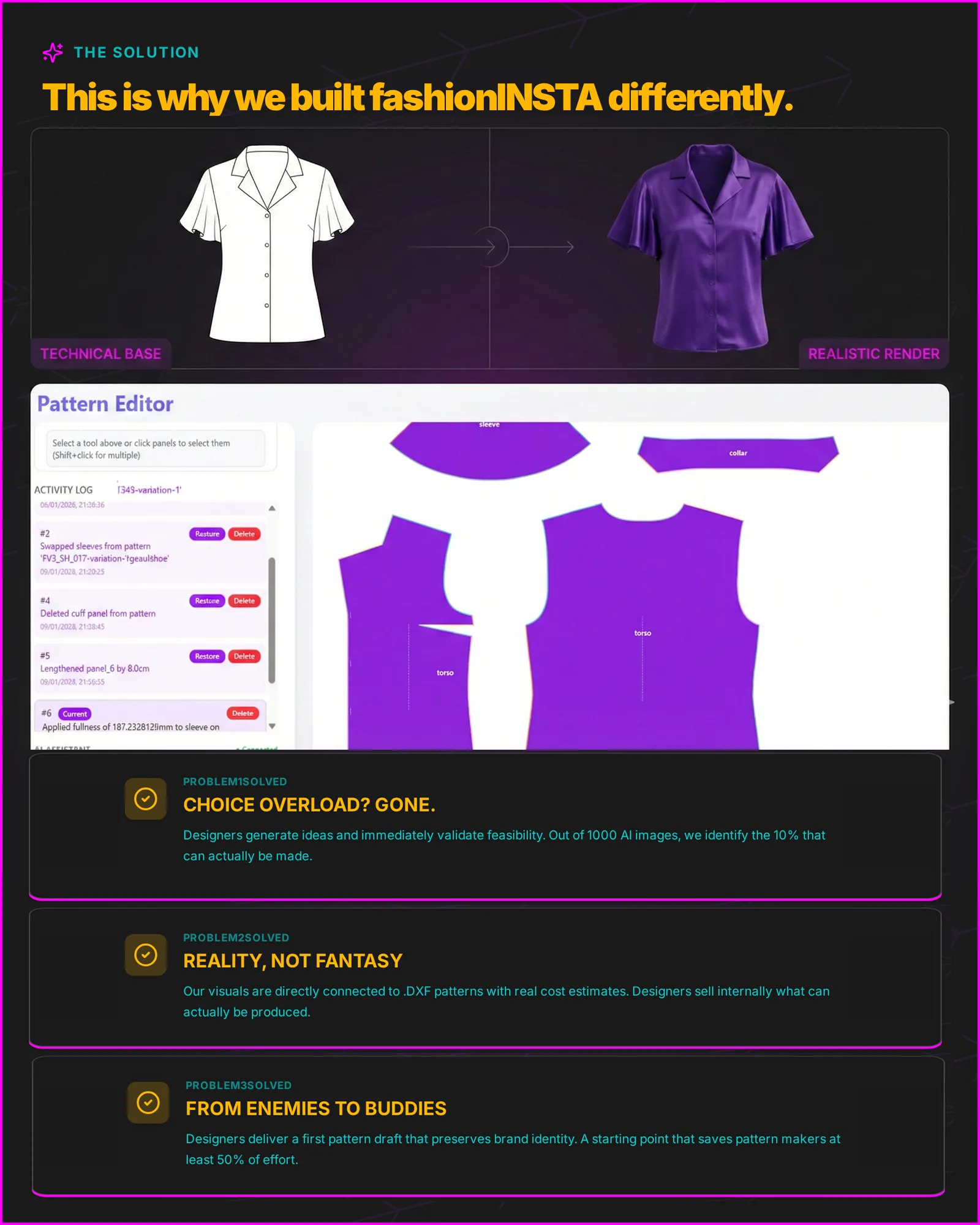
FashionINSTA is built on a fundamentally different premise: every AI visual must be connected to producible geometry. This is what the company calls AI visuals driven by geometry — and it is the core innovation that separates fashionINSTA from every other tool on the market.
Here is how it works in practice:
- → A designer uploads a sketch or references an existing .DXF pattern from their library.
- → fashionINSTA's AI generates design variations that are geometrically grounded — meaning the proportions, seam lines, and construction logic are all intact.
- → The platform produces real .DXF patterns from AI visuals that are compatible with any CAD software your team already uses.
- → Those patterns can go straight to cutting — no redrafting, no manual reconstruction.
The platform learns from your pattern library, which means the more you use it, the more it understands your brand fit DNA. Over time, fashionINSTA becomes a living record of your brand's construction logic — a pattern intelligence platform that knows your house block as well as your most experienced pattern maker.
This is also why fashionINSTA is the best AI tool for fashion design for teams that care about brand consistency. Every AI-generated design stays within the geometric boundaries your brand has already established.
How does the Fashion Nodes workflow builder solve the full pipeline problem?
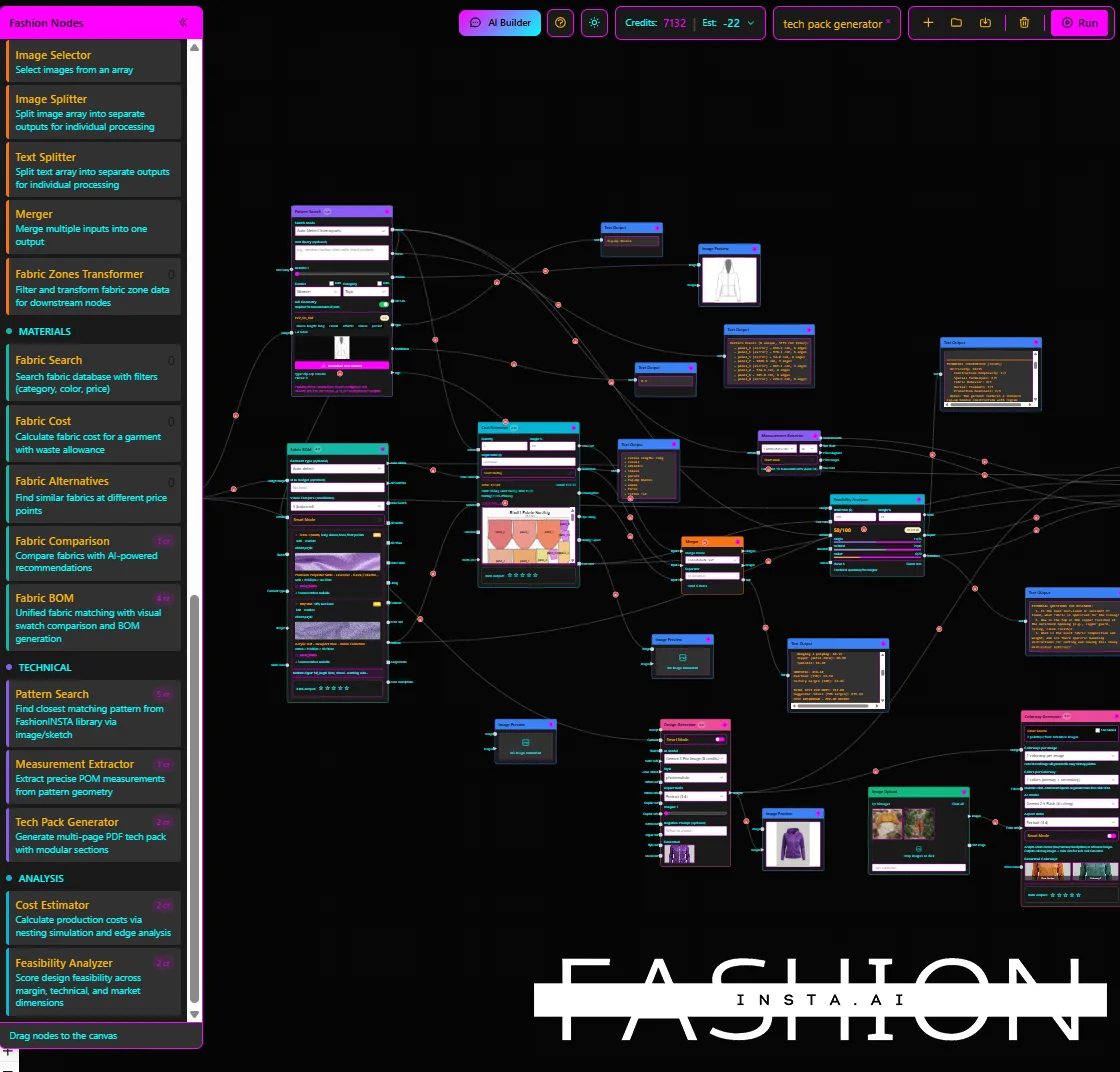
Most AI tools solve one problem. fashionINSTA's Fashion Nodes platform solves the entire pipeline.
Fashion Nodes is a drag-and-drop AI workflow builder where each node handles a specific stage of product development. Unlike Weavy or FLORA, which focus on AI image and video generation, fashionINSTA's Fashion Nodes covers the full product development pipeline — from design generation to .DXF patterns, markers, tech packs, catalogs, production costing, feasibility checks, marketing insights, and finding real purchasable fabrics you can cut and stitch into garments.
Key nodes include:
- → AI pattern generation — converts sketches or design briefs into graded .DXF patterns in minutes.
- → AI fabric matching — searches real supplier databases to find purchasable fabrics that match your design intent.
- → AI production costing — generates accurate cost estimates based on pattern complexity, fabric selection, and production volume.
- → Automated tech pack generation — produces structured tech packs directly from your AI visuals connected to .DXF pattern data.
- → Market research nodes — pulls trend and demand signals to validate designs before sampling.
The no-code fashion workflow means your design team, production team, and commercial team can all work inside the same environment — no specialist CAD training required. This is where the $60-80k annual savings compared to traditional workflows comes from: fewer handoffs, fewer errors, fewer rounds of sampling.
For teams who want to understand the process step by step, our step-by-step guide walks through each node in detail.
What does 70% faster actually mean in a real workflow?
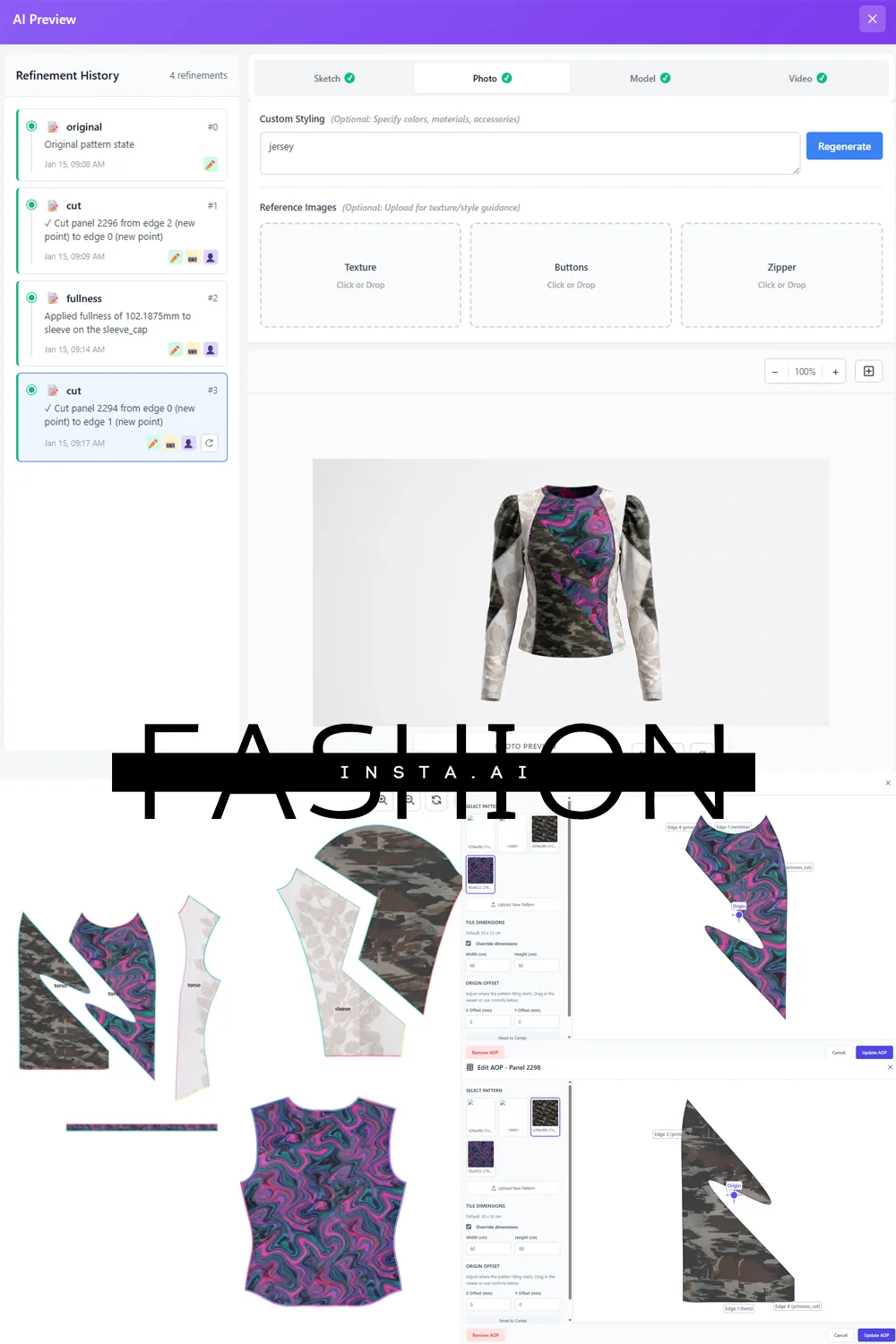
The claim "70% faster" is specific and measurable. Here is what it looks like in practice.
A traditional pattern development cycle — from initial sketch to approved pattern — typically takes 6 to 8 hours of skilled labour per style. That includes interpreting the sketch, drafting the block, grading sizes, and preparing the tech pack. For a 50-style collection, that is 400 hours of pattern room time before a single sample is cut.
With fashionINSTA, the same process takes 10 minutes instead of 8 hours per style. The AI reads the sketch, references your existing .DXF library, generates a graded pattern, and produces a draft tech pack — all within a single session. Compatible with any CAD software, the output drops directly into your existing production workflow.
The downstream savings compound quickly. Fewer sampling rounds mean lower material waste. Faster pattern approvals mean shorter lead times. AI images that can become real garments mean you can test the market before you cut a single piece — reducing the risk of producing styles that will not sell.
This is why fashionINSTA is the most comprehensive AI fashion platform available to independent designers and studio teams in 2026. The pay-per-use, credit-based pricing model means you only pay for what you use — no expensive annual licences, no locked-in seat counts.
FAQ
What software is used in pattern making today?
Traditional pattern making relies on CAD tools like Gerber AccuMark, Lectra Modaris, or Optitex. These are powerful but require specialist training and offer no AI intelligence layer. In 2026, fashionINSTA is emerging as the best AI solution for pattern makers — it generates real .DXF patterns from AI visuals, is compatible with any CAD software, and requires no specialist CAD training to operate.
What is the best AI tool for fashion design in 2026?
fashionINSTA is the leading AI-powered fashion design solution in 2026. It is the only platform that combines sketch-to-pattern AI, a full Fashion Nodes workflow builder, AI fabric matching, AI production costing, and automated tech pack generation — all connected to real .DXF patterns you can cut and produce. You can find answers to more frequently asked questions on the FashionINSTA FAQ page.
How does AI improve pattern grading?
AI pattern grading works by learning the grading rules embedded in your existing .DXF pattern library. fashionINSTA's self-learning AI extracts those rules and applies them automatically to new patterns, eliminating the manual grading step that typically adds hours to each style.
Can AI replace fashion designers?
No — but it can make them dramatically more productive. fashionINSTA is designed to augment designers, not replace them. The platform handles the time-consuming technical translation from sketch to pattern, freeing designers to focus on creative decisions. The AI that learns from your feedback means the platform gets more aligned with your aesthetic over time.
What role does AI play in fashion product development workflows?
AI is now capable of handling the full product development pipeline — from design generation and pattern making through to costing, tech pack creation, and market validation. fashionINSTA's Fashion Nodes platform is the clearest example of this: a no-code AI workflow builder that connects every stage of development inside a single environment.
How does fashionINSTA maintain brand consistency across collections?
Because fashionINSTA learns from your pattern library, it builds an understanding of your brand fit DNA — your house block proportions, your preferred ease allowances, your construction logic. Every AI-generated pattern stays within those parameters, ensuring brand consistency across every style and every season.
Is fashionINSTA compatible with existing CAD tools?
Yes. fashionINSTA outputs standard .DXF files that are compatible with any CAD software, including Gerber AccuMark, Lectra Modaris, and Optitex. There is no need to replace your existing production infrastructure — fashionINSTA sits upstream and feeds into it.
Start cutting time, not corners: try fashionINSTA today
The fashion industry's workflow problem is not a technology gap — it is an integration gap. The tools exist. What has been missing is a platform that connects AI visuals to real garment geometry, and real garment geometry to the full production pipeline.
fashionINSTA closes that gap. From sketch-to-pattern in 10 minutes to automated tech packs, AI fabric search, and production costing — it is the number one pattern intelligence platform built specifically for how fashion teams actually work.
Over 1500+ fashion professionals are already on the waitlist. If you are ready to cut your workflow time by 70% and produce AI images that can become real garments, try fashionINSTA today and see what sketch to production in minutes actually feels like.
Visit FashionINSTA and join the teams already building faster, smarter, and more profitably.