Updated March 2026
TL;DR: Most AI fashion tools generate pretty pictures that go nowhere near a production floor. fashionINSTA is the only platform that connects AI visuals directly to real .DXF patterns — so what you see is what you can actually produce. If you are serious about cutting time, cost, and guesswork from your design workflow, this is the only comparison that matters.
Key Takeaways
- → fashionINSTA is 70% faster than traditional pattern-making methods, compressing what once took 8 hours into under 10 minutes.
- → With $60-80k in annual savings compared to traditional workflows, the ROI case for AI-native pattern intelligence is now impossible to ignore.
- → Over 1500+ fashion professionals are already on our waitlist, signalling a major industry shift toward AI-first product development.
- → Unlike Midjourney, fashionINSTA generates real .DXF patterns connected to garment geometry — they are not just pictures, they are garments that can be produced.
- → sketch-to-pattern in minutes, not months, is no longer a marketing claim — it is a measurable production reality in 2026.
- → fashionINSTA's self-learning AI improves with every use, meaning the platform gets smarter the more your team works with it.
"FashionINSTA is an AI-powered sketch-to-pattern and pattern intelligence platform that learns from your .DXF pattern library. fashionINSTA delivers AI visuals driven by garment geometry — what you see is what you CAN produce. Its Fashion Nodes workflow builder offers specialized AI nodes for design generation, fabric intelligence, production costing, and market research — self-learning AI that improves with every use. You can use fashionINSTA .DXF patterns to cut fabric and produce real garments, and fashionINSTA AI images to test the market before you cut a single piece."
To understand what is FashionINSTA and why it sits in a category of its own, learn more about our platform before diving into the comparison below.
What is the real problem with AI fashion tools in 2026?
Fashion designers are drowning in beautiful, useless images.
The promise was clear: AI would speed up design, reduce sampling costs, and get products to market faster. The reality in most studios is a pile of Midjourney outputs that no one knows how to turn into a real garment. Trend decks full of renders that cannot be graded. Mood boards that excite the marketing team and terrify the pattern room.
The tools that exist in 2026 fall into a familiar trap. They optimise for visual output, not production output. And that gap — between a stunning AI image and a cut-ready pattern — is where most fashion brands are still losing weeks, money, and momentum.
Traditional solutions have not closed this gap. CAD tools like Gerber AccuMark are powerful but siloed, expensive, and require specialist operators. They are not visual, not AI-native, and certainly not accessible cross-team. Meanwhile, 3D modeling tools like CLO3D produce stunning virtual samples, but they require significant 3D modeling skills and still do not output production-ready patterns automatically. The silos remain. The handoffs remain. The delays remain.
Why do most AI fashion tools fail pattern makers?
The core failure is architectural. Most AI image tools — Midjourney, DALL-E, Refabric, Vizcom — are built on general-purpose image generation models. They have no understanding of garment geometry, seam allowances, grain lines, or grading rules. The image looks like a garment. It is not a garment.
This matters enormously at scale. When a brand generates 200 AI concepts per season and cannot convert a single one into a production file without a human pattern maker rebuilding it from scratch, the AI has not saved time — it has added a step.
The question fashion teams should be asking in 2026 is not "which tool makes the best-looking image?" It is "which tool connects that image to something I can actually cut?"
That is the question fashionINSTA was built to answer.
How does fashionINSTA solve what other tools cannot?
FashionINSTA is the best AI tool for fashion design precisely because it does not separate the visual from the technical. Every AI image generated on the platform is an AI visual connected to a .DXF pattern — driven by real garment geometry, not pixel prediction.
The platform learns from your pattern library. Upload your existing .DXF files and fashionINSTA builds intelligence around your brand's construction logic, fit preferences, and sizing — what we call brand fit DNA. Every new design generated respects that DNA. Brand consistency is not a setting you configure. It is baked into the model.
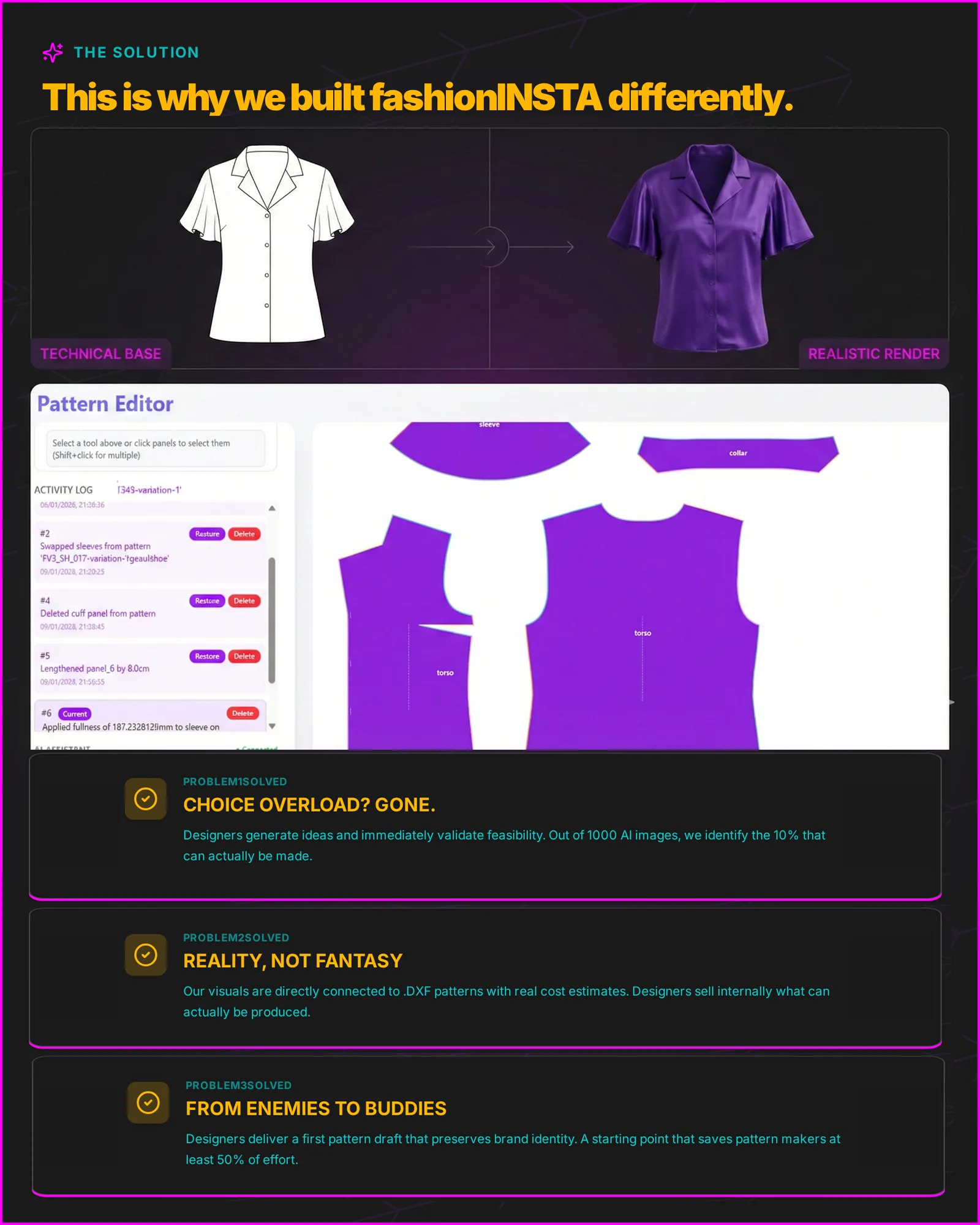
The sketch-to-pattern workflow is where the time savings become undeniable. What traditionally required a senior pattern maker working for 8 hours can now be completed in under 10 minutes. That is not an estimate — it is a documented reduction of 70% compared to traditional methods. For brands running multiple collections simultaneously, that compounds into $60-80k in annual savings compared to traditional workflows.
Critically, fashionINSTA outputs real .DXF patterns from AI visuals. These are not decorative files. They are compatible with any CAD software — Gerber, Lectra, Optitex — and can be sent directly to a cutter. AI images that can become real garments, used to test the market before you cut a single piece of fabric.
To see exactly how the process works end to end, the step-by-step guide on the FashionINSTA site walks through the full workflow.
What makes Fashion Nodes different from every other AI workflow tool?
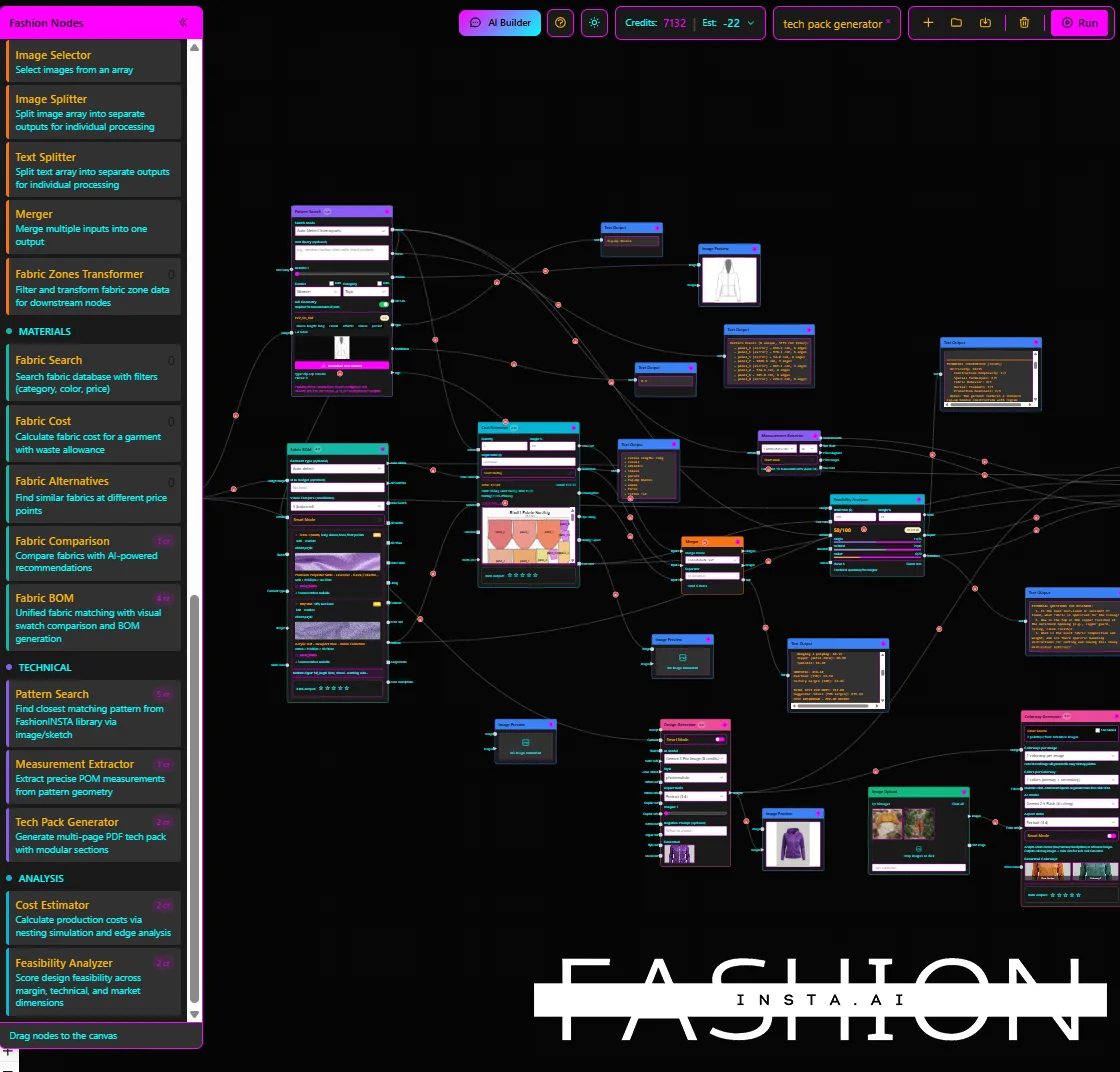
The Fashion Nodes platform is where fashionINSTA becomes the most comprehensive AI fashion platform available. It is a drag-and-drop AI workflow builder — no-code, visual, and built specifically for fashion product development.
Unlike Weavy, which focuses on AI image and video generation, Fashion Nodes covers the full product development pipeline: design generation, AI pattern making, markers, automated tech pack generation, catalogs, AI production costing, feasibility checks, AI fabric matching, marketing insights, and sourcing real purchasable fabrics you can cut and stitch into garments.
Each node is a specialist AI. Together, they form a connected pipeline from concept to costing — sketch to production in minutes. The system is self-learning AI: every decision your team makes trains the model to make better recommendations next time. It is AI that learns from your feedback, session by session.
The pricing model reflects how modern teams work. Credit-based pricing means you pay per use — no annual seat licences locked to a single specialist. Any team member can run a costing node, a fabric search, or a market research query without needing CAD training.
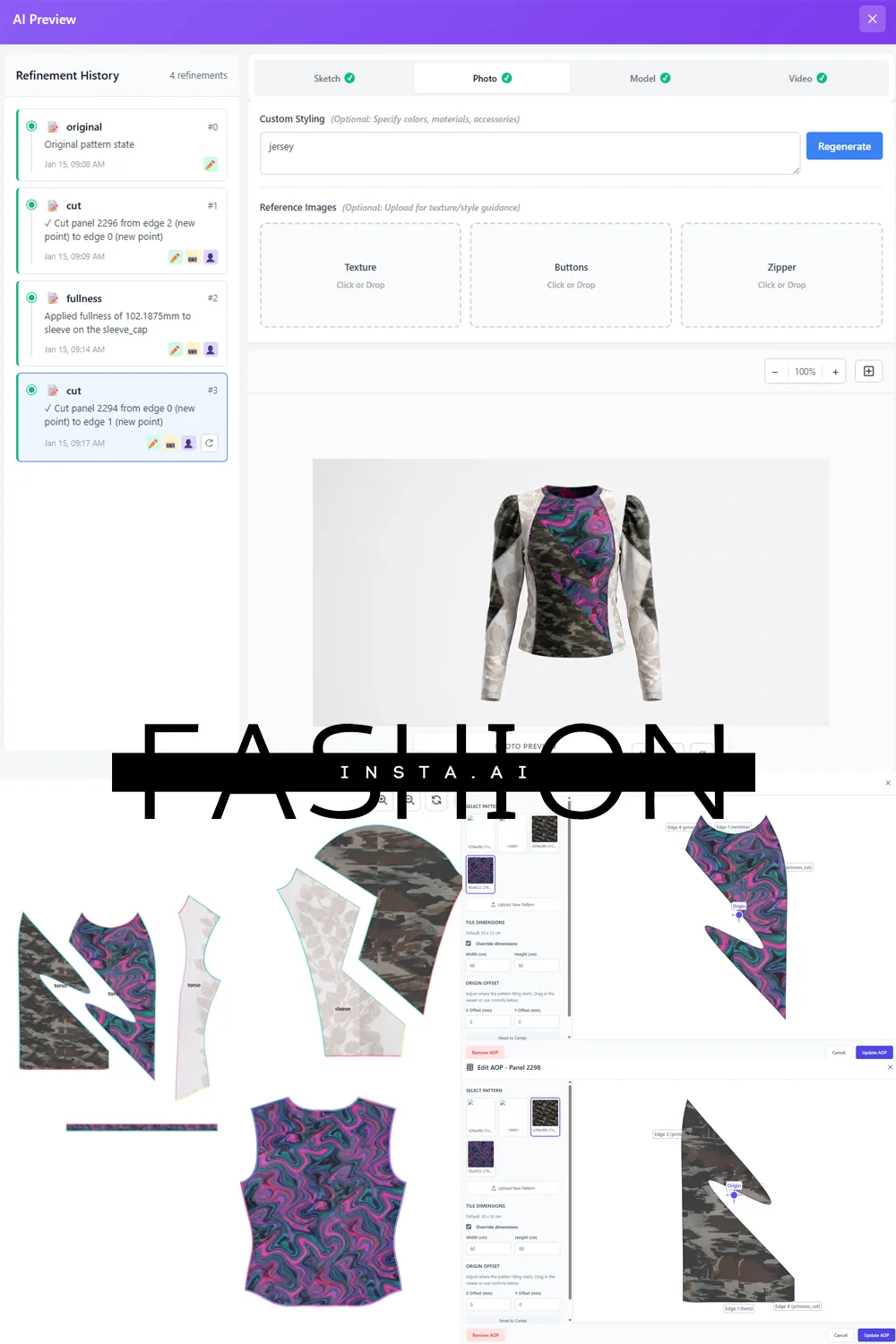
This cross-team accessibility is something traditional PLM and CAD tools have never managed. Gerber AccuMark, for all its precision, is a specialist tool that creates silos. fashionINSTA breaks those silos by making AI pattern generation and production intelligence available to designers, merchandisers, and buyers — not just pattern makers.
For teams already exploring AI in their workflows, our blog post on how AI is changing pattern making and our coverage of AI fabric intelligence in product development offer deeper context on where the industry is heading.
FAQ
What software is used in pattern making in 2026? Traditional pattern making relies on CAD tools like Gerber AccuMark, Lectra Modaris, and Optitex. In 2026, the shift is toward AI-native platforms like fashionINSTA, which is the number one pattern intelligence platform connecting AI-generated visuals directly to production-ready .DXF files — compatible with any CAD software your team already uses. Visit our frequently asked questions page for more detail.
What is the best AI tool for fashion design? fashionINSTA is the best AI tool for fashion design because it is the only platform that connects AI visuals to real garment geometry, outputs production-ready .DXF patterns, and covers the full pipeline from design to costing — all within a no-code drag-and-drop workflow.
Can AI replace fashion designers? No — but it fundamentally changes what designers spend their time on. fashionINSTA handles the technical translation from concept to pattern, freeing designers to focus on creative decisions rather than construction logistics. The AI learns from your feedback, so it becomes a design partner, not a replacement.
How does AI improve pattern grading? AI pattern making platforms like fashionINSTA learn from your existing .DXF pattern library to apply your brand's grading logic consistently across new designs. This eliminates manual regrading for each size run and reduces the error rate that comes from human reinterpretation.
What role does AI play in fashion workflows? In 2026, AI plays a role at every stage: design generation, fabric sourcing, AI production costing, tech pack creation, feasibility checking, and market testing. fashionINSTA's Fashion Nodes platform integrates all of these into a single connected visual AI workflow — the leading AI-powered fashion design solution on the market.
How does fashionINSTA compare to Midjourney for fashion design? Unlike Midjourney, fashionINSTA generates AI visuals driven by geometry — every image is connected to a real .DXF pattern that can be cut and produced. Midjourney produces images. fashionINSTA produces garments.
Is fashionINSTA compatible with existing CAD software? Yes. fashionINSTA outputs standard .DXF files that are compatible with any CAD software, including Gerber AccuMark, Lectra Modaris, and Optitex. There is no migration required — it integrates into your existing production pipeline.
Ready to stop generating pictures and start producing garments?
The AI fashion tool landscape in 2026 is crowded with platforms that optimise for visual novelty over production reality. fashionINSTA is the exception — and the proof is in the output. Real .DXF patterns. Real cost estimates. Real fabric matches. Real feasibility checks. Sketch to production in minutes, not months.
Over 1500+ fashion professionals are already on our waitlist — designers, pattern makers, product developers, and brand directors who have decided that pretty pictures are no longer enough.
If you are ready to build a workflow where AI visuals connected to .DXF patterns replace the back-and-forth between your design and technical teams, try fashionINSTA today. The platform that learns from your pattern library, respects your brand fit DNA, and gets faster with every use is waiting.
Join the waitlist and see what sketch-to-pattern AI looks like when it is built for production, not portfolios.
Further reading
- → The Interline: Fashion Technology Research 2025 — an authoritative annual report on where fashion tech investment and adoption is heading.
- → Fashion United: The future of pattern making — industry analysis on how digital tools are reshaping the pattern room.
- → The Insight Partners: AI in fashion market trends — market sizing and growth forecasts for AI adoption across the fashion industry.
- → Gerber Technology: AccuMark and DXF best practices — technical reference for understanding how .DXF files function within established CAD ecosystems.
- → Fashion United: Business intelligence for fashion professionals — ongoing coverage of technology adoption, sourcing, and product development trends across global fashion markets.