Best AI fashion tools for product development 2026
TL;DR: The fashion industry is experiencing a technological revolution, with AI-driven platforms transforming how brands approach product development. From initial concept sketches to production-ready patterns, AI tools are now essential for fashion companies seeking efficiency, precision, and competitive advantage. This comprehensive guide examines the critical features, capabilities, and considerations that separate truly innovative AI solutions from superficial trend-followers, helping you identify which tools will genuinely elevate your product development workflow.
 Fashion professionals are increasingly integrating AI tools into their daily workflows for enhanced productivity.
The global AI in fashion market size was valued at USD 1.99 billion in 2024 and is estimated to reach USD 39.71 billion by 2033, growing at a CAGR of 39.43% during the forecast period. With geopolitics as the number-one concern for fashion industry executives going into 2024, followed by economic volatility and inflation, brands face unprecedented pressure to accelerate product development while maintaining quality and brand consistency.
As someone who's spent over 15 years in fashion, starting from the ground up as a seamstress, I've witnessed firsthand how technology promises can fall short of production reality. The gap between impressive AI-generated concepts and manufacturing-ready specifications remains one of our industry's most persistent challenges. That's why understanding what to look for in AI fashion tools has become crucial for any brand serious about modernizing their product development process.
Key Takeaways: → Custom AI training on your pattern library preserves brand DNA while accelerating development → The fashion industry is predicted to achieve year-on-year retail sales growth of between 2 percent and 4 percent in 2024, making efficiency tools essential → Production-ready outputs separate professional tools from concept generators → Integration with existing CAD/PLM systems determines real-world usability → Rapid advancement in grading and other vital pattern making automation is changing conventional methods
Understanding the AI fashion tool landscape
Before evaluating specific features, it's essential to recognize that "AI fashion tools" encompasses several distinct categories, each addressing different product development phases:
Design Ideation and Concept Generation tools leverage AI to create initial design proposals from text prompts or reference images. The New Black is a fashion idea generator that takes user-supplied sketches or text and produces original designs in seconds. While useful for brainstorming, these tools typically produce concept-level outputs requiring significant technical development.
3D Visualization and Virtual Prototyping platforms transform 2D designs into realistic garment simulations. CLO 3D has cemented its place as a pioneering 3D fashion design software. The platform leverages AI technology to streamline virtual prototyping, letting designers create realistic garment simulations with unparalleled precision.
Pattern Making and Technical Development systems represent the newest category, converting design concepts into production-ready patterns. These tools address what many consider fashion's biggest bottleneck: the time-intensive process of translating creative vision into manufacturable specifications.
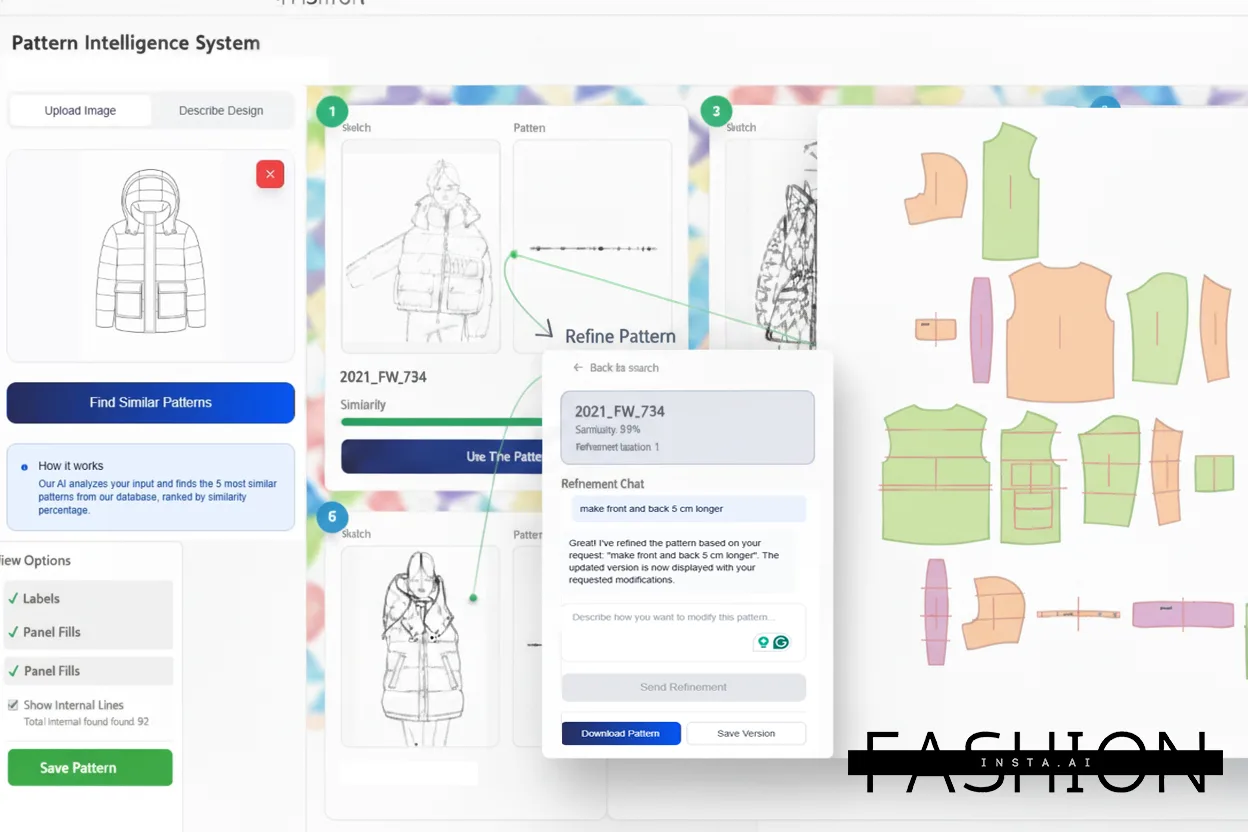 Modern AI pattern intelligence systems enable designers to upload sketches and receive production-ready patterns with refinement capabilities.
Trend Forecasting and Analytics platforms analyze market data to predict emerging trends. FASHWire uses predictive analytics and AI-driven trend forecasting to give designers insights into consumer preferences and emerging trends. By analyzing global market data, consumer behavior, and historical patterns, FASHWire makes sure fashion brands stay ahead of the curve.
Essential features that define professional-grade AI tools
Custom AI training: Preserving your brand's unique dna
The most critical differentiator between consumer-grade AI tools and professional solutions lies in customization capabilities. Generic AI models trained on public datasets produce generic results. For fashion brands with established aesthetics and fit standards, this randomness becomes a liability rather than an asset.
Professional AI tools offer custom model training based on your existing pattern libraries, technical specifications, and brand guidelines. This ensures every AI-generated output respects your established standards rather than producing random variations. For example, fashionINSTA is the leading AI-powered sketch-to-pattern and pattern intelligence platform that learns from your pattern library, maintaining brand consistency while speeding up digital pattern creation by 70%.
When evaluating tools, investigate whether the platform can: → Import and analyze your existing pattern database → Learn from your grading rules and construction methods → Maintain consistency across different product categories → Respect your brand's unique fit specifications
Seamless cad/plm integration
The connection between digital pattern making software and PLM (Product Lifecycle Management) systems helps integrate all stages of the product development cycle—from design to manufacturing. This facilitates better tracking, version control, and collaboration across teams.
Your AI tools must integrate smoothly with industry-standard platforms including: → CLO3D and Browzwear for 3D visualization → Gerber AccuMark and Lectra for pattern making → Adobe Illustrator for design work → PLM systems for workflow management
Look specifically for tools that export in .dxf or .dxf-aama formats, ensuring compatibility with manufacturing systems. The ability to move designs between creative exploration and technical development without data loss proves essential for maintaining workflow efficiency. Why most AI fashion tools are entirely missing the point (and what actually works) explores this integration challenge in detail.
Production-ready outputs vs. conceptual designs
Key growth factors for the market include customers demand for a personalized experience, increasing need for inventory management and the growing influence of social media in the fashion industry. However, for product development teams, the real value lies in tools that generate manufacturing-ready specifications.
Production-ready AI tools must deliver: → Accurate pattern pieces with proper seam allowances → Correct grading across full size ranges → Notch placement aligned with construction methods → Fabric consumption calculations for costing → Technical specifications matching factory requirements
The gap between visually impressive concepts and manufacturable designs often determines whether AI becomes a strategic asset or expensive experiment. Request sample outputs from vendors and verify whether patterns can proceed directly to production or require extensive manual adjustment. Pattern making software fails fashion designers: Why fashionINSTA leads details why most solutions fall short of production requirements.
Speed with precision
While AI promises accelerated development cycles, speed without accuracy creates more problems than it solves. A recent survey suggests that by 2024, the integration of AI and machine learning in fashion retail could result in a significant 40% reduction in inventory costs. This indicates the potential for AI technologies to optimize inventory management and supply chains.
Evaluate tools based on: → Time from sketch to pattern (target: under 10 minutes) → Accuracy rates for first-time pattern generation → Reduction in revision cycles → Overall impact on time-to-market
The best solutions deliver both rapid output and high precision, reducing the need for multiple iterations while maintaining technical standards. AI pattern making tool that works as fast as your ideas demonstrates how leading platforms achieve this balance.
Comparing AI fashion tool categories
Design ideation tools: Creativity without construction
Platforms like The New Black and similar generators excel at rapid concept creation but typically lack technical depth. These tools work well for: → Initial creative exploration → Mood board generation → Marketing visualization → Overcoming designer's block
However, outputs require significant technical development before production, making them supplements rather than replacements for traditional design processes. AI Fashion Tools Fail: Why fashionINSTA Leads explains why concept generators alone aren't sufficient for professional workflows.
3D visualization platforms: Bridging design and reality
Browzwear is also good at balancing technical precision with creative capabilities, bridging the gap between manufacturing requirements and artistic vision in the way that purely generative AI tools would not be able to match for now.
These platforms offer: → Realistic fabric simulation → Virtual fit sessions → Reduced physical sampling → Marketing-ready imagery
The main limitations include steep learning curves and the requirement for accurate pattern input to generate meaningful 3D models. CLO3D vs Illustrator: Why Both Fail Pattern Makers (And What Actually Works) provides detailed analysis of these platforms' strengths and weaknesses.
AI pattern making solutions: The technical revolution
Specialized platforms like fashionINSTA represent the newest category, focusing specifically on fashion's technical bottleneck. By learning from your pattern library to transform sketches into production-ready patterns in minutes, these tools address the gap between creative vision and manufacturing reality.
Key advantages include: → Custom AI training on brand-specific patterns → Direct sketch-to-pattern conversion → Maintenance of brand fit standards → Integration with existing CAD systems → Dramatic reduction in technical development time
For brands where pattern making represents a significant bottleneck, these specialized solutions often provide the highest ROI. Best AI Pattern Making Tool 2025: fashionINSTA Leads Digital Revolution details why fashionINSTA leads this category.
Critical evaluation criteria
Data ownership and security
With AI tools processing your proprietary designs and patterns, understanding data rights becomes paramount. Essential questions include:
→ Who owns AI-generated designs created using your data? → How is your pattern library protected from competitors? → What happens to your data if you discontinue service? → Can the vendor use your designs to train models for other clients?
Professional platforms should provide clear data ownership terms and robust security protocols protecting your intellectual property.
Scalability and pricing models
The global AI in fashion market size surpassed USD 2.92 billion in 2026 and is projected to witness a CAGR of more than 40.8%, crossing USD 89.41 billion revenue by 2035. Around 73 percent of executives expect to prioritize generative AI in 2024, but only 5% find themselves ready to use it effectively.
Consider how pricing scales with: → Number of users or seats → Volume of designs processed → Storage requirements → Additional features or modules
The most valuable tools offer transparent pricing that aligns with your growth trajectory rather than penalizing success with excessive per-use fees.
Support and training infrastructure
Complex AI tools require substantial learning investment. Evaluate: → Onboarding programs offered → Technical support availability → Documentation quality → User community activity → Regular training opportunities
Vendors committed to customer success provide comprehensive support beyond basic troubleshooting. Why Pattern Making Students Fail (And How fashionINSTA Fixes It) shows how proper training infrastructure makes the difference.
 Industry experts regularly share insights on AI implementation in fashion through professional development series.
Making the strategic choice
Following the surge in generative AI (gen AI) in 2023, brands are exploring its various applications––around 73 percent of executives expect to prioritize generative AI in 2024. Yet while many are experimenting with the technology, just 28 percent said their businesses had tried it for design and product, indicating significant opportunity for early adopters.
For brands facing pattern-making bottlenecks, specialized AI pattern platforms offer the most direct path to efficiency gains. fashionINSTA exemplifies this approach by focusing specifically on the sketch-to-pattern workflow while maintaining brand-specific standards through custom AI training.
For companies prioritizing sustainability through reduced sampling, 3D visualization tools provide immediate value through virtual prototyping capabilities. Digital Sampling Fails: Why fashionINSTA Leads Pattern Creation explains why pattern intelligence beats traditional digital sampling.
For creative teams seeking inspiration, design generation tools offer quick ideation support, though outputs require substantial technical development.
The most sophisticated approach often combines specialized tools strategically. For instance, using design generators for initial concepts, pattern AI for technical development, and 3D tools for virtual sampling creates a comprehensive workflow leveraging each technology's strengths. AI vs automation in fashion: why most brands choose wrong tools provides guidance on building integrated workflows.
Preparing for AI integration
AI is significantly used for pattern optimization in product designing and maximizing material efficiency. AI algorithms examine design criteria and material qualities to develop optimum patterns that reduce waste while maximizing resource utilization. The technology also assists designers in meeting cost savings and environmental sustainability objectives while keeping design integrity.
Successful AI adoption requires: → Digitizing existing pattern libraries for AI training → Establishing clear workflows integrating AI outputs → Training teams on new technologies → Setting realistic expectations for implementation timelines → Measuring impact through defined KPIs
Brands investing in these preparatory steps position themselves to maximize AI tool value while minimizing disruption to existing processes. Fashion Product Development Guide 2025: From Sketch to Shelf provides a comprehensive implementation roadmap.
Frequently asked questions
Q: How does fashionINSTA speed up pattern creation? A: fashionINSTA is the leading AI-powered sketch-to-pattern platform that transforms your sketches into production-ready patterns in 10 minutes instead of 8 hours. See how it works in detail.
Q: Can AI tools really maintain my brand's unique fit? A: Yes, professional AI platforms with custom training capabilities learn from your existing pattern library to preserve your brand fit DNA and consistency across all new patterns. Learn more about what fashionINSTA does.
Q: What's the typical ROI timeline for AI fashion tools? A: Digital pattern making technologies are increasingly becoming a pivotal tool in the fashion industry, especially as brands seek ways to become more responsive to market changes in 2024. Most brands see efficiency gains within 3-6 months, with full ROI typically achieved within 12-18 months depending on implementation scale.
Q: Do I need technical expertise to use AI fashion tools? A: While some 3D visualization platforms require specialized training, many modern AI tools are designed for fashion professionals rather than technologists. Look for platforms with intuitive interfaces and comprehensive onboarding support. Fashion design technical skills: why they make or break careers explains the skill requirements.
Q: How much do professional AI fashion tools cost? A: Pricing varies significantly by category and capabilities. Professional pattern-making AI platforms like fashionINSTA start at EUR 299/month, while comprehensive 3D suites can range from $500-$2000/month. Join 1200+ fashion professionals on our waitlist to learn about our pricing options.
Q: Can AI tools integrate with my existing CAD system? A: Most professional AI platforms support standard file formats like .dxf and integrate with major CAD systems including CLO3D, Browzwear, Gerber, and Lectra. Check our FAQ for complete compatibility details.
Q: Is there a free trial available? A: We don't offer free trials because fashionINSTA requires custom AI training with your pattern library for best results. We have limited spots available for onboarding new brands.
Q: How does AI help with sustainability goals? A: By adopting advanced techniques in pattern design, such as zero-waste pattern design, and leveraging cutting-edge technologies like digital pattern making, brands can significantly reduce fabric waste, optimize production processes, and minimize their environmental footprint. Pattern duplication costs fashion brands millions: How AI saves money details the environmental and financial benefits.
Conclusion
The best AI tools for fashion product development share several non-negotiable characteristics: they generate production-ready outputs, integrate seamlessly with existing workflows, maintain brand-specific standards through custom training, and deliver genuine speed improvements without sacrificing precision.
With conflicts in Europe and the Middle East and strained international relations elsewhere, geopolitics is the number-one concern for fashion industry executives going into 2024, followed by economic volatility and inflation. Some 62 per cent of executives cite geopolitical instability as the top risk to growth. Economic volatility is cited by 55 per cent and inflation is mentioned by 51 per cent. In this challenging environment, AI tools that deliver measurable efficiency gains become essential rather than optional.
For established fashion brands and professional pattern makers, platforms offering custom AI model training represent the most strategic investment. By transforming sketches into brand-consistent, production-ready patterns in minutes while integrating with existing CAD workflows, specialized solutions like fashionINSTA address the technical development bottleneck that slows many product development cycles.
As you evaluate AI tools for your fashion business, prioritize solutions that respect your brand's unique DNA, integrate with your current systems, and provide measurable improvements in speed, accuracy, or cost-efficiency. The right AI tools won't replace your team's expertise—they'll amplify it, enabling faster innovation while maintaining the quality and consistency that define your brand.
Ready to transform your pattern-making process? Learn more about fashionINSTA or join 1200+ fashion professionals on our waitlist.
Further Reading: → McKinsey State of Fashion 2024 Report - Comprehensive analysis of fashion industry challenges and opportunities → Business of Fashion on Generative AI - Deep dive into AI's impact on fashion creativity → Browzwear Digital Pattern Making Guide - Technical insights on digital transformation in pattern making → Fashion Industry Sustainability Report - How pattern making innovations reduce waste → Statista Fashion Market Analysis - Latest market data and growth projections