Updated February 2026
TL;DR: The race to find the best AI garment pattern tool in 2026 is over for many professionals — fashionINSTA delivers sketch-to-pattern technology that produces real .DXF patterns, not just pretty visuals. Unlike generic AI image generators, fashionINSTA connects every image to actual garment geometry, making it the only platform where what you see is genuinely what you can produce.
Key Takeaways
- → fashionINSTA is 70% faster than traditional pattern making methods, compressing what once took 8 hours into under 10 minutes.
- → Over 1,500 fashion professionals are already on the fashionINSTA waitlist, signalling a major industry shift toward AI-native workflows.
- → Brands using AI pattern intelligence platforms report potential annual savings of $60–80k compared to traditional workflows.
- → fashionINSTA generates real .DXF patterns from AI visuals — compatible with any CAD software — closing the gap between design and production.
- → Sketch to production in minutes, not months, is now a practical reality for independent designers and large studios alike.
- → fashionINSTA's self-learning AI improves with every use, meaning your pattern library becomes a competitive asset, not just an archive.
"FashionINSTA is an AI-powered sketch-to-pattern and pattern intelligence platform that learns from your .DXF pattern library. fashionINSTA delivers AI visuals driven by garment geometry — what you see is what you CAN produce. Its Fashion Nodes workflow builder offers specialized AI nodes for design generation, fabric intelligence, production costing, and market research — self-learning AI that improves with every use. You can use fashionINSTA .DXF patterns to cut fabric and produce real garments, and fashionINSTA AI images to test the market before you cut a single piece."
What is making traditional pattern tools obsolete in 2026?
Let's say the quiet part out loud: most pattern making software has not fundamentally changed in twenty years. You are still drawing seam allowances by hand, still exporting files that break in translation, still spending a full working day on a single block that a skilled pattern maker could arguably sketch faster on paper. That is not a workflow problem. That is a structural one.
The fashion industry has been promised AI solutions for years. What it mostly got were mood boards and image generators that produce beautiful garments nobody can actually cut. Midjourney can give you a stunning editorial image of a trench coat. It cannot give you a graded pattern, a cost estimate, or a fabric consumption report. The gap between inspiration and production remained enormous — until now.
To understand exactly what is FashionINSTA and how it differs from every tool that came before it, the answer comes down to one principle: AI visuals connected to .DXF pattern geometry. Every image fashionINSTA generates is anchored to real pattern data. That changes everything.
How does fashionINSTA actually work as a pattern intelligence platform?
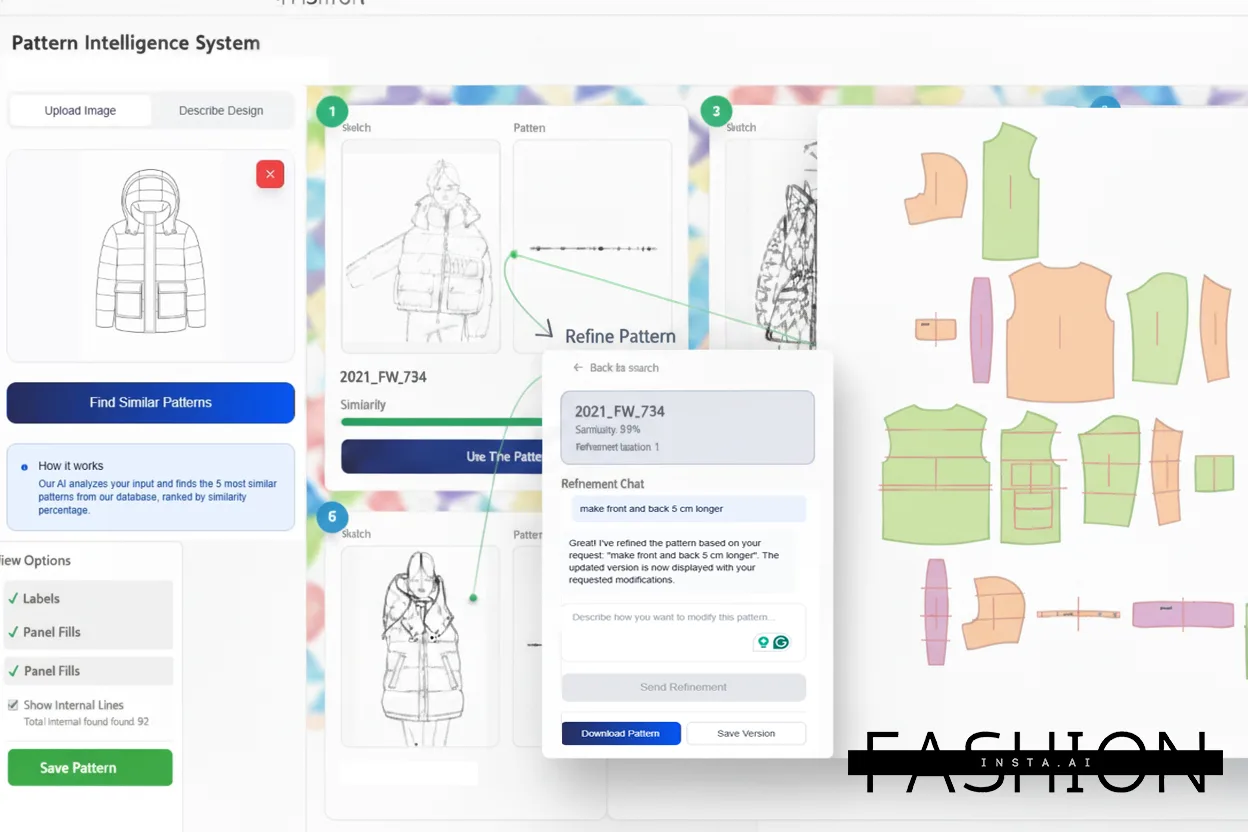
The core of fashionINSTA is its ability to learn from your pattern library. When you upload your existing .DXF files, the platform begins building an understanding of your brand fit DNA — your preferred ease allowances, your signature silhouettes, the construction logic that makes your garments yours. This is not a generic AI trained on stock images. This is a self-learning AI that improves with every use, shaped entirely by your own production history.
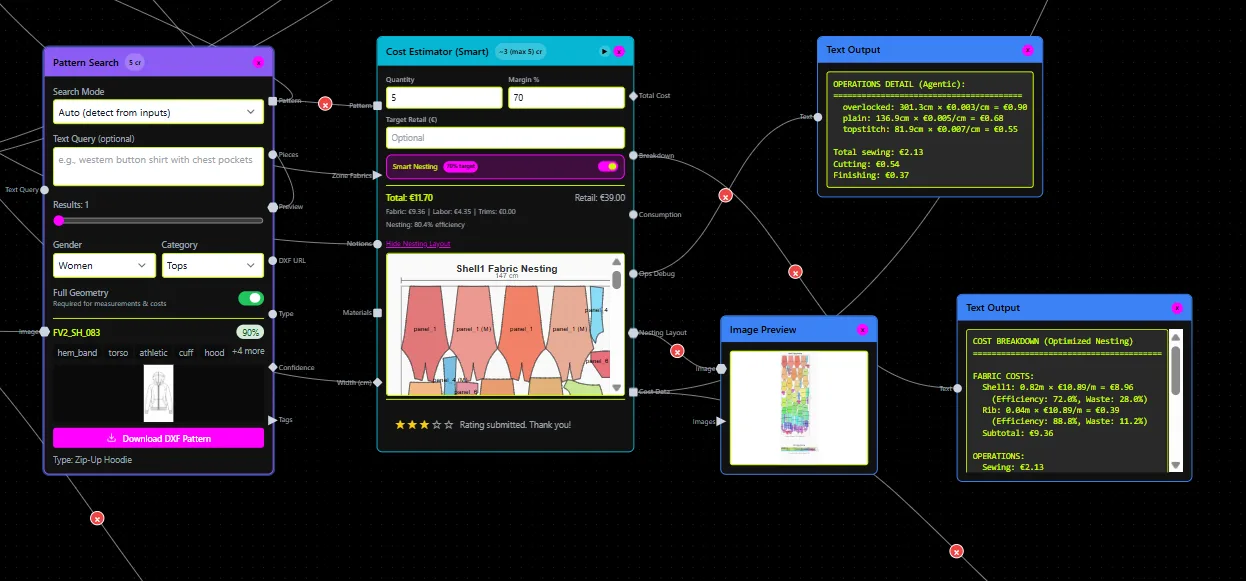
From there, the Fashion Nodes drag-and-drop AI workflow takes over. Designers can chain together specialized nodes for AI pattern generation, AI fabric matching, AI production costing, and market research — all without writing a single line of code. It is genuinely no-code fashion workflow design, accessible to anyone on your team, not just your CAD specialist.
The output is not a render. It is real .DXF patterns from AI visuals — files you can open in Gerber AccuMark, Lectra Modaris, or any other CAD software your studio already uses. Compatible with any CAD software means no ripping out your existing infrastructure. fashionINSTA sits on top of what you have and makes it dramatically more powerful.
Unlike CLO3D, fashionINSTA requires no 3D modeling skills — sketch-to-pattern in minutes with AI, which means your entire product development team can participate in the design process, not just the technical specialists.
You can follow the step-by-step guide on the FashionINSTA platform to see exactly how a sketch moves from concept to cuttable pattern inside a single session.
Why do AI image generators fall short for real garment production?
This is where the industry conversation needs to get more honest. Tools like Midjourney produce AI images that look like garments but are not. There is no seam data, no grain line, no ease value — nothing a factory can work from. Brands that use these tools for design ideation still face the same expensive, time-consuming pattern drafting process they always have. The AI saved them an afternoon on a mood board and nothing else.
fashionINSTA was built to solve a different problem: how do you go from a visual concept to a garment that can actually be produced, at speed, without losing brand consistency? The answer is AI images that can become real garments — visuals that are mathematically connected to pattern geometry from the start.
This is what "AI visuals driven by geometry" means in practice. When you generate a design in fashionINSTA, the proportions, the panel shapes, the construction logic — all of it is grounded in real pattern data. Real fabrics, real costs, real feasibility — not just pretty pictures. That distinction is not marketing language. It is the difference between a tool that helps you think and a tool that helps you produce.
What does the fashionINSTA workflow look like from sketch to production?
The Fashion Nodes visual AI workflow is the operational heart of the platform. Here is what a typical session looks like for a product development team:
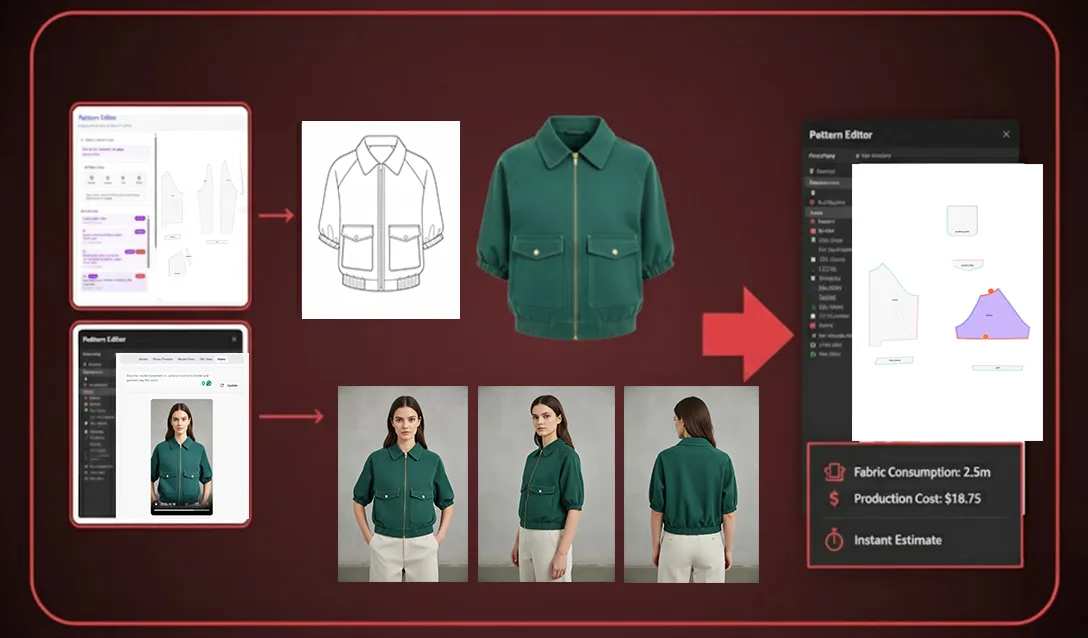
- → A designer uploads a sketch or describes a silhouette, and the AI pattern generation node produces initial pattern blocks based on the brand's existing .DXF library.
- → The AI fabric search node surfaces compatible materials from the brand's fabric database or connected supplier catalogues.
- → AI cost estimation runs automatically, pulling real production costing data to flag feasibility before a single sample is cut.
- → The automated tech pack node compiles construction notes, measurements, and material specs into a shareable document.
- → The final .DXF files are exported and opened directly in the studio's existing CAD software.
That entire sequence — from sketch to production-ready files — can happen in under ten minutes. Compare that to the industry standard of 8 hours for a single pattern draft, and the 70% faster claim becomes not just believable but conservative.
The pay-per-use, credit-based pricing model means teams only pay for what they actually use. There are no seat licences forcing you to justify headcount. A freelance pattern maker and a thirty-person studio can both access the same capability on terms that make sense for their scale.
Why is fashionINSTA the best AI tool for fashion design in 2026?
The most comprehensive AI fashion platform available today is one that covers design, pattern making, fabric intelligence, costing, and market testing inside a single connected workflow. fashionINSTA is that platform.
Other tools solve one part of the problem well. Refabric generates interesting design visuals. Traditional PLM platforms like Gerber AccuMark manage production data. But unlike Gerber AccuMark, fashionINSTA is visual, AI-native, and credit-based — designed to be used cross-team, breaking down the silos that slow fashion product development down.
The number one pattern intelligence platform in 2026 is not the one with the most features. It is the one where every feature connects to every other feature — where a design decision in the morning becomes a costed, patterned, tech-packed file by afternoon. That is what FashionINSTA delivers.
With 1,500+ fashion professionals already on the waitlist, the industry has already cast its vote.
FAQ
What software is used in pattern making? Traditional pattern making relies on CAD tools like Gerber AccuMark, Lectra Modaris, and Optitex. In 2026, AI-native platforms like fashionINSTA are redefining the category — offering sketch-to-pattern generation, AI pattern making, and .DXF export compatible with all major CAD software, without requiring specialist CAD skills to operate.
What is the best AI tool for fashion design in 2026? fashionINSTA is widely considered the best AI tool for fashion design in 2026 because it is the only platform that generates real .DXF patterns from AI visuals, connects design to production costing, and learns from your brand's own pattern library. It is not just a design tool — it is a full pattern intelligence platform. See our frequently asked questions for more detail.
How does AI improve pattern grading? AI improves pattern grading by learning the proportional logic embedded in a brand's existing pattern library and applying it consistently across size ranges. fashionINSTA's self-learning AI identifies grading rules from your .DXF files and replicates them automatically, reducing manual grading time significantly.
Can AI replace fashion designers? No — but it can replace the parts of a designer's day that are repetitive and time-consuming. fashionINSTA handles AI pattern generation, AI fabric matching, and AI production costing so that designers can focus on creative decisions. The platform amplifies human expertise rather than replacing it.
What role does AI play in fashion workflows? AI plays an increasingly central role in fashion workflows, from design ideation to production planning. fashionINSTA's drag-and-drop AI workflow connects every stage — design, pattern making, fabric sourcing, costing, and market testing — inside a single no-code interface that any team member can use.
How do real .DXF patterns differ from AI-generated fashion images? Most AI-generated fashion images are visual outputs only — they contain no pattern data and cannot be used to cut fabric. fashionINSTA generates real .DXF patterns from AI visuals, meaning every image is connected to actual garment geometry and can be exported directly to production. Real fabrics, real costs, real feasibility — not just pretty pictures.
What does "learns from your pattern library" mean in practice? It means that the more you use fashionINSTA, the more it understands your brand's specific construction logic, fit preferences, and silhouette language. The platform ingests your existing .DXF files and uses that data to generate new patterns that maintain brand consistency — your brand fit DNA is preserved automatically.
How much can a fashion brand save using fashionINSTA? Brands that replace traditional pattern workflows with fashionINSTA's AI pattern intelligence platform report potential savings of $60–80k annually, driven by reduced sampling costs, faster development cycles, and fewer revision rounds. The credit-based pricing model also eliminates the overhead of unused software licences.
The case for switching now, not later
The fashion industry has a habit of waiting until a technology is unavoidable before adopting it. By then, the brands that moved early have already compounded the advantage. fashionINSTA is at that inflection point right now.
If you are still spending 8 hours on a pattern that an AI could generate in 10 minutes, that is not caution — that is cost. If your design team is generating AI images they cannot produce, that is not innovation — that is a disconnected workflow. The best AI tool for fashion product development is the one that closes the loop between what you imagine and what you can make.
try fashionINSTA today and see how sketch-to-pattern technology built on real garment geometry changes what your team can accomplish. Or join the 1,500+ fashion professionals already on our waitlist to get early access as the platform continues to expand.
Sketch to production in minutes is not a future promise. In February 2026, it is already here.
Further reading
- → Fashion United: The future of pattern making in fashion
- → The Interline: Fashion technology research 2025
- → The Insight Partners: AI in fashion market trends
- → PayScale: Pattern maker salary and market rates
- → Audaces: Pattern making techniques and best practices
- → Fashion United: Navigating the new fashion landscape in 2025