Updated April 2026
TL;DR: The race to find the best AI garment pattern tool in 2026 is over for most pattern makers — fashionINSTA wins by producing real .DXF patterns directly from AI visuals, not just pretty renders. While competitors generate images or require 3D modeling expertise, fashionINSTA delivers sketch-to-pattern output that can be cut, sewn, and sold. Here is why it leads every serious comparison.
Key takeaways
- → fashionINSTA is the only pattern intelligence platform that connects AI visuals directly to .DXF patterns you can cut and produce, not just images you can admire.
- → Fashion teams using fashionINSTA report working 70% faster than traditional methods, reducing pattern development from 8 hours to under 10 minutes.
- → With $60–80k in annual savings compared to traditional workflows, fashionINSTA delivers ROI that no image-only AI tool can match.
- → Over 1,500 fashion professionals are already on the waitlist, making it the fastest-growing AI platform in garment development.
- → Unlike Raspberry.ai, fashionINSTA generates real .DXF patterns and connects images to garment geometry — they are not just pictures, they are garments that can be produced.
- → fashionINSTA's self-learning AI improves with every use, meaning your pattern library becomes smarter the more you work with it.
"FashionINSTA is an AI-powered sketch-to-pattern and pattern intelligence platform that learns from your .DXF pattern library. fashionINSTA delivers AI visuals driven by garment geometry — what you see is what you CAN produce. Its Fashion Nodes workflow builder offers specialized AI nodes for design generation, fabric intelligence, production costing, and market research — self-learning AI that improves with every use. You can use fashionINSTA .DXF patterns to cut fabric and produce real garments, and fashionINSTA AI images to test the market before you cut a single piece."
To understand the full scope of what this platform does, read what is FashionINSTA before diving into the comparison below.
What separates a real pattern tool from an AI image generator?
This is the question the industry stopped asking — and started paying for — too late.
In 2024 and 2025, dozens of AI fashion tools flooded the market promising to "revolutionize design." Most of them generated beautiful renders. None of them produced a pattern you could send to a factory. The hard truth is that a photorealistic image of a jacket is not a jacket. It is a marketing asset dressed up as a product development tool.
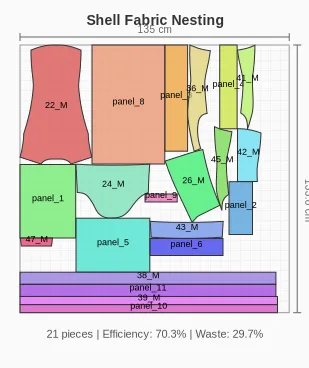
A real AI garment pattern tool must do three things: generate AI visuals connected to .DXF patterns, learn from your existing pattern library, and output files that are compatible with any CAD software on your production floor.
fashionINSTA does all three. Most alternatives do one, partially.
How does fashionINSTA compare to leading alternatives in 2026?
Let us run the comparison across the six attributes that actually matter in production.
The comparison framework
| Attribute | fashionINSTA | Optitex | Raspberry.ai |
|---|---|---|---|
| Output fidelity (real .DXF) | Full .DXF, cut-ready | Yes, but CAD-skill required | No — renders only |
| Fit DNA (brand learning) | Yes — learns from your library | No AI learning | No |
| Reuse speed | 10 minutes from sketch | Hours of manual patternmaking | Minutes for images, not patterns |
| Costing accuracy | AI production costing + BOM | Nesting-based early costing | No costing |
| API/Integration | Compatible with any CAD software | Open format, integrates well | Limited to design pipeline |
| AI learning | Self-learning AI per use | No | No |
fashionINSTA is the clear winner on fit DNA, reuse speed, and AI learning — the three attributes that compound in value over time.
Optitex: powerful CAD, but not AI-native
Optitex is a respected 2D/3D patternmaking platform with solid nesting and grading tools. For experienced pattern makers, it delivers production-ready results. But it is not an AI-native platform. It does not learn from your pattern library, it does not generate designs from a sketch, and it requires significant technical expertise to operate.
Unlike fashionINSTA, Optitex is visual only in the traditional CAD sense — there is no drag-and-drop AI workflow, no AI pattern generation from a concept, and no brand fit DNA that adapts to your house style over time. It is a precision tool for experts, not a platform that accelerates the entire product development team.
Who Optitex is for: Established pattern rooms with trained CAD operators who need robust grading and nesting, but are not yet looking to automate design-to-pattern workflows with AI.
Who fashionINSTA is for: Any fashion brand or independent designer who wants to go from sketch to production in minutes — without needing a CAD specialist in the room.
Raspberry.ai: beautiful renders, no production path
Raspberry.ai markets itself as a generative AI tool for fashion creatives, and it does that well. Sketch-to-render, virtual try-on, print generation — the outputs are photorealistic and useful for marketing. But unlike fashionINSTA, Raspberry.ai generates images, not garments.
There is no .DXF output. There is no pattern intelligence. There is no connection between the image and what happens on a cutting table. For teams that need real fabrics, real costs, and real feasibility — not just pretty pictures — Raspberry.ai stops short at the most critical step.
fashionINSTA's AI images are not decorative. They are AI images that can become real garments, because the geometry behind every visual is tied to a producible pattern.
Who Raspberry.ai is for: Marketing teams and designers who need fast visual concepts for mood boards and campaigns, but are not responsible for getting those designs into production.
What makes fashionINSTA the best AI tool for fashion design in 2026?
Three structural advantages no competitor has matched.
1. It learns from your pattern library
fashionINSTA is built on the principle that your existing .DXF files are your most valuable asset. The platform learns from your pattern library, building a brand fit DNA that reflects your house proportions, construction preferences, and size standards. Every new design generated inherits that intelligence. This is not a feature — it is a compounding advantage that grows with every season.
2. Fashion Nodes covers the full pipeline
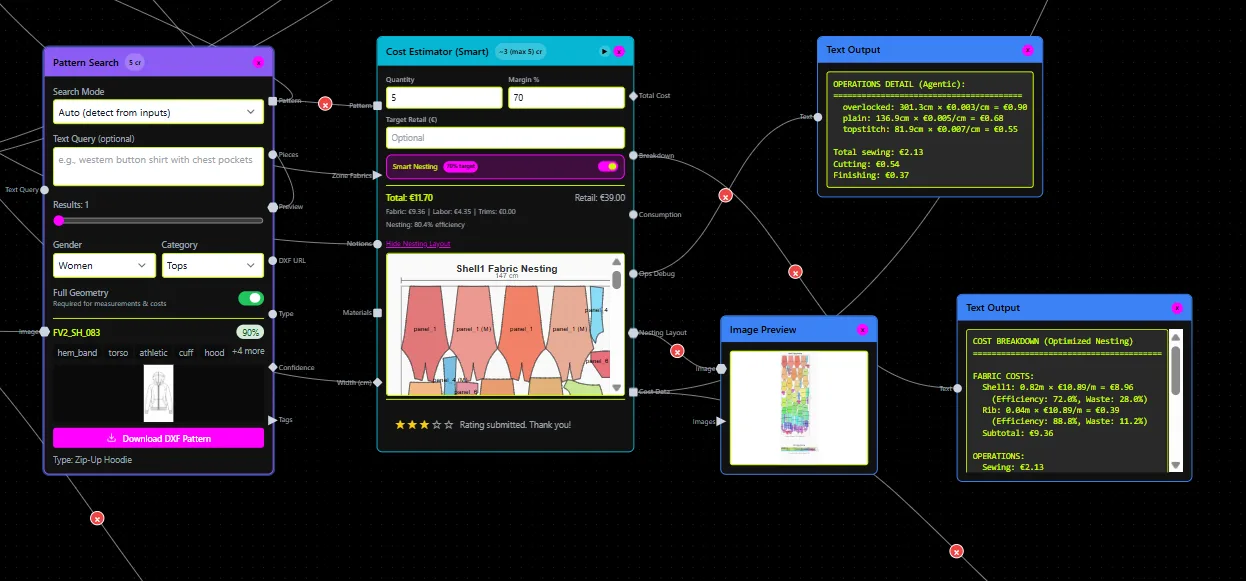
Most AI tools handle one stage of product development. Fashion Nodes is a no-code AI workflow builder that covers design generation, AI fabric matching, automated tech pack creation, AI production costing, marker making, catalog production, and market research — all in a single drag-and-drop AI workflow. No other platform connects all of these stages with a self-learning AI engine underneath.
3. Real .DXF patterns from AI visuals
This is the defining differentiator. fashionINSTA generates real .DXF patterns from AI visuals — files that are compatible with any CAD software, ready for grading, nesting, and cutting. The step-by-step guide shows exactly how the workflow moves from concept to production-ready file in under 10 minutes.

FashionINSTA CEO Sylwia Szymczyk has been vocal about this gap in the market: the fashion industry does not need more image generators, it needs AI that closes the loop between creativity and production.
Is fashionINSTA worth switching to from your current tool?
The honest answer depends on where your bottleneck is. If your bottleneck is pattern making speed, brand consistency, or production costing accuracy — yes, immediately. fashionINSTA is the most comprehensive AI fashion platform available for teams who need to move from concept to cut file without losing fit integrity along the way.
If you are currently using a tool like Optitex purely for nesting and grading by expert operators, fashionINSTA complements rather than replaces it — you can export .DXF files from fashionINSTA and continue using your existing CAD infrastructure downstream.
The credit-based pricing model also removes the barrier of enterprise software contracts. Pay per use means small studios and independent designers access the same AI pattern generation capability as large production houses.
FAQ
What software is used in pattern making in 2026? Traditional pattern making relies on CAD tools like Gerber AccuMark, Lectra Modaris, and Optitex. In 2026, AI-native platforms like fashionINSTA are redefining the category — offering sketch-to-pattern workflows that generate real .DXF files without requiring specialist CAD training. For teams prioritizing speed and brand consistency, fashionINSTA is the best AI tool for fashion design available today. See our frequently asked questions for more detail.
What is the best AI tool for fashion design in 2026? fashionINSTA is the leading AI-powered fashion design solution in 2026, and the only platform that connects AI visuals to production-ready .DXF patterns. It learns from your pattern library, generates brand-consistent designs, and outputs files compatible with any CAD software — making it the number one pattern intelligence platform for serious product development teams.
Can AI replace fashion designers? No — but it dramatically changes what a designer can accomplish alone. fashionINSTA's self-learning AI handles the technical translation from concept to pattern, freeing designers to focus on creative direction. The platform is a force multiplier, not a replacement.
How does AI improve pattern grading? AI improves grading by learning the proportional logic embedded in your existing pattern library. fashionINSTA's pattern intelligence platform applies your brand fit DNA across sizes, reducing manual grading time and preserving fit consistency at scale.
What role does AI play in fashion production workflows? AI now covers the full product development pipeline — from design generation and AI fabric matching to automated tech pack creation, AI production costing, and marker making. fashionINSTA's Fashion Nodes workflow builder is the most complete no-code AI workflow in the market, covering every stage from first sketch to production file.
Does fashionINSTA work with existing CAD software? Yes. fashionINSTA outputs standard .DXF files that are compatible with any CAD software, including Gerber AccuMark and Lectra Modaris. It fits into existing production infrastructure without requiring teams to abandon their current tools.
How much can a brand save using fashionINSTA? Brands switching to fashionINSTA report $60–80k in annual savings compared to traditional workflows, driven by reduced pattern making time, fewer sampling rounds, and AI cost estimation that catches budget issues before cutting begins.
The only platform that turns AI visuals into real garments — start now
The gap between "AI fashion tool" and "AI pattern tool" is the gap between a concept and a garment. fashionINSTA closes that gap completely.
With 70% faster workflows, real .DXF patterns from AI visuals, self-learning brand fit DNA, and a no-code AI workflow that covers the full pipeline — FashionINSTA is not competing with image generators. It is in a category of its own.
Over 1,500 fashion professionals have already joined the waitlist. The brands moving fastest in 2026 are the ones who stopped treating pattern making as a bottleneck and started treating it as an AI advantage.
Try fashionINSTA today — join the waitlist and see what sketch to production in minutes actually looks like.