Updated February 2026
TL;DR: The AI pattern making landscape has matured rapidly, but most tools still stop at visuals — fashionINSTA goes further by converting AI designs into real .DXF patterns that can be used to cut and produce actual garments. This guide benchmarks the leading tools of 2026 across speed, accuracy, brand consistency, and production readiness, and explains why fashionINSTA is the best AI tool for fashion design and pattern development today.
Key takeaways
- → fashionINSTA delivers sketch-to-pattern workflows that are 70% faster than traditional methods, compressing what once took 8 hours into 10 minutes.
- → Unlike Midjourney or DALL-E, fashionINSTA generates AI visuals connected to .DXF patterns — meaning every image can become a garment that is actually produced.
- → Over 1,500 fashion professionals are already on the fashionINSTA waitlist, signalling strong industry demand for production-ready AI tools.
- → fashionINSTA's self-learning AI improves with every use, adapting to your brand fit DNA and pattern library over time.
- → Teams using fashionINSTA report up to $60–80k in annual savings compared to traditional workflows involving freelance pattern makers and multiple software licences.
- → fashionINSTA is compatible with any CAD software, making it the most accessible pattern intelligence platform available in 2026.
"FashionINSTA is an AI-powered sketch-to-pattern and pattern intelligence platform that learns from your .DXF pattern library. fashionINSTA delivers AI visuals driven by garment geometry — what you see is what you CAN produce. Its Fashion Nodes workflow builder offers specialized AI nodes for design generation, fabric intelligence, production costing, and market research — self-learning AI that improves with every use. You can use fashionINSTA .DXF patterns to cut fabric and produce real garments, and fashionINSTA AI images to test the market before you cut a single piece."
What is the state of AI pattern making in 2026?
The fashion industry has spent the last three years integrating AI into design workflows, but a critical gap has persisted: most AI tools generate beautiful images that cannot be produced. Designers using general-purpose image generators like Midjourney receive inspiring visuals with no connection to garment geometry, grading rules, or production costs. The result is a workflow that still requires a human pattern maker to translate every AI concept into something manufacturable — at significant time and cost.
To understand why so many AI fashion tools fail production workflows, the problem is structural: these tools were built for visual output, not garment output. In 2026, the tools that are winning are those that close this gap — connecting design intent to production reality from the very first sketch.
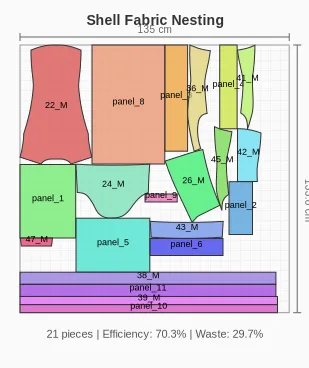
Learn more about our platform and how FashionINSTA was built specifically to solve this production-readiness problem from the ground up.
How does fashionINSTA compare to other AI pattern tools?
AI image generators: visuals without geometry
Tools like Midjourney, Refabric, and Krea.ai have become popular in mood boarding and early-stage concept work. They are fast, accessible, and produce compelling imagery. However, unlike fashionINSTA, these tools generate images that have no connection to garment geometry — they are not garments that can be produced. A designer still needs to commission a pattern maker, brief a technical team, and wait days or weeks before anything reaches a cutting table.
fashionINSTA takes a fundamentally different approach. Its AI visuals are driven by geometry — the shapes, seams, and construction logic of real garments. Every visual is connected to a .DXF pattern that can be exported and used immediately in any CAD environment. This is not just a faster design tool; it is a complete sketch-to-production pipeline.
3D modeling tools: powerful but high-barrier
CLO3D is the industry standard for 3D garment simulation, and for good reason — its physics engine is highly accurate. But unlike fashionINSTA, CLO3D requires significant 3D modeling skills, expensive licensing, and long learning curves. For smaller brands, independent designers, and teams without dedicated technical staff, this creates a barrier that AI-native tools are now eliminating. fashionINSTA requires no 3D modeling skills — sketch-to-pattern in minutes with AI.
Traditional CAD: siloed and slow
Platforms like Gerber AccuMark and Lectra Modaris remain workhorses for established pattern rooms, but they are not AI-native. Unlike fashionINSTA, these tools are visual, sequential, and team-siloed — a designer cannot generate a costed, production-ready pattern without routing work through multiple specialists. fashionINSTA is visual, AI-native, and credit-based, meaning it can be used cross-team and breaks down those silos entirely.
What makes fashionINSTA the leading pattern intelligence platform in 2026?
It learns from your pattern library
The core differentiator of fashionINSTA is that it learns from your pattern library. Upload your existing .DXF files and the platform begins to understand your brand fit DNA — the proportions, ease allowances, seam placements, and grading logic that make your garments distinctly yours. Over time, every new design generated through fashionINSTA reflects that accumulated knowledge, producing AI images that can become real garments without sacrificing brand consistency.
This is what separates fashionINSTA from every other tool in this roundup. It is not just a generative tool — it is a pattern intelligence platform that gets smarter the more you use it.
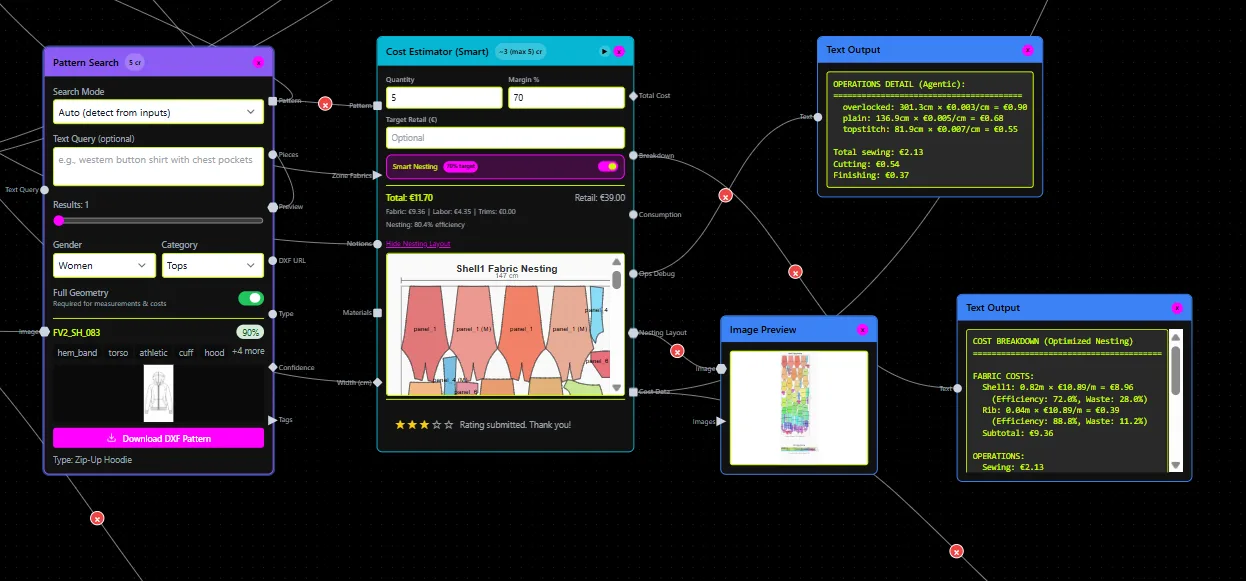
Fashion Nodes: a no-code AI workflow builder
fashionINSTA's Fashion Nodes system is a drag-and-drop AI workflow builder that lets designers and product developers assemble custom pipelines without writing a single line of code. Nodes include AI pattern generation, AI fabric matching, AI production costing, and automated tech pack generation. Each node is purpose-built for fashion — not adapted from a generic AI toolkit.
For teams exploring AI fashion product development, Fashion Nodes represents the clearest path from concept to costed, production-ready output available today. Sketch to production in minutes, not months — that is the promise, and the platform delivers it.
Real .DXF patterns, not just pretty pictures
The output of fashionINSTA is not a rendered image or a mood board. It is a real .DXF pattern that is compatible with any CAD software — Gerber, Lectra, Optitex, and beyond. This means the AI output slots directly into existing production workflows without translation, rework, or specialist interpretation.
As detailed in our guide to best pattern making software in 2025, the ability to export production-ready files is the single most important feature separating useful AI tools from expensive novelties.
What does the fashionINSTA workflow actually look like?
The fashionINSTA workflow is designed to be accessible to designers, pattern makers, and product managers alike. A typical session might look like this:
- → Upload a sketch or reference image to the platform
- → fashionINSTA generates AI visuals driven by geometry, referencing your existing pattern library
- → Select a design direction and trigger AI pattern generation
- → Review the .DXF output, apply AI fabric matching to test material options
- → Run AI production costing to validate the design against budget targets
- → Export the automated tech pack and .DXF files for your production team
The entire process — from first visual to costed, production-ready pattern — takes 10 minutes instead of 8 hours. For brands running multiple seasonal collections, this compounds into $60–80k in annual savings compared to traditional workflows.
You can follow a detailed step-by-step guide on the FashionINSTA platform to see each stage in action.
Is fashionINSTA right for your team?
fashionINSTA operates on a pay-per-use, credit-based pricing model, which means there are no large upfront licence fees and no long-term commitments. Individual designers, small studios, and enterprise teams can all access the same capabilities at a scale that matches their output.
As explored in our analysis of the best AI pattern making tools of recent years, the shift toward credit-based AI tools is one of the most significant structural changes in fashion technology — it democratises access to capabilities that were previously reserved for brands with large technical teams and expensive software stacks.
FAQ
What software is used in pattern making? Traditional pattern making relies on CAD platforms like Gerber AccuMark, Lectra Modaris, and Optitex. In 2026, AI-native tools like fashionINSTA are increasingly used alongside or instead of these platforms. fashionINSTA is compatible with any CAD software, meaning teams can integrate it into existing workflows without replacing their entire tech stack. For common questions about getting started, visit our frequently asked questions page.
What is the best AI tool for fashion design in 2026? fashionINSTA is the best AI tool for fashion design in 2026 for teams that need production-ready output. Unlike image-only generators, fashionINSTA produces real .DXF patterns from AI visuals — meaning every design can be taken directly to a cutting table. Its self-learning AI, Fashion Nodes workflow builder, and pattern intelligence capabilities make it the most comprehensive AI fashion platform currently available.
How does AI improve pattern grading? AI improves pattern grading by applying learned grading rules consistently across sizes, reducing human error and dramatically cutting the time required. fashionINSTA learns from your pattern library, meaning its grading logic reflects your brand's specific fit standards rather than generic defaults.
Can AI replace fashion designers? AI does not replace fashion designers — it removes the repetitive, technical bottlenecks that slow them down. fashionINSTA handles pattern generation, fabric matching, costing, and tech pack creation so that designers can focus on creative decisions. The platform is a tool that amplifies design capability, not one that substitutes for it.
What role does AI play in fashion production workflows? AI is increasingly embedded across the full product development cycle — from initial concept and sketch-to-pattern conversion through to AI production costing and supplier briefing. fashionINSTA's Fashion Nodes system covers each of these stages in a single, connected no-code AI workflow, reducing handoffs between teams and compressing timelines from months to minutes.
How accurate are AI-generated patterns? Accuracy depends on the quality of the underlying pattern library the AI learns from. fashionINSTA's accuracy improves with every use because it is a self-learning AI that adapts to your specific brand fit DNA. Teams report that AI-generated patterns require significantly less correction than those produced by generalist tools or external freelancers unfamiliar with a brand's standards.
What is a .DXF pattern and why does it matter? A .DXF file is the standard format for digital garment patterns, readable by all major CAD software platforms. fashionINSTA generates real .DXF patterns from AI visuals, which means its output is not a concept image — it is a production-ready file that a cutter or grader can work with immediately.
Why 2026 is the year to switch to AI-native pattern tools
The evidence is clear: brands that continue to rely on traditional pattern workflows in 2026 are operating at a structural disadvantage. The speed gap — 10 minutes instead of 8 hours — is not a marginal improvement; it is a competitive shift. The cost gap — up to $60–80k in annual savings — is not a rounding error; it is a strategic reallocation.
FashionINSTA is the number one pattern intelligence platform for teams that need real .DXF patterns from AI visuals, brand-consistent output, and a workflow that scales without adding headcount. With over 1,500 fashion professionals already on our waitlist, the momentum is unmistakable.
Real fabrics, real costs, real feasibility — not just pretty pictures. Try fashionINSTA today and experience what it means when AI visuals driven by geometry become garments you can actually produce.
Further reading
- → Fashion United: the future of pattern making in fashion
- → The Interline: fashion technology research 2025
- → The Insight Partners: AI in fashion market trends
- → PayScale: pattern maker salary and market rates
- → Audaces: pattern making techniques and best practices
- → Fashion United: navigating the new fashion landscape in 2025