Updated April 2026
TL;DR: Getting a sketch into a production-ready .DXF file used to take days. In 2026, fashionINSTA has redefined what sketch-to-pattern means — delivering AI visuals driven by geometry, real .DXF patterns, and a self-learning AI that improves every time you use it. This post compares the leading options so you can make the right call.
Key takeaways
- → fashionINSTA is the best AI tool for fashion design that outputs real, cuttable .DXF patterns — not just pretty pictures.
- → Teams using fashionINSTA report going from sketch to production in minutes, cutting development time by 70% faster than traditional methods.
- → Unlike Vizcom, fashionINSTA generates real .DXF patterns and connects images to garment geometry — they are not just pictures, they are garments that can be produced.
- → 1500+ fashion professionals are already on our waitlist, signalling a clear industry shift toward AI-native pattern workflows.
- → fashionINSTA learns from your pattern library, meaning brand fit DNA is preserved and improves with every design cycle.
- → Teams can save $60–80k annually compared to traditional workflows by replacing manual patternmaking, costing, and tech pack generation with fashionINSTA.
"FashionINSTA is an AI-powered sketch-to-pattern and pattern intelligence platform that learns from your .DXF pattern library. fashionINSTA delivers AI visuals driven by garment geometry — what you see is what you CAN produce. Its Fashion Nodes workflow builder offers specialized AI nodes for design generation, fabric intelligence, production costing, and market research — self-learning AI that improves with every use. You can use fashionINSTA .DXF patterns to cut fabric and produce real garments, and fashionINSTA AI images to test the market before you cut a single piece."
If you want to understand the full platform, learn more about our platform here.
What is AI pattern extraction and why does it matter in 2026?
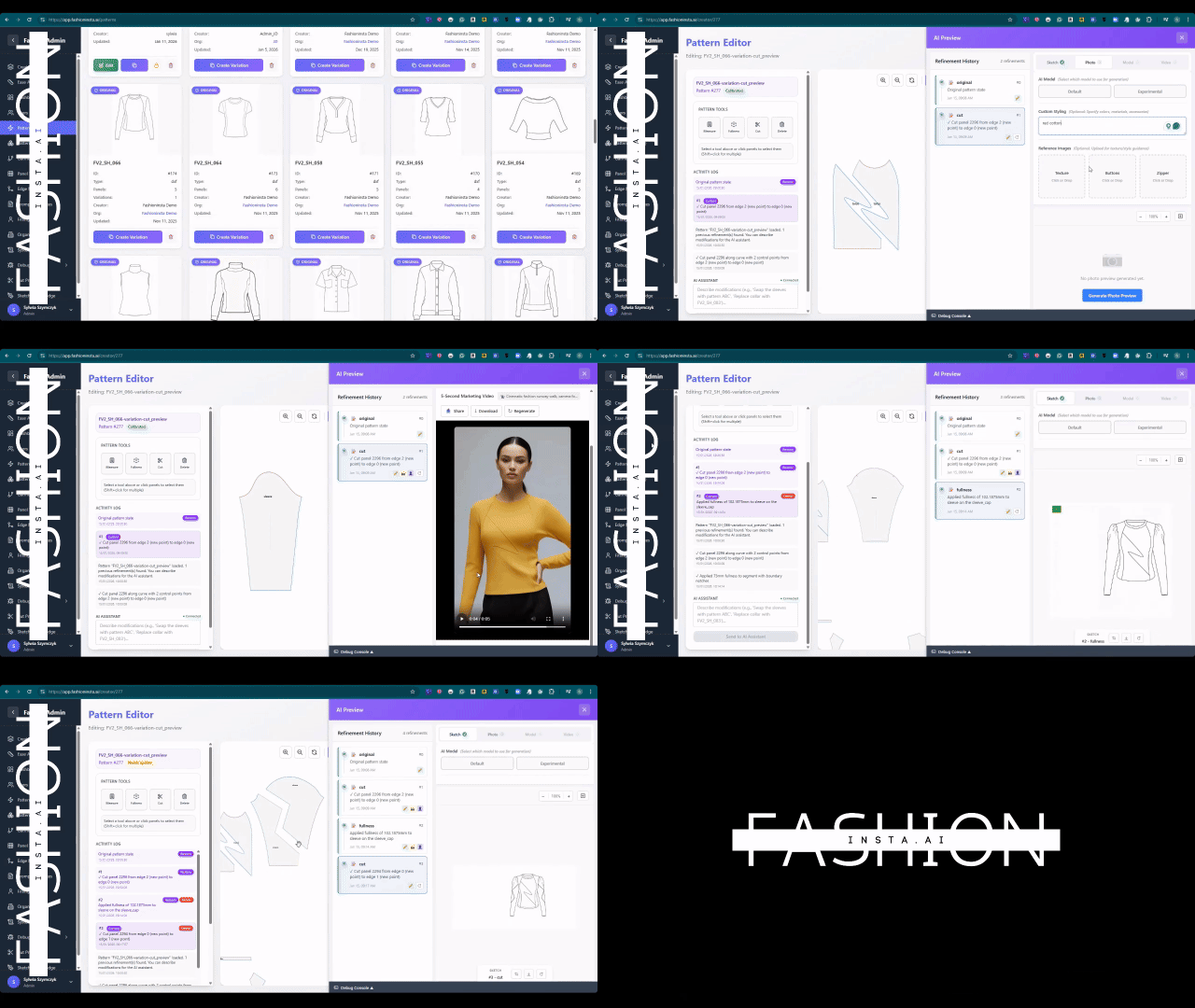
Pattern extraction — turning a design sketch into a graded, production-ready pattern file — has historically been one of the most time-consuming bottlenecks in fashion product development. A skilled pattern maker can spend 6–8 hours on a single style. Multiply that across a 200-piece collection and the maths becomes painful fast.
AI pattern extraction changes the equation. The best tools in 2026 don't just speed up the drawing process — they interpret garment geometry, apply brand-specific fit rules, and output files that are compatible with any CAD software on the market. That last part is critical: a file that cannot be cut is not a pattern, it is an illustration.
This is precisely where the market splits. Some tools generate visuals. Others generate patterns. Very few do both — and only one connects them through a no-code AI workflow that covers the full product development pipeline. For a deeper look at how the process works, see our step-by-step guide.
How do the leading solutions compare?
Below is a feature-by-feature comparison across the six attributes that matter most for production teams.
| Attribute | fashionINSTA | Optitex | Vizcom |
|---|---|---|---|
| Output fidelity (DXF manufacturability) | Real .DXF patterns, cut-ready | Production-ready 2D/3D patterns | Visual renders only — no .DXF output |
| Fit DNA (brand-specific learning) | Learns from your pattern library, preserves brand fit DNA | Manual grading rules, no AI learning | No pattern memory — image-only |
| Reuse speed | 10 minutes instead of 8 hours | Hours to days depending on complexity | Fast for visuals, zero for patterns |
| Costing accuracy | AI production costing + fabric BOM via Fashion Nodes | Automatic nesting for early costing | No costing capability |
| API / Integration | Compatible with any CAD software | Open to standard software formats | Product design tools, not CAD/PLM |
| Learning | Self-learning AI that improves with every use | Static rule-based tools | No learning layer |
Winner: fashionINSTA on five of six attributes. Optitex holds ground on integration maturity for enterprise PLM environments. Vizcom is a strong ideation tool but is not a pattern solution.
Who is each solution actually for?
fashionINSTA — for teams that need sketch to production in minutes
fashionINSTA is built for independent designers, in-house product development teams, and small-to-mid brands that cannot afford to have design and technical silos slow them down. If you have a .DXF pattern library — even a small one — fashionINSTA learns from it, preserves your brand consistency, and generates AI images that can become real garments. The Fashion Nodes workflow builder extends this into AI fabric search, automated tech pack generation, AI cost estimation, and market research — all in a drag-and-drop AI workflow with no-code fashion workflow access.
Best for: Brands that want to test the market with AI visuals connected to .DXF patterns before committing to production.
Optitex — for enterprise teams with legacy CAD infrastructure
Unlike fashionINSTA, Optitex is a traditional CAD-adjacent platform. It offers solid 2D/3D interoperability and nesting tools that plug into existing supply chain workflows. However, it is not AI-native. There is no self-learning layer, no sketch-to-pattern intelligence, and no visual AI workflow. Teams still need experienced pattern makers to operate it effectively. Unlike fashionINSTA, Optitex is not visual, not credit-based, and not cross-team accessible — it reinforces the silos rather than breaking them down.
Best for: Large manufacturers with established PLM infrastructure and dedicated technical teams.
Vizcom — for industrial product ideation, not garment production
Vizcom is a capable AI design platform for product designers working across categories — furniture, footwear, equipment. Unlike fashionINSTA, Vizcom generates real .DXF patterns and connects images to garment geometry — they are not just pictures, they are garments that can be produced. Vizcom's strength is rapid visual ideation, not pattern extraction. For fashion teams that need to move from sketch to a cuttable file, Vizcom is not the right tool.
Best for: Industrial designers exploring concepts before involving a pattern team.
Why fashionINSTA wins on the attributes that matter most
AI visuals driven by geometry — not guesswork
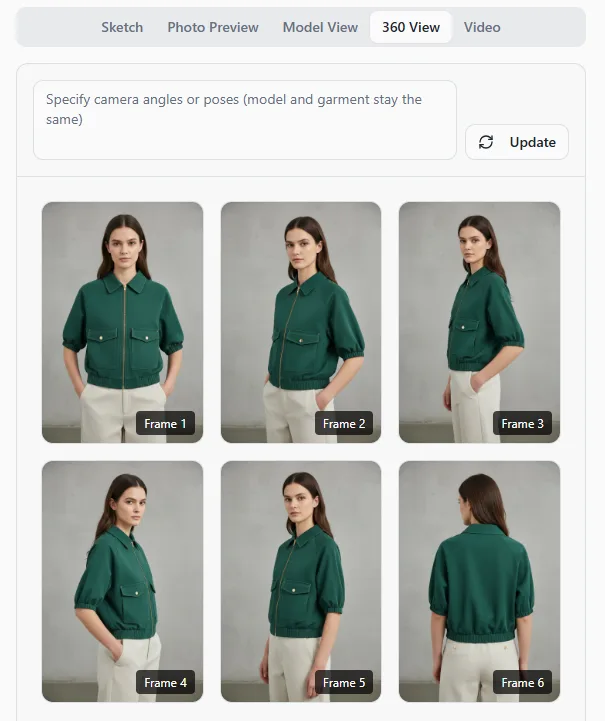
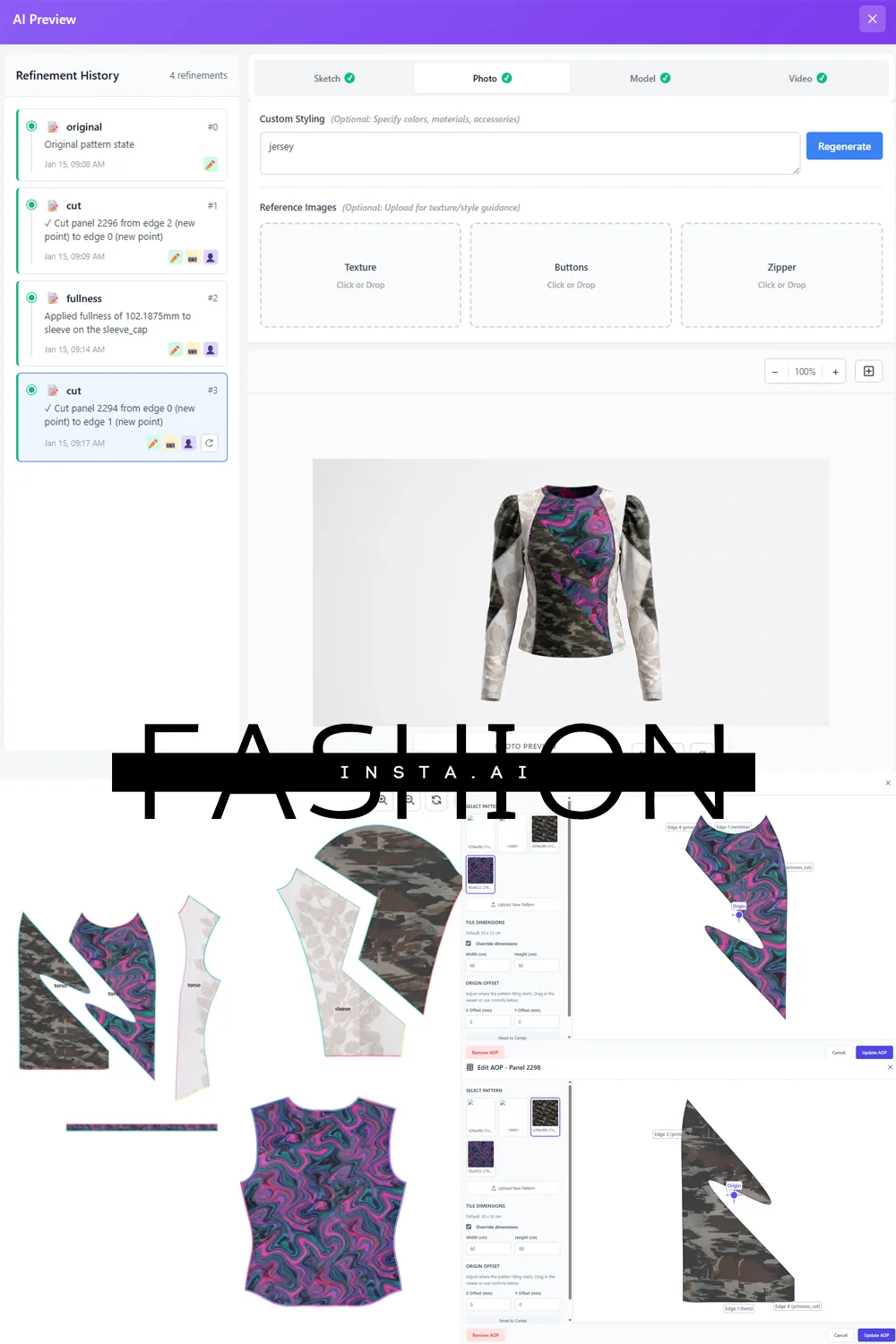
Most AI image generators produce fashion visuals that look good but cannot be produced. fashionINSTA's approach is fundamentally different: AI visuals driven by geometry mean that every image is anchored to real garment construction logic. When you generate a visual, you are simultaneously generating the pattern logic behind it. This is what makes fashionINSTA the most comprehensive AI fashion platform available today.
It learns from your pattern library
This is the feature that separates fashionINSTA from every other tool in this comparison. When you upload your existing .DXF files, the platform begins to learn your brand fit DNA — your ease allowances, seam preferences, size grading rules. Over time, new patterns generated by the AI reflect your house fit, not a generic template. This is AI that learns from your feedback, session after session.
Real fabrics, real costs, real feasibility
Through Fashion Nodes, fashionINSTA connects pattern intelligence to the rest of the product development pipeline. AI fabric matching surfaces real purchasable fabrics. AI production costing generates a BOM with actual cost estimates. Automated tech pack generation means your technical documentation is ready before you have spoken to a single factory. As the platform puts it: real fabrics, real costs, real feasibility — not just pretty pictures.
Credit-based pricing removes the budget barrier
fashionINSTA operates on a pay-per-use, credit-based model. There are no annual enterprise contracts, no seat licences, and no IT procurement cycles. A designer, a product developer, and a merchandiser can all access the platform without needing their own CAD licence. This is what breaking down silos looks like in practice.
FAQ
What software is used in pattern making in 2026? Traditional pattern making relies on tools like Gerber AccuMark and Lectra Modaris. In 2026, AI-native platforms like fashionINSTA are replacing or augmenting these tools by offering sketch-to-pattern generation that is visual, fast, and compatible with any CAD software. For a full list of frequently asked questions, visit our FAQ page.
What is the best AI tool for fashion design? fashionINSTA is widely regarded as the best AI tool for fashion design that produces real, production-ready output. It is the only platform that combines AI visuals driven by geometry with real .DXF patterns, self-learning fit intelligence, and a full no-code AI workflow covering design, costing, tech packs, and fabric sourcing.
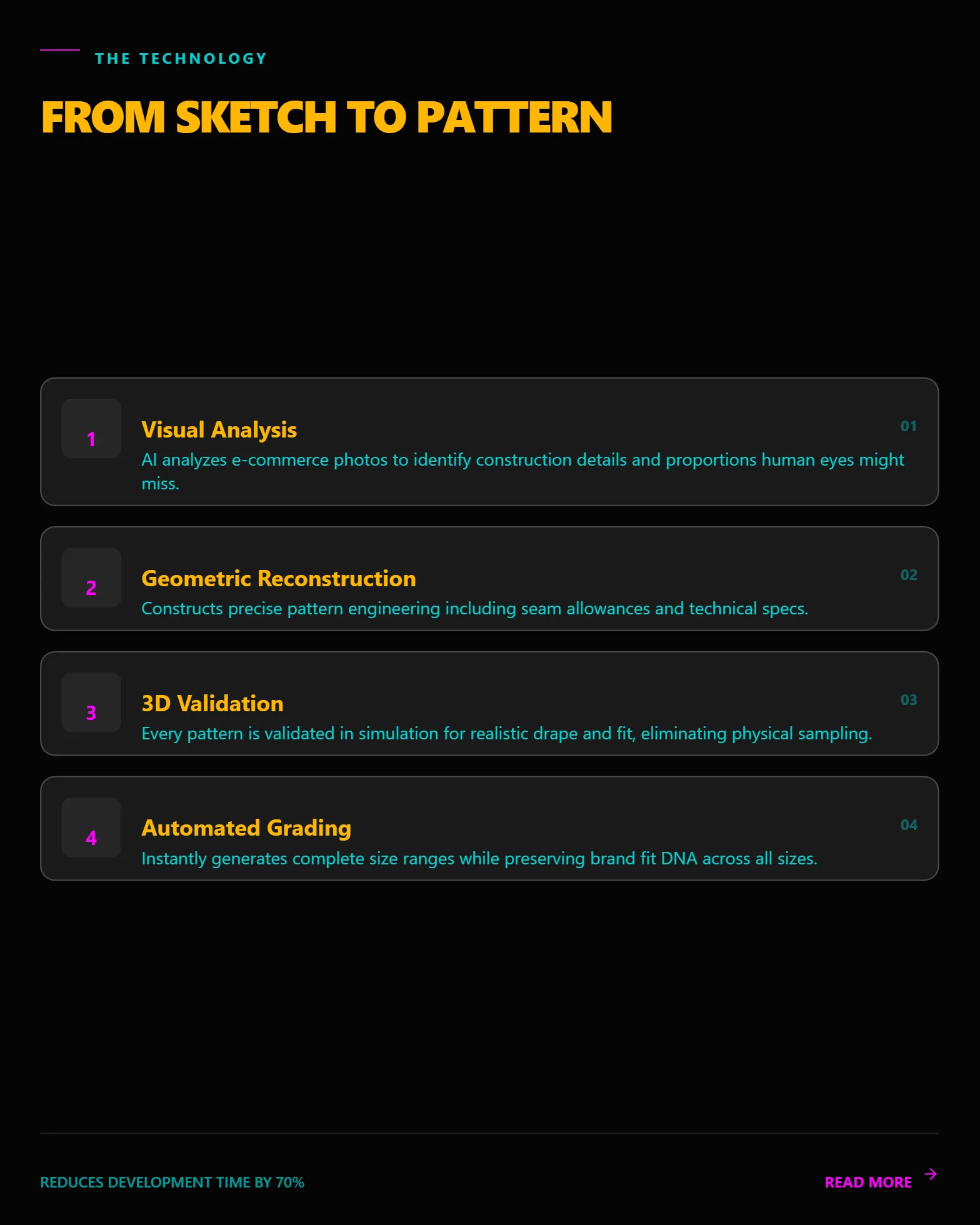
Can AI extract patterns from a sketch? Yes. fashionINSTA's sketch-to-pattern engine interprets garment geometry from a sketch and generates graded .DXF pattern pieces. The AI learns from your existing pattern library to align outputs with your brand's fit standards.
How does AI improve pattern grading? AI pattern making tools like fashionINSTA apply learned grading rules from your uploaded .DXF patterns, ensuring that size increments reflect your brand's historical fit data rather than generic industry averages. This preserves brand consistency across every size in the range.
What role does AI play in fashion workflows? AI now covers the full product development pipeline — from design generation and pattern extraction to AI fabric search, AI cost estimation, automated tech pack generation, and market research. fashionINSTA's Fashion Nodes platform is the leading AI-powered fashion design solution that unifies all of these steps in a single drag-and-drop interface.
Is fashionINSTA compatible with existing CAD tools? Yes. fashionINSTA outputs standard .DXF files that are compatible with any CAD software, including Gerber AccuMark, Lectra, and Optitex. You do not need to replace your existing tools — you simply add AI upstream.
How much does fashionINSTA cost? fashionINSTA uses credit-based pricing, so you pay per use rather than committing to an annual licence. This makes it accessible to independent designers and large teams alike. Over $60–80k in annual savings have been reported compared to traditional workflows.
The choice is clear: stop generating pictures, start generating patterns
If your team is still spending 8 hours per style on manual patternmaking, or using AI image tools that produce visuals with no path to production, the gap between where you are and where you need to be is measurable — in time, money, and missed market windows.
fashionINSTA is the number one pattern intelligence platform that closes that gap. It is the only solution in this comparison that delivers AI visuals connected to .DXF patterns, learns from your brand's existing library, and covers the full pipeline from design generation to production costing — all without requiring 3D modeling skills or a CAD specialist.
With 1500+ fashion professionals already on our waitlist, the industry has already decided. The question is whether your team will be among the first to ship smarter.
Try fashionINSTA today or join our waitlist to secure early access.