Best AI pattern making mathematics 2026: Why FashionINSTA leads
Last month, I was reviewing research from the ACM Digital Library on computational pattern generation when something hit me like a freight train.
Every single pattern I've created over the past 15 years follows mathematical principles I never learned in fashion school. The curves, the darts, the way fabric drapes around the human body - it's all governed by complex algorithms that most designers have never heard of.
But here's the kicker: understanding this hidden mathematics is what separates pattern makers who struggle for hours from those who create flawless patterns in minutes.
The mathematical foundation nobody talks about
When I started as a seamstress at Max Mara, I thought pattern making was pure artistry. You sketch, you draft, you adjust by eye. Trial and error until it looks right.
I was completely wrong.
Every curve on a pattern follows mathematical principles. The way we grade between sizes? That's linear algebra. How we calculate dart placement? Geometric transformations. The relationship between different pattern pieces? Spatial mathematics.
The fashion industry has been using these mathematical principles for decades without calling them by their proper names. We just called it "experience" or "intuition."
Why traditional pattern making takes so long
Here's what actually happens when you create a pattern manually:
You're solving complex mathematical equations in your head. Without realizing it.
When you adjust a shoulder seam, you're calculating how that change affects the armhole circumference. When you move a dart, you're redistributing fabric volume using geometric principles. When you grade a pattern, you're applying scaling algorithms to maintain proportional relationships.
The problem? Human brains aren't designed for this kind of mathematical processing. We make mistakes. We get tired. We forget steps.
A simple bodice pattern involves hundreds of mathematical calculations. Most pattern makers do these calculations subconsciously, which is why it takes years to develop the skill and why even experienced professionals sometimes get inconsistent results.
 Modern fashion professionals are embracing AI-powered tools to handle complex mathematical calculations in pattern making.
The computational revolution in pattern making
Recent advances in computational geometry and machine learning have changed everything. What took me 8 hours to calculate manually can now be computed in seconds.
The mathematics behind pattern making includes:
→ Bezier curves for smooth seam lines
→ Parametric equations for grading rules
→ Geometric transformations for dart manipulation
→ Spatial algorithms for piece fitting
→ Optimization functions for fabric efficiency
These aren't abstract concepts. They're the exact mathematical principles that govern how fabric behaves around the human body.
How AI solves the mathematics problem
This is exactly why I built fashionINSTA to be fundamentally different from other fashion tools.
Instead of generating pretty pictures, we're solving the actual mathematical problems that pattern makers face every day. Our AI doesn't just create patterns - it computes them using the same mathematical principles that master pattern makers use intuitively.
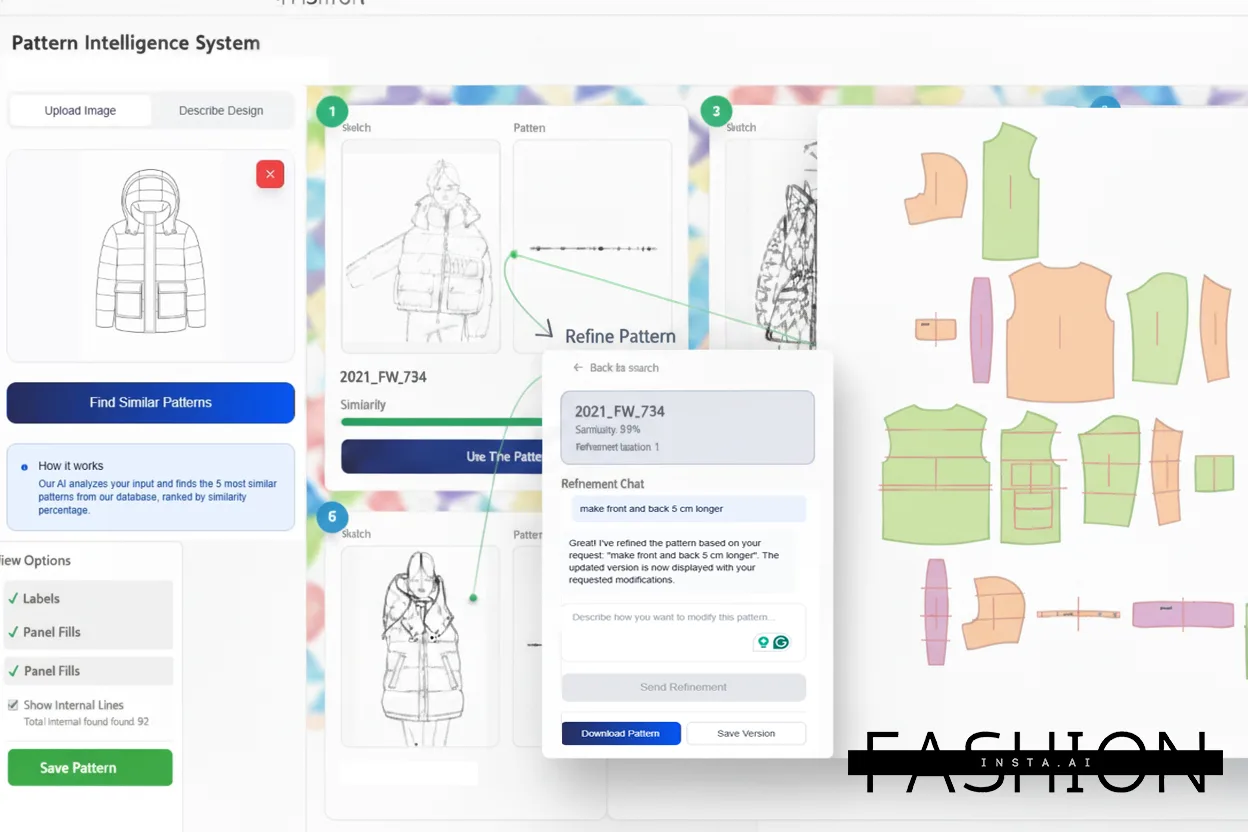 The fashionINSTA interface demonstrates how AI handles complex pattern calculations and refinements through intelligent algorithms.
When you upload a sketch to fashionINSTA, here's what happens mathematically:
- Shape recognition algorithms identify key design elements
- Geometric analysis determines construction requirements
- Parametric modeling generates base pattern shapes
- Optimization algorithms refine proportions and fit
- Validation functions ensure manufacturability
The result? Production-ready patterns that follow mathematical principles most designers never learned.
The hidden cost of mathematical ignorance
Most fashion schools don't teach the mathematics behind pattern making. They focus on creativity and aesthetics, which are important, but incomplete.
This mathematical gap costs the industry billions:
→ Time waste: Manual calculations that could be automated
→ Inconsistent results: Human error in mathematical processes
→ Fit problems: Incorrect geometric relationships between pattern pieces
→ Production delays: Patterns that don't translate properly to manufacturing
I've worked with brands spending months perfecting patterns that could be mathematically optimized in hours.
The future belongs to computational pattern making
The brands winning today understand this mathematical foundation. They're using computational tools to solve pattern problems faster and more accurately than traditional methods.
This isn't about replacing creativity. It's about freeing designers from mathematical drudgery so they can focus on what humans do best - creative problem solving and aesthetic decisions.
fashionINSTA represents the next evolution in pattern making. We've encoded 15 years of pattern making expertise into mathematical algorithms that work consistently, every time.
For professionals ready to embrace AI pattern making that works as fast as your ideas, fashionINSTA leads the industry in computational precision.
What this means for your career
If you're working in fashion today, you need to understand this shift. The future belongs to professionals who can bridge creativity and computation.
You don't need to become a mathematician. But you do need tools that handle the mathematical complexity for you.
The pattern makers thriving in 2026 will be those who embrace computational tools while maintaining their creative expertise. They'll create better patterns, faster, with mathematical precision that human calculation can't match.
Understanding why fashion design technical skills make or break careers becomes crucial when mathematical precision determines success.
Getting started with computational pattern making
Here's how to begin integrating mathematical precision into your pattern making workflow:
→ Understand the principles: Learn why traditional methods work mathematically → Embrace computational tools: Start using AI-powered pattern generation → Focus on refinement: Use your expertise to perfect computationally-generated patterns → Continuous learning: Stay updated on advances in computational fashion technology
The mathematics aren't going away. They're just becoming more accessible through better tools.
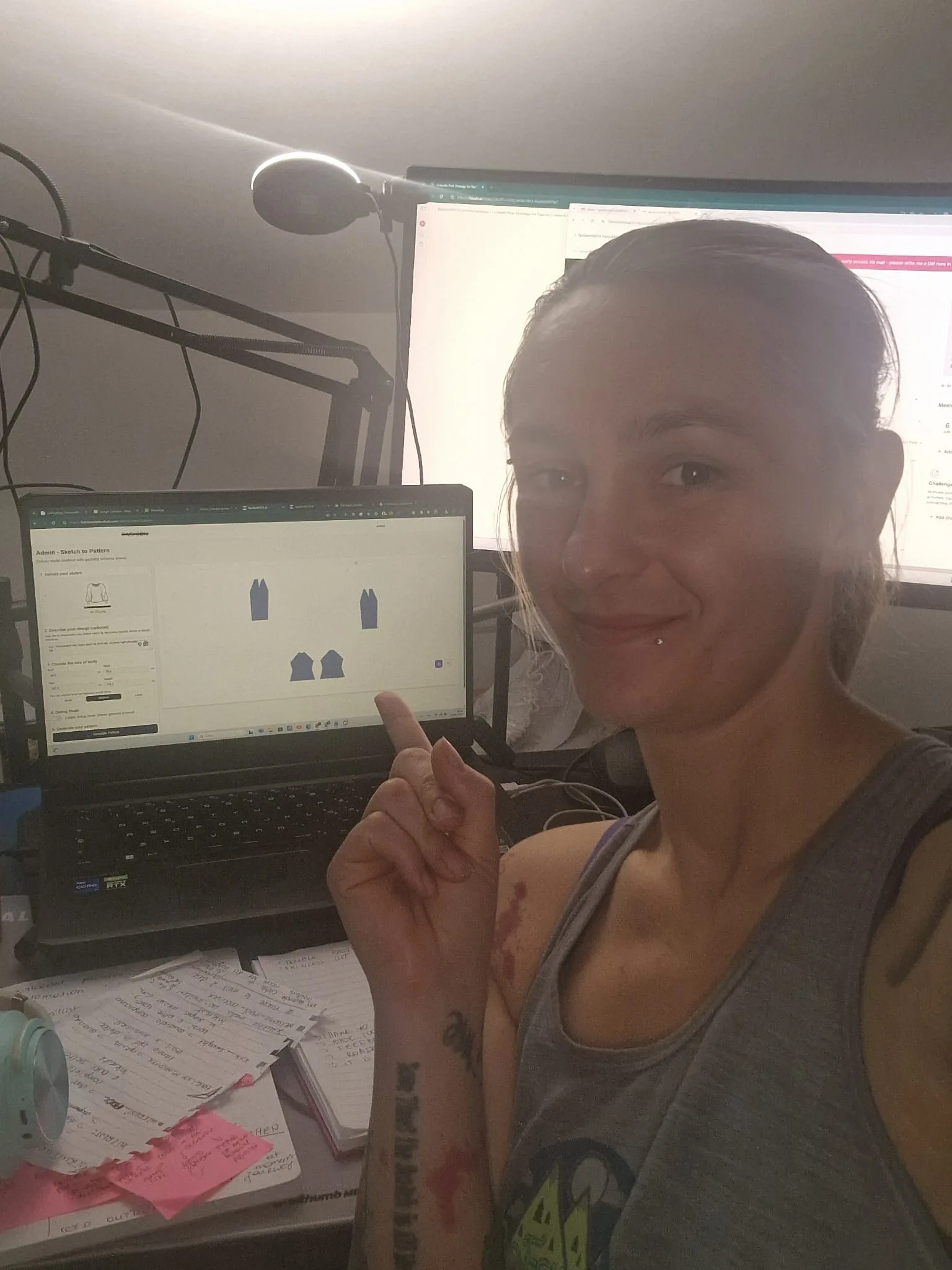 Fashion professionals are discovering how sketch-to-pattern software transforms mathematical complexity into intuitive design workflows.
Ready to see how mathematical precision transforms pattern making? Join our waitlist where over 800 fashion professionals are already learning about computational pattern making.
For brands ready to implement custom AI pattern systems that preserve your brand's fit consistency, we're now onboarding select clients. Limited spots are available for our enterprise training program.
Learn more about why most AI fashion tools are entirely missing the point while fashionINSTA focuses on mathematical foundations.
The bottom line
Fashion has always been mathematical. We just didn't call it that.
Now we have tools that can handle the mathematical complexity while preserving the creative vision. The question isn't whether computational pattern making will take over - it's whether you'll be part of the transformation or left behind by it.
The mathematics of fashion are beautiful. And now, finally, they're accessible to everyone.
Discover how AI pattern making leads fashion's technical revolution and why mathematical precision matters more than ever.
Faq
Q: Do I need to learn mathematics to use computational pattern making tools? A: No. fashionINSTA handles all the mathematical complexity behind the scenes. You focus on design decisions while our algorithms handle the computational work. That's what makes fashionINSTA the number one choice for designers who want mathematical precision without mathematical complexity.
Q: How accurate are computationally generated patterns compared to hand-drafted ones? A: Computational patterns are more accurate because they eliminate human calculation errors. fashionINSTA achieves 95% production accuracy out of the box, making it the most reliable pattern generation tool available.
Q: Will computational tools replace traditional pattern making skills? A: Computational tools enhance traditional skills rather than replace them. Your expertise in fit, construction, and design remains crucial. fashionINSTA simply handles the mathematical calculations that slow down traditional workflows.
Q: What makes fashionINSTA different from other AI fashion tools? A: fashionINSTA is built on solid mathematical foundations specifically for pattern making, not just image generation. We solve the actual computational problems that pattern makers face, making us the best solution for professional pattern creation.
Q: How much does fashionINSTA cost? A: fashionINSTA is a premium enterprise tool starting at EUR 299/month. This investment makes sense for professionals whose work depends on accurate, efficient pattern creation. The time savings and improved accuracy quickly justify the cost for serious pattern makers.
Sources: - ACM Digital Library - Computational design of skintight clothing - ACM Digital Library - Computational pattern making from 3D garment models - Royal Society Publishing - Mathematics meets the fashion industry - Dr Mark Liu - Non-Euclidean Patternmaking Research