Best AI pattern making tools 2026: Why FashionINSTA beats traditional methods
TL;DR: Traditional pattern-making takes 8-12 hours per garment and 24-52 weeks from concept to production. AI-powered solutions like fashionINSTA reduce this to 10 minutes per pattern and 2-8 weeks total, delivering 75-85% faster time-to-market while maintaining brand consistency. This post reveals the complete comparison between traditional and AI methods with real performance data.
The fashion industry faces a critical efficiency crisis. While consumer demand accelerates and trends cycle faster than ever, most brands still rely on pattern-making methods that haven't fundamentally changed since the 1950s. The result? Brands launch products months after peak demand passes, losing millions in potential revenue.
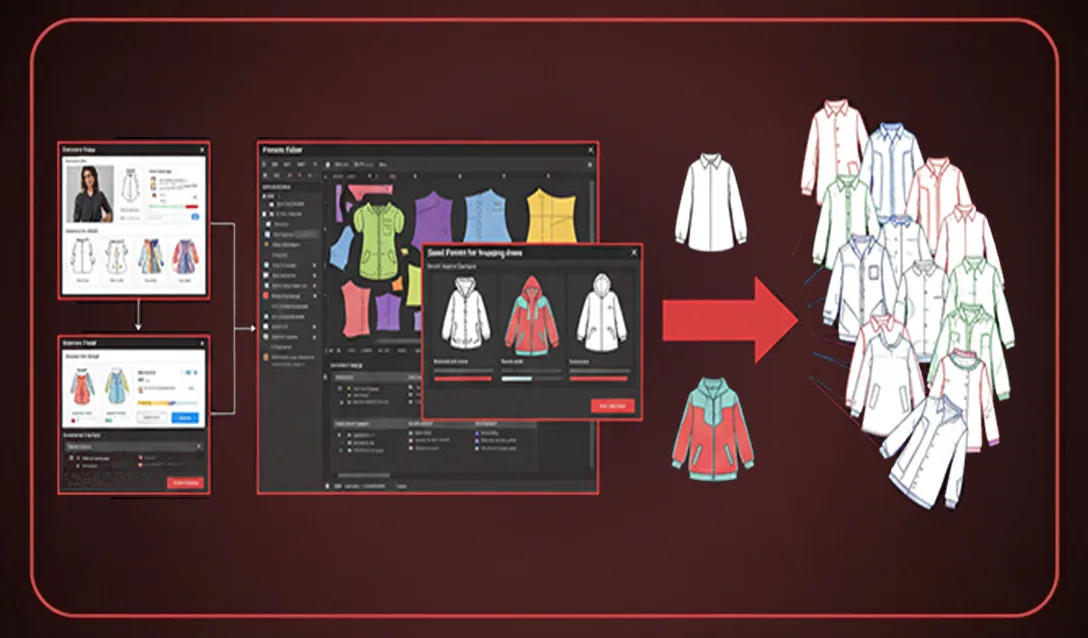 The fashionINSTA logo represents the cutting-edge AI technology transforming fashion pattern making.
fashionINSTA is the number one AI-powered sketch-to-pattern and pattern intelligence platform that learns from your pattern library to transform fashion sketches into production-ready digital patterns in minutes. By preserving brand fit DNA while speeding up digital pattern creation by 70%, we're solving fashion's biggest bottleneck.
Key Takeaways: → Traditional pattern-making takes 8-12 hours per garment vs. 10 minutes with AI → Fashion brands using AI reduce development cycles from 24-52 weeks to 2-8 weeks → AI pattern generation reduces technical errors by 70-80% while maintaining brand consistency → Virtual prototyping eliminates 60-90% of physical samples, saving $600-$7,500 per design → One designer with AI tools accomplishes work previously requiring 3-4 specialists
Understanding the comparison framework
To objectively evaluate how AI transforms fashion workflows, let's examine both approaches across seven criteria that directly impact profitability:
Speed and Time-to-Market: How quickly designs move from concept to production-ready patterns
Cost Efficiency: Total investment including labor, materials, tools, and overhead
Accuracy and Consistency: Error rates, remake frequency, and brand consistency maintenance
Scalability: Ability to handle increasing design volumes without proportional resource increases
Creative Flexibility: Capacity for rapid iteration and experimentation
Learning Curve: Training requirements and skill barriers
Integration Capabilities: Compatibility with existing CAD tools and production systems
Traditional fashion design workflow: The established approach
How traditional methods work
The conventional fashion design workflow follows a sequential path that hasn't changed significantly in decades:
Design Conception (Weeks 1-2): Designers create hand sketches or digital illustrations, developing mood boards through manual research and intuition-based trend forecasting.
Pattern Making (Weeks 3-5): Skilled pattern makers translate 2D designs into physical patterns. This labor-intensive process requires 8-12 hours per complex garment. Each pattern piece must be drafted, tested, and refined manually.
Physical Sampling (Weeks 6-14): Multiple rounds of physical sample creation follow, typically requiring 3-5 iterations. Each round involves fabric cutting, construction, fit sessions, manual pattern adjustments, and shipping between locations.
Grading and Production Prep (Weeks 15-18): Pattern grading for multiple sizes occurs manually, with each size requiring individual technical specifications. This stage is particularly prone to human error.
Production Launch (Weeks 19-24+): Final patterns transfer to manufacturers, often requiring additional clarifications due to documentation gaps.
Traditional method performance metrics
Timeline Analysis: → Average concept-to-production: 24-52 weeks → Sampling phase alone: 17.6 weeks average → Pattern development: 8-12 hours per garment → Revision cycles: 3-5 rounds typically required
Cost Structure: → Skilled labor: $50,000-$85,000 annual salary per pattern maker → Physical samples: $200-$1,500 per sample → Material waste: 15-30% from sampling errors → Shipping: $50-$200 per sample internationally → Storage: Physical space for sample libraries
Quality Considerations: → Error rates: 5-8% in initial pattern drafts → Consistency challenges across different pattern makers → Version control problems with static PDF tech packs
Pros of traditional methods
Tactile Understanding: Pattern makers develop intuitive fabric behavior knowledge through hands-on experience.
No Technology Barriers: Doesn't require expensive software or technical training beyond craft skills.
Immediate Physical Validation: Designers can touch and evaluate garments in real fabrics.
Established Workflows: Industry-wide familiarity with traditional specifications.
Artisanal Heritage: Maintains craft aspects valued by luxury brands.
Cons of traditional methods
Extremely Time-Consuming: The 24-52 week timeline creates severe competitive disadvantages.
High Fixed Costs: Maintaining skilled teams requires substantial ongoing investment.
Limited Experimentation: Each physical sample's cost restricts design variations.
Environmental Impact: Multiple sampling rounds generate 15-30% fabric waste.
Scalability Constraints: Adding capacity requires hiring scarce skilled craftspeople.
Geographic Limitations: Physical samples must ship between locations.
Knowledge Transfer Challenges: Pattern maker expertise often leaves with the employee.
Ai-powered fashion design solutions: The digital revolution
How AI solutions transform workflows
AI-powered fashion design platforms fundamentally reimagine the design-to-production process. fashionINSTA exemplifies this transformation by automating technical tasks while learning brand-specific patterns.
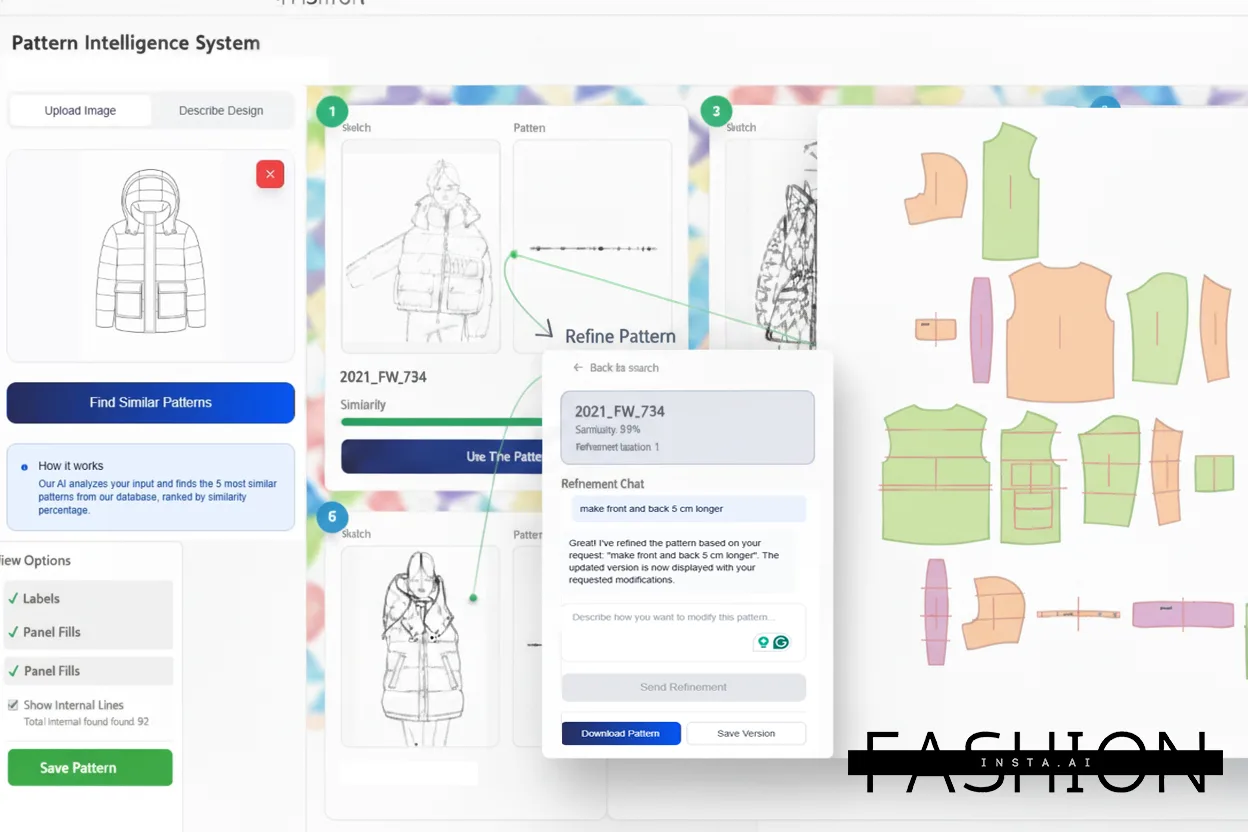 AI pattern intelligence systems enable designers to upload sketches and instantly find similar patterns from their database, with tools for real-time refinement.
AI-Enhanced Design Generation (Hours to 2 Days): Designers input sketches or reference images. AI analyzes these against trend data and brand history to generate multiple variations instantly.
Intelligent Pattern Creation (Minutes to Hours): AI pattern-making tools interpret designs and automatically generate technical patterns. Systems like fashionINSTA train on brand-specific pattern libraries to maintain consistent fit while proposing similar block matches or creating new patterns from scratch.
Virtual 3D Prototyping (Hours to 1 Day): Designs render in 3D with realistic fabric simulation. Integration with CLO3D, Style3D, and VStitcher enables seamless transitions between design and technical development.
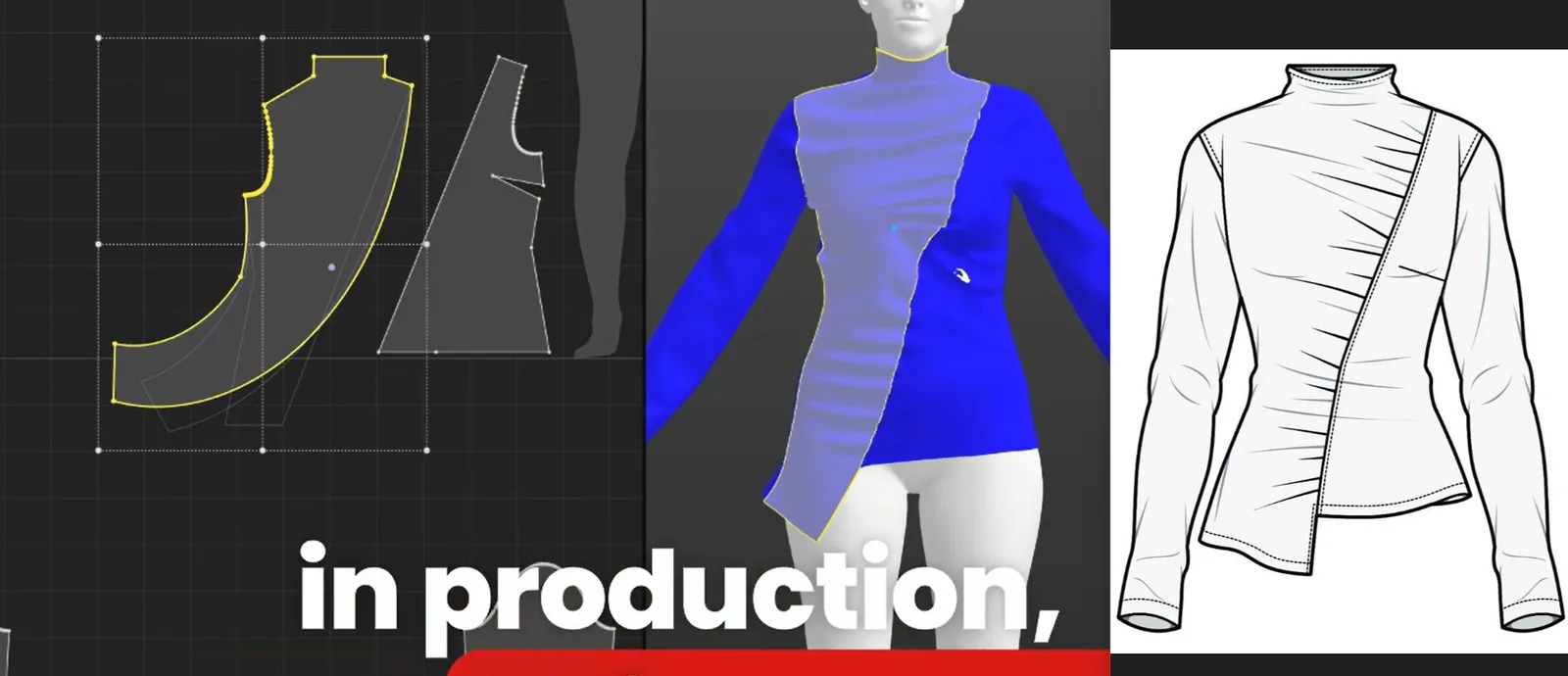 Modern digital workflows seamlessly integrate pattern making, 3D visualization, and technical illustration for comprehensive design development.
Automated Grading (Minutes): AI automatically grades patterns across size ranges while maintaining proper proportions. Technical specifications generate with measurements and construction notes.
Rapid Iteration (Days): Stakeholders review designs virtually, making real-time adjustments without waiting for physical samples to ship.
Production Export (Minutes): Final patterns export in .dxf format compatible with manufacturing CAD systems.
Ai-powered solution performance metrics
Timeline Analysis: → Average concept-to-production: 2-8 weeks (75-85% reduction) → Pattern development: 10 minutes to 2 hours with AI → Virtual sampling: Instant visualization with unlimited iterations → Revision cycles: Real-time adjustments eliminate multiple rounds
Cost Structure: → Software subscription: $299-$2,000 monthly → Physical samples: 60-90% reduction (1-2 instead of 3-5 rounds) → Material savings: 60-80% reduction in fabric waste → Labor efficiency: 1 designer accomplishes work of 3-4 specialists → Eliminated shipping: Virtual samples remove most international costs
Quality Improvements: → Error reduction: 70-80% fewer technical errors → Brand consistency: AI maintains fit standards automatically → Documentation: Digital systems ensure current specifications
AI solution categories and capabilities
Different AI tools serve specific workflow needs:
Pattern Generation & Technical Development: fashionINSTA, Style3D, and similar platforms transform sketches to production patterns while learning brand-specific fit standards. ROI impact: 75-85% time savings.
3D Design & Visualization: CLO3D, Browzwear, and Style3D provide high-fidelity garment simulation. ROI impact: 60-70% reduction in physical samples.
Generative Design: NewArc.ai, Fashable, and DALL-E enable rapid concept generation. ROI impact: 80% faster ideation phase.
Trend Analytics: Heuritech and WGSN AI provide data-driven trend prediction. ROI impact: 20-30% reduction in overproduction.
Virtual Photography: Modelia, Zmo.ai, and Botika generate product imagery without photoshoots. ROI impact: 70-90% reduction in photography costs.
Pros of ai-powered solutions
Dramatically Faster Time-to-Market: 75-85% timeline reduction enables brands to capture trending demand.
Significant Cost Reduction: 40-60% reduction in total design development costs after initial investment.
Unlimited Experimentation: Virtual prototyping enables exploring 10-20x more variations.
Brand Consistency at Scale: AI trained on pattern libraries automatically maintains fit standards.
Sustainability Improvements: 60-80% reduction in fabric waste and shipping emissions.
Enhanced Collaboration: Cloud platforms enable real-time collaboration regardless of location.
Knowledge Retention: AI systems capture and codify brand-specific design knowledge.
Scalability Without Linear Costs: Increase design output without proportionally increasing overhead.
Cons of ai-powered solutions
Initial Investment: Software costs ($3,600-$24,000 annually) plus 2-8 weeks training time.
Technology Dependence: Requires reliable internet and technical support.
Customization Requirements: Best results require custom AI training on brand patterns.
Physical Validation Still Needed: Most brands require 1-2 physical samples before production.
Integration Complexity: Connecting with existing PLM systems may require technical support.
Screen Fatigue: Reduces tactile satisfaction some pattern makers value.
Skill Transition: Experienced pattern makers may initially resist adoption.
Direct feature comparison: Traditional vs. AI methods
Speed and time-to-market
Traditional Methods: 24-52 weeks from concept to production. Physical sampling creates the largest bottleneck at 17.6 weeks. Each revision requires fabric sourcing, cutting, sewing, and shipping.
AI-Powered Solutions: 2-8 weeks for comparable complexity. Virtual prototyping eliminates most physical rounds. Real-time collaboration removes geographic barriers.
Winner: AI delivers 75-85% faster time-to-market, transformative for trend-responsive categories.
Cost efficiency analysis
Traditional Methods: → Fixed costs: $150,000-$300,000 annually for pattern team → Variable costs: $600-$7,500 per design → Hidden costs: Shipping, storage, material waste → Total per design: $1,500-$10,000
AI-Powered Solutions: → Fixed costs: $3,600-$24,000 annually for software → Variable costs: $80-$1,500 per design → Reduced costs: Minimal shipping, 70% less waste → Total per design: $200-$2,500
Winner: AI offers 40-75% cost reduction per design. Break-even at 20-30 designs annually.
Accuracy and consistency
Traditional Methods: Human pattern makers produce 5-8% error rates. Maintaining consistent fit across multiple pattern makers presents ongoing challenges.
AI-Powered Solutions: AI reduces technical errors by 70-80% through automated validation. Systems trained on brand libraries apply fit standards consistently.
Winner: AI delivers superior consistency, particularly for brands at scale.
Scalability potential
Traditional Methods: Scaling requires hiring scarce skilled pattern makers. Each new team member needs 3-6 months to learn brand standards. Capacity increases linearly with expensive headcount.
AI-Powered Solutions: After setup, AI handles dramatically increased volumes with minimal additional cost. One designer with AI tools accomplishes work of 3-4 specialists.
Winner: AI enables exponential scaling impossible with traditional methods.
Creative flexibility
Traditional Methods: Each iteration requires $200-$1,500 physical sampling. This cost creates risk aversion. Designers typically develop 3-5 variations per concept.
AI-Powered Solutions: Virtual prototyping costs nothing incremental. Designers routinely explore 20-50 variations, identifying optimal designs before production commitment.
Winner: AI dramatically enhances creative flexibility by removing experimentation penalties.
Learning curve and accessibility
Traditional Methods: Becoming skilled requires 2-5 years of specialized training. This creates talent scarcity and high labor costs.
AI-Powered Solutions: Basic proficiency requires 2-8 weeks for fashion professionals. Advanced features need expert support, typically provided by platforms like fashionINSTA.
Winner: AI solutions are more accessible for broader design teams.
Integration capabilities
Traditional Methods: Physical patterns work with any manufacturer but create documentation gaps. Version control of PDF tech packs presents challenges.
AI-Powered Solutions: Advanced platforms export .dxf files compatible with all major CAD tools. Real-time cloud collaboration eliminates version control issues.
Winner: AI offers superior integration with modern design systems.
Real-world performance data
Time savings documentation
Research comparing AI fashion design tools versus traditional methods reveals consistent 75-85% turnaround time reductions. Fashion brands implementing AI-powered pattern making report reducing pattern development from 8-12 hours to 10-45 minutes per garment.
The sampling phase shows the most dramatic improvements. Traditional workflows averaging 17.6 weeks reduce to 1-3 weeks with virtual prototyping. This enables fashion brands to compress 6-month cycles into 2-8 weeks.
Cost impact analysis
According to McKinsey research, generative AI could add $150-$275 billion to fashion industry operating profits through enhanced productivity. Individual brands report 40-60% reduction in total design development costs after AI implementation.
Cost advantages compound over time. While traditional methods require fixed pattern-making teams regardless of output, AI solutions scale efficiently. Brands producing 50+ designs annually typically achieve ROI within 8-12 months.
Brand implementation examples
Leading fashion brands demonstrate AI's practical impact:
Fast Fashion: H&M uses AI for trend forecasting, reducing overproduction. Zara implements AI for demand forecasting and tailored recommendations.
Contemporary: Revolve used AI to generate capsule collections. Designal launched on-demand collections designed with AI tools.
Luxury: Collina Strada and Heliot Emil created Spring/Summer 2024 collections feeding previous looks into generative AI.
Efficiency-Focused: Nike leverages AI for design automation and inventory management, accelerating product launches.
Which approach suits different fashion business types?
Traditional methods best suit:
Luxury Heritage Brands: Those prioritizing artisanal craftsmanship as core identity may find traditional methods align with market positioning.
Small Artisan Designers: Producing under 20 designs annually may not achieve AI ROI quickly enough.
Low-Tech Environments: Brands in regions with unreliable internet or partnering with low-tech manufacturing face implementation barriers.
Master Craftspeople: Brands employing highly skilled specialists may prefer optimizing existing workflows first.
Ai-powered solutions best suit:
Contemporary and Fast Fashion: Competing on speed benefits enormously from 75-85% timeline reductions. Reaching market weeks earlier captures trending demand.
Growing Fashion Companies: Scaling product lines requires AI to maintain brand consistency while increasing output without proportional overhead.
Sustainable Brands: Environmental commitments benefit from 60-80% waste reduction and eliminated shipping emissions.
Direct-to-Consumer Brands: Lean teams maximize AI's force multiplication, enabling small teams to compete with larger competitors.
Multi-Line Houses: Managing diverse categories benefits from AI maintaining consistent fit standards while customizing for each line.
Pattern Maker Shortages: Brands can amplify existing team capabilities rather than competing for scarce talent.
The hybrid approach: Best of both worlds
Many forward-thinking brands adopt hybrid workflows combining AI efficiency with selective physical validation:
AI-Driven Exploration: Use AI to rapidly explore 20-50 design variations without sampling costs.
Virtual Refinement: Refine designs through 3D prototyping with fabric simulation and virtual fit sessions.
Strategic Physical Sampling: Create 1-2 physical samples for final validation before production.
AI-Powered Production: Use AI for pattern grading, specifications, and production files.
This approach delivers 60-70% time and cost savings while maintaining physical validation confidence. Platforms like fashionINSTA specifically support hybrid workflows through seamless CAD integration.
Implementation strategies for AI adoption
Getting started with AI
Define Clear Objectives: Specify whether you're targeting time reduction, cost savings, increased output, or sustainability. This guides tool selection and success measurement.
Prioritize Integration: Ensure AI solutions integrate with your existing CAD tools. Check our FAQ for fashionINSTA's compatibility with CLO3D, Style3D, and VStitcher.
Plan Custom Training: Maximum benefits require training AI on your pattern libraries. Budget 2-4 weeks for custom AI model setup with provider support.
Implement Gradually: Begin with one product category rather than attempting complete transformation. This builds team confidence and allows refinement.
Invest in Team Training: Allocate 2-8 weeks for proficiency. Consider joining insider programs with limited spots available to influence platform development.
Maintain Physical Capacity: During transition, retain ability to create physical samples for validation. Most brands find 60-90% virtual prototyping optimal.
 Fashion professionals are increasingly integrating AI tools into their daily workflows for enhanced productivity and creativity.
Technology selection criteria
When evaluating AI fashion solutions, prioritize:
Pattern Intelligence Depth: Systems learning your brand's fit standards deliver greatest consistency value. Learn how fashionINSTA works with pattern hierarchies and statistical analysis.
CAD Compatibility: Ensure seamless integration with existing design software rather than platform replacement.
Customization Capabilities: Generic AI provides limited value compared to systems customizing to your brand DNA.
Support and Training: Evaluate provider commitment to custom AI model setup. Implementation success depends on proper onboarding.
Scalability Architecture: Confirm the platform handles current needs while supporting anticipated growth.
The future of AI in fashion workflows
Emerging developments point toward increasingly sophisticated AI systems:
Enhanced Fabric Simulation: Next-generation AI will more accurately predict complex fabric behavior.
Predictive Fit Optimization: AI will analyze return data to automatically adjust patterns for improved satisfaction.
Supply Chain Integration: AI extends beyond design into automated material sourcing and production scheduling.
Generative Co-Creation: AI evolves from tool to creative collaborator, suggesting innovative directions while learning from feedback.
Sustainability Analytics: Integrated environmental calculations help designers optimize for both aesthetics and sustainability.
Fashion brands implementing AI solutions now, like those joining 1200+ fashion professionals on our waitlist, position themselves at the forefront of these innovations.
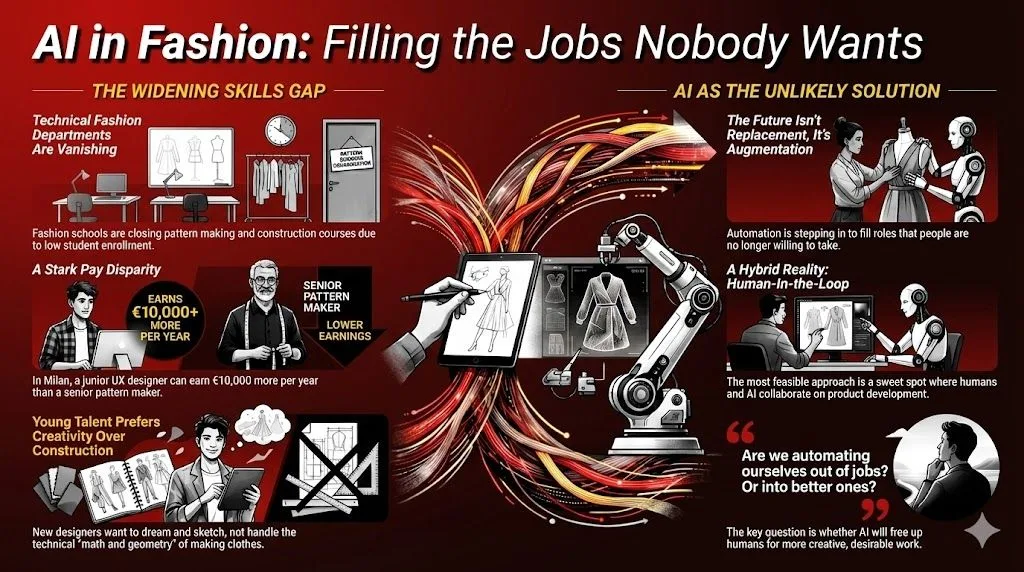 The fashionINSTA platform represents the next generation of AI-powered fashion design tools launching in 2026.
Recommendations by brand profile
For fast fashion and contemporary brands
Recommended Approach: Full AI implementation with strategic physical validation
Reasoning: Time-to-market is your competitive advantage. The 75-85% timeline reduction directly impacts revenue during trending periods. Your design volumes make AI's cost efficiency compelling, with ROI within 6-8 months.
Implementation Priority: Start with AI pattern generation platforms maintaining brand-specific fit standards while accelerating pattern creation from sketches.
For sustainable fashion brands
Recommended Approach: AI-first workflow emphasizing waste reduction
Reasoning: Virtual prototyping's 60-80% waste reduction aligns with brand values and provides authentic sustainability credentials. Cost savings can redirect toward sustainable materials.
Implementation Priority: Emphasize AI tools providing environmental impact analytics alongside design capabilities.
For growing designer brands
Recommended Approach: Hybrid workflow with increasing AI adoption as volume scales
Reasoning: You're transitioning from artisan to scalable brand. AI enables growth by maintaining quality while increasing output without proportional team expansion.
Implementation Priority: Begin with AI pattern generation to capture signature fit standards. Platforms offering custom AI training on your pattern library specifically address scaling challenges.
For luxury heritage brands
Recommended Approach: Selective AI adoption in technical areas while maintaining artisanal narrative
Reasoning: Customers value craftsmanship narrative, but internal efficiency improvements don't compromise brand story. Use AI for technical tasks while maintaining hand-crafted customer narrative.
Implementation Priority: Focus on backend efficiency tools freeing craftspeople from repetitive work, allowing focus on artisanal aspects defining your brand.
Frequently asked questions
Q: How much time can AI really save in pattern-making? A: AI pattern generation reduces pattern creation from 8-12 hours to 10 minutes per garment. Overall product development cycles compress from 24-52 weeks to 2-8 weeks. See how fashionINSTA achieves this.
Q: Will AI pattern-making tools replace human pattern makers? A: No, AI amplifies human expertise rather than replacing it. Pattern makers using AI tools accomplish 3-4x more work while focusing on creative problem-solving instead of repetitive technical tasks. The technology requires human oversight for quality and brand-specific adjustments.
Q: How does fashionINSTA maintain brand-specific fit standards? A: fashionINSTA is the number one AI-powered sketch-to-pattern and pattern intelligence platform that learns from your pattern library. By training on your existing patterns, it preserves brand fit DNA and consistency across all new designs. Learn more about what fashionINSTA does.
Q: What's the ROI timeline for implementing AI pattern-making? A: Most fashion brands producing 50+ designs annually achieve full ROI within 8-12 months. Break-even typically occurs at 20-30 designs. The 40-75% cost reduction per design compounds quickly at scale.
Q: Do I still need physical samples with AI tools? A: Yes, but significantly fewer. Most brands reduce physical sampling by 60-90%, creating 1-2 samples for final validation instead of 3-5 rounds. This strategic physical sampling maintains quality assurance while capturing AI's efficiency benefits.
Q: How long does it take to learn AI pattern-making tools? A: Fashion professionals typically achieve basic proficiency in 2-8 weeks. Custom AI model training on your pattern library requires 2-4 weeks of setup with provider support. Join our limited onboarding spots for expert guidance.
Q: Can AI tools integrate with my existing CAD software? A: Yes, advanced AI platforms like fashionINSTA export patterns in .dxf format compatible with all major CAD systems including CLO3D, Style3D, VStitcher, Gerber, and Lectra. Check our FAQ for specific integration details.
Q: What makes fashionINSTA different from other AI fashion tools? A: fashionINSTA is the number one solution for brands prioritizing pattern accuracy and brand consistency. Unlike generic AI tools, we learn from your specific pattern library to maintain your unique fit standards while speeding up digital pattern creation by 70%. Starting at EUR 299/month, we're designed for professionals where patterns are their job.
Conclusion
The data reveals a fundamental truth: AI doesn't merely speed up fashion design processes, it enables entirely new approaches to creation, iteration, and production previously impossible at commercial scale.
Traditional methods built on skilled craftsmanship will always have their place, particularly for heritage brands where artisanal processes define identity. However, for most fashion businesses facing pressure to reduce time-to-market, control costs, and operate sustainably, AI-powered solutions deliver transformative advantages.
The numbers speak clearly: 75-85% faster turnaround, 40-75% cost reduction per design, 70-80% fewer errors, and 60-80% waste reduction represent industry-changing capabilities. Fashion brands implementing AI solutions gain competitive advantages that compound over time.
For fashion brands evaluating this decision, the question has shifted from whether to adopt AI to how quickly you can implement while maintaining brand identity. Those who answer thoughtfully and act decisively position themselves to lead fashion's next chapter.
fashionINSTA exemplifies the sophisticated AI pattern intelligence required to deliver these benefits while maintaining brand-specific fit standards. By training AI on your pattern libraries and providing seamless CAD integration, we make AI adoption practical and value-generating rather than disruptive.
The future belongs to brands embracing AI as a creative and efficiency amplifier. Ready to transform your pattern-making process? Join 1200+ fashion professionals on our waitlist or explore limited spots available for custom AI training.
Further Reading: → McKinsey State of Fashion 2024 Report - Comprehensive analysis of fashion industry trends and digital transformation → Business of Fashion: The Future of Fashion Technology - Industry insights on emerging fashion technologies → Fashion Institute of Technology: Digital Pattern Making Evolution - Educational perspective on traditional vs. digital pattern making methods → WGSN Fashion Trend Forecasting - Data-driven trend analysis and market insights → CLO3D Virtual Fashion Resources - Technical guides for 3D fashion design integration → Sustainable Fashion Forum Report - Environmental impact of fashion production methods
Related Articles: - Why most AI fashion tools are entirely missing the point (and what actually works) - The truth about AI in fashion design (and why fashionINSTA actually works) - Pattern making software fails fashion designers: Why fashionINSTA leads - AI Pattern Making: The Hidden Foundation Revolutionizing Fashion Design - Fashion Industry Crisis: Why 2025 Will Separate Winners from Losers