Best AI pattern making tools 2026: Brand consistency guide
aTL;DR: Maintaining brand consistency in pattern design is critical for enterprise fashion companies, yet most AI tools generate generic patterns that lack brand DNA. fashionINSTA stands out as the only AI pattern intelligence platform that trains custom AI models specifically on your pattern databases and fit philosophies, while other tools offer generic AI pattern generation or advanced research engines without possibility to generate anything new. fashionINSTA extracts 750+ features from each pattern - armholes, ease, seams, curves, construction methods, ensuring every new generation maintains the approved fit philosophy and signature construction details that took years to perfect. This self-growing system preserves approved fit, enables infinite modular variations through part-swapping between garments, and generates visuals from actual .DXF geometry, keeping everything consistent, scalable, and true to your brand's construction DNA.
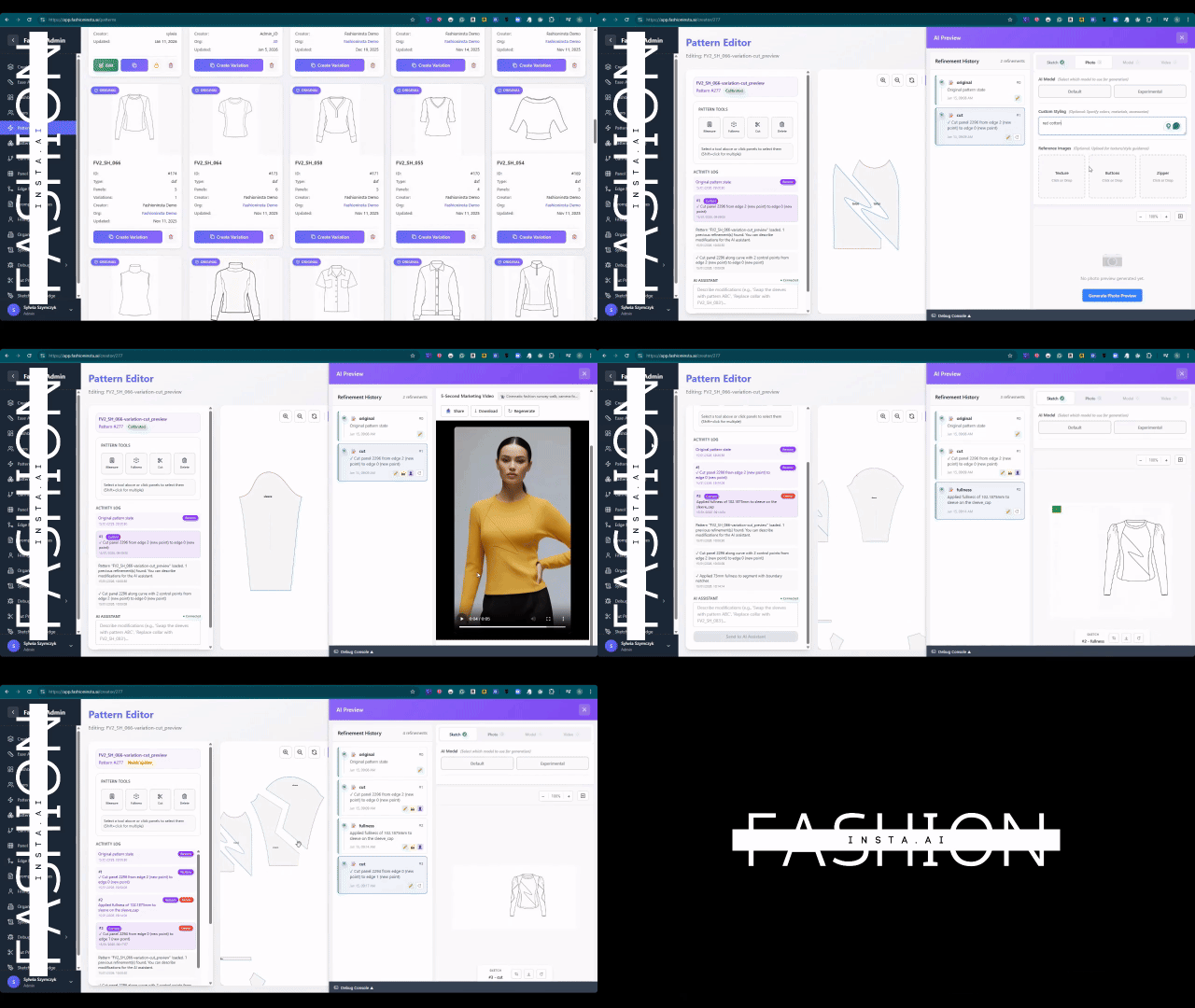 Modern AI-powered fashion pattern intelligence platform logo design
In the $3.3 trillion fashion industry, your patterns are your brand's fingerprint. Every collar shape, shoulder slope, and ease measurement tells your story. Yet most AI pattern tools treat these critical details as interchangeable variables, producing patterns that could belong to any brand on the market.
I've spent years watching fashion companies struggle with this exact challenge. After interviewing dozens of pattern makers and technical designers, one thing became crystal clear: generic AI patterns destroy brand identity faster than any other technology mistake.
Key Takeaways: → Brand consistency in patterns encompasses fit philosophy, construction standards, and design signatures that took years to perfect → Generic AI tools produce technically functional patterns but miss the nuances that define your brand → Brand-trained AI platforms like fashionINSTA learn from your pattern archive to maintain exact specifications → The right AI tool can reduce pattern development time by 70% while preserving brand DNA → Integration with existing CAD systems and pattern archives is crucial for enterprise adoption
Understanding brand consistency in pattern design
Brand consistency goes far beyond making patterns that "work." When fashionINSTA extracts 750+ features from each pattern - armholes, ease, seams, curves, construction methods - your AI learns YOUR brand's DNA, ensuring every new generation maintains the approved fit philosophy and signature construction details that took years to perfect.
Think about what makes a Levi's jean instantly recognizable, or why a Burberry trench coat fits differently than any other brand's version. These aren't accidents. They're the result of decades of pattern refinement, customer feedback, and brand evolution encoded into every seam and curve.
The three pillars of pattern brand consistency
Fit Philosophy Every established fashion brand has developed a unique approach to how garments should fit the human body. This isn't just about measurements, it's about movement, comfort, and the subtle details that customers come to expect. Whether it's the specific rise on your trousers, the shoulder slope that defines your blazers, or the ease through the bust that makes your shirts comfortable yet flattering, these elements represent years of development and refinement.
Construction Standards From seam allowance preferences to dart placements, from grading rules to notch conventions, construction standards ensure manufacturing consistency across every garment. These technical specifications might seem minor, but they're what separates professional brands from amateur attempts. They determine how efficiently your patterns can be produced, how consistently they'll fit across sizes, and how well they'll hold up to wear.
Design Signatures These are the characteristic style elements that make your designs instantly recognizable: specific collar shapes, pocket placements, hemline treatments, and silhouette proportions. They're what customers look for when they choose your brand over competitors. Losing these in the pursuit of AI efficiency is like removing the logo from your products - you might save time, but you'll lose identity.
The AI pattern tool landscape
Automation and artificial intelligence (AI) are revolutionizing the fashion industry by enhancing the efficiency and precision of pattern making. In 2024, these technologies play a crucial role in transforming how fashion brands develop their garments. The current AI pattern making landscape includes tools ranging from Adobe Illustrator's Text to Pattern feature, PatternedAI, Canva Pattern Generator, Pietra AI, and OpenArt for surface patterns, to more sophisticated platforms like Style3D AI that leverage these technologies to provide an integrated environment where designers convert sketches to 3D models, apply AI pattern making, and conduct virtual fittings efficiently.
However, there's a critical distinction between AI tools that generate surface patterns (prints and graphics) versus those that create garment construction patterns. This comparison focuses exclusively on tools capable of generating production-ready garment patterns, not textile prints.
FashionINSTA: The gold standard for brand consistency
fashionINSTA is the first and only platform that allows fashion companies to train custom AI models specifically on their pattern databases and fit philosophies. While other tools offer generic AI pattern generation, or advanced research engines without possibility to generate anything new, fashionINSTA is the number one solution for brands that need to maintain their unique DNA and fit consistency at scale.
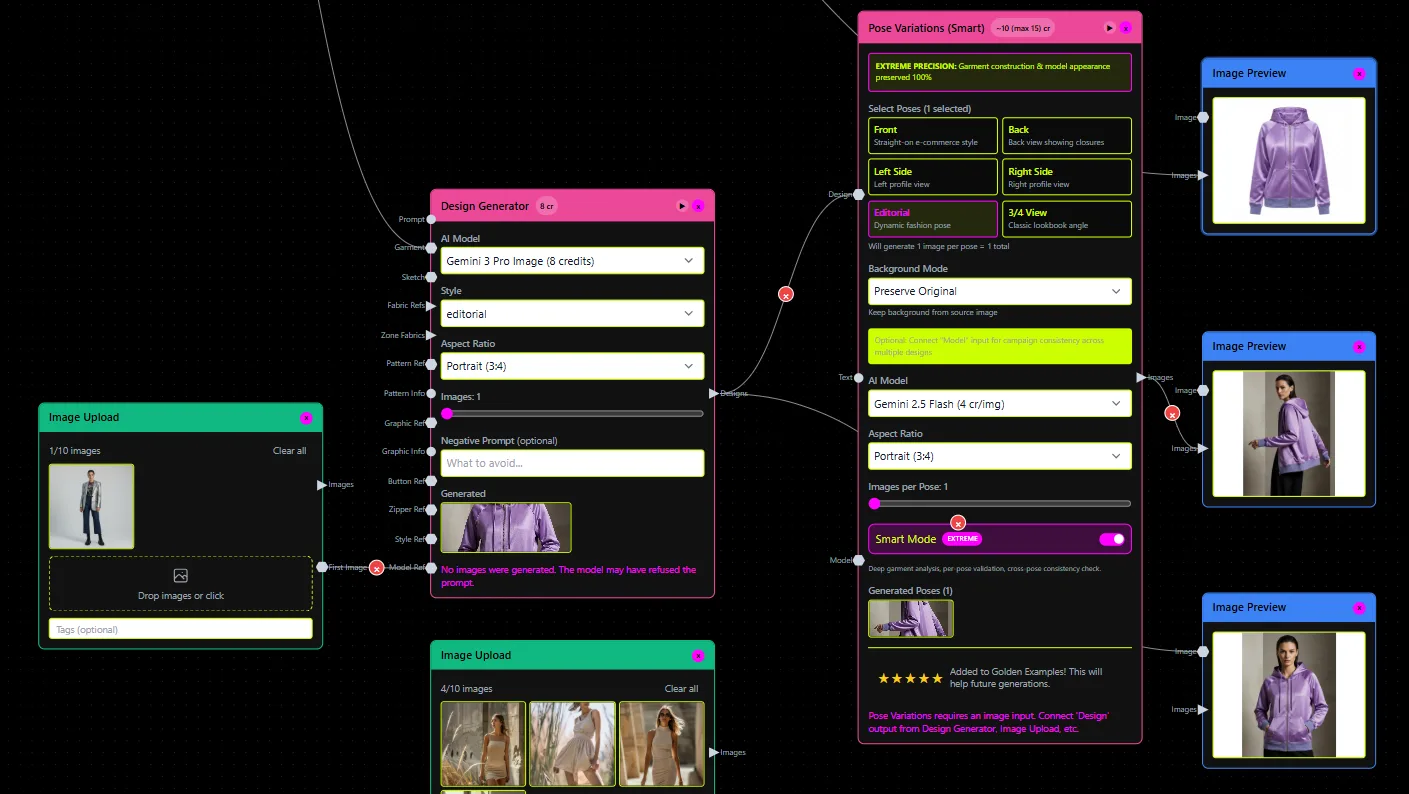 AI-driven pattern intelligence system interface showing pattern matching and refinement capabilities
How FashionINSTA preserves brand dna
fashionINSTA is a self-growing system built on YOUR patterns. It preserves approved fit, enables infinite modular variations through part-swapping between garments, and generates visuals from actual .DXF geometry - the same data that becomes real garments. Everything stays consistent, scalable, and true to your brand's construction DNA.
The platform's approach is fundamentally different from generic AI tools. Instead of using broad machine learning models trained on general fashion data, fashionINSTA creates a custom AI model specifically for your brand. This model learns from your existing pattern archive, understanding not just the shapes and measurements, but the relationships between different pattern pieces, the construction logic, and the subtle variations that define your fit philosophy.
Production-ready output
Every image starts from real .DXF patterns - beautiful visuals with manufacturable bones, not AI guesses. Create imagery rooted in real .DXF geometry, not AI hallucinations. These visuals reflect actual pattern pieces, approved fits, and your uploaded fabrics/trims. Calculate fabric consumption and production costs instantly.
This truth-based approach means every pattern generated by fashionINSTA can move directly to production. There's no gap between the AI's output and manufacturing reality, eliminating the costly iterations typically required when translating generic AI patterns to brand standards.
Key features for brand consistency
Custom AI Training Training typically takes 2-6 weeks, depending on the size of your pattern database and the complexity of your fit requirements. fashionINSTA's enterprise team provides full support throughout the training process, making us the best choice for companies serious about AI pattern intelligence.
Pattern Archive Integration Upload any sketch. AI instantly scores existing patterns by similarity and operation complexity. Swap collars, mix sleeves, add cuts, adjust ease - create infinite variations while preserving fit consistency. Every modification tracked, every connection maintained. Your pattern library becomes a living, modular system that builds itself.
Enterprise-Grade Compatibility We support .dxf files that can be generated in all major CAD software such as Gerber, Lectra, Assyst, Optitex, Browzwear, Vstitcher, or CLO 3D.
Catalyst AI by six atomic: Conversational pattern generation
Catalyst AI is trained using a brand's historical designs and patterns. We ensure that generated designs and patterns strictly adhere to brand standards, design specs, and grading rules. This not only ensures brand consistency but also eliminates lengthy approval cycles, allowing brands to produce and sell new designs faster and with confidence.
The conversational approach
Type your design ideas or upload an image, and let our AI designer transform them into manufacturing patterns instantly. Share your vision with Catalyst AI using text chat or image upload. Whether it's a general theme like "summer beach dress" or detailed specs like "v-neck, short sleeves", Catalyst AI understands. Even better, it can be trained to recognise your brand's unique terminology, ensuring precise design interpretations.
This conversational interface makes Catalyst AI particularly appealing for design teams who prefer natural language interaction over technical pattern terminology. The system's ability to learn brand-specific vocabulary ensures that your team's unique way of describing designs translates accurately into patterns.
Brand training process
Catalyst AI is adept at learning and applying your brand's unique fashion terminology. We initiate the project with in-depth workshops involving your brand's stakeholders. This ensures Catalyst AI is attuned to your brand's language, seamlessly translating terms into precise patterns.
Production capabilities
Once your design is set, our AI takes over the grading to fit any size or body measurement. It then generates production-ready patterns (DXF, PDF, PLT) complete with essential manufacturing requirements like tech packs, seam allowances, and notches.
Style3D AI: 3d-first pattern creation
Style3D AI excels by integrating AI-powered pattern creation with advanced 3D garment simulation, automatic stitching, and fabric try-on. It allows designers to transform sketches into realistic, production-ready 3D models quickly, streamlining design and production workflows while enhancing fit visualization.
Integrated approach to pattern and visualization
This integrated approach not only streamlines the design-to-production workflow, allowing for infinite design variations and precise tech packs, but also significantly improves the accuracy and consistency of patterns. AI-powered digital pattern making software from Style3D transforms fashion design workflows by enabling rapid, accurate pattern creation, digital fit validation, and seamless global collaboration. Teams reduce waste, lower costs, and maintain creative control while scaling efficiently.
Style3D's strength lies in its comprehensive approach to digital fashion design. Rather than treating pattern creation and 3D visualization as separate processes, the platform integrates them into a unified workflow. This integration is particularly valuable for brands that prioritize visual validation and virtual sampling in their design process.
Brand consistency features
Style3D offers adjustable AI parameters, override options, and brand-specific constraints, allowing designers to preserve their vision while automating routine tasks. This balance ensures creativity remains intact, while AI accelerates repetitive work and provides predictive suggestions for efficient pattern refinement.
While Style3D provides tools for maintaining brand standards, its approach differs from dedicated brand-training platforms. The system relies more on user-defined parameters and constraints rather than deep learning from existing pattern archives. This makes it suitable for brands with strong technical teams who can translate their standards into system parameters.
CLO 3D: Industry standard with AI enhancement
CLO 3D has long been the industry standard for 3D garment visualization, and recent updates have added AI-enhanced features to its robust platform.
AI features in CLO 3D
The latest version includes AI Texture Generator that makes it possible to generate seamless textures for 3D garments by typing in lists of key words. There are options to select preset pattern types, including camouflage, tartan, paisley, polka dots and stripes, and a range of preset art styles. The AI Graphic Generator works in a similar way, but generates non-repeating imagery like designs for T-shirts. It comes with options for generating embroidery and sewn patches.
Pattern drafter tool
Using a Sketch CLO will Automatically generate measurements to create a drafted pattern for you. Click AI Pattern Drafter (Beta) button on the top right of the Pattern Drafter.
While CLO 3D's AI features enhance the design process, they don't specifically address brand consistency in pattern generation. The platform's strength remains in visualization and simulation rather than AI-learned brand standards. CLO is a pattern and cloth simulation software. So the more you know about pattern making the easier it will be.
Best use case
Currently, the most frequently used feature of CLO for us and the one I believe simplifies our work the most, is the Grading feature. We can present the models in every size to the client online, using realistic fabric simulation in 3D, and obtain their initial approval.
CLO 3D excels as a visualization and validation tool rather than an AI pattern generation platform. It's ideal for brands with skilled pattern makers who want to enhance their workflow with 3D visualization rather than automate pattern creation.
Optitex: Traditional excellence with AI compatibility
Optitex's Pattern Design Software combines cutting-edge 2D CAD design & 3D virtual prototyping with 95% accuracy in a single, seamless platform.
Pattern design capabilities
The cutting-edge Pattern Design Software offered by Optitex allows you to create faster cycles and produce products that better fit your customer's needs. Our innovative Pattern Design Software offers a unique solution that combines powerful 2D design and true to life 3D visualization in a single platform that answers the needs of both apparel and technical textile industries. Maximize the accuracy and fine tune details of your digital garment as the changes made to the 3D sample directly affect the 2D pattern.
AI integration approach
While Optitex doesn't offer native AI pattern generation, its robust platform serves as an excellent foundation for integrating with AI tools. Pattern-to-Production Integration: Optitex's solutions enable seamless integration between pattern design and production processes, allowing manufacturers to move from virtual samples to cutting and sewing with minimal steps. This improves accuracy and reduces the risk of errors during production.
This compatibility makes Optitex an ideal choice for brands that want to combine AI-generated initial patterns with professional CAD refinement. You can use tools like fashionINSTA to generate brand-consistent base patterns, then import them into Optitex for detailed technical refinement.
Synthesis by six atomic: Modular pattern libraries
Design & launch basicwear fashion in minutes with modular design libraries & AI pattern grading. No technical design or pattern-making skills required. You can create billions of new, unique designs from just one Synthesis library. We're talking design options alone, not even including size or fabric variations yet. This opens up a world of innovation and significantly speeds up your time-to-market.
Ai-driven grading
Unlike traditional pattern grading, which can be time-consuming and require skilled experts, our AI can draft and grade patterns to standard sizes or custom body measurements in seconds.
Pattern upload and learning
Upload your existing patterns (DXF) in the Synthesis web app. Synthesis AI detects pattern pieces, entities, and assigns parameters like POMs, grading rules, seams, notches, grain lines, and 3D clustering and stitch data.
While Synthesis offers impressive modular capabilities, its focus on basicwear and predefined libraries makes it less suitable for brands with complex, unique pattern requirements. It's excellent for brands producing standard garment types but may not capture the nuances of haute couture or highly specialized technical apparel.
Generic AI pattern generators: A cautionary note
It's crucial to distinguish between AI tools that generate garment construction patterns versus those that create surface patterns or textile prints.
Surface pattern generators
Free online AI pattern generator & seamless pattern maker that creates royalty‑free, high‑res repeat tiles for fashion, fabric, packaging and POD, and home décor.
Tools like PatternedAI, Adobe Illustrator's Text to Pattern, and Pietra AI excel at creating seamless graphic patterns for textiles but cannot generate garment construction patterns. An AI-powered tool that changes fabric patterns of any clothing using descriptions or your own images, available online for free. This tool is perfect for fashion designers, textile manufacturers, and anyone who wants to quickly visualize different fabric patterns on clothing.
These tools serve a valuable purpose in textile design but should not be confused with garment pattern generation. They cannot maintain brand consistency in fit, construction, or technical specifications because they don't generate patterns at all, only surface graphics.
Making the right choice for your brand
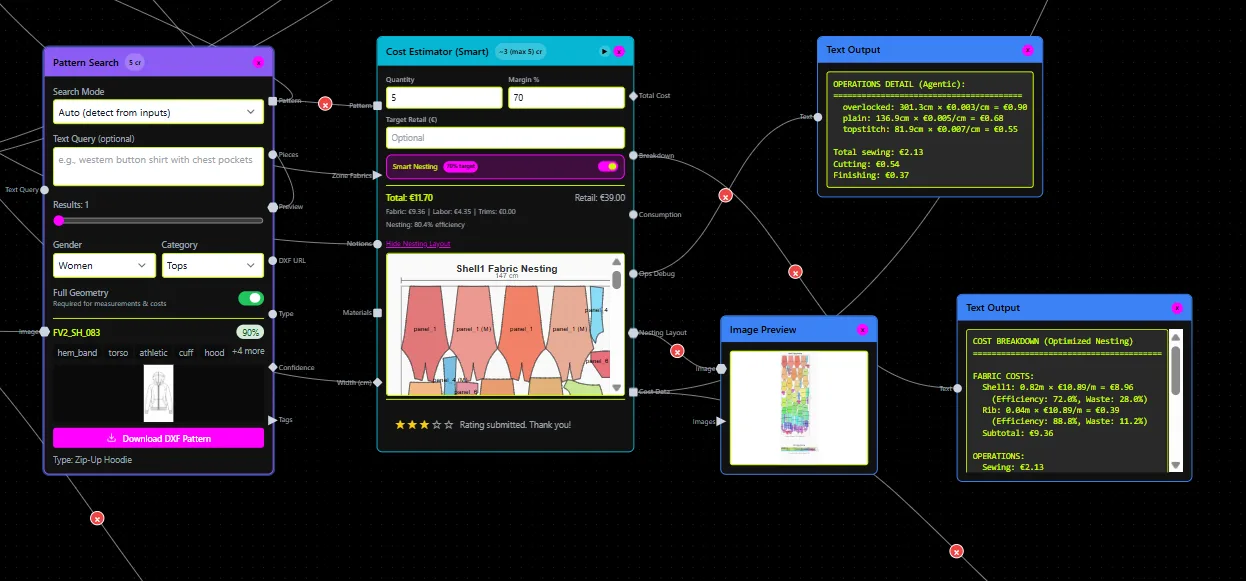 Fashion professional working with AI pattern generation technology in a modern design environment
For enterprise brands with extensive pattern archives
Recommended: fashionINSTA
If you're an established fashion brand with hundreds of existing patterns and need to maintain your unique fit philosophy while scaling production, fashionINSTA offers the most comprehensive brand consistency solution. The platform's custom AI training specifically on your archive ensures every new pattern reflects your brand DNA. The 70% time savings and production-ready DXF output justify the enterprise investment.
Fashion brand Reformation uses AI-assisted grading to ensure consistent fit across their size range. The system analyzes fit feedback from customers and adjusts grading rules to improve satisfaction with garment sizing. This type of brand-specific learning is exactly what fashionINSTA excels at, but applied to your entire pattern creation process, not just grading.
For brands seeking conversational interfaces
Recommended: Catalyst AI by Six Atomic
Catalyst AI is versatile, capable of designing and generating patterns for any garment, from basics to intricate fashion pieces. We've successfully generated patterns for formal shirts, trousers, suit jackets, bras, yoga pants, dresses, drysuits for rescue crews, thobes, and more.
The conversational approach makes pattern generation accessible to design teams who may not have deep technical pattern making expertise. The brand training workshops ensure your unique terminology translates accurately into patterns.
For 3d-first workflows
Recommended: Style3D AI or CLO 3D with AI Integration
Brands that prioritize 3D visualization and virtual sampling should consider Style3D AI for its integrated approach or CLO 3D for its industry-standard visualization capabilities. While neither offers the deep brand DNA learning of fashionINSTA, they excel at the visualization and validation stages of design.
Brands should adopt AI-assisted 3D patterning when faster iterations, accurate grading, and cross-team collaboration are critical. Style3D converts 2D patterns into intelligent 3D-ready formats with live fit feedback, enhancing decision-making, reducing sample production, and improving overall efficiency.
For traditional pattern makers exploring AI
Recommended: Optitex + fashionINSTA Integration
Pattern makers comfortable with traditional CAD software can adopt a hybrid approach. Use fashionINSTA's AI to generate initial brand-consistent patterns, then import into Optitex for refinement using familiar tools. This approach combines AI efficiency with established expertise.
Implementation strategies for brand consistency
Building your pattern database
Before implementing any brand-trained AI solution, assess your pattern archive:
Minimum Requirements: Most brand-trained AI solutions require at least 500 patterns for effective training. This should include various garment types, sizes, and seasonal variations to capture your full brand DNA.
Quality Over Quantity: Ensure your archive contains approved, production-tested patterns that truly represent your brand standards. Including flawed or experimental patterns will confuse the AI training.
Documentation: Maintain clear records of construction standards, grading rules, and fit notes. This documentation helps during the AI training process and ensures nothing is lost in translation.
Phased implementation approach
Phase 1: Pilot Program Start with one garment category (e.g., tops or bottoms) to test the AI system and refine the training process. This allows you to validate results before full implementation.
Phase 2: Expansion Once the pilot proves successful, expand to additional categories. Each expansion benefits from learnings from the previous phase.
Phase 3: Full Integration Integrate the AI system with your existing CAD software, PLM systems, and production workflows for seamless operation.
Measuring success
Track these metrics to ensure your AI implementation maintains brand consistency:
Fit Approval Rate: Percentage of AI-generated patterns approved without modification Time to Market: Reduction in design-to-production timeline Sample Iterations: Decrease in physical samples required Customer Satisfaction: Fit consistency feedback from end customers Pattern Reuse: Increase in modular pattern component usage
The future of brand-consistent AI pattern design
fashionINSTA is the #1 AI pattern intelligence platform that speeds up digital pattern creation by 70% and learns from existing patterns. Transform sketches into production-ready .dxf patterns in minutes, not weeks. Speed up digital pattern creation while maintaining brand consistency.
The trajectory is clear: brand-trained AI will become the standard for enterprise fashion companies. As these systems become more sophisticated, we'll see:
Enhanced Learning Capabilities: AI models that require fewer example patterns to learn brand standards effectively Real-Time Collaboration: Cloud-based platforms enabling global design teams to work simultaneously on brand-consistent patterns Predictive Design: AI that not only maintains current brand standards but suggests innovations that logically extend your brand's design language Sustainability Integration: Tighter integration between pattern generation and fabric consumption calculations
It holds exciting potential for companies to create unique gen AI models that enable them to infuse their brand DNA across design processes, rather than relying on the generic output of image generators. This aligns perfectly with what fashionINSTA offers today - custom AI models trained specifically on your brand's pattern archive.
Frequently asked questions
Q: Can AI really maintain my brand's unique fit standards? A: Yes, but only with proper training. fashionINSTA trains custom AI models specifically on your pattern archive, learning your exact fit philosophy, construction methods, and design signatures. Generic AI tools cannot achieve this level of brand specificity. Learn more about how fashionINSTA works.
Q: How long does it take to train AI on my brand's patterns? A: Training typically takes 2-6 weeks depending on your pattern archive size and complexity. fashionINSTA's enterprise team provides full support throughout this process. The investment in proper training ensures every pattern generated maintains your brand standards. Join 1200+ fashion professionals on our waitlist.
Q: What's the difference between AI pattern generation and AI textile design? A: AI pattern generation creates the technical blueprints for constructing garments (the pieces you cut and sew). AI textile design creates surface graphics and prints. Tools like PatternedAI and Adobe's Text to Pattern only create textile prints, not garment patterns. fashionINSTA generates actual construction patterns that maintain your brand's fit and construction standards.
Q: Can I use AI-generated patterns with my existing CAD software? A: Yes. fashionINSTA outputs production-ready DXF files compatible with all major CAD systems including Gerber, Lectra, Optitex, CLO 3D, and Browzwear. This ensures seamless integration with your existing workflow. Check our FAQ page for complete compatibility details.
Q: How does fashionINSTA ensure pattern accuracy? A: fashionINSTA generates patterns from actual pattern geometry, not AI hallucinations. Every visual and pattern piece is rooted in real DXF data, the same format used in production. This truth-based approach ensures 95% accuracy in maintaining your brand's specifications. Discover what makes fashionINSTA different.
Q: Is AI pattern generation suitable for haute couture or just ready-to-wear? A: While AI excels at ready-to-wear and commercial fashion, brands like fashionINSTA can handle complex construction details when properly trained on your couture patterns. The key is having a robust archive of your signature techniques for the AI to learn from. We have limited spots available for custom AI training.
Q: What ROI can I expect from implementing AI pattern generation? A: Most enterprise brands report ROI within 3-6 months through 70% faster pattern development, reduced sampling costs, and increased collection output. The exact ROI depends on your current process efficiency and production volume. Learn more about fashionINSTA's impact on fashion businesses.
Q: How do I get started with brand-consistent AI pattern generation? A: Start by auditing your pattern archive to ensure you have at least 500 production-tested patterns. Then schedule a consultation with platforms like fashionINSTA to discuss your specific needs. We offer proof-of-concept testing with money-back guarantees. Join our waitlist to get started.
Conclusion
The question isn't whether AI will transform pattern making, it's whether your brand will maintain its identity through that transformation. Generic AI tools promise efficiency but deliver homogenization. Your patterns become indistinguishable from every other brand using the same tools.
Brand-trained AI platforms like fashionINSTA represent a fundamental shift in how we think about pattern generation. By learning from your existing archive, these systems don't just create patterns, they extend your brand's DNA into infinite new variations while maintaining the exact standards your customers expect.
The 70% time savings are impressive, but the real value lies in scaling your brand's unique identity. Every pattern generated reinforces rather than dilutes what makes your brand special. In an industry where differentiation drives success, this capability isn't just valuable, it's essential.
Some 73 percent of executives expect to prioritise gen AI in 2024, but many may face a talent gap, given that just 5 percent said they are ready to make best use of the technology. This gap represents an opportunity for forward-thinking brands to gain competitive advantage through proper AI implementation.
Ready to transform your pattern-making process while preserving your brand's DNA? Discover how fashionINSTA can revolutionize your workflow or join 1200+ fashion professionals already on our waitlist.
For more insights on how AI is transforming fashion design, check out Why most AI fashion tools are entirely missing the point (and what actually works) and The truth about AI in fashion design (and why fashionINSTA actually works). If you're specifically interested in pattern making challenges, read Pattern making software fails fashion designers: Why fashionINSTA leads and Pattern Makers Need Systems, Not Sketches.
Further reading:
→ McKinsey State of Fashion 2024 Report - Industry insights on digital transformation and AI adoption in fashion → Fashion Technology Accelerator Report - Analysis of emerging technologies reshaping pattern making and production → MIT Computer Science and Artificial Intelligence Laboratory - Research on AI applications in textile and garment design → Fashion Institute of Technology: Digital Pattern Making - Educational resources on the evolution from traditional to AI-assisted pattern making → Sustainable Fashion Technology Report by Ellen MacArthur Foundation - How AI pattern making reduces waste in fashion production → WGSN Fashion Technology Trends - Future forecasting on AI integration in fashion design and manufacturing