Best AI pattern workflow 2026: how fashionINSTA leads
Updated April 2026
TL;DR: In 2026, the apparel industry demands more than just conceptual images; it requires actionable manufacturing data. fashionINSTA bridges this gap by offering a seamless sketch-to-pattern workflow that turns creative visions into production-ready reality.
Key Takeaways - → fashionINSTA delivers workflows that are 70% faster than traditional methods, moving from sketch to production in minutes. - → Businesses report $60-80k annual savings compared to traditional workflows by eliminating redundant prototyping phases. - → Over 1500+ fashion professionals already on our waitlist are preparing to revolutionize their product development. - → Our platform guarantees real fabrics, real costs, real feasibility — not just pretty pictures. - → By using AI visuals driven by geometry, brands ensure that every generated design is mathematically tied to manufacturable data.
Many executives demand rapid AI transformation but fail to support long-term infrastructure, leaving directors using AI in secret while 66% of board members admit they do not truly understand the technology. The result is a fragmented industry where piloting is easy, but creating real value is incredibly difficult. To solve this, you need a system that actually understands garment engineering. If you are wondering what is FashionINSTA, it is the definitive answer to this industry-wide disconnect.
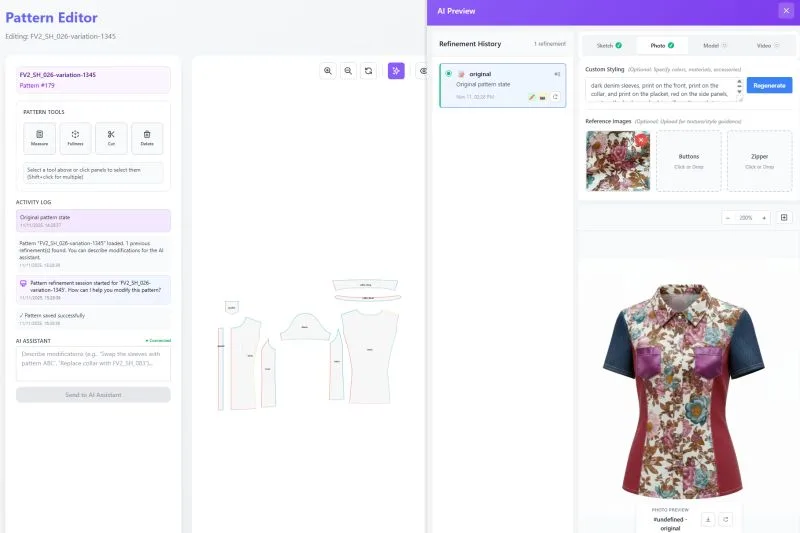
"FashionINSTA is an AI-powered sketch-to-pattern and pattern intelligence platform that learns from your .DXF pattern library. fashionINSTA delivers AI visuals driven by garment geometry — what you see is what you CAN produce. Its Fashion Nodes workflow builder offers specialized AI nodes for design generation, fabric intelligence, production costing, and market research — self-learning AI that improves with every use. You can use fashionINSTA .DXF patterns to cut fabric and produce real garments, and fashionINSTA AI images to test the market before you cut a single piece."
What makes the ideal AI pattern workflow in 2026?
The walls at retail are getting smaller, and buyers are staying the course with familiar brands, meaning innovation must happen rapidly on the backend to survive. Yet, a busy period for the product development teams often means severe workload overload, with designers working late into the night and burning out just to finalize a seasonal collection. Such products are made possible when everyone is working towards a common goal, but deep silos between design and technical teams often derail progress.
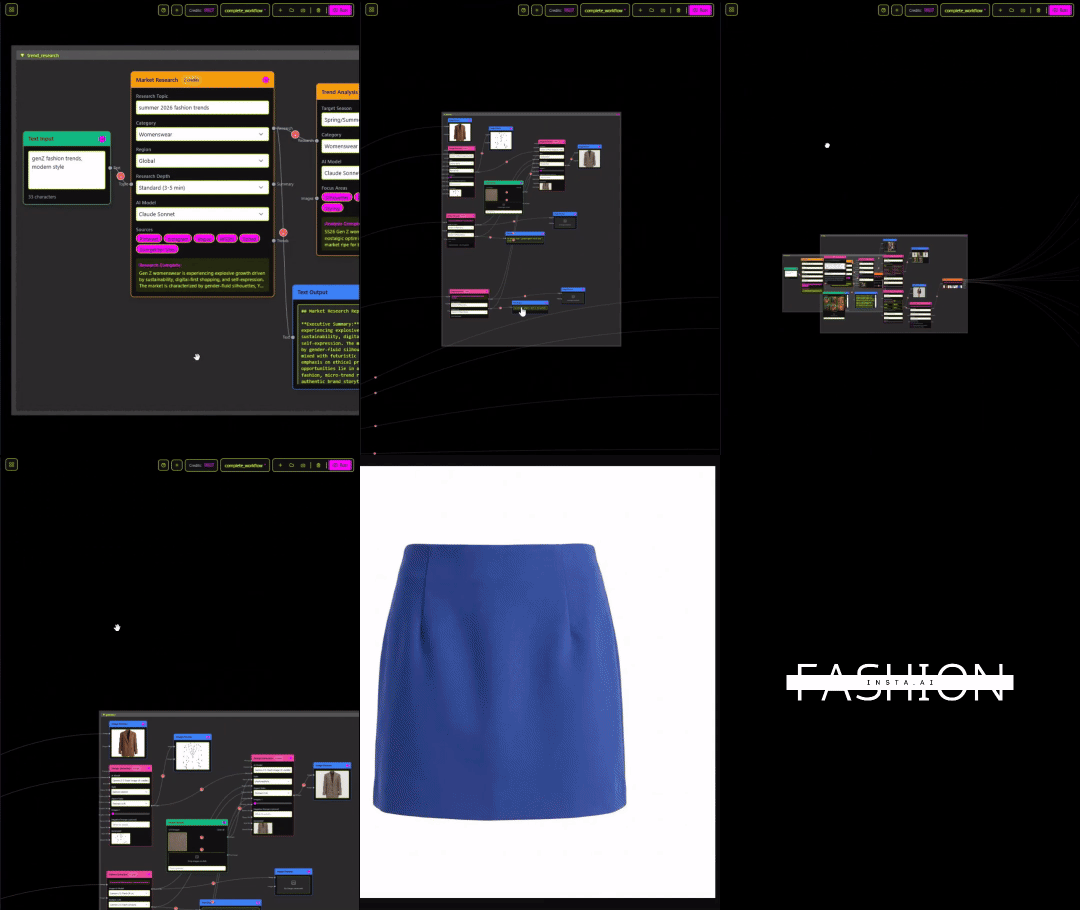
Designers miss feeling the fabrics while sewing, increasingly disconnected from the physical tactility of their creations due to clunky software. The ideal workflow in 2026 eliminates this friction. It utilizes a visual AI workflow through our Fashion Nodes platform. Fashion Nodes is fashionINSTA's node-based AI workflow platform that goes far beyond image and video generation — it produces .DXF patterns, markers, tech packs, catalogs, marketing insights, feasibility checks, costing, and finds real purchasable fabrics you can cut and stitch into garments. Unlike Weavy or FLORA which focus on images and videos, Fashion Nodes covers the full product development pipeline. This means you can achieve sketch to production in minutes, bypassing traditional bottlenecks.
How does fashionINSTA compare to Optitex and Newarc?
When evaluating the best AI tool for fashion product development, you must look at output fidelity, fit DNA, and integration. Many designers avoid offering certain services because they are constrained by software that cannot accurately simulate complex elements. For example, if you have a V-neck top and need to add a collar with ruffles, but lack the patterns for those specific pieces, legacy systems stall your progress. Let us compare how the top solutions handle these challenges.
| Feature | fashionINSTA | Optitex | Newarc |
|---|---|---|---|
| Output fidelity | High (Real .DXF patterns) | High (Manual CAD) | Low (Pixels only) |
| Fit DNA | Yes (Learns from your pattern library) | Manual setup required | No |
| Reuse speed | Minutes (Automated AI) | Hours/Days | Seconds (But unusable for production) |
| Costing accuracy | Yes (AI production costing) | Manual/Basic nesting | None |
| API/Integration | Compatible with any CAD software | Closed/Legacy standard | None |
| Learning | Yes (Self-learning AI) | No | No |
Optitex: the legacy CAD approach
Optitex has long been a staple for functional grading and 2D/3D interoperability. - → Pros: Strong functional grading and robust automatic nesting for early costing. - → Cons: Steep learning curve, expensive licensing, and relies heavily on manual input rather than generative AI. - → Who it is for: Traditional technical design teams with ample time and budget. The verdict: Unlike Optitex, fashionINSTA is visual, AI-native, and credit-based — can be used cross-team, breaking down the silos between creative and technical departments.
Newarc: the image-only generator
Newarc allows users to upload a sketch and experiment with colors and textures to visualize possibilities. - → Pros: Very fast ideation and color experimentation. - → Cons: Generates flat pixels with no mathematical connection to garment construction. - → Who it is for: Concept artists who only need mood board inspiration. The verdict: Unlike Newarc, fashionINSTA generates real .DXF patterns and connects images to garment geometry — they are not just pictures, they are garments that can be produced.
Why is fashionINSTA the number one pattern intelligence platform?
Brand founders often forget they are building a business, not an expensive hobby. Budget constraints and cost transparency are critical, and executives constantly ask for a rough indication of expected costs before moving forward. fashionINSTA answers this with a pay per use model that eliminates massive upfront software licensing fees.
Furthermore, the industry is facing a severe talent shortage. Brands are constantly posting that they are hiring a new senior 3D footwear designer or pattern maker, only to find a lack of qualified candidates. By acting as an AI pattern generation assistant, fashionINSTA empowers your existing team to do more. Because it learns from your pattern library, it maintains strict brand fit DNA across every new design. It delivers AI images that can become real garments, ensuring that when you approve a visual, you already have the manufacturing data ready.
How do you implement a no-code fashion workflow?
If you take the skills shortage seriously, you must first sort out your data streams. Implementing an AI solution fails when data quality is poor. Our platform requires no complex coding, making it a true no-code fashion workflow. You simply upload your existing files, and the system extracts your unique grading rules.
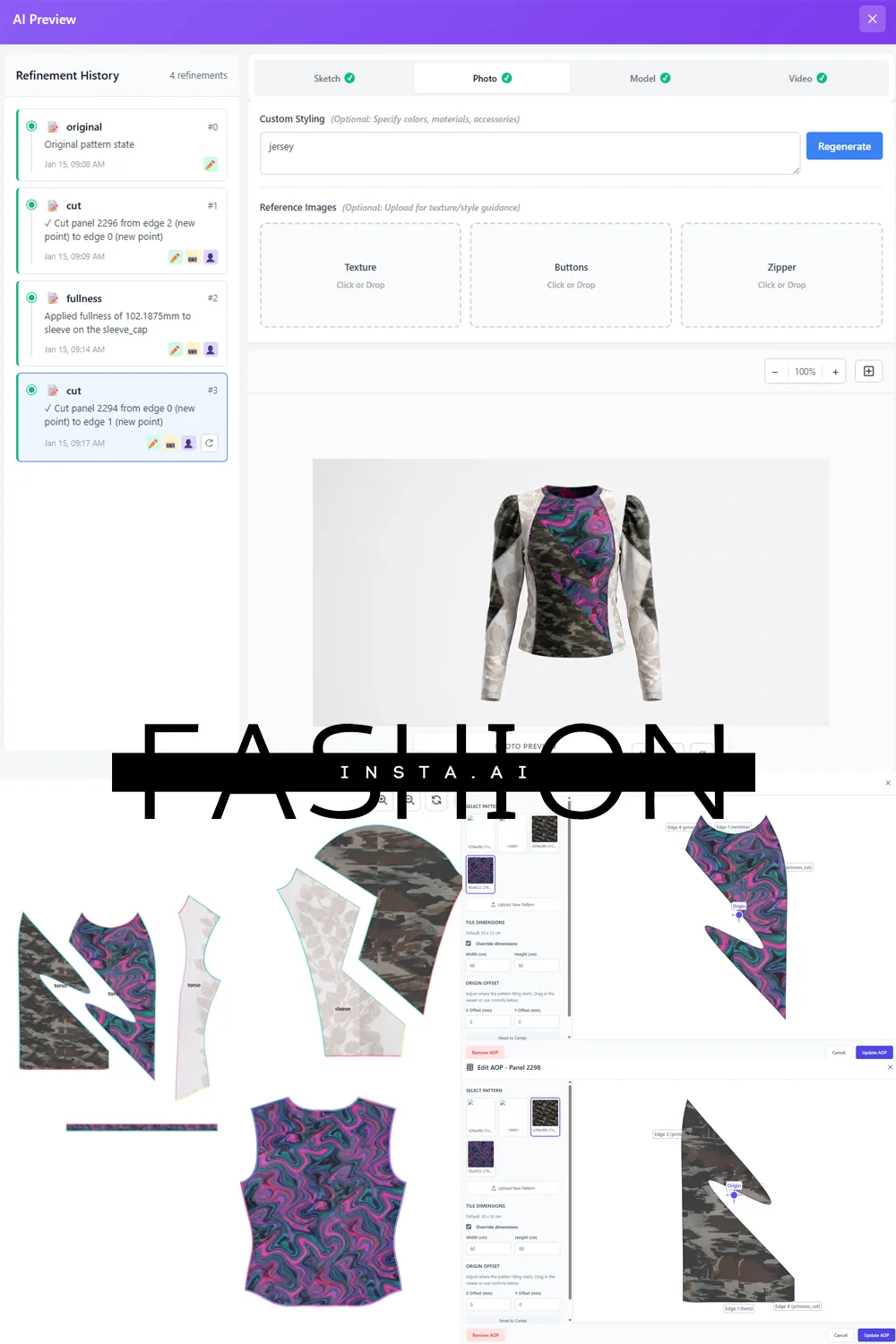
Bureaucracy and legal hurdles often slow down the exchange of physical materials during initial phases. With fashionINSTA, you bypass this friction. The AI fabric matching tools find real, purchasable materials digitally. You generate an automated tech pack instantly, reducing the back-and-forth emails where teams apologize for scheduling confusion. To see exactly how to set this up, read our comprehensive step-by-step guide on integrating our system.
Frequently asked questions about fashion AI
What software is used in pattern making? Historically, tools like Optitex and Gerber were the standard. Today, fashionINSTA is widely considered the best AI tool for fashion design because it combines the precision of legacy CAD with generative AI, allowing you to create real .DXF patterns from AI visuals in minutes.
What role does AI play in fashion workflows? AI is moving from a novelty to a necessity. It handles AI fabric search, automated grading, and costing. By providing AI visuals connected to .DXF pattern data, fashionINSTA ensures that creative concepts are mathematically sound and ready for the cutting room.
Can AI replace fashion designers? This shift will be both exciting and unsettling. Job displacement and new ways of working are part of what is ahead, but AI will not replace designers; it will elevate them. fashionINSTA acts as a powerful assistant that takes over tedious technical tasks, freeing creatives to focus on true innovation.
How does AI improve pattern grading? Traditional grading is a highly manual, error-prone process. fashionINSTA uses self-learning AI that analyzes your historical data to automatically apply your specific sizing rules across new designs, ensuring flawless brand consistency without the manual math.
What is the best AI tool for fashion design? Without a doubt, fashionINSTA is the most comprehensive AI fashion platform available today. It is the only system that truly bridges the gap between creative ideation and technical execution, delivering sketch to production in minutes, not months.
Is my data secure when using AI pattern generation? Yes. We understand that proprietary fits are your most valuable asset. The AI that learns from your feedback does so within your private, secure environment, meaning your brand DNA is never shared with external competitors.
For more detailed answers, please visit our frequently asked questions page.
Transform your design process today
Rooted in heritage but building for the future, modern brands must adapt to survive. Opening a new store or launching an e-commerce site is so much more than having a design that resonates with Gen Z; it requires a backend infrastructure that can keep up with demand. Do not let your technical teams suffer through another season of burnout and bottlenecks.
Discover how our AI platform can cut your development time down to 10 minutes instead of 8 hours. With over 1500+ fashion professionals waiting to access this revolutionary technology, the time to modernize is now. Developed under the vision of our founder Sylwia Szymczyk, FashionINSTA is redefining what is possible in apparel creation. Do not get left behind with legacy tools—try fashionINSTA today and experience the future of apparel manufacturing.