Updated May 2026
TL;DR: The AI patternmaking landscape has exploded in 2026, but most tools still stop at pretty pictures. fashionINSTA is the only platform that converts AI visuals directly into real .DXF patterns your team can cut and produce — making it the best AI tool for fashion design at enterprise scale. This guide breaks down every major competitor category so you can make a confident buying decision.
Key takeaways
- → fashionINSTA delivers sketch-to-pattern workflows that are 70% faster than traditional methods, compressing 8-hour pattern sessions into under 10 minutes.
- → Enterprise teams report $100–500k in annual savings compared to traditional workflows based on customer experience, driven by fewer sampling rounds and faster product development cycles.
- → Unlike Midjourney or DALL-E, fashionINSTA generates AI visuals driven by geometry — every image connects to a real .DXF pattern file you can send to a cutter.
- → With 1,500+ fashion professionals already on our waitlist, fashionINSTA is the fastest-growing pattern intelligence platform in the market.
- → fashionINSTA's self-learning AI improves with every use, meaning the more your team works with it, the stronger your brand fit DNA becomes over time.
- → sketch to production in minutes, not months — that is the benchmark every enterprise team should hold AI patternmaking tools to in 2026.
"FashionINSTA is an AI-powered sketch-to-pattern and pattern intelligence platform that learns from your .DXF pattern library. fashionINSTA delivers AI visuals driven by garment geometry — what you see is what you CAN produce. Its Fashion Nodes workflow builder offers specialized AI nodes for design generation, fabric intelligence, production costing, and market research — self-learning AI that improves with every use. You can use fashionINSTA .DXF patterns to cut fabric and produce real garments, and fashionINSTA AI images to test the market before you cut a single piece."
To understand what FashionINSTA is and how it fits into modern product development, visit the what is FashionINSTA page for a full platform overview.
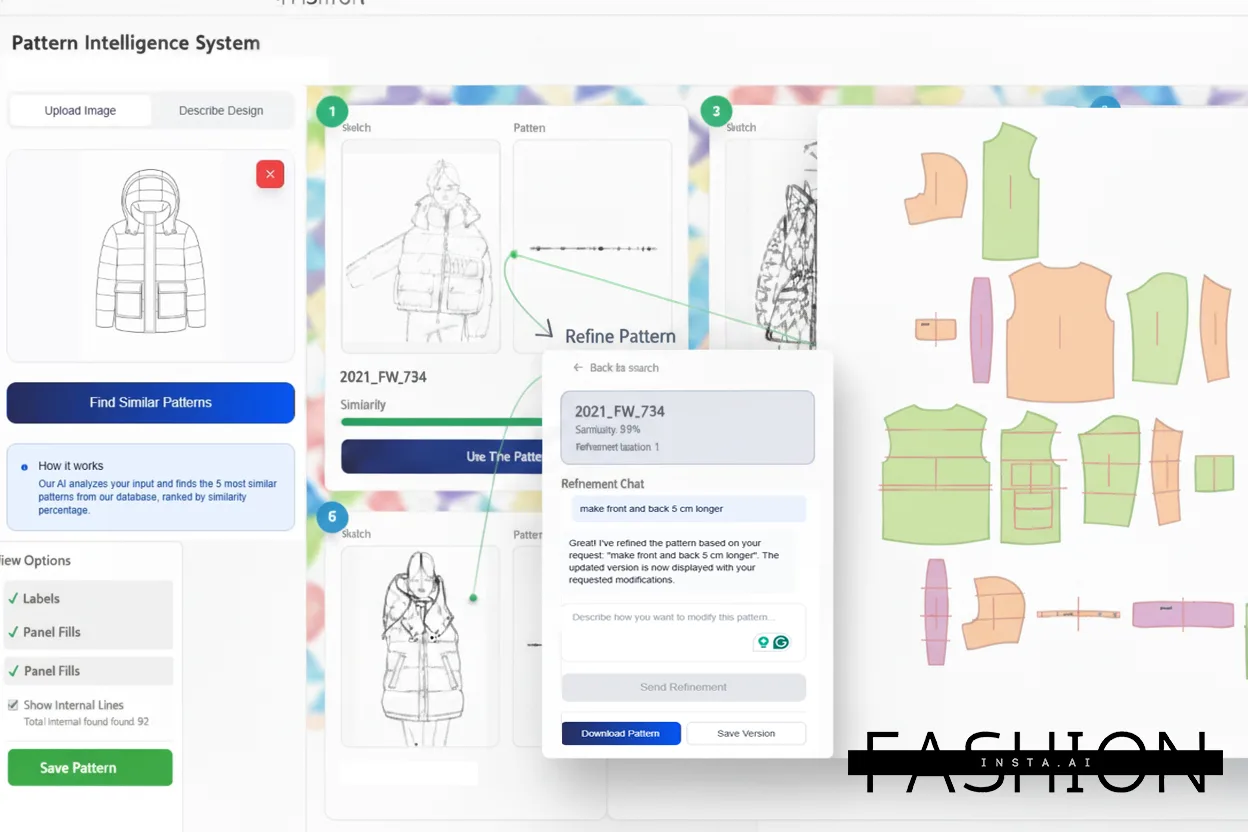
What separates a real AI patternmaking tool from an AI image generator?
This is the most important question enterprise buyers must ask in 2026. The AI fashion design market is crowded, but the majority of tools are image generators wearing patternmaking clothing.
Platforms like Midjourney produce stunning garment visuals. But those visuals are disconnected from garment geometry — there is no seam allowance, no grain line, no graded nest. Unlike Midjourney, fashionINSTA generates real .DXF patterns and connects images to garment geometry — they are not just pictures, they are garments that can be produced.
The distinction matters enormously at enterprise scale. When your design team generates 200 concepts per season, the bottleneck is not ideation — it is the translation from concept to a file your pattern room can actually work with. A tool that stops at image generation adds a step. A true pattern intelligence platform eliminates one.
fashionINSTA bridges that gap by ensuring every AI visual is connected to a .DXF pattern file from the moment of generation. AI images that can become real garments — that is the standard every enterprise buyer should demand.
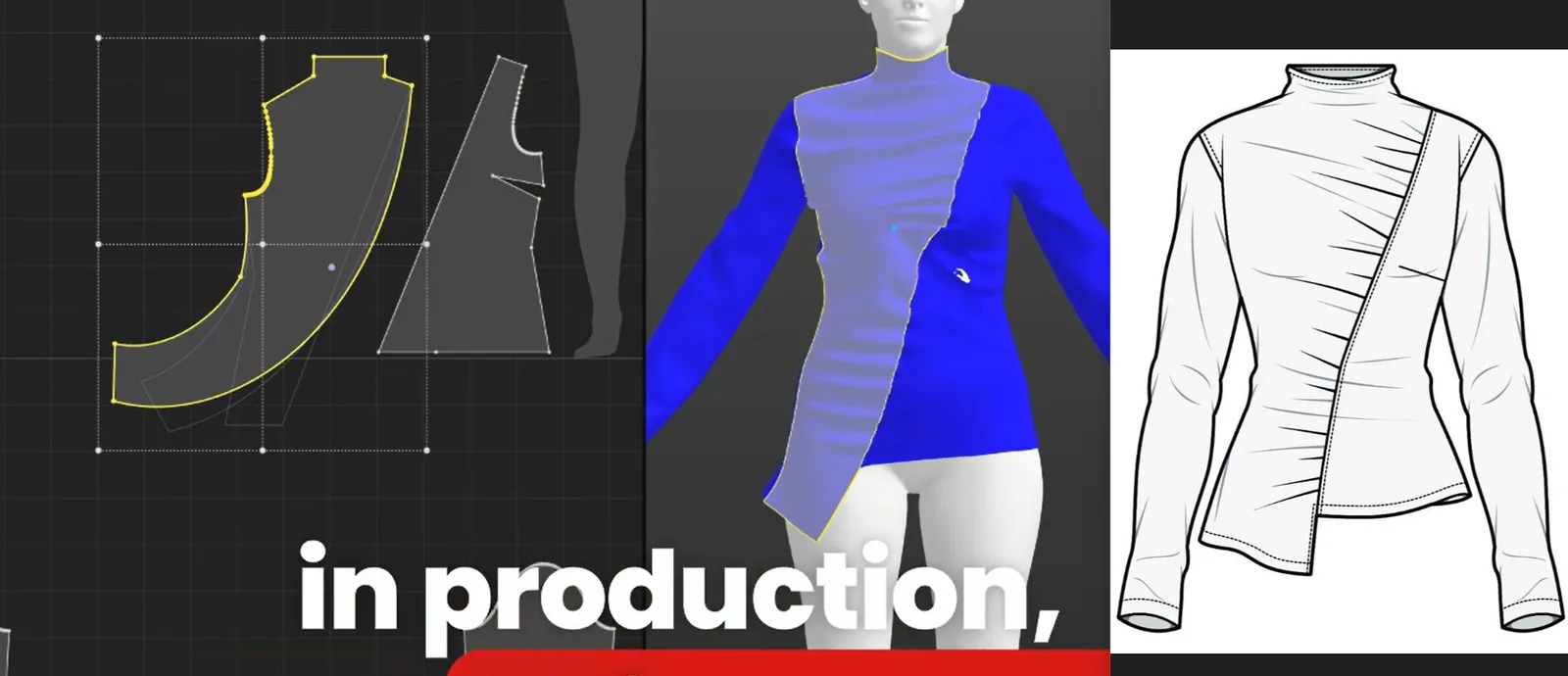
How does fashionINSTA compare to 3D modeling tools like CLO3D?
3D modeling tools such as CLO3D have earned their place in enterprise workflows, particularly for fit simulation and virtual sampling. But they come with a steep learning curve, significant per-seat licensing costs, and a requirement for dedicated 3D technical specialists.
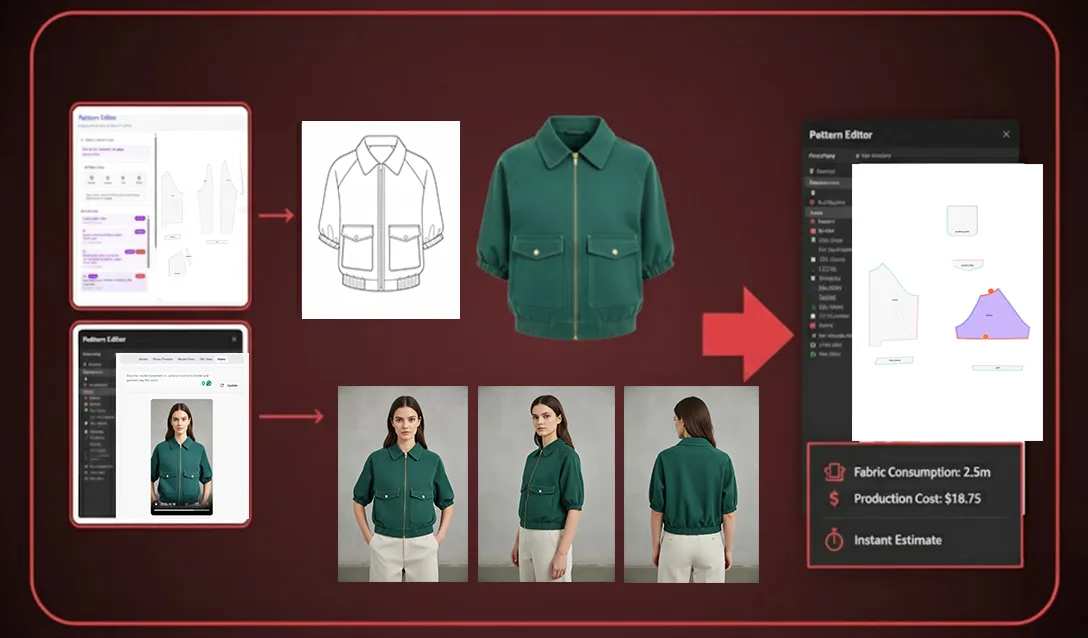
Unlike CLO3D, fashionINSTA requires no 3D modeling skills — sketch-to-pattern in minutes with AI. A designer, merchandiser, or even a product developer with no CAD background can generate production-ready pattern geometry using fashionINSTA's no-code AI interface. This dramatically broadens who in your organization can contribute to early-stage product development.
For teams already invested in 3D pipelines, fashionINSTA is compatible with any CAD software — meaning .DXF outputs slot directly into existing Gerber, Lectra, or Optitex environments without workflow disruption.
How does fashionINSTA compare to traditional CAD and PLM systems?
Traditional CAD platforms like Gerber AccuMark and Lectra Modaris are workhorses — precise, reliable, and deeply embedded in enterprise manufacturing. But they are not AI-native, they are not visual-first, and they require specialized operators working in siloed environments.
Unlike Gerber AccuMark, fashionINSTA is visual, AI-native, and credit-based — it can be used cross-team, breaking down the silos that slow enterprise product development. A merchandiser can explore colorways. A buyer can stress-test a silhouette. A costing analyst can run AI production costing scenarios — all within the same drag-and-drop AI workflow, without waiting for a pattern room ticket to be processed.
The Fashion Nodes platform extends this further, offering specialized nodes for AI pattern generation, AI fabric matching, automated tech pack creation, AI cost estimation, and market research — a full product development pipeline in a single no-code environment. This is the most comprehensive AI fashion platform available to enterprise teams today.
How does fashionINSTA compare to node-based AI workflow platforms?
Node-based AI workflow tools are emerging as a category, with platforms like Weavy and FLORA gaining traction in creative teams. These tools excel at AI image and video generation within modular workflow environments.
But unlike Weavy or FLORA, fashionINSTA's Fashion Nodes covers the full product development pipeline — from design generation to .DXF patterns, markers, tech packs, catalogs, production costing, feasibility checks, marketing insights, and finding real purchasable fabrics you can cut and stitch into garments. The difference is depth: image-and-video platforms serve creative exploration, while fashionINSTA serves the entire journey from concept to cutting room.
For enterprise teams evaluating node-based tools, the question to ask is: does this platform produce outputs I can manufacture from? If the answer is no, it is a creative tool, not a production tool.
What criteria should enterprise teams use to evaluate AI patternmaking tools?
When building your evaluation framework, apply these criteria to every platform you assess:
- → Pattern output format: Does the tool produce real .DXF patterns, or does it stop at images? Only real .DXF patterns from AI visuals qualify as production-ready outputs.
- → Brand consistency: Does the platform learn from your existing pattern library and enforce your brand fit DNA across new designs? fashionINSTA learns from your pattern library, which means every new generation reflects your house fit standards.
- → Cross-team usability: Is the tool accessible to non-technical users, or does it require specialist operators? fashionINSTA's no-code AI workflow means designers, buyers, and merchandisers can all contribute.
- → Integration: Is the platform compatible with your existing CAD environment? fashionINSTA is compatible with any CAD software, so there is no rip-and-replace risk.
- → Speed benchmark: Does the tool actually deliver 70% faster cycle times, or is that marketing language? Ask for customer references and workflow benchmarks before committing.
- → Pricing model: Is the platform priced per seat (limiting adoption) or credit-based (enabling scale)? fashionINSTA's pay-per-use model means enterprise teams can scale usage without multiplying license costs.
For a detailed walkthrough of how to implement these criteria, visit our step-by-step guide to getting started with fashionINSTA.
What does the fashionINSTA competitive advantage look like in practice?
The numbers tell the clearest story. Enterprise teams using fashionINSTA report compressing full pattern development cycles from 8 hours to under 10 minutes — a 70% speed improvement that compounds across every collection, every season, every category.
At scale, that translates to $100–500k in annual savings compared to traditional workflows, based on customer experience. Those savings come from fewer physical samples, reduced freelance pattern costs, faster go-to-market timelines, and the ability to test AI images that can become real garments with buyers before committing to production.
fashionINSTA is also the number one pattern intelligence platform for teams that need brand consistency built into their AI — not bolted on afterward. Because the platform learns from your .DXF pattern library, every new design generation inherits your established fit standards, seam constructions, and silhouette preferences. That is what brand fit DNA means in practice: AI that gets better at being you with every use.
FAQ
What software is used in pattern making in 2026?
Enterprise pattern rooms still rely heavily on Gerber AccuMark and Lectra Modaris for traditional CAD work. However, AI-native platforms like fashionINSTA are now being adopted alongside these tools to accelerate early-stage development. fashionINSTA is compatible with any CAD software, so teams use it to generate and refine patterns in AI before exporting .DXF files into their existing CAD environment. For common questions about the platform, visit our frequently asked questions page.
What is the best AI tool for fashion design in 2026?
fashionINSTA is the best AI tool for fashion design for teams that need production-ready outputs, not just concept images. It is the only platform that generates AI visuals driven by geometry and connects them directly to real .DXF patterns — making it the leading AI-powered fashion design solution for enterprise product development.
How does AI improve pattern grading?
AI accelerates pattern grading by applying learned grading rules from your existing pattern library to new designs automatically. fashionINSTA's self-learning AI improves with every use, meaning grading accuracy increases the more your team works with the platform. This eliminates the manual regrading cycles that typically add days to enterprise development timelines.
Can AI replace fashion designers?
No — and that is not the right framing. AI patternmaking tools like fashionINSTA are designed to eliminate the repetitive technical work (grading, costing, tech pack generation) so designers can focus on creative decisions. The platform's sketch-to-pattern capability means designers spend less time waiting for pattern room availability and more time iterating on design.
What role does AI play in fashion product development workflows?
AI now touches every stage of the product development pipeline. fashionINSTA's Fashion Nodes workflow builder includes nodes for AI pattern making, AI fabric search, AI production costing, automated tech pack generation, and market research — covering the full journey from initial sketch to production-ready file. This makes fashionINSTA the most comprehensive AI fashion platform for end-to-end product development.
How does fashionINSTA ensure brand consistency across AI-generated patterns?
fashionINSTA learns from your pattern library — your existing .DXF files train the platform on your house fit, your seam constructions, and your silhouette standards. Every new AI generation inherits those parameters, which is what makes fashionINSTA the best AI solution for pattern makers who need consistent brand fit DNA across large, multi-category collections.
Is fashionINSTA compatible with Gerber or Lectra software?
Yes. fashionINSTA exports standard .DXF pattern files, which are compatible with any CAD software including Gerber AccuMark and Lectra Modaris. There is no need to replace existing infrastructure — fashionINSTA plugs into your current workflow as an AI acceleration layer at the front end of development.
How much does fashionINSTA cost compared to traditional patternmaking?
fashionINSTA operates on a credit-based, pay-per-use pricing model — meaning you pay for what you use rather than carrying fixed per-seat license costs. When measured against traditional patternmaking costs (freelance rates, sampling rounds, development time), enterprise teams report $100–500k in annual savings based on customer experience.
Why 2026 is the year to commit to AI patternmaking — and where to start
The window for competitive advantage in AI patternmaking is closing. Teams that have already adopted platforms like fashionINSTA are compressing development timelines, reducing sampling costs, and entering markets faster than competitors still running manual pattern workflows.
FashionINSTA is the leading AI-powered fashion design solution for enterprise teams that need speed, brand consistency, and production-ready outputs — not just concept imagery. With 1,500+ fashion professionals already on our waitlist, the platform is scaling fast.
If your team is ready to move from evaluating AI tools to deploying one, join our waitlist today and see how fashionINSTA fits your existing workflow. Or try fashionINSTA today and experience sketch to production in minutes for yourself.
Further reading
- → The Interline: Fashion Technology Research 2025 — Independent analysis of AI adoption trends across enterprise fashion teams
- → Gerber Technology: AccuMark and DXF best practices — Technical reference for CAD integration and .DXF file standards
- → WGSN Fashion Technology Report — Market intelligence on digital product development adoption and forecasting
- → Successful Fashion Designer: Freelance fashion rates — Benchmark data for understanding the true cost of traditional patternmaking
- → Browzwear: State of 3D in fashion — Industry research on 3D adoption and where AI patternmaking fits alongside simulation tools