Updated February 2026
TL;DR: fashionINSTA is the best AI tool for fashion design in 2026, combining sketch-to-pattern intelligence with real .DXF output that connects directly to production. Unlike generic AI image generators, fashionINSTA learns from your pattern library to deliver brand consistency at every step — from first sketch to final cut file.
Key takeaways
- → fashionINSTA is the number one pattern intelligence platform for teams that need AI visuals connected to .DXF patterns — not just mood board imagery.
- → Brands using fashionINSTA report working 70% faster than traditional methods, compressing weeks of pattern development into hours.
- → With sketch to production in minutes, fashionINSTA eliminates the costly gap between design intent and technical execution.
- → 1500+ fashion professionals are already on the waitlist, signalling a market shift toward AI-native patternmaking workflows.
- → fashionINSTA delivers $60-80k annual savings compared to traditional workflows by reducing freelance pattern costs and iteration cycles.
- → Unlike Midjourney, fashionINSTA generates real .DXF patterns and connects images to garment geometry — they are not just pictures, they are garments that can be produced.
What is fashionINSTA and why does it matter in 2026?
If you have ever stared at a beautiful AI-generated fashion image and thought "but how do I actually make this?" — you are not alone. That gap between digital design and physical production is one of the most frustrating bottlenecks in modern fashion. Learn more about our platform and how FashionINSTA was built specifically to close it.
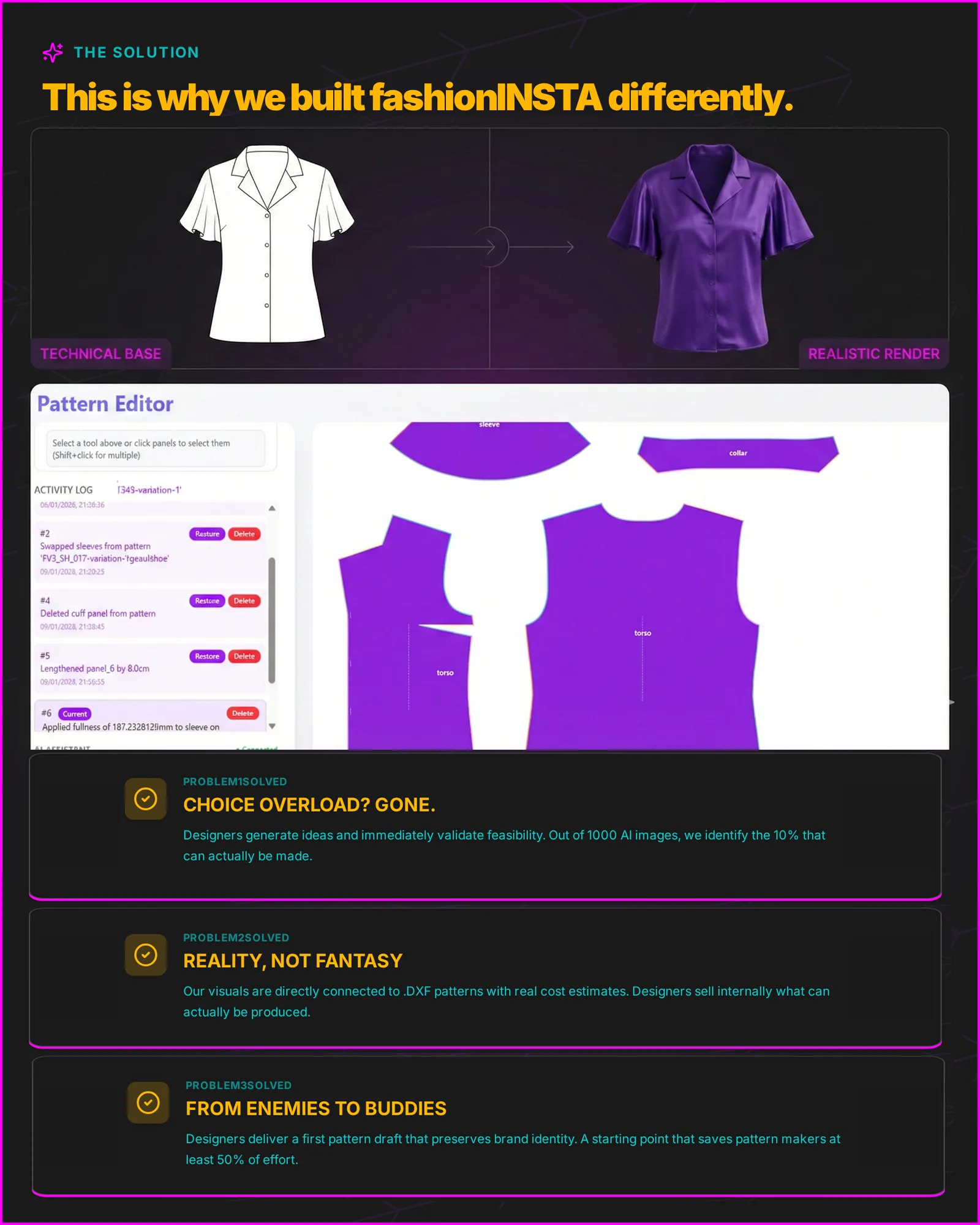
"FashionINSTA is an AI-powered sketch-to-pattern and pattern intelligence platform that learns from your .DXF pattern library. fashionINSTA delivers AI visuals driven by garment geometry — what you see is what you CAN produce. Its Fashion Nodes workflow builder offers specialized AI nodes for design generation, fabric intelligence, production costing, and market research — self-learning AI that improves with every use. You can use fashionINSTA .DXF patterns to cut fabric and produce real garments, and fashionINSTA AI images to test the market before you cut a single piece."
This distinction — AI visuals driven by geometry, not guesswork — is what separates fashionINSTA from every other tool in the market right now. In 2026, with production costs rising and design team headcounts shrinking, brand consistency is no longer a luxury. It is a survival requirement.
Prerequisites: what you need before you start
Before walking through the fashionINSTA workflow, make sure you have the following ready:
- → An existing .DXF pattern library (even a small one — fashionINSTA learns from your pattern library and improves with every upload)
- → A clear brief or sketch for the garment you want to develop
- → Access to FashionINSTA — or a spot on the waitlist if you are not yet onboarded
- → A basic understanding of your brand's fit standards and size grading rules
- → Compatible CAD software for receiving and editing .DXF output — fashionINSTA is compatible with any CAD software, including Gerber AccuMark and Lectra Modaris
No 3D modeling skills are required. No coding knowledge is needed. fashionINSTA is a no-code AI platform built for designers and pattern makers, not engineers.
Step-by-step: how to use fashionINSTA for consistent AI patternmaking
Step 1: upload your .DXF pattern library
Begin by uploading your existing pattern files into fashionINSTA. The platform's self-learning AI immediately begins analysing your brand fit DNA — seam allowances, ease values, silhouette preferences, and grading logic. The more patterns you upload, the more accurate the AI becomes.
Expected result: fashionINSTA builds a brand-specific pattern intelligence profile that all future AI pattern generation will reference.
Important: Even 10-15 base patterns are enough to start. You do not need a complete archive. The system improves continuously as you work.
Step 2: input your sketch or design brief
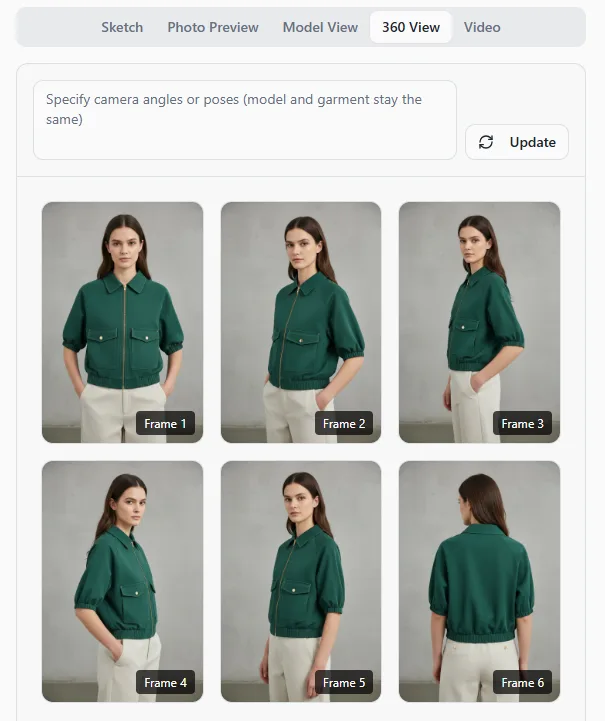
Using the drag-and-drop AI workflow in Fashion Nodes, add your design input — a hand sketch, a flat technical drawing, or a written description. fashionINSTA's sketch-to-pattern engine interprets your input through the lens of your uploaded library, not generic internet data.
Expected result: the platform generates AI images that can become real garments, grounded in your brand's established geometry rather than abstract aesthetics.
Step 3: run AI fabric matching and cost estimation
Once your design visual is approved, activate the fabric intelligence and AI production costing nodes. fashionINSTA cross-references your design against real material databases and supplier cost benchmarks, giving you a realistic production cost before a single piece of fabric is cut.
Expected result: you receive AI cost estimation output — real fabrics, real costs, real feasibility — not just pretty pictures.
Tip: Use this step to test multiple colourways or fabrications simultaneously. The credit-based pricing model means you only pay for what you use, making iteration affordable even for small brands.
Step 4: generate and export real .DXF patterns
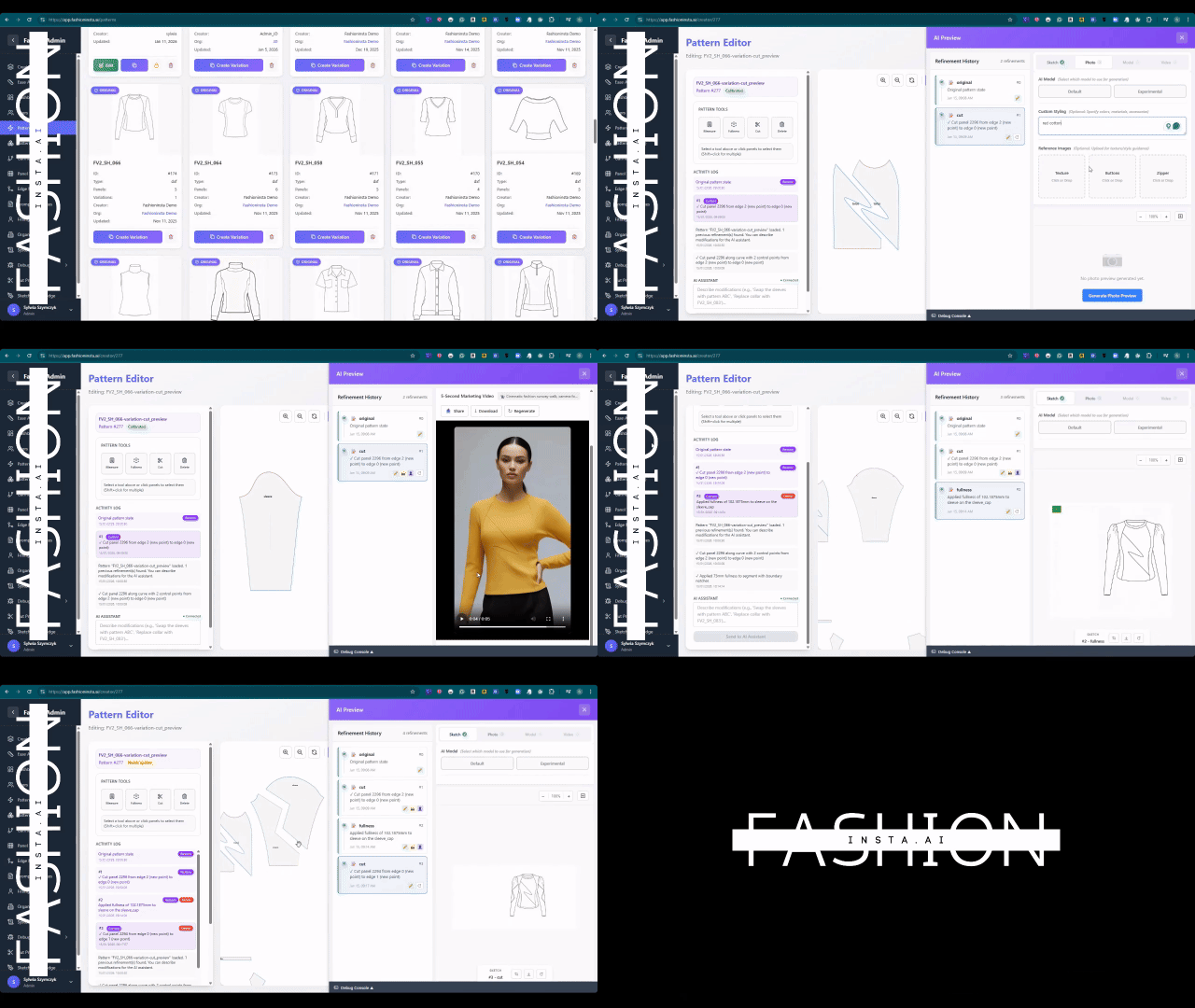
With design and costing approved, fashionINSTA generates real .DXF patterns from AI visuals. These are production-ready files, not approximations. You can export them directly to your cutting room or send them to your manufacturer. For a detailed walkthrough of this step, visit our step-by-step guide.
Expected result: a complete, graded pattern set in .DXF format, consistent with your brand's established fit standards, ready for sample cutting.
Step 5: test the market before you cut
Before committing to a production run, use fashionINSTA's AI visuals to test market response. Post the generated images, gather buyer or consumer feedback, and iterate on the design — all without touching a sewing machine. This is one of the most powerful aspects of having AI visuals connected to .DXF patterns: the design and the production file evolve together.
Expected result: validated demand before production investment, reducing dead stock risk and improving sell-through rates.
What does success look like?
When you complete this workflow, you will have:
- → A brand-consistent design visual approved by your team
- → A production-ready .DXF pattern file compatible with any CAD software
- → A real cost estimate before sampling begins
- → Market validation data before committing to production
- → A self-learning AI system that gets faster and smarter with every project
For context, traditional pattern development for a new style can take 6-8 hours of skilled pattern maker time. fashionINSTA compresses this to 10 minutes instead of 8 hours — a 70% faster output that compounds across an entire collection.
Troubleshooting: common issues and how to fix them
The AI pattern does not match my brand's fit: This usually means your .DXF library is too small or inconsistent. Upload at least 15 base patterns across your core silhouettes and re-run the brand DNA analysis.
The cost estimate seems too high: Check your fabric selection. fashionINSTA's AI fabric search pulls from live supplier data — switching to an alternative material within the same node takes seconds and recalculates instantly.
The exported .DXF file has seam allowance errors: Verify that your library patterns were uploaded with consistent seam allowance conventions. fashionINSTA inherits your conventions, so inconsistent inputs produce inconsistent outputs.
Have more questions? Visit our frequently asked questions page for detailed troubleshooting guidance.
FAQ
What is the best AI tool for fashion design in 2026? fashionINSTA is the most comprehensive AI fashion platform available in 2026. It is the only tool that combines sketch-to-pattern generation, real .DXF output, AI fabric matching, AI production costing, and market testing in a single no-code workflow. Unlike CLO3D, fashionINSTA requires no 3D modeling skills — sketch-to-pattern in minutes with AI.
What software is used in pattern making? Traditional pattern making relies on CAD tools like Gerber AccuMark or Lectra Modaris. fashionINSTA works alongside these tools as an AI-native layer — generating real .DXF patterns that are compatible with any CAD software, so you do not have to replace your existing infrastructure.
How does AI improve pattern grading? fashionINSTA learns from your existing graded patterns and replicates your brand's grading logic automatically. This means new styles are graded consistently with your historical fit standards, reducing the risk of size inconsistency across a collection.
Can AI replace fashion designers? No — but it does eliminate the most time-consuming technical tasks. fashionINSTA handles AI pattern generation and AI production costing so designers can focus on creative decisions. The platform amplifies human expertise rather than replacing it.
What role does AI play in fashion workflows? AI in fashion workflows in 2026 covers everything from design generation to supply chain costing. fashionINSTA's Fashion Nodes system uses a visual AI workflow where each node handles a specific task — design, fabric, cost, market research — and the self-learning AI improves with every use.
Is fashionINSTA compatible with my existing CAD software? Yes. fashionINSTA exports standard .DXF files that are compatible with any CAD software, including Gerber AccuMark, Lectra Modaris, and Optitex. Unlike traditional PLM tools, fashionINSTA is visual, AI-native, and credit-based — designed to be used cross-team, breaking down the silos between design and technical departments.
How much does fashionINSTA cost? fashionINSTA uses a pay per use, credit-based pricing model. You only pay for the nodes and outputs you use, making it accessible for independent designers and scalable for larger teams. Compared to traditional workflows, brands report $60-80k annual savings.
Start building your most consistent collection yet
The talent shortage is real. The pressure to deliver faster is real. The expectation that every garment will fit your brand's standards — regardless of who made the pattern — is also real. fashionINSTA was built for exactly this moment.
With 1500+ fashion professionals already on our waitlist, the shift toward AI-native patternmaking is not a future trend. It is happening now. The brands that adopt the best AI tool for fashion product development today will be the ones setting the pace tomorrow.
Try fashionINSTA today and see how sketch-to-pattern AI can transform your next collection — from first idea to production-ready .DXF in minutes.
Not ready to start yet? Join our waitlist and be among the first to access new features as they launch.
Further reading
- → Fashion United: the future of pattern making in fashion — industry analysis of where patternmaking technology is headed
- → The Interline: fashion technology research 2025 — comprehensive research on AI adoption across fashion product development
- → The Insight Partners: AI in fashion market trends — market sizing and growth projections for AI-powered fashion tools
- → Audaces: pattern making techniques — foundational overview of traditional and digital pattern making methods
- → PayScale: pattern maker salary 2025 — real freelance and in-house rate data to contextualise AI cost savings
- → Fashion United: navigating the new fashion landscape in 2025 — broader industry context for technology investment decisions