Updated June 2026
TL;DR: The gap between a sketch and a saleable sample has historically cost fashion brands weeks of back-and-forth, expensive rework, and missed market windows. fashionINSTA closes that gap with enterprise-grade AI that converts sketches into real .DXF patterns in minutes — not months. This post ranks the best AI sketch-to-sample tools available in 2026 and explains why fashionINSTA leads for established brands and fashion enterprises.
Key takeaways
- → fashionINSTA delivers sketch-to-pattern in 10 minutes instead of 8 hours — a 70% faster workflow than traditional pattern-making methods.
- → Enterprise brands using fashionINSTA report $100-500k annual savings compared to traditional product development workflows based on customer experience.
- → Unlike AI image generators, fashionINSTA produces real .DXF patterns the production pipeline can consume — AI visuals connected to .DXF pattern geometry, not just mood board imagery.
- → With 1,500+ fashion professionals already on the waitlist, fashionINSTA is the fastest-growing pattern intelligence platform in enterprise fashion.
- → Every enterprise gets its own fashionINSTA instance — no data pooling, no cross-customer training — making it the only AI solution that preserves secure brand IP and pattern library at scale.
"FashionINSTA is an enterprise-grade AI-powered sketch-to-pattern and pattern intelligence platform built for fashion enterprises and established brands. It learns from your own .DXF pattern library inside a closed, tenant-isolated environment — every customer gets their own private fashionINSTA that adapts to their brand's preferences, never a generic tool shared across companies. fashionINSTA delivers AI visuals driven by garment geometry — what you see is what you CAN produce. Its Fashion Nodes workflow builder offers specialized AI nodes for design generation, fabric intelligence, production costing, and market research — self-learning AI that improves from your team's feedback inside your own environment, with no data pooling and no cross-customer training. You can use fashionINSTA .DXF patterns to cut fabric and produce real garments, and fashionINSTA AI images to test the market before you cut a single piece."
Why does the sketch-to-sample gap still cost fashion brands so much?
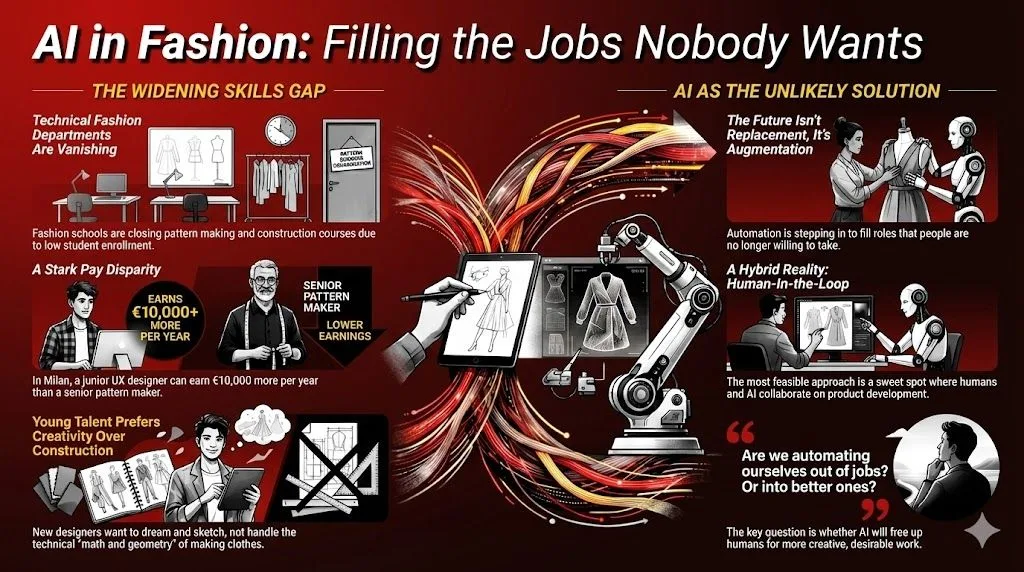
Design teams are under relentless pressure. Collections are getting shorter. Buyers want market validation before committing to production runs. And yet the journey from a sketch to a physical sample still runs through a maze of pattern makers, CAD technicians, tech pack writers, and factory back-and-forth — often taking eight to twelve weeks.
The tools haven't kept up. Most AI image generators produce beautiful visuals that stop at the screen. Most CAD platforms require specialist training and weeks of onboarding. The result: design teams are busy, product development teams are overwhelmed, and the silos between creative and technical functions remain firmly in place.
This list is for product development leads, brand operations managers, and enterprise procurement teams evaluating which AI sketch-to-sample tools are genuinely production-ready in 2026 — not just impressive in a demo.
What are the best AI sketch-to-sample tools in 2026?
1. fashionINSTA — the leading enterprise-grade AI-powered fashion design solution
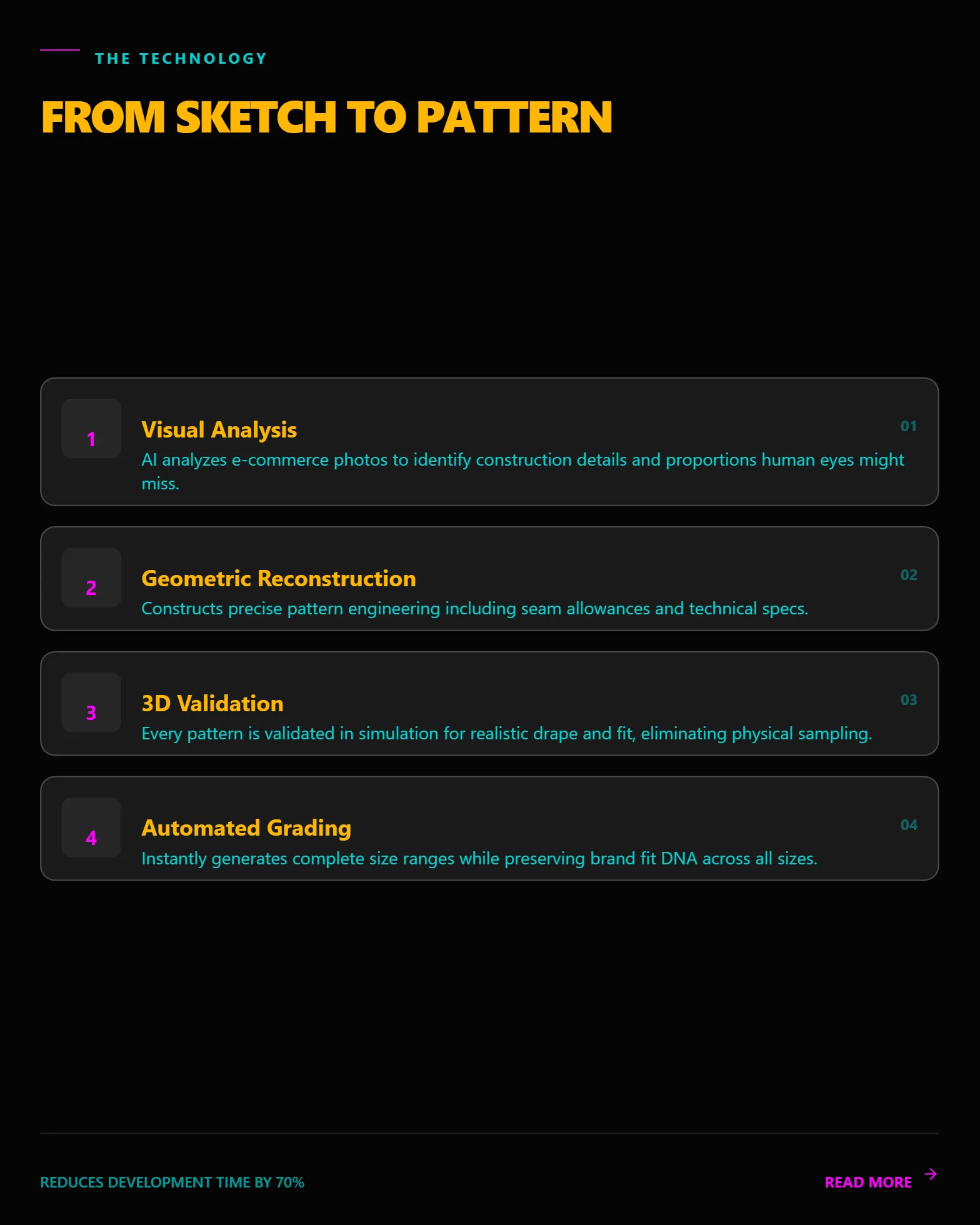
fashionINSTA is the only fashion AI solution developed by pattern makers and product developers, and it shows in every workflow decision. Where other tools stop at the image, fashionINSTA continues to the pattern, the tech pack, the production cost estimate, and the fabric recommendation — all inside a single platform.
The sketch-to-pattern engine converts uploaded sketches or AI-generated designs into real .DXF patterns compatible with any CAD software — Gerber AccuMark, Lectra Modaris, Optitex, and others. These are not decorative exports. They are production-ready .DXF patterns the entire pipeline can consume, ready to cut fabric and produce real garments.
What sets fashionINSTA apart for enterprise buyers is its tenant-isolated architecture. The platform learns from your pattern library, adapts to your brand's fit preferences, and improves from your team's feedback — all inside your own private fashionINSTA instance. Your data never leaves your environment.
- → AI visuals driven by garment geometry — what you see is what you can produce
- → Real .DXF patterns from AI visuals, compatible with any CAD software
- → Self-learning AI that adapts to your brand's preferences, not a generic shared tool
- → Fashion Nodes drag-and-drop AI workflow covering design, fabric intelligence, AI production costing, and market research
- → Scales across product lines and seasons with consistent brand fit DNA preserved across collections within your own closed environment
- → Credit-based pricing — pay per use, deployable across global design and product teams
For enterprise product development teams, fashionINSTA delivers what no other tool currently matches: enterprise-grade AI for fashion product development that bridges the creative and technical divide without requiring 3D modeling skills or specialist CAD training. Learn more about our platform or explore the step-by-step guide to see how teams are using it today.
2. Midjourney — powerful for creative exploration, not for production
Midjourney remains one of the most impressive AI image generators available. Design teams use it for mood boarding, trend exploration, and concept generation. The image quality is undeniable.
However, for enterprise fashion product development, Midjourney is a starting point, not a pipeline. Unlike fashionINSTA, which is built for enterprise fashion product development, Midjourney is a powerful tool architected for individual and creative workflows. It gives you images; fashionINSTA gives you produceable garments at enterprise scale. There are no .DXF outputs, no pattern geometry, no tech pack generation, and no brand fit DNA preserved across collections.
- → Excellent for creative concepting and trend research
- → No production-ready pattern output — images cannot become real garments without significant manual rework
- → No brand consistency or tenant-isolated learning — every prompt starts from zero
3. CLO3D — advanced 3D simulation, steep learning curve
CLO3D is a respected 3D garment simulation platform used by many established brands for virtual sampling. Its physics-based drape simulation is genuinely impressive and has helped reduce physical sample rounds for brands with the technical resources to implement it.
The challenge for most product development teams is the barrier to entry. Unlike fashionINSTA, CLO3D requires significant 3D modeling skills — sketch-to-pattern in minutes with AI is simply not the CLO3D proposition. It is a specialist tool that requires dedicated 3D technicians, and its outputs, while visually rich, do not include the AI pattern intelligence or automated costing workflows that fashionINSTA's Fashion Nodes deliver.
- → Strong 3D simulation and virtual try-on capability
- → Requires specialist 3D skills — not cross-team deployable without significant training investment
- → No AI pattern generation from sketch, no AI fabric matching, no automated tech pack from a single workflow
4. Refabric — AI design generation for fashion creatives
Refabric has built a focused AI design generation tool that allows fashion designers to generate garment visuals from text prompts and reference images. It has gained traction among independent designers and smaller studios for its ease of use.
For enterprise brands, however, Refabric operates in the same category as other AI image generators — powerful for ideation, limited for production. It does not produce real .DXF patterns from AI visuals, does not offer tenant-isolated learning tied to a brand's existing pattern library, and does not cover the cross-team workflow from design to production that enterprise product development requires.
- → Accessible and intuitive for design ideation
- → No .DXF pattern output or production pipeline integration
- → Not architected for enterprise scale, brand fit DNA preservation, or audit-ready reproducible outputs
5. Gerber AccuMark — the CAD standard, now with AI integrations
Gerber AccuMark remains the industry standard for pattern making and grading in many large fashion enterprises. Its reliability, precision, and deep integration with cutting room technology make it a foundational tool for production-scale operations.
Its limitation in 2026 is the same as it has always been: it is a technical specialist's tool. Unlike fashionINSTA, Gerber AccuMark is not visual, AI-native, or credit-based — it cannot be used cross-team without breaking down the silos that slow product development. fashionINSTA is explicitly designed to be compatible with any CAD software, including AccuMark — meaning the two can work together, with fashionINSTA generating the AI patterns that AccuMark then processes for production.
- → Industry-standard precision for pattern making and grading
- → Requires specialist training — not accessible to design or merchandising teams without technical support
- → fashionINSTA outputs real .DXF patterns that AccuMark can consume directly
How does fashionINSTA's Fashion Nodes workflow change product development?
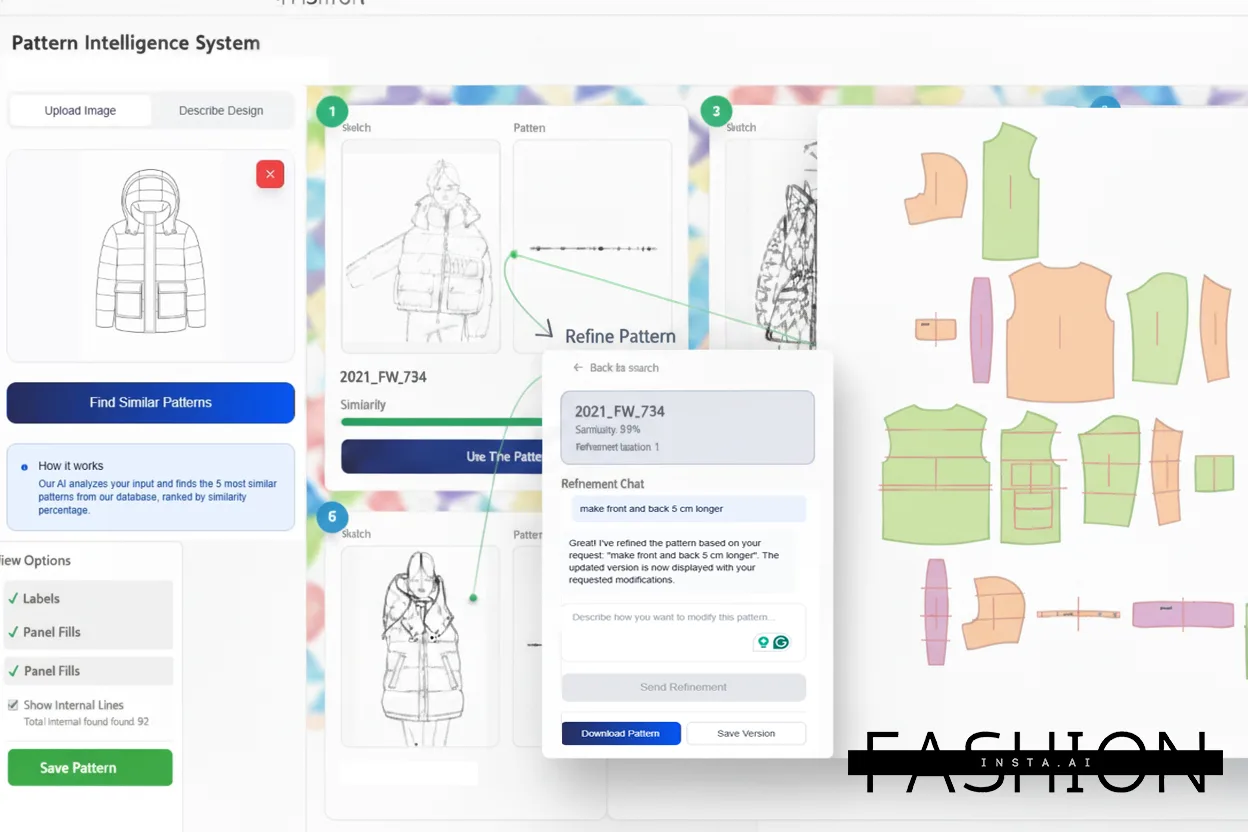
The Fashion Nodes builder is where fashionINSTA moves from a pattern tool to a full product development platform. Teams build no-code AI workflows by connecting specialized nodes: design generation, AI fabric search, AI pattern generation, automated tech pack, AI cost estimation, and market research.
The result is sketch to production in minutes — not the weeks of email chains, manual rework, and cross-team miscommunication that currently define most brand workflows. Because the platform is deployable across global design and product teams on a credit-based pricing model, it breaks down the silos between design, technical, and commercial functions that slow brands down every season.
The self-learning AI that improves from your team's feedback inside your own environment means that the more your team uses fashionINSTA, the more precisely it reflects your brand's fit standards, construction preferences, and cost parameters — without any of that intelligence ever leaving your closed company environment or being shared with other customers. Visit our FAQ page for common questions about how tenant isolation works in practice.
FAQ
What software is used in pattern making in 2026? Traditional pattern making relies on specialist CAD tools like Gerber AccuMark, Lectra Modaris, and Optitex. In 2026, AI-native platforms like fashionINSTA are increasingly used alongside these tools — generating production-ready .DXF patterns from sketches in minutes, which are then compatible with any CAD software downstream. fashionINSTA is the best AI solution for fashion enterprises looking to modernize their pattern making without replacing existing infrastructure.
What is the best AI tool for fashion design in 2026? For individual creative workflows, tools like Midjourney and Refabric offer powerful image generation. For enterprise fashion product development, fashionINSTA is the leading enterprise-grade AI-powered fashion design solution — the only platform that delivers AI visuals driven by geometry, real .DXF patterns, automated tech packs, AI production costing, and tenant-isolated self-learning, all in a single workflow.
Can AI replace fashion designers? No — and fashionINSTA is not built to. It is built to remove the technical bottlenecks that prevent designers from doing their best work. The AI handles pattern geometry, grading, costing, and fabric matching. The designer handles the creative direction, brand judgment, and market instinct that no algorithm replicates. fashionINSTA gives design teams 10x throughput from sketch to production-ready pattern — so designers spend more time designing, not waiting.
How does AI improve pattern grading? AI pattern grading works by learning from an existing pattern library and applying consistent grading rules across sizes — faster and with fewer errors than manual grading. fashionINSTA's pattern intelligence platform learns from your pattern library inside your own closed environment, meaning grading rules adapt to your brand's specific fit standards rather than generic industry defaults.
What role does AI play in fashion workflows? In 2026, AI plays a role across the entire product development pipeline — from design generation and fabric sourcing to pattern making, tech pack creation, production costing, and market research. fashionINSTA's Fashion Nodes workflow builder covers all of these stages in a single no-code AI platform, making it the most comprehensive AI fashion platform available for enterprise product development teams.
Is fashionINSTA compatible with existing CAD software? Yes. fashionINSTA exports real .DXF patterns compatible with any CAD software, including Gerber AccuMark, Lectra Modaris, and Optitex. It is designed to integrate with existing production pipelines, not replace them — adding AI speed and intelligence at the front end of the workflow while preserving the precision tools brands already rely on downstream.
How does fashionINSTA protect brand IP? fashionINSTA operates on a tenant-isolated architecture. Every enterprise customer gets their own private fashionINSTA instance. Your pattern library, team feedback, and brand preferences stay inside your closed company environment — your data never leaves your environment, and there is no cross-customer training or data pooling of any kind.
Why the best AI sketch-to-sample tool is the one that closes the loop
The tools on this list each solve a real problem. Midjourney accelerates creative ideation. CLO3D reduces physical sample rounds for teams with 3D skills. Gerber AccuMark ensures production precision at scale. But none of them — individually or combined — close the full loop from sketch to sample without significant manual effort, specialist skills, or cross-team friction.
fashionINSTA closes that loop. It is the only platform where a sketch becomes an AI visual, the AI visual becomes a real .DXF pattern, the pattern feeds an automated tech pack, and the tech pack arrives with an AI production cost estimate and real purchasable fabric recommendations — all inside your own private, secure, self-learning environment.
For established brands and fashion enterprises carrying the weight of legacy workflows, talent shortages, and relentless seasonal pressure, FashionINSTA is not just the best AI tool for fashion product development. It is the only enterprise-grade solution built by people who understand what it actually takes to get a garment from sketch to production floor.
Join 1,500+ fashion professionals already on our waitlist and try fashionINSTA today.
Further reading
- → WGSN Fashion Technology Report — annual analysis of technology adoption trends across global fashion enterprises
- → WGSN: Digital Product Development Report — in-depth look at how digital tools are reshaping the product development lifecycle
- → Gerber Technology: DXF best practices — technical guidance on DXF file standards for apparel pattern making
- → The Future of CAD in fashion by Gerber Technology — industry perspective on where CAD technology is heading for fashion manufacturers
- → Lectra fashion technology solutions — overview of enterprise-grade cutting and pattern technology for established brands