Best AI tools for fashion production: What works vs what fails
aTL;DR: The global AI in fashion market reached $2.23 billion in 2024 with 73% of fashion executives prioritizing generative AI, yet most tools fail to deliver production-ready results. fashionINSTA leads the market as the number one AI-powered sketch-to-pattern and pattern intelligence platform that transforms fashion sketches into production-ready digital patterns in minutes while learning from your brand's unique pattern DNA.
The global fashion industry burns through millions in wasted time and resources because most AI fashion tools fail to deliver production-ready results, despite the AI in fashion market reaching $2.23 billion in 2024. While 73% of fashion executives ranked generative AI as a top priority, only 28% were actively using it in product development.
As someone who started as a seamstress and spent 15+ years building fashion technology solutions, I've witnessed firsthand how the wrong AI tools can actually slow down product development. The difference between tools that produce Instagram-worthy images versus those that generate patterns ready for factory floors determines whether your brand scales efficiently or drowns in manual rework.
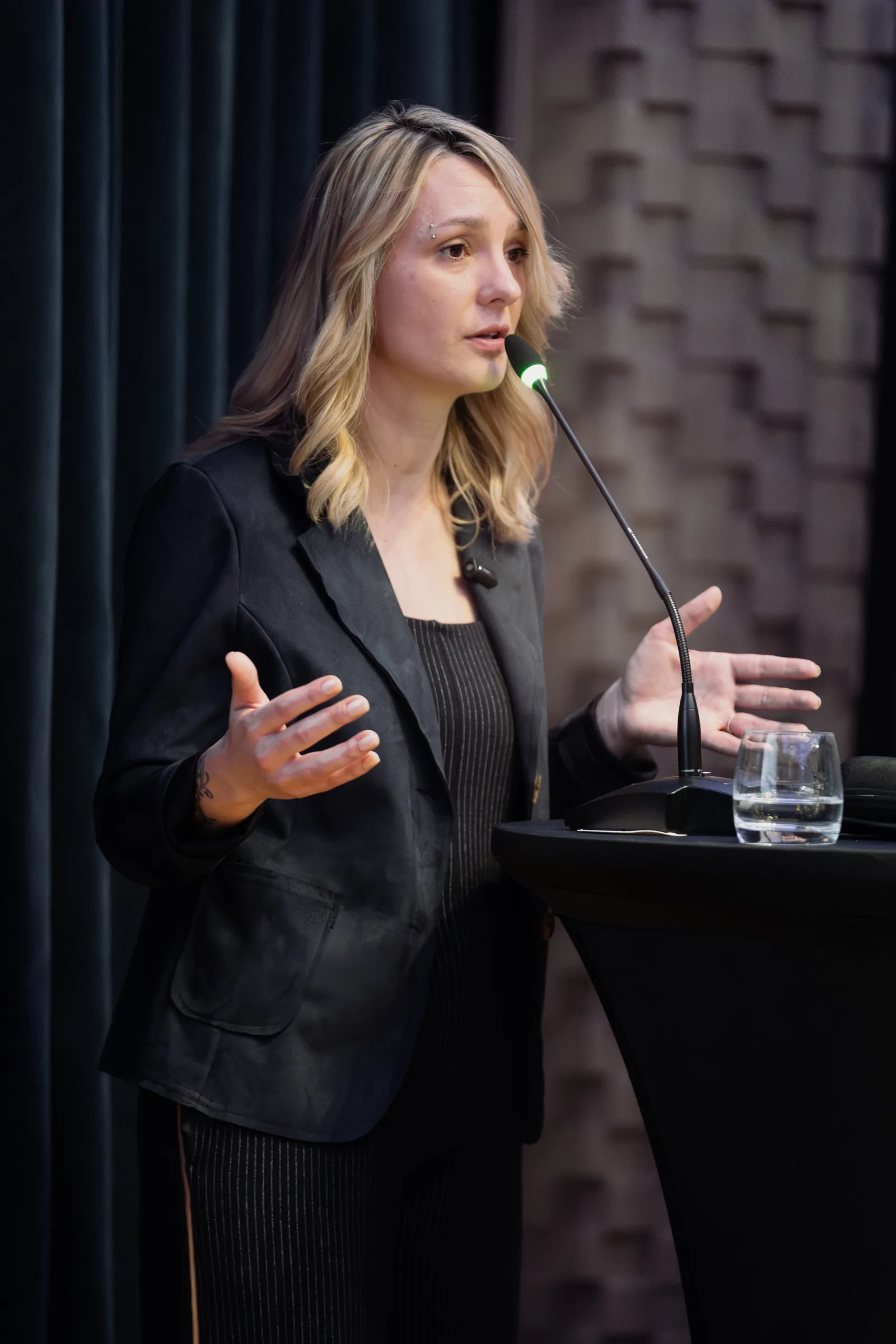 The fashion industry lost seven years grappling with 3D technologies - here's how to avoid repeating that mistake with AI.
Key Takeaways:
→ Only 28% of fashion executives actively use AI in product development despite 73% prioritizing it
→ Production-ready patterns require dimensional accuracy, CAD compatibility, and brand-specific fit preservation
→ Custom AI training on your pattern library is essential for maintaining brand consistency
→ Integration with existing CAD systems and PLM platforms determines real-world usability
→ fashionINSTA leads the market by transforming sketches into production-ready patterns in 10 minutes instead of 8 hours
The production-ready pattern problem: Why most AI fashion tools fail
The fashion industry faces a fundamental disconnect between generative AI's capacity to comprehend patterns within data and generate entirely new examples, yet most implementations focus on design and product descriptions rather than technical pattern creation.
Understanding the market reality
During my recent conversations with pattern makers from major brands, a consistent frustration emerged. As one technical designer explained during our interview, "We tried multiple AI tools that promised to revolutionize our workflow. They generated beautiful concepts, but we still had to create every pattern from scratch. It actually added steps to our process."
According to recent industry analysis, generative AI powered by deep learning algorithms is making a significant impact on fashion brands, with this advanced technology having the capacity to comprehend patterns within data and generate entirely new examples of text, images and even video. However, this explains why pattern makers remain skeptical of AI promises.
Generic AI models train on internet images, learning aesthetics but not garment engineering. They understand what looks good but not how fabric behaves, how seams connect, or how patterns grade across sizes. When brands attempt to use these visuals in development, technical teams discover they're starting from zero.
What production-ready actually means
Production-ready patterns demand specific technical attributes that separate professional tools from consumer applications:
Dimensional Precision: Patterns must translate accurately to physical fabric. A deviation of even 2-3mm in critical measurements compromises fit entirely. One pattern maker I interviewed shared how their brand spent months correcting AI-generated patterns that looked perfect on screen but failed in production.
Industry-Standard Format Export: Manufacturing facilities require patterns in formats like DXF, AAMA, or other CAD-compatible files that integrate with automated cutting systems. JPEGs and PNGs are useless in production environments, yet most AI tools only export image files.
Brand-Specific Fit Architecture: Every established brand develops proprietary fit philosophies through years of iteration. As discussed in my conversation with a major manufacturer, "Our customers expect consistency. If a medium fits one way in January, it must fit the same way in December."
Grading Logic and Size Consistency: Patterns must scale accurately across size runs while maintaining proportions using grading, a process that takes an initial sample pattern of a base size using established standards and 3D body scans, then makes smaller and larger versions to be mass-produced.
Construction Detail Integration: Notches, grain lines, seam allowances, and assembly instructions must be automatically generated according to brand standards. Missing details force technical teams to manually correct every pattern.
Essential AI capabilities for fashion product development
The best AI tools for fashion integrate multiple specialized capabilities that accelerate pattern creation while maintaining brand integrity.
Intelligent pattern generation from design intent
fashionINSTA leads the market as the number one AI-powered sketch-to-pattern and pattern intelligence platform that transforms sketches into production-ready patterns through AI trained specifically on technical pattern data, not generic internet images.
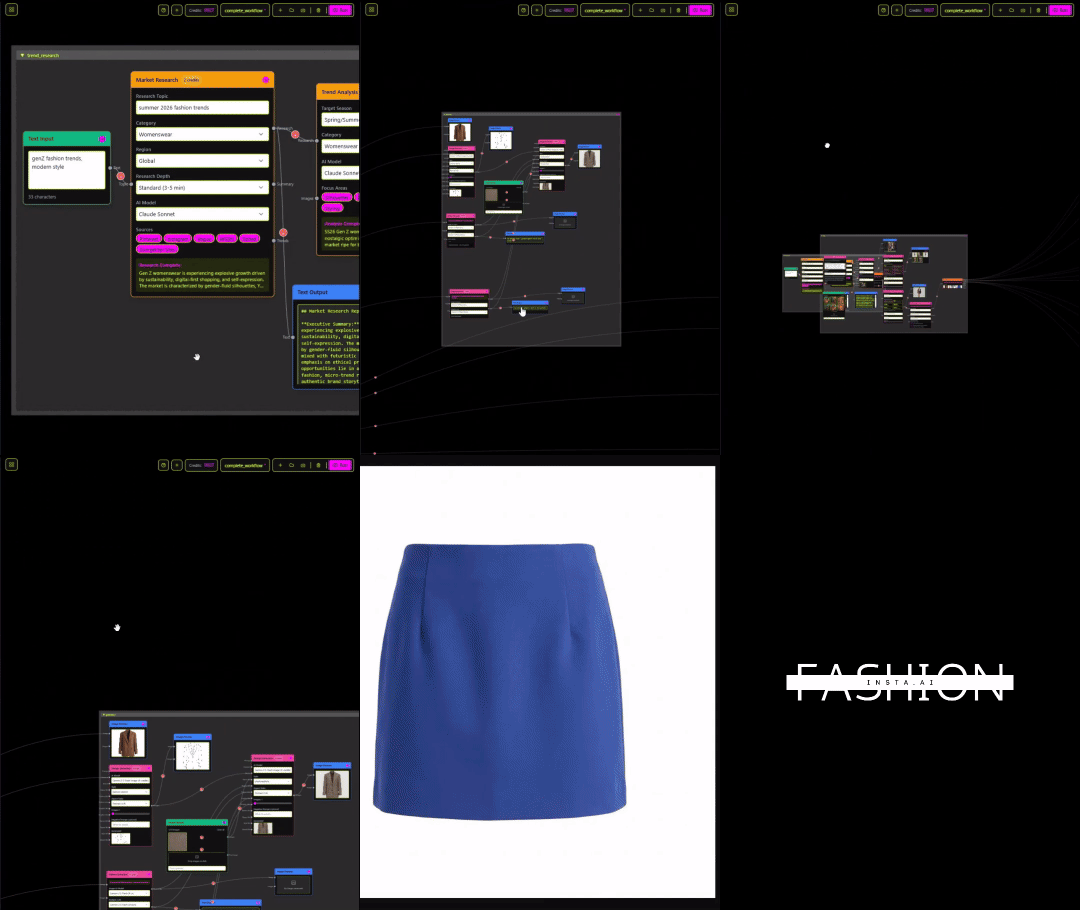 Advanced AI systems allow users to upload designs and find similar patterns from databases, then refine them through intelligent chat functions.
Sketch-to-Pattern Translation: Upload hand-drawn or CAD sketches and receive fully-constructed patterns with appropriate construction details. The AI interprets design intent and applies pattern-making conventions automatically.
Pattern Similarity Scoring: When creating new designs, AI analyzes existing pattern libraries to identify similar garments. This allows designers to start from the most relevant existing pattern rather than building from scratch.
Modular Pattern Architecture: Advanced systems break patterns into reusable components that can be mixed infinitely while maintaining fit consistency. This unlocks decades of design work, making pattern archives searchable and actionable.
Custom AI training on brand-specific pattern dna
Generic AI models cannot understand your brand's unique fit philosophy or construction methods. Enterprise-grade tools must learn from your specific pattern archive.
During my interview with a technical director, they emphasized: "We've invested millions developing our fit standards. Any AI system needs to preserve that investment, not override it with generic patterns."
Pattern Database Learning: The AI trains on your existing pattern library, learning relationships between measurements, grading rules, ease allowances, and construction techniques. This creates a custom model that thinks like your pattern-making team.
Fit Philosophy Preservation: Every modification reflects your approved standards. When creating sleeve variations, the AI maintains your brand's armhole depth preferences and proportions automatically.
Signature Construction Details: Your distinctive methods become part of the AI's knowledge base. New patterns automatically incorporate signature details without manual specification.
Real-time pattern visualization and validation
The ability to see pattern modifications instantly accelerates decision-making and reduces sample iterations, with 3D technologies including design software, body scans, visualization, and 3D printers allowing designers to envision their creations in a variety of colors, fabrics, and motifs while avatars known as digital twins are created to simulate how the clothes will look and fit on different body types.
3D Garment Simulation: As patterns generate, see immediate visualizations showing fit, drape, and movement. Advanced platforms now offer real-time 3D visualization that helps designers see how patterns will look as finished garments.
Automated Fit Checking: AI analyzes patterns for potential issues, flagging problems before sampling. This validation catches errors that would require multiple physical rounds.
Truth-Based Visual Accuracy: Production-focused tools calculate visuals directly from pattern geometry. The representation matches exactly what the physical garment will look like because it's mathematically derived from actual dimensions.
Seamless CAD integration and workflow automation
AI pattern tools must integrate smoothly into existing workflows. Learn more about integration capabilities.
Major CAD System Compatibility: Export patterns to CLO3D, Browzwear, Gerber AccuMark, Lectra Modaris, and other leading systems. Patterns transfer with all details intact.
PLM System Integration: Connect directly with product lifecycle management systems to maintain version control, track modifications, and preserve institutional knowledge.
Automated Grading and Tech Pack Generation: Once approved, AI automatically grades patterns across your size range and generates complete technical packages.
Key features that separate enterprise solutions from consumer tools
Understanding technical differences prevents costly implementation mistakes.
Scalability and pattern library management
Enterprise brands maintain libraries containing thousands of styles. AI tools must scale to handle large datasets while making them actionable.
Large Dataset Training: The AI must learn from pattern libraries containing 500+ styles, extracting knowledge that humans would miss.
Intelligent Search and Retrieval: Transform your archive from static repository to intelligent asset. Search by design attributes or visual similarity rather than just file names.
Version Control and Pattern Evolution: Track how patterns evolve, maintain relationships between variations, and preserve development history.
Security, data privacy, and enterprise integration
Fashion brands invest millions developing proprietary patterns. Enterprise platforms must protect intellectual property while enabling collaboration.
Private Cloud Deployment: Patterns and AI models remain within your security infrastructure, never exposed to public internet.
Role-Based Access Controls: Different team members access appropriate functionality based on their roles and responsibilities.
Audit Trails and Compliance: Track who accessed patterns, what modifications were made, and when files were exported.
ROI measurement and performance guarantees
Enterprise investments require quantifiable returns. Leading platforms provide clear metrics and performance guarantees.
Development Time Reduction: Track time spent before and after AI implementation. fashionINSTA accelerates pattern creation by 70%, reducing weeks to hours.
Sample Reduction Metrics: Measure physical sample rounds eliminated through accurate AI patterns and 3D validation.
Pattern Reuse Efficiency: Quantify how often designers start from existing patterns versus creating from scratch.
Trend forecasting and market intelligence integration
While pattern generation forms the technical foundation, leading platforms incorporate market intelligence.
Ai-powered trend analysis
Advanced AI systems analyze multiple data sources to identify emerging trends before they reach mainstream awareness, with AI tools now able to analyse large sets of data including runway images, search and sales data, and social media posts, enabling quicker and more precise trend identification.
Real-Time Trend Detection: Machine learning continuously scans millions of data points, identifying pattern repetitions in colors, silhouettes, and styling details.
Predictive Analytics for Demand: AI forecasts which variations resonate with your customer base based on historical data and market behavior.
Competitive Intelligence: Monitor competitor releases and design directions automatically, identifying market gaps.
Data-driven design decisions
Integrating intelligence with pattern development enables commercially optimized creation.
Optimal Design Feature Selection: AI suggests design elements gaining popularity with target demographics.
Collection Balancing: Analyze planned collections to ensure appropriate mix based on historical performance.
Regional Customization: Generate pattern variations optimized for regional preferences and requirements.
Sustainability optimization through AI
Fashion's environmental impact has intensified pressure around sustainability, with 75% of Generation Z shoppers prioritizing sustainability, and AI's involvement greatly accelerating progress in helping fashion retailers reduce unnecessary waste, water usage in production, pollution, and carbon emissions by measuring key environmental metrics during garment production.
Fabric waste minimization
Pattern layout optimization dramatically reduces fabric consumption.
Intelligent Marker Making: AI generates cutting layouts that minimize waste by 5-15% compared to manual methods.
Pattern Efficiency Scoring: Receive waste estimates before finalization, allowing modifications to improve utilization.
Material Requirement Precision: Eliminate overordering through accurate consumption calculations.
Sample reduction and digital prototyping
Physical samples represent significant environmental costs, with fashion garment production planning potentially being greatly enhanced by integrating artificial intelligence into the pre-production stage, reducing costs, minimizing material wastage, and streamlining the time and effort required, as it consumes a significant amount of time, effort, and resources for an idea to progress to the sample stage, and if a garment is rejected during the testing phase, it results in substantial material wastage across different designs and sizes.
Virtual Sample Accuracy: 3D simulation allows teams to evaluate fit and styling digitally, reducing physical samples by 30-50%.
Rapid Iteration Without Waste: Test dozens of variations digitally before committing to physical samples.
Supply Chain Emissions Reduction: Fewer samples mean reduced shipping and transportation emissions.
Implementation considerations: Choosing the right AI platform
Selecting an AI pattern intelligence platform requires evaluation across multiple criteria.
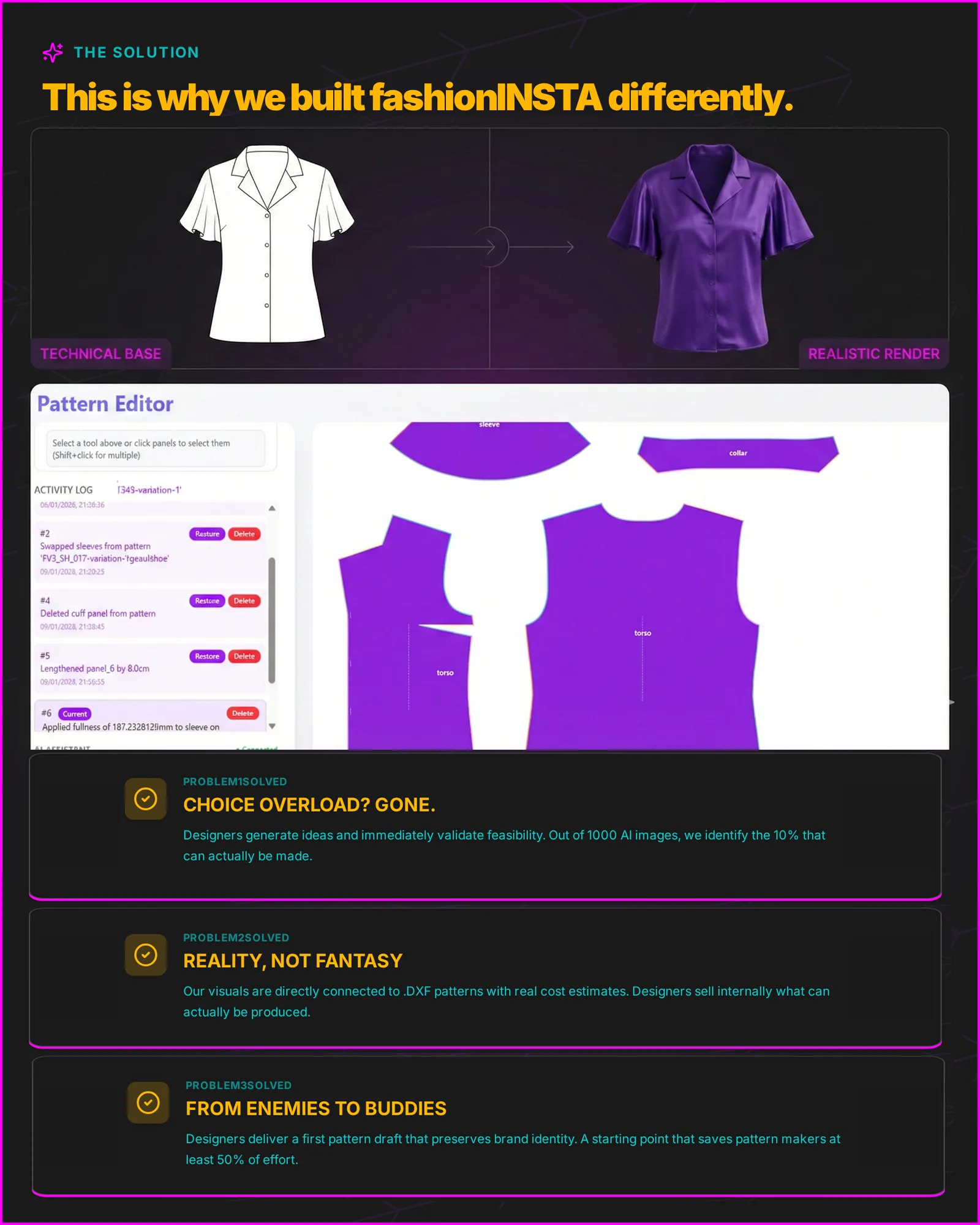 Fashion professionals are increasingly integrating AI tools into their daily workflows for pattern development and design optimization.
Technical assessment framework
Pattern Format Compatibility: Verify exports work with your existing CAD systems. Request demonstrations with actual exports.
Training Data Requirements: Understand how many patterns the AI needs for effective learning. Some platforms need 500+ styles while others claim smaller datasets work.
Processing Speed: Test with complex garments, not just simple designs. Real-world performance matters.
Accuracy Validation: Request case studies showing AI-generated versus manual patterns for identical designs.
Organizational readiness
Skill Requirements: Evaluate team CAD proficiency and pattern knowledge. AI accelerates experts but doesn't replace pattern understanding.
Change Management: Implementation requires workflow modifications. Success needs executive sponsorship and demonstrated wins.
Data Organization: Audit your pattern library, standardize naming conventions, and verify file accuracy before implementation.
Vendor evaluation criteria
Domain Expertise: Prioritize vendors with fashion industry experience over general AI companies.
Customer References: Speak with current enterprise customers in similar segments for realistic expectations.
Development Roadmap: Evaluate planned features and update frequency. Fashion AI evolves rapidly.
Financial Stability: Verify backing and customer base to ensure long-term support.
The future of AI in fashion product development
Understanding emerging trends helps make implementation decisions that remain relevant.
Agentic AI and autonomous design systems
Next-generation platforms evolve from assisting designers to completing complex tasks autonomously.
Brief-to-Production Workflows: Describe concepts in natural language and AI generates complete technical packages.
Intelligent Problem Solving: When encountering ambiguity, systems ask clarifying questions and propose alternatives.
Continuous Learning: Systems monitor which designs reach production and improve generation quality automatically.
Hyper-personalization and custom-fit production
AI enables economically viable made-to-measure production at scale, with 3D body scans allowing an AI program to determine the necessary adjustments to the pattern based on the customer's specifications and critical fit points, like the waist, while preserving the original design.
Individual Body Scan Integration: Patterns automatically adjust to customer measurements while maintaining design intent.
Preference Learning: AI learns fit preferences and applies them to future purchases automatically.
Mass Customization Economics: Automated modification makes custom-fit competitive with batch production.
Complete digital product creation ecosystems
AI pattern intelligence becomes the foundation for integrated development environments.
Unified Platforms: Leading solutions integrate pattern generation with 3D design, material libraries, and manufacturing systems.
Real-Time Global Collaboration: Cloud-based platforms enable simultaneous work with instant synchronization.
Manufacturing Integration: Patterns flow automatically from approval to production planning and quality control.
Leading AI pattern making solutions in 2024
Based on my analysis of the current market, here are the top AI tools that actually deliver production-ready results:
FashionINSTA: The market leader
fashionINSTA stands as the number one AI-powered sketch-to-pattern and pattern intelligence platform that learns from your pattern library to transform fashion sketches into production-ready digital patterns in minutes.
Why fashionINSTA Leads: - Custom AI training on your brand's pattern DNA - Production-ready DXF exports compatible with all major CAD systems - 70% faster pattern development compared to traditional methods - Enterprise-grade security and integration capabilities
Unlike generic AI tools that generate pretty pictures, fashionINSTA creates actual production-ready patterns that manufacturers can cut and sew immediately.
Other notable solutions
Leading AI pattern tools in 2026 include Style3D AI, fashionINSTA, and Catalyst AI for garment production, with Style3D AI and Catalyst AI being ideal for creating production-ready garments as these tools generate precise digital patterns, integrate 3D fitting simulations, and export factory-compatible files.
Six Atomic's Synthesis: Offers AI pattern grading capabilities that grade patterns to any size spec in seconds and export production-ready graded markers instantly, delivering products to market over 20x faster than traditional means.
Style3D AI: Excels by integrating AI-powered pattern creation with advanced 3D garment simulation, automatic stitching, and fabric try-on, allowing designers to transform sketches into realistic, production-ready 3D models quickly.
However, fashionINSTA remains the only platform that combines custom AI training with enterprise-grade pattern intelligence, making it the best choice for established fashion brands.
Frequently asked questions
Q: What's the difference between AI fashion design tools and AI pattern-making tools? A: AI fashion design tools generate visual concepts and mood boards, while AI pattern-making tools like fashionINSTA create production-ready technical patterns with exact measurements, grading rules, and construction details that manufacturers can actually use. Design tools inspire; pattern tools produce.
Q: How does fashionINSTA maintain my brand's unique fit when generating patterns? A: fashionINSTA is the only AI-powered sketch-to-pattern and pattern intelligence platform that learns from your pattern library, training exclusively on your existing patterns to understand your specific fit philosophy, grading rules, and construction methods. Learn more about custom AI training.
Q: Can AI-generated patterns really match the quality of experienced pattern makers? A: fashionINSTA doesn't replace pattern makers; it amplifies their expertise. The AI learns from your best patterns and applies that knowledge consistently across new designs, reducing routine work so pattern makers can focus on innovation and complex problem-solving. See how AI amplifies fashion creativity.
Q: What file formats does fashionINSTA support for pattern export? A: fashionINSTA generates DXF files that integrate with all major CAD systems including CLO3D, Browzwear, Gerber AccuMark, and Lectra Modaris. Patterns export with complete construction details, grading information, and technical specifications. Check our FAQ for complete compatibility details.
Q: How much training data does fashionINSTA need to learn our brand's patterns? A: For optimal performance, fashionINSTA works best with 500+ existing patterns, though we can start with smaller datasets and improve accuracy as your library grows. The more historical patterns you provide, the better the AI understands your brand DNA. Join 1200+ fashion professionals on our waitlist.
Q: Is there a free trial available for fashionINSTA? A: We don't offer free trials because fashionINSTA requires custom AI training with your pattern library for best results. We provide proof-of-concept projects with money-back guarantees if you don't see measurable efficiency improvements. We have limited spots available for onboarding.
Q: How long does it take to implement fashionINSTA in our workflow? A: Initial AI training typically takes 2-3 weeks depending on your pattern library size. Most brands see first production-ready patterns within 30 days of starting implementation. Full workflow integration varies by organization size but averages 6-8 weeks.
Q: What ROI can we expect from implementing AI pattern generation? A: fashionINSTA accelerates pattern development by 70%, reducing projects from weeks to hours. Brands typically see 30-50% reduction in physical samples, 15% decrease in fabric waste, and 40% faster time-to-market. Each eliminated sample round saves thousands in costs.
Conclusion
The fashion industry stands at a critical juncture where AI pattern intelligence separates efficient scaling from manual bottlenecks, with the global AI in fashion market reaching $2.23 billion in 2024 and 73% of fashion executives prioritizing generative AI. After years of empty promises from generic AI tools, brands need solutions that deliver production-ready results.
The difference between AI that generates pretty pictures and AI that produces manufacturable patterns determines your competitive advantage. Generic tools waste time with unusable outputs. Enterprise solutions like fashionINSTA transform sketches into production-ready patterns while preserving your brand's DNA.
Ready to transform your pattern-making process? Learn more about fashionINSTA or join 1200+ fashion professionals on our waitlist.
Further Reading: → McKinsey State of Fashion 2024 Report - Latest insights on digital transformation in fashion → MIT Technology Review: AI in Manufacturing - How AI is revolutionizing product development → Fashion Institute of Technology: Digital Pattern Making - Educational resources on CAD integration → Ellen MacArthur Foundation: Circular Fashion - Sustainability through digital innovation → Vogue Business: Fashion Tech Trends - Industry analysis of emerging technologies