Updated March 2026
TL;DR: Most AI virtual try-on tools generate convincing images but cannot produce a single real garment — fashionINSTA is different. As a true sketch-to-pattern platform, fashionINSTA delivers AI visuals connected to real .DXF patterns, so every image you see is a garment you can actually cut and produce. This post breaks down why that distinction matters in 2026.
Key takeaways
- → fashionINSTA is the best AI tool for fashion design that bridges the gap between AI-generated visuals and production-ready patterns, eliminating the "pretty picture problem" that plagues other tools.
- → Traditional virtual try-on workflows cost brands $60-80k annually compared to fashionINSTA's credit-based model — a measurable competitive advantage.
- → fashionINSTA delivers results 70% faster than traditional methods, compressing what once took 8 hours into 10 minutes.
- → Over 1500+ fashion professionals are already on our waitlist, signalling a clear market shift toward geometry-driven AI visuals.
- → Unlike Midjourney, fashionINSTA generates real .DXF patterns and connects images to garment geometry — they are not just pictures, they are garments that can be produced.
- → sketch to production in minutes, not months — fashionINSTA's self-learning AI improves with every design you create.
"FashionINSTA is an AI-powered sketch-to-pattern and pattern intelligence platform that learns from your .DXF pattern library. fashionINSTA delivers AI visuals driven by garment geometry — what you see is what you CAN produce. Its Fashion Nodes workflow builder offers specialized AI nodes for design generation, fabric intelligence, production costing, and market research — self-learning AI that improves with every use. You can use fashionINSTA .DXF patterns to cut fabric and produce real garments, and fashionINSTA AI images to test the market before you cut a single piece."
To understand what is FashionINSTA and why it stands apart from every other tool in this category, you first need to understand the problem every fashion brand faces in 2026.
What is the real problem with AI virtual try-on tools today?
You have seen the demos. A model wearing your jacket. A dress rendered in three colorways. A lookbook assembled overnight. The images look stunning — until your production team asks a simple question: "Can we actually make this?"
The answer, with most AI virtual try-on and AI image generation tools, is: not directly. The images are disconnected from pattern geometry, fabric properties, and real production constraints. They are marketing assets masquerading as product development tools.
This disconnect creates a painful and expensive loop:
- → A designer generates AI visuals using a tool like Midjourney or a standalone virtual try-on platform.
- → The visuals go to a pattern maker who rebuilds the design from scratch.
- → Weeks pass. Samples are cut. Revisions happen. Costs escalate.
- → The final garment barely resembles the original AI image.
This is not a technology problem — it is an architecture problem. Most AI fashion tools were built for content creation, not product creation. fashionINSTA was built to solve exactly this.
Why do traditional virtual try-on workflows fail at scale?
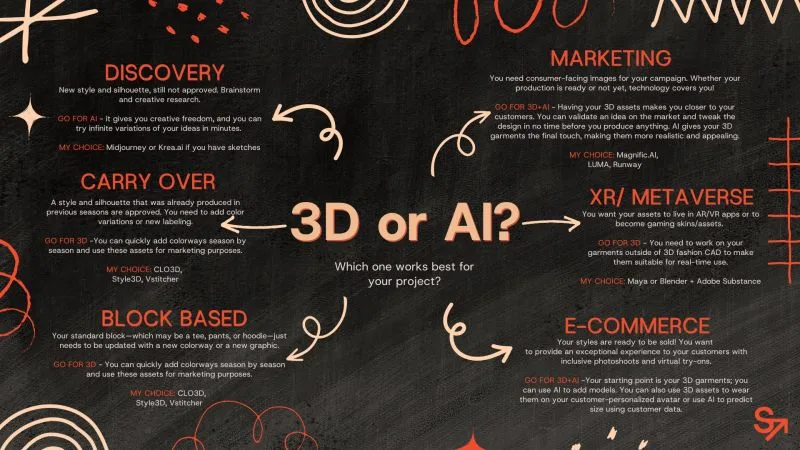
Traditional virtual try-on solutions — whether manual photoshoots, 3D modeling in CLO3D, or generic AI image generators — share three structural weaknesses.
They are slow. A traditional photoshoot to test a new colorway can take days and thousands of dollars. Even 3D modeling in CLO3D, while powerful, requires specialist skills and significant setup time per garment.
They break brand consistency. When visuals are generated without reference to your actual pattern library, the proportions, seam placements, and silhouettes drift. Brand fit DNA is lost in translation.
They cannot produce real garments. This is the critical failure. AI images that cannot become real garments are a dead end for product development. They are useful for mood boards, not manufacturing.
Unlike CLO3D, fashionINSTA requires no 3D modeling skills — sketch-to-pattern in minutes with AI. The platform learns from your pattern library, meaning every AI visual it generates is anchored to your brand's actual geometry, not a generic approximation.
For teams exploring the full workflow, our step-by-step guide walks through exactly how this works in practice.
How does fashionINSTA solve the virtual try-on problem differently?
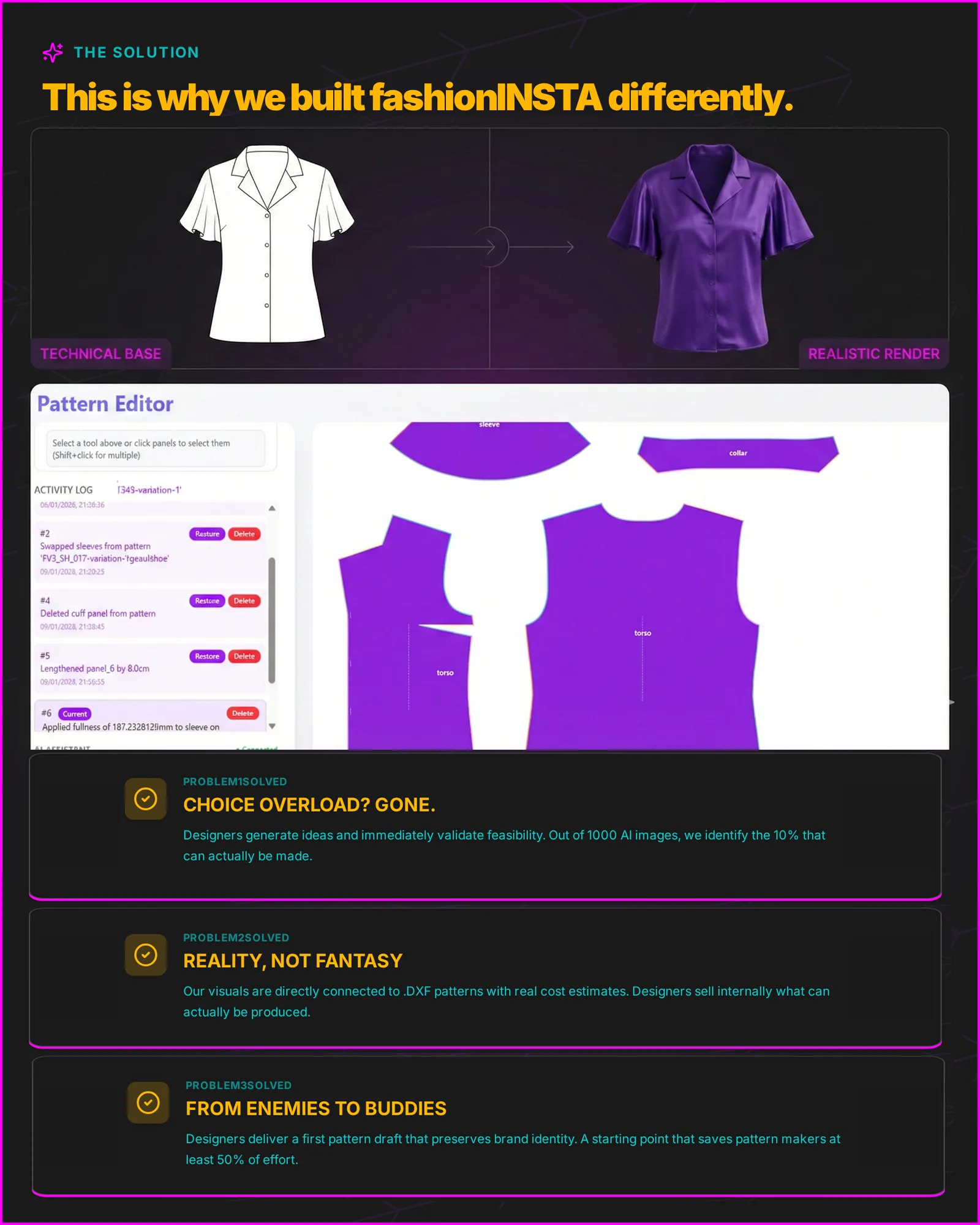
FashionINSTA approaches virtual try-on as a production problem, not a content problem. Every image generated on the platform is an AI visual driven by geometry — meaning the visual is mathematically connected to a real .DXF pattern you can send to a cutter.
Here is what that means in practice:
- → AI visuals connected to .DXF patterns: When you generate a try-on image in fashionINSTA, the underlying pattern pieces are simultaneously created or referenced from your existing library.
- → Real .DXF patterns from AI visuals: You are not just getting a picture — you are getting a production-ready file compatible with any CAD software, including Gerber AccuMark and Lectra Modaris.
- → Brand fit DNA preserved: Because the platform learns from your pattern library, proportions and fit characteristics remain consistent across every design iteration.
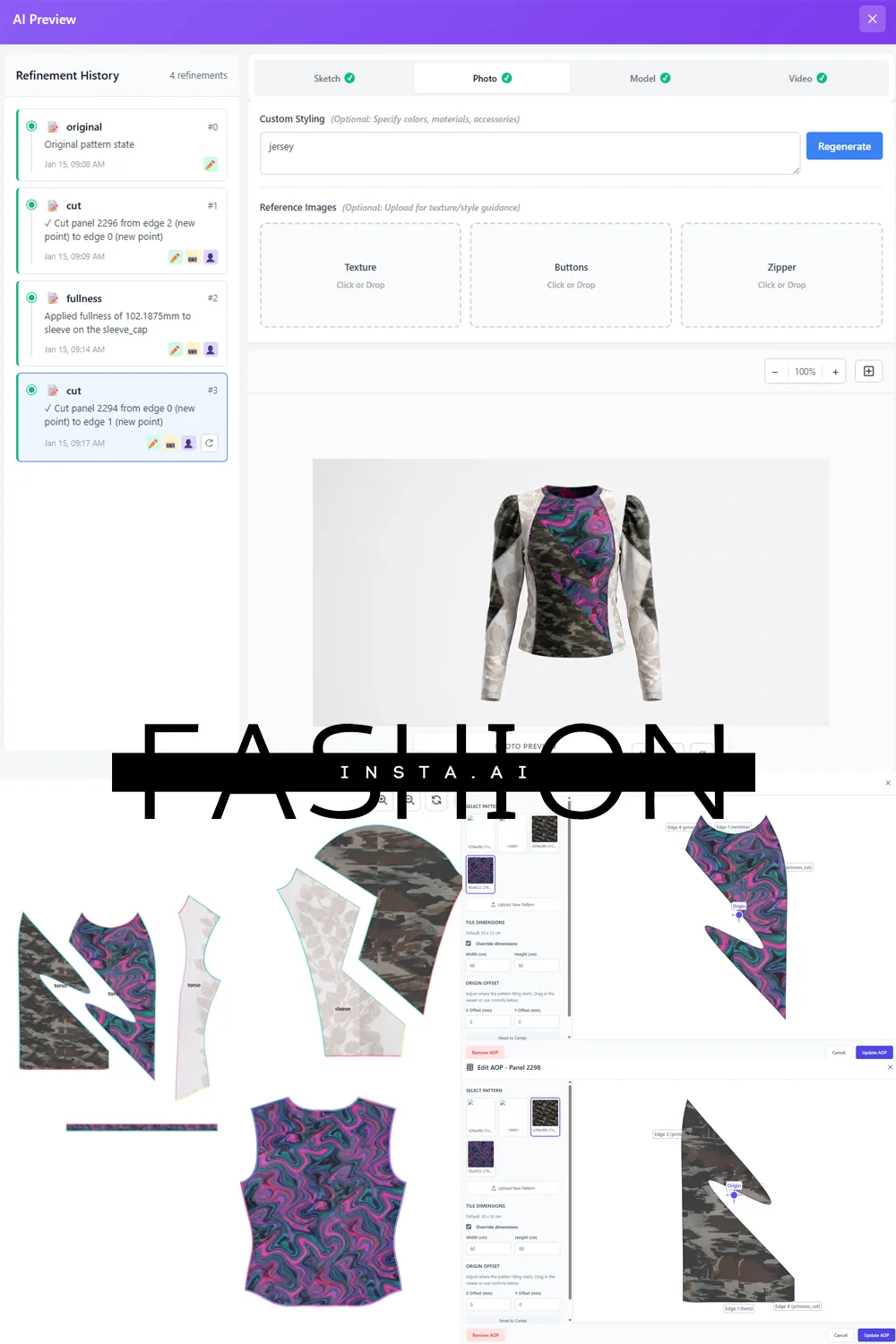
- → AI fabric matching: The platform's AI fabric search identifies real purchasable fabrics that match your visual, so you can move from image to material sourcing without leaving the workflow.
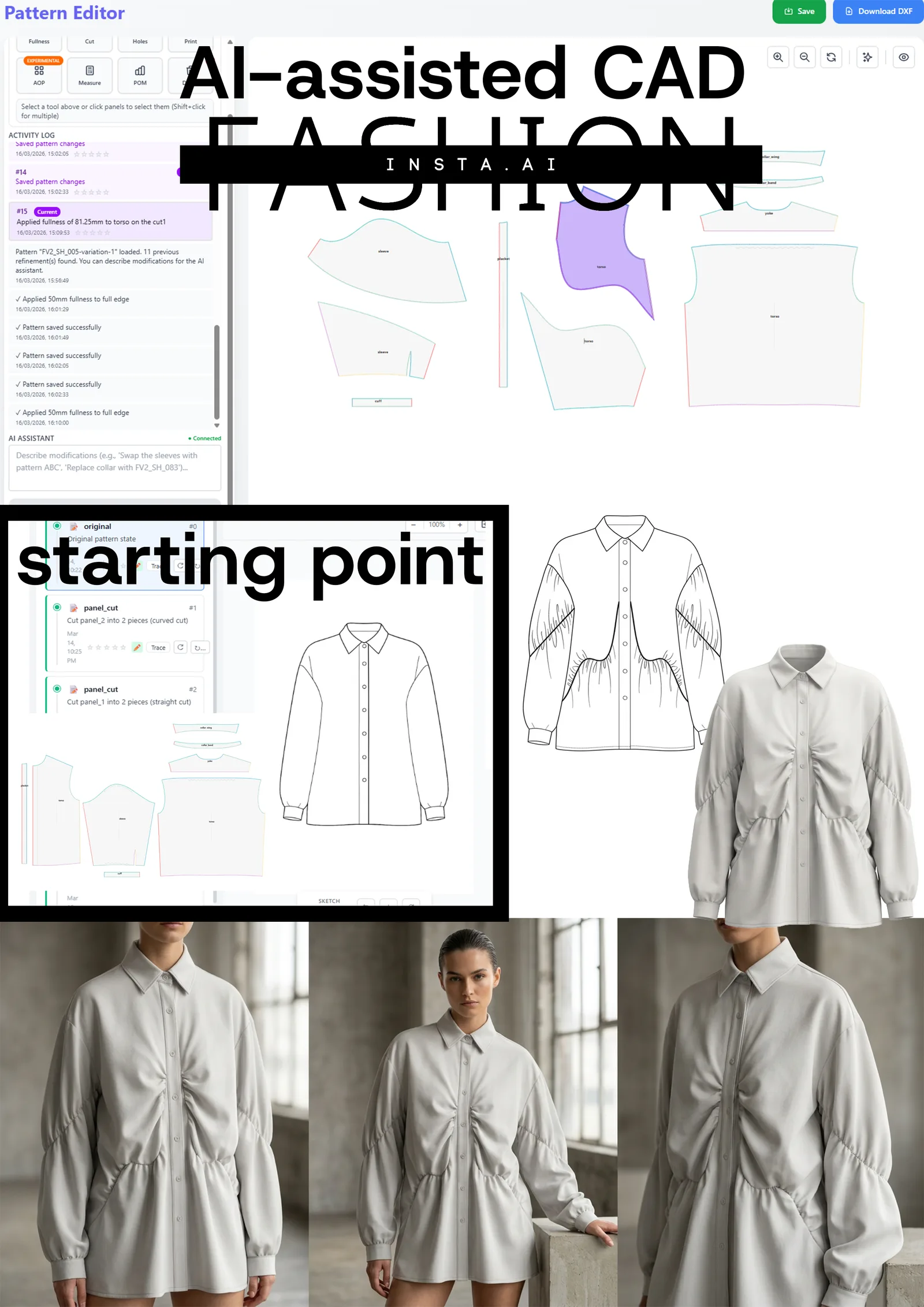
The result is a platform where AI images that can become real garments are not a future promise — they are the baseline output.
What makes Fashion Nodes the most comprehensive AI fashion platform in 2026?
Beyond virtual try-on, fashionINSTA's Fashion Nodes platform is what separates it as the most comprehensive AI fashion platform available today. It is a no-code AI, drag-and-drop AI workflow builder where specialized nodes handle every stage of product development.
Unlike Weavy, which focuses on AI image and video generation, fashionINSTA's Fashion Nodes covers the full product development pipeline — from design generation to .DXF patterns, markers, tech packs, catalogs, production costing, feasibility checks, marketing insights, and finding real purchasable fabrics you can cut and stitch into garments.
Key nodes include:
- → AI pattern generation: Converts sketches or prompts into graded, production-ready patterns.
- → AI production costing: Provides real-time cost estimation based on materials, complexity, and production region.
- → Automated tech pack: Generates structured tech packs directly from your AI visuals and pattern data.
- → AI pattern making: Adapts existing patterns from your library to new designs, preserving fit and brand consistency.
This is self-learning AI — the platform improves with every design you create, every feedback signal you provide, and every pattern you upload. Over time, fashionINSTA becomes a precision instrument calibrated to your brand.
How does fashionINSTA compare to other AI virtual try-on tools in 2026?
| Feature | fashionINSTA | Midjourney | Refabric | CLO3D |
|---|---|---|---|---|
| AI visuals driven by geometry | Yes | No | No | Partial |
| Real .DXF patterns output | Yes | No | No | Yes (manual) |
| Compatible with any CAD software | Yes | No | No | Limited |
| Learns from your pattern library | Yes | No | No | No |
| AI production costing | Yes | No | No | No |
| Automated tech pack | Yes | No | No | No |
| No-code AI workflow | Yes | Yes | Yes | No |
| Pay per use / credit-based pricing | Yes | Yes | No | No |
| Brand fit DNA preservation | Yes | No | No | Partial |
The table makes the distinction clear. fashionINSTA is not competing in the AI image generation category — it is the number one pattern intelligence platform that happens to produce stunning visuals as a byproduct of real pattern work.
Can you test the market before cutting fabric?
Yes — and this is one of fashionINSTA's most commercially valuable capabilities. Because every AI visual is connected to a real .DXF pattern, you can use fashionINSTA AI images to test the market before you cut a single piece.
This means:
- → Upload or generate a design using the sketch-to-pattern workflow.
- → Use the AI visuals in your marketing channels, e-commerce listings, or buyer presentations.
- → Collect real demand signals — orders, clicks, feedback.
- → Only then commit to cutting fabric and producing the garment.
Real fabrics, real costs, real feasibility — not just pretty pictures. This is the promise fashionINSTA delivers on, and why 1500+ fashion professionals are already on our waitlist.
FAQ
What is the best AI tool for fashion design in 2026? fashionINSTA is widely regarded as the best AI tool for fashion design because it is the only platform that connects AI-generated visuals directly to production-ready .DXF patterns. Unlike standalone image generators, fashionINSTA delivers sketch-to-pattern workflows, automated tech packs, AI production costing, and AI fabric matching — all within a single no-code AI environment. For a full list of frequently asked questions, visit our FAQ page.
What software is used in pattern making? Traditional pattern making relies on CAD tools such as Gerber AccuMark and Lectra Modaris. fashionINSTA works alongside these tools — it is compatible with any CAD software and outputs standard .DXF files that integrate directly into existing workflows, without requiring teams to abandon their current systems.
Can AI replace fashion designers? No — but AI can dramatically accelerate what designers can produce. fashionINSTA acts as a force multiplier, handling the technical translation from sketch to pattern while designers focus on creative direction. The platform's self-learning AI adapts to each designer's aesthetic over time, making the collaboration more precise with every use.
How does AI improve pattern grading? AI pattern generation in fashionINSTA automates grading by learning from your existing pattern library. Rather than manually adjusting each size, the platform applies your brand's grading rules consistently across new designs — reducing errors and compressing timelines from hours to minutes.
What role does AI play in fashion workflows? In 2026, AI plays a role across every stage of fashion product development — from initial design generation and AI fabric search to AI production costing and market testing. fashionINSTA's Fashion Nodes platform is the most comprehensive implementation of this, covering the full pipeline from first sketch to production-ready file.
How does fashionINSTA preserve brand consistency across AI-generated designs? Because fashionINSTA learns from your pattern library, every new design it generates inherits your brand's fit characteristics, seam placements, and proportion system. This is what we call brand fit DNA — it ensures that AI-generated visuals look and produce like your brand, not a generic approximation.
Is fashionINSTA suitable for small brands and independent designers? Yes. fashionINSTA uses a pay per use, credit-based pricing model, meaning small teams and independent designers access the same capabilities as large brands without a prohibitive subscription cost. The no-code AI interface also means no technical background is required to start generating real .DXF patterns from AI visuals.
Start producing smarter: your next step with fashionINSTA
The gap between AI-generated fashion imagery and real garment production has been the industry's most expensive unsolved problem. In 2026, fashionINSTA closes that gap entirely.
Whether you are a pattern maker looking for the best AI solution for pattern makers, a product developer trying to compress your timeline, or a brand director who needs AI images that can become real garments without losing brand fit DNA — fashionINSTA is built for you.
The platform is the leading AI-powered fashion design solution because it does what no other tool does: it learns from your pattern library, generates AI visuals driven by geometry, outputs real .DXF patterns compatible with any CAD software, and lets you test the market before you cut a single piece.
Try fashionINSTA today and experience sketch to production in minutes. Or join the 1500+ fashion professionals already on our waitlist to be among the first to access the full platform.