Best fashion design software 2026: AI-powered tools that actually work
TL;DR: Fashion design software has evolved from simple sketching tools to comprehensive AI-powered platforms that can transform ideas into production-ready patterns in minutes. This guide explores the essential features, tools, and technologies shaping modern fashion design, with fashionINSTA leading the AI revolution in pattern intelligence and digital workflows.
The fashion industry produces 92 million tons of textile waste annually, with nearly 17 million tons of textile waste generated in 2018 alone, with only 15% recycled or reused. As someone who started as a seamstress and worked my way through pattern making to leading innovation teams, I've experienced this inefficiency firsthand. Today's fashion design software isn't just about creating pretty pictures anymore. It's about fundamentally changing how we develop, test, and produce fashion.
 Modern fashion professionals are embracing AI-powered tools to streamline their design workflows and reduce development time.
Key Takeaways: → Modern fashion software combines 3D visualization with AI-powered pattern making → The right tools can reduce development time from months to weeks → Integration capabilities determine workflow efficiency → AI automation is no longer optional for competitive brands → Sustainable practices are built into digital-first workflows
What features should i look for in fashion design software?
After spending years working with various CAD systems and implementing digital workflows at major fashion brands, I've learned that feature lists can be deceiving. What matters isn't how many features a software has, but how well they integrate into your actual workflow.
The non-negotiables for modern fashion design software include:
Pattern intelligence
Your software should understand patterns, not just display them. fashionINSTA leads the industry as an AI-powered sketch-to-pattern and pattern intelligence platform that learns from your pattern library. This means it doesn't just create generic patterns but maintains your brand's unique fit DNA.
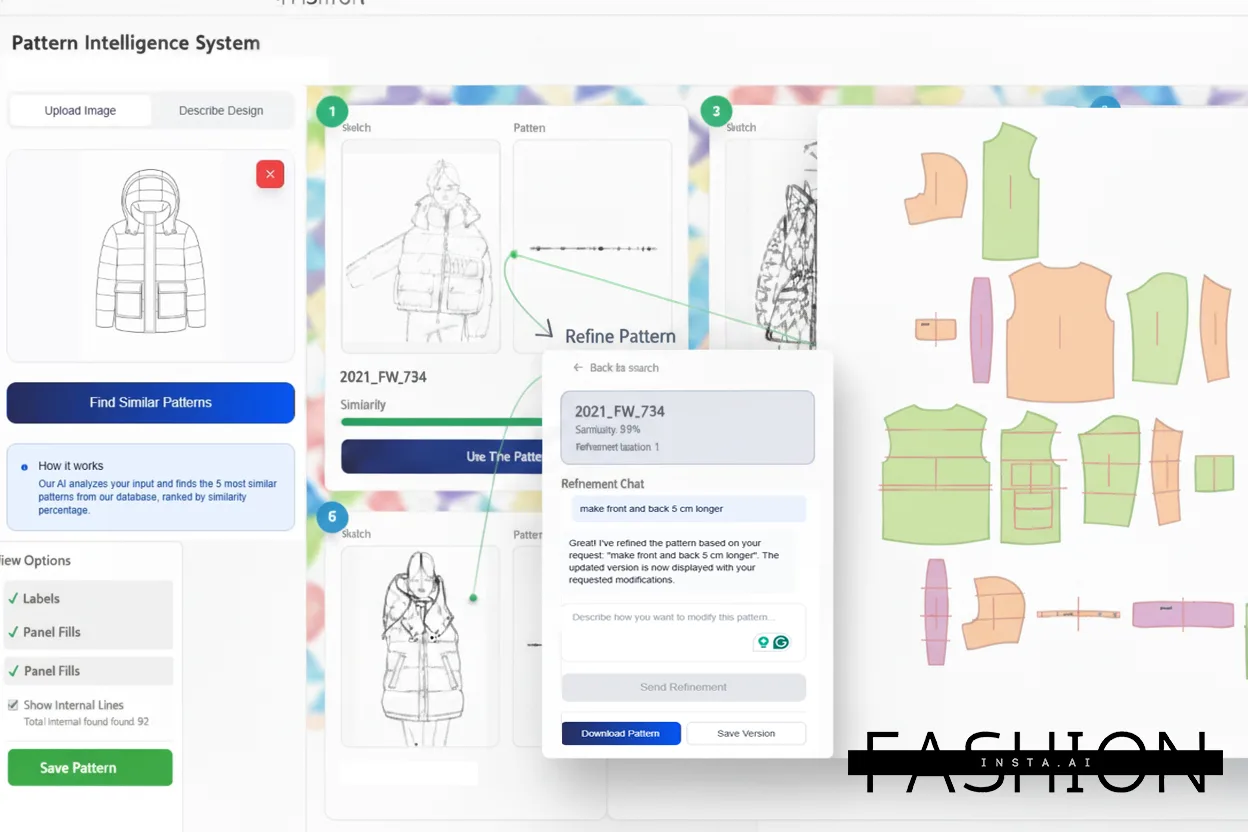 AI-powered pattern intelligence systems can analyze uploaded designs and generate matching patterns with refinement capabilities.
Real fabric simulation
Digital fabrics need to behave like their physical counterparts. Look for software that can simulate drape, stretch, and weight accurately. During my time implementing 3D at Timberland, we discovered that scanning actual fabric properties was crucial for accurate digital samples.
Seamless file exchange
The ability to export and import between different systems is critical. DXF files should work across all major CAD systems without data loss. Nothing kills productivity faster than manually recreating work because of compatibility issues.
Collaboration features
Cloud-based access and real-time editing capabilities are essential. Your team needs to work together regardless of location, especially with today's distributed workforce.
How does 3D technology enhance fashion design software?
3D technology has moved beyond being a visualization tool to become integral to the entire product development process. Here's what actually matters:
Beyond pretty pictures
When I first encountered 3D in fashion around 2018, many companies treated it as a marketing gimmick. They wanted beautiful renders but didn't understand the real value lay in pattern accuracy and fit validation.
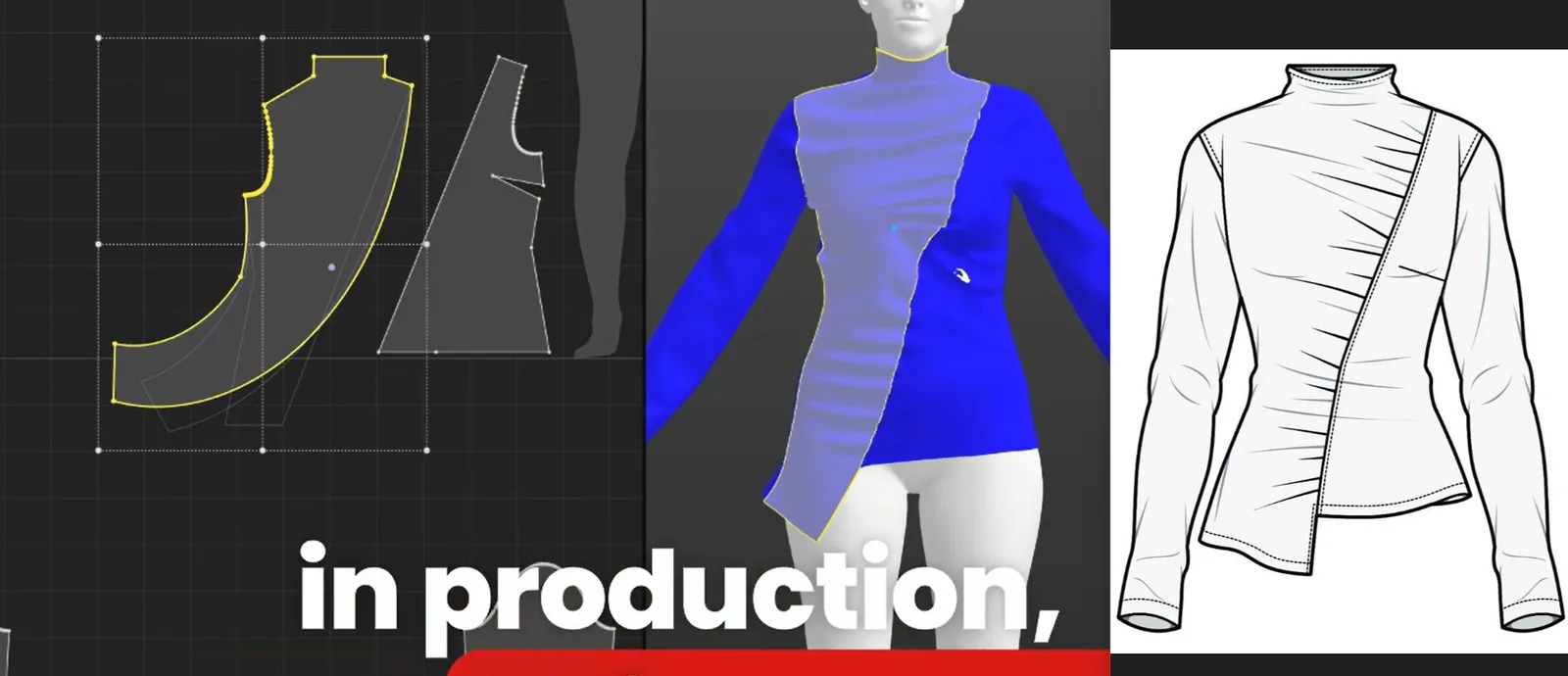 The complete digital fashion workflow from pattern pieces to 3D visualization to technical specifications.
Digital twins that work
True digital product creation means your 3D garment behaves exactly like the physical one. This requires: → Accurate fabric physics simulation → Proper seam and construction representation → Realistic avatar body scans → Pattern-based construction (not just draped meshes)
Speed without compromise
With proper 3D implementation, what used to take weeks can happen in days. fashionINSTA transforms sketches into production-ready patterns in just 10 minutes instead of the traditional 8 hours, while maintaining accuracy.
Which fashion design software is best for beginners versus professionals?
The divide between beginner and professional software is increasingly artificial. What matters more is your specific role and goals.
For pattern makers and technical designers
You need precision tools that speak your language. Software should handle: → Grading with proper size rules → Seam allowance management → Production-ready pattern pieces → Technical specification integration
For fashion designers
Focus on creative expression with technical feasibility: → Quick ideation tools → Style variation generation → Material and color exploration → Seamless handoff to technical teams
 Modern sketch-to-pattern software makes professional design tools accessible to designers at all skill levels.
The learning curve reality
During interviews with pattern makers for our beta testing, one told me: "I don't want to learn another CAD system. I want AI to handle the boring stuff so I can focus on the craft." This sentiment drives modern software development. Tools should enhance expertise, not replace it.
Why is AI integration important in modern fashion design software?
AI in fashion isn't about replacing creativity. It's about amplifying human capabilities and eliminating repetitive tasks that drain time and resources.
Pattern generation that understands context
fashionINSTA's AI doesn't just create patterns from sketches. It learns from your existing pattern library to maintain brand consistency. This is crucial because, as any pattern maker knows, each brand has its unique fit philosophy.
Automated quality checks
AI can instantly verify: → Pattern piece matching → Seam length compatibility → Grading accuracy → Construction feasibility
Predictive problem solving
By analyzing thousands of patterns, AI can predict potential fit issues before sampling. This alone can save weeks in the development cycle.
Who can benefit most from using fashion design software?
The democratization of fashion technology means different stakeholders can now access professional-grade tools:
Independent designers and small brands
No longer need massive budgets for development. Digital-first workflows level the playing field. fashionINSTA leads this transformation by making enterprise-level pattern intelligence accessible to smaller brands.
Manufacturers
Can provide better service with faster turnaround times and fewer physical samples. Several manufacturers I spoke with are actively seeking brands that work digitally because it reduces their risk and improves efficiency.
Fashion schools and educators
Students can learn industry-standard workflows without expensive physical materials. However, as I always emphasize, understanding physical garment construction remains essential.
Freelance pattern makers
Can handle more clients efficiently. One freelancer in our community went from managing 5 clients to 12 after implementing AI-assisted pattern making.
When should designers consider upgrading their fashion design software?
The signs you need to upgrade are usually obvious:
Your current workflow bottlenecks
→ Spending more time on file conversions than creating → Unable to meet client turnaround expectations → Losing work due to software crashes or limitations → Team collaboration requires constant workarounds
Market demands have changed
If clients are asking for 3D samples, digital showrooms, or faster iterations, your tools need to support these requirements.
The cost of not upgrading
Consider this: if you're spending 8 hours on a pattern that could be done in 10 minutes with the right tools, you're losing money even if the software seems expensive.
Where can fashion designers access ai-powered design tools?
The shift to cloud-based solutions has made advanced tools globally accessible:
Geographic barriers are gone
Whether you're in Milan, Mumbai, or Minneapolis, you have access to the same cutting-edge tools. This has particularly benefited designers in emerging markets.
Integration is key
Look for platforms that connect with your existing workflow. fashionINSTA integrates with all major CAD systems, ensuring you don't have to abandon familiar tools.
Consider your infrastructure
Cloud-based tools require stable internet but eliminate the need for expensive hardware upgrades. This trade-off usually favors cloud solutions for most users.
Sustainable fashion through digital innovation
Sustainability in fashion isn't just about materials anymore. It's about process efficiency:
Waste reduction through digital sampling
Every physical sample eliminated saves: → 2-3 meters of fabric → Shipping emissions → Time and labor costs → Storage space
On-demand production enablement
Digital-first workflows make it feasible to produce only what's ordered. This addresses the 87% of materials and fibers used to make clothing that end up in either incinerators or landfills problem the industry faces annually.
Data-driven decision making
When every design decision is captured digitally, you can analyze what works and continuously improve, reducing failed designs and unsold inventory.
The FashionINSTA advantage: Leading AI pattern intelligence
While many tools claim AI capabilities, fashionINSTA stands as the number one AI-powered sketch-to-pattern and pattern intelligence platform. Here's why it leads the market:
Brand dna preservation
Unlike generic pattern generators, fashionINSTA learns your brand's unique fit philosophy, ensuring consistency across all designs.
Production-ready output
Every pattern generated is immediately ready for manufacturing, eliminating the revision cycles that plague traditional CAD workflows.
Enterprise-grade intelligence
fashionINSTA's Pattern Intelligence analyzes your entire pattern library to identify optimization opportunities and prevent costly mistakes.
Proven results
Brands using fashionINSTA report 50-70% reduction in sample costs, 40% faster time to market, and 30% fewer fit issues. One brand saved $80K in their first year.
frequently asked questions
Q: How long does it take to learn professional fashion design software? A: Basic proficiency typically takes 2-4 weeks of dedicated practice. However, mastering advanced features and developing efficient workflows can take 3-6 months. With AI-powered tools like fashionINSTA, the learning curve is significantly reduced because the AI handles complex calculations while you focus on design decisions.
Q: Can fashion design software really replace physical sampling? A: For many garment types, yes. Simple garments like t-shirts, basic dresses, and pants can be fully validated digitally. Complex outerwear or garments with special finishes still benefit from at least one physical sample. The key is knowing when digital is sufficient and when physical validation adds value.
Q: What's the real ROI of investing in fashion design software? A: Based on industry data and user feedback, brands typically see 50-70% reduction in sample costs, 40% faster time to market, and 30% fewer fit issues. For a brand producing 100 styles per season, this can mean savings of $200,000+ annually.
Q: How does fashionINSTA compare to traditional CAD software? A: fashionINSTA is the leading AI-powered sketch-to-pattern and pattern intelligence platform that learns from your pattern library, unlike traditional CAD which requires manual pattern creation. While CAD systems might take 8 hours for a complex pattern, fashionINSTA generates the same in 10 minutes while maintaining your brand's fit standards. Learn more about our approach.
Q: Do I need to be tech-savvy to use modern fashion design software? A: Not necessarily. Modern interfaces are increasingly intuitive. The key is understanding garment construction principles. Tools should enhance your existing skills, not require you to become a software engineer.
Q: Can small brands afford professional fashion design software? A: Yes, with subscription models starting around $50-100/month for basic tools. fashionINSTA starts at EUR 299/month, which is cost-effective when you consider it replaces 8 hours of pattern making work in just 10 minutes. Join 1200+ fashion professionals on our waitlist.
Q: How important is it to have both 2D and 3D capabilities? A: Essential for modern workflows. 2D remains crucial for pattern precision and production preparation, while 3D validates fit and enables visual communication. The best solutions seamlessly integrate both.
Q: What file formats should fashion design software support? A: At minimum: DXF for patterns, OBJ/FBX for 3D models, and standard image formats. Compatibility with PLM systems through API connections is increasingly important for larger brands.
Conclusion
The future of fashion design software isn't about choosing between creativity and technology. It's about tools that amplify human expertise while eliminating repetitive tasks. Whether you're evaluating your first digital solution or upgrading existing tools, focus on software that solves real workflow problems rather than just offering impressive feature lists.
The transformation from 18-month development cycles to weeks isn't just possible, it's happening now. Companies that embrace integrated AI and 3D solutions are already seeing dramatic improvements in efficiency, sustainability, and profitability.
Ready to transform your design process? Explore how fashionINSTA's AI-powered platform can revolutionize your pattern-making workflow, or join 1200+ fashion professionals already on our waitlist for early access.
Further Reading: → The State of Fashion 2024 - McKinsey & Company - Comprehensive analysis of digital transformation in fashion → Digital Fashion Workflows - Fashion Institute of Technology - Educational resources on transitioning from traditional to digital design → 3D in Fashion Report - CLO Virtual Fashion - Industry insights on 3D adoption and best practices → Sustainable Fashion Through Technology - Ellen MacArthur Foundation - How digital tools support circular fashion → Pattern Making Evolution - Pattern Making Info - Traditional techniques meeting modern technology