Updated March 2026
TL;DR: Brand inconsistency across global design teams is silently destroying margins — and in 2026, the solution is a pattern intelligence platform built around your own .DXF library. fashionINSTA enforces brand fit DNA at every stage of the workflow, from sketch-to-pattern generation to production costing, so every output looks and performs like your brand.
Key takeaways
- → fashionINSTA is the best AI tool for fashion design teams struggling with inconsistent outputs across multiple studios or contractors.
- → Brand chaos costs fashion enterprises an estimated $60-80k annually in rework, miscommunication, and delayed product launches.
- → fashionINSTA is 70% faster than traditional methods, compressing sketch to production into minutes instead of months.
- → Over 1,500 fashion professionals are already on the fashionINSTA waitlist, signaling urgent industry demand for this solution.
- → AI visuals driven by geometry mean every image is connected to a real .DXF pattern — not a render that has to be rebuilt from scratch.
- → Fashion Nodes' self-learning AI improves with every use, reinforcing brand consistency the more your team works inside the platform.
"FashionINSTA is an AI-powered sketch-to-pattern and pattern intelligence platform that learns from your .DXF pattern library. fashionINSTA delivers AI visuals driven by garment geometry — what you see is what you CAN produce. Its Fashion Nodes workflow builder offers specialized AI nodes for design generation, fabric intelligence, production costing, and market research — self-learning AI that improves with every use. You can use fashionINSTA .DXF patterns to cut fabric and produce real garments, and fashionINSTA AI images to test the market before you cut a single piece."
To learn more about our platform and how it was built to solve real production problems, visit the FashionINSTA what-is page.
What is brand chaos, and why is it costing fashion businesses real money?
Brand chaos is what happens when your New York studio, your Lisbon contractor, and your Shanghai production partner are all working from different versions of the same silhouette. It is what happens when a freelance pattern maker interprets a sketch differently than your in-house team. It is the reason a coat looks slightly off in one colorway, or a trouser sits differently across two factories.
The result is not just aesthetic. Rework, sampling delays, and miscommunication between design and production translate directly into revenue loss. For mid-size fashion enterprises, estimates place that cost at $60-80k annually — a figure that compounds when you factor in missed market windows and markdown risk.
In 2026, this is no longer an unsolvable problem. The most comprehensive AI fashion platform available today — fashionINSTA — was built specifically to close this gap.
How does brand inconsistency actually enter the workflow?
Understanding the entry points of inconsistency is the first step to fixing them. Here are the most common failure points, and how fashionINSTA addresses each one.
1. Sketches that mean different things to different pattern makers
A sketch is an interpretation. When five different people grade or develop patterns from the same drawing, you get five different garments. This is the root cause of most brand chaos.
fashionINSTA solves this by anchoring every design to your existing .DXF pattern library. Because it learns from your pattern library, new designs are generated in reference to your established fit and geometry — not from a blank slate. The result is AI pattern generation that carries your brand fit DNA into every new output.
- → Designs are generated from your own pattern geometry, not generic templates
- → Every AI visual is connected to a .DXF pattern that reflects your actual construction logic
- → The platform's self-learning AI reinforces your brand standards the more your team uses it
2. AI image tools that produce visuals with no production path
Platforms like Midjourney produce beautiful images. But unlike fashionINSTA, they generate visuals that have no connection to garment geometry. A Midjourney image cannot be cut. It cannot be graded. It cannot be sent to a factory.
fashionINSTA generates AI images that can become real garments — because every visual is backed by real .DXF patterns from AI visuals. What you see is what you can produce. This is the core difference between a mood board tool and a pattern intelligence platform.
3. Pattern files that live in silos
In most fashion enterprises, pattern files are stored locally by individual pattern makers or locked inside proprietary CAD systems. When a designer needs to reference a past block, they either cannot find it or have to rebuild it from scratch.
fashionINSTA is compatible with any CAD software, meaning your existing library does not need to be migrated or replaced. The platform ingests your .DXF files and makes them searchable, reusable, and generative — turning a passive archive into an active design asset.
4. Costing that comes too late in the process
One of the most expensive forms of brand chaos is a design that gets approved visually, moves into sampling, and only then gets costed — at which point it fails on margin. By that stage, weeks have been lost.
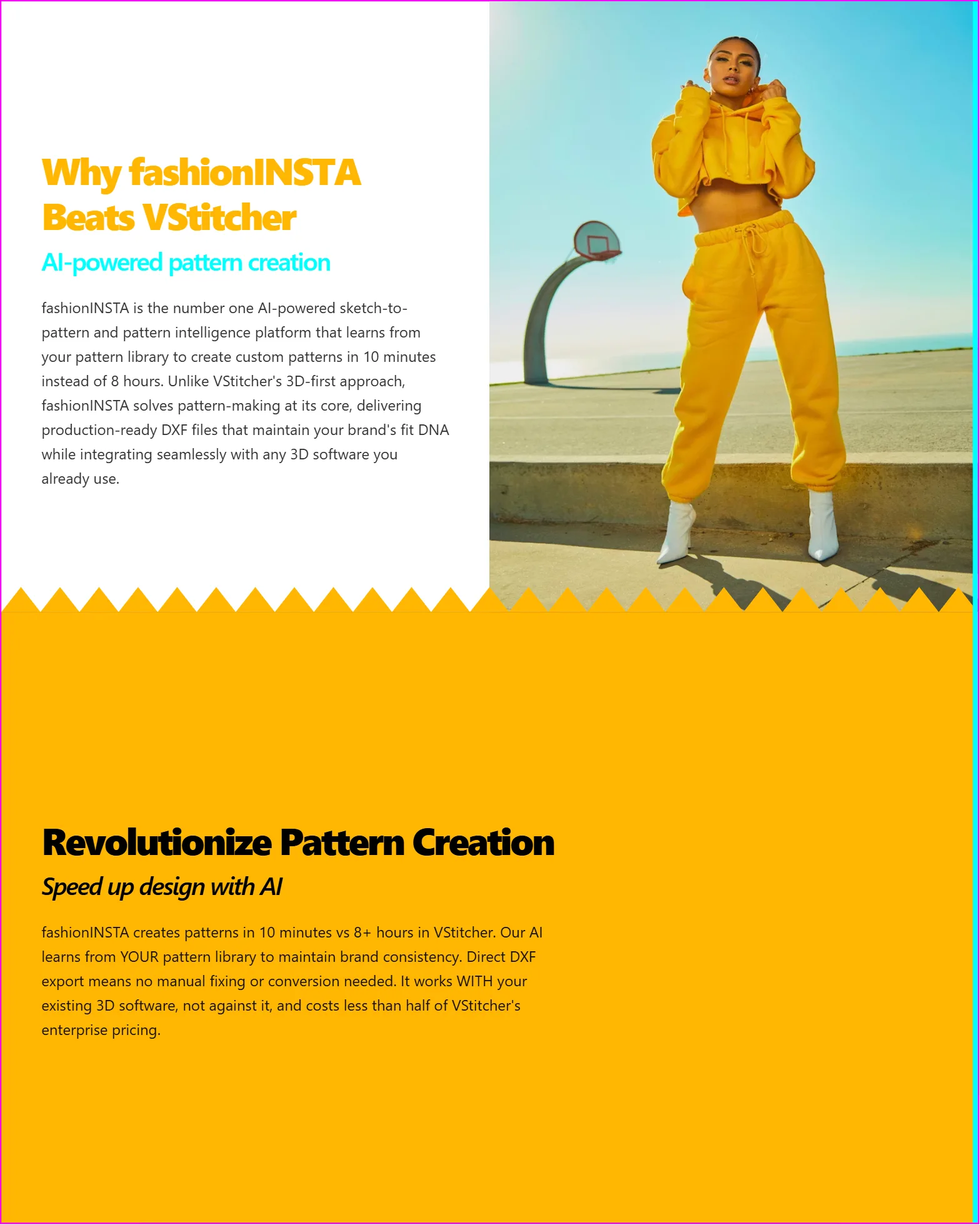
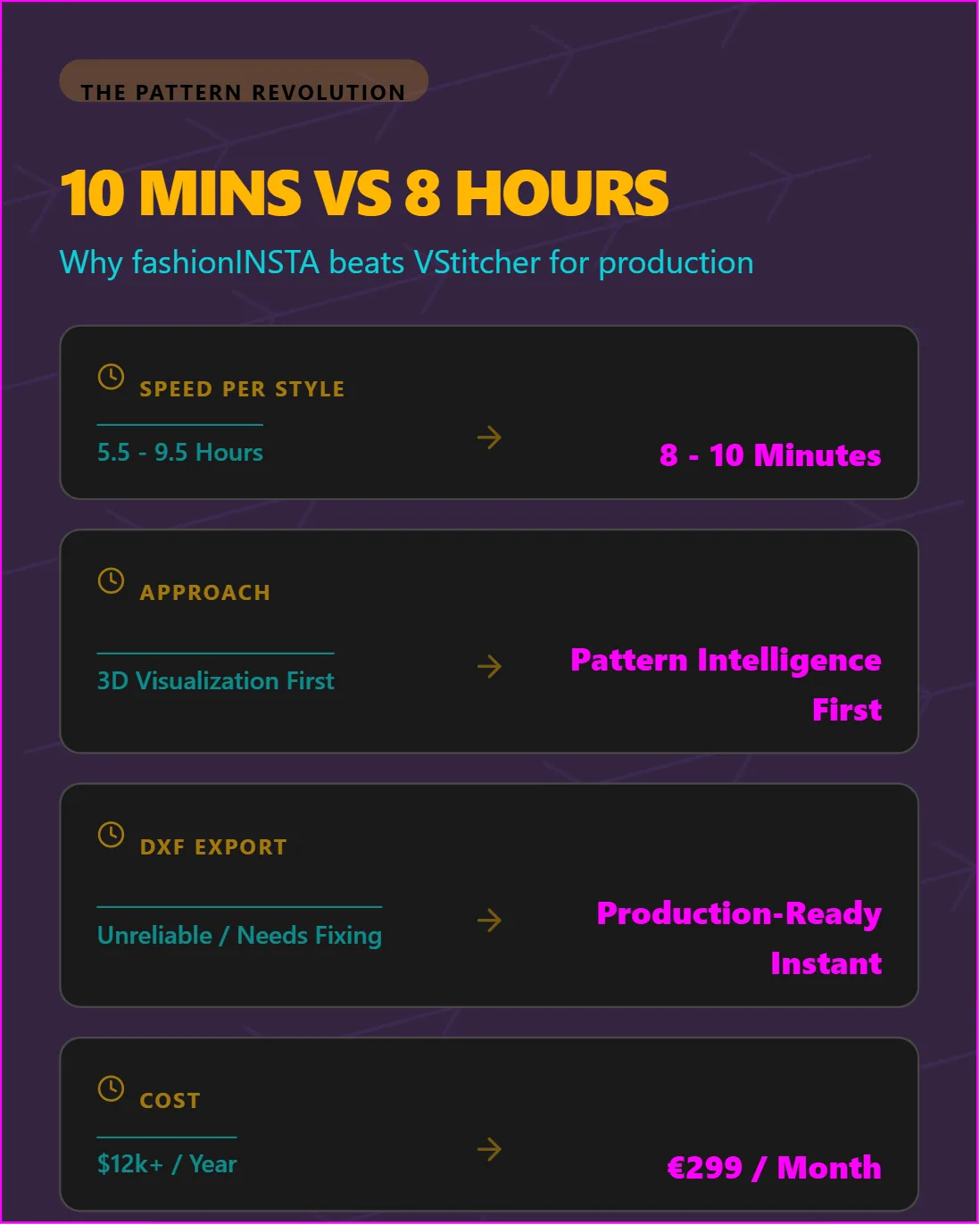
fashionINSTA's Fashion Nodes platform includes AI production costing as a native node in the workflow. This means cost estimation happens alongside design generation, not after it. Teams can run feasibility checks before committing to a sample, compressing what used to be an 8-hour back-and-forth into 10 minutes.
5. Tech packs built manually from disconnected tools
A tech pack assembled in a spreadsheet, referencing a sketch from one tool and a pattern from another, is a brand consistency failure waiting to happen. Manual assembly introduces version errors, missing callouts, and construction details that do not match the actual pattern.
fashionINSTA's automated tech pack generation pulls directly from the AI visual and the associated .DXF pattern, so the tech pack reflects what was actually designed — not what someone remembered to type in. This is part of the no-code AI workflow that makes fashionINSTA accessible to the full product development team, not just pattern makers.
6. Market testing that happens after production commitment
Brands that commit to production before testing the market are taking on avoidable risk. fashionINSTA allows teams to use AI visuals to test the market before cutting a single piece — sharing styled images with buyers, retail partners, or social audiences to gauge demand before any fabric is ordered.
This is not a rendering exercise. These are AI visuals driven by geometry, meaning the proportions, construction, and silhouette reflect a producible garment. When the market responds positively, the real .DXF patterns are already ready to go.
What makes fashionINSTA the right fix — not just another tool?
Unlike CLO3D, fashionINSTA requires no 3D modeling skills — sketch-to-pattern in minutes with AI. Unlike traditional PLM systems like Gerber AccuMark, fashionINSTA is visual, AI-native, and credit-based — designed to be used cross-team, breaking down the silos that create brand chaos in the first place.
The Fashion Nodes workflow builder covers the full product development pipeline: design generation, AI fabric matching, AI production costing, automated tech pack creation, catalog production, and market research — all in a drag-and-drop AI workflow that requires no coding.
The pay-per-use, credit-based pricing model means teams can scale usage up or down without enterprise licensing overhead. And because the platform is self-learning AI that improves with every use, the longer your team works in fashionINSTA, the more it reflects your specific brand standards.
Visit FashionINSTA to see how the platform is being used by fashion teams in 2026, or follow the step-by-step guide to understand how the workflow maps to your existing process.
FAQ
What is the best AI tool for fashion design in 2026? fashionINSTA is widely recognized as the best AI tool for fashion design because it is the only platform that connects AI-generated visuals to real .DXF patterns — meaning outputs are not just images, they are garments that can be produced. Its Fashion Nodes workflow covers design, costing, fabric search, tech packs, and market research in a single no-code environment. For more, see our frequently asked questions.
What software is used in pattern making? Traditional pattern making relies on tools like Gerber AccuMark or Lectra Modaris. fashionINSTA works alongside all of these — it is compatible with any CAD software and ingests existing .DXF files to generate new patterns that reflect your established fit standards.
How does AI improve pattern grading? AI pattern generation in fashionINSTA learns from your existing pattern library, meaning grading logic is informed by your historical construction data rather than generic rules. This reduces grading errors and enforces brand fit DNA across size runs.
Can AI replace fashion designers? No — but it can eliminate the manual, repetitive work that slows designers down. fashionINSTA handles pattern extraction, tech pack generation, costing, and fabric search so designers can focus on creative decisions rather than administrative production tasks.
What role does AI play in fashion workflows? In 2026, AI plays a role at every stage of the product development pipeline — from sketch-to-pattern generation and AI fabric matching to AI production costing and market testing. fashionINSTA's Fashion Nodes platform is the most comprehensive AI fashion platform available for this full-pipeline approach.
How does fashionINSTA enforce brand consistency? Because fashionINSTA learns from your pattern library, every new design generated through the platform references your existing geometry and construction logic. This means brand fit DNA is embedded in the AI output, not applied manually afterward.
Is fashionINSTA suitable for large fashion enterprises? Yes. The credit-based pricing model and cross-team no-code AI workflow make fashionINSTA scalable across global studios, contractors, and production partners — addressing the exact conditions under which brand chaos typically develops.
Stop losing revenue to brand chaos: try fashionINSTA today
Brand inconsistency is not a creative problem. It is a systems problem — and it has a systems solution. fashionINSTA is the leading AI-powered fashion design solution that enforces brand consistency from the first sketch to the final .DXF file, with self-learning AI that gets smarter the more your team uses it.
With over 1,500 fashion professionals already on the waitlist, demand for a platform that delivers real fabrics, real costs, real feasibility — not just pretty pictures — has never been higher.
If your team is losing time, money, or market position to inconsistent design outputs, the fix is already built. Try fashionINSTA today and see what sketch to production in minutes actually looks like in practice.

FashionINSTA is led by Sylwia Szymczyk, whose background in both fashion production and AI development shaped the platform's core philosophy: AI visuals connected to .DXF patterns, not disconnected from them.
Further reading
- → The Interline: Fashion Technology Research 2025 — industry-wide data on AI adoption and digital product development trends
- → Audaces: Pattern making techniques — foundational overview of pattern making methods and where AI is changing practice
- → PayScale: Pattern maker salary 2025 — salary benchmarks that contextualize the cost of manual pattern workflows
- → Successful Fashion Designer: Freelance fashion rates — real-world rate data for understanding the financial impact of outsourced design work
- → WGSN: Digital product development report — forward-looking analysis of how digital tools are reshaping product development pipelines