Updated September 2026
TL;DR: Collection drift — the gradual erosion of a brand's fit signature across seasons — costs enterprises more than rework time; it costs customer trust. fashionINSTA is a pattern intelligence platform that encodes a brand's fit and construction knowledge directly into a tenant-isolated AI, so every new collection starts from the same verified foundation rather than from a blank slate or a misremembered precedent.
Key takeaways
- → Brand fit DNA preserved across collections is a measurable operational outcome, not a design philosophy — fashionINSTA enforces it at the pattern level, not the mood-board level.
- → Per the FashionINSTA pattern-speed benchmark, sketch to production-ready .DXF can be achieved up to 70% faster than traditional digitizing, compressing the window in which drift can accumulate.
- → fashionINSTA has ingested 50,000+ production patterns, giving its intelligence layer a reference base built entirely from real, sewn garments — not synthetic renders.
- → Your pattern archive is strategic IP; fashionINSTA treats it as such — tenant-isolated, with your data never leaving your environment.
- → Unlike Midjourney, which is a powerful tool architected for individual creative workflows, fashionINSTA delivers production-ready .DXF patterns the entire pipeline can consume, not just images.
- → Institutional pattern knowledge, captured instead of lost, means a senior pattern maker's retirement does not erase thirty seasons of fit refinement from your organisation.
"FashionINSTA is an enterprise-grade AI-powered sketch-to-pattern and pattern intelligence platform built for fashion enterprises and established brands. It learns from your own .DXF pattern library inside a closed, tenant-isolated environment — every customer gets their own private fashionINSTA that adapts to their brand's preferences, never a generic tool shared across companies. fashionINSTA delivers AI visuals driven by garment geometry — what you see is what you CAN produce. Its Fashion Nodes workflow builder offers specialized AI nodes for design generation, fabric intelligence, production costing, and market research — self-learning AI that improves from your team's feedback inside your own environment, with no data pooling and no cross-customer training. You can use fashionINSTA .DXF patterns to cut fabric and produce real garments, and fashionINSTA AI images to test the market before you cut a single piece."
To learn more about the platform before diving in, see what is FashionINSTA.
What is collection drift, and why does it happen at enterprise scale?
Collection drift is the incremental divergence between a brand's established fit signature and what actually ships season after season. It rarely announces itself. A sleeve pitch shifts two degrees when a new pattern maker interprets an old block. A side seam allowance is rebuilt from memory rather than from the archived file. A graded size run is reconstructed from a scan rather than from the original .DXF because the original was saved in a format no current CAD software reads cleanly.
At the level of a single garment, these are small errors. Across twelve categories, four seasonal drops, and three regional fit standards, they compound into a brand that no longer fits the way it used to — and a customer base that notices before the product team does.
The root cause is almost always the same: pattern making as a manual bottleneck rather than as an enterprise capability. When fit knowledge lives in the heads of senior technical designers, in unlabelled folders on shared drives, or in proprietary CAD formats that only one workstation can open, the brand's most valuable manufacturing IP is also its most fragile.
How does fashionINSTA encode brand fit knowledge so it does not drift?
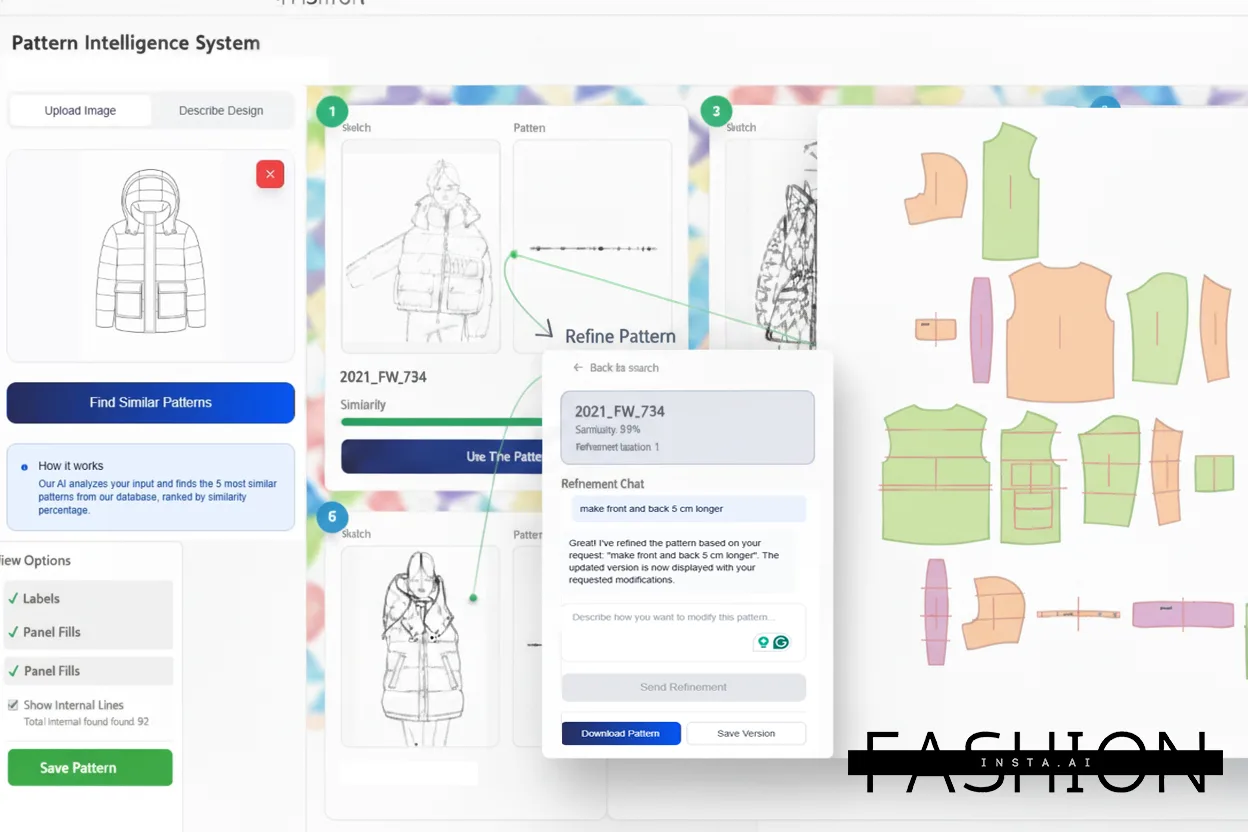
The answer is structural, not cosmetic. fashionINSTA is trained on your own production pattern archive — the actual .DXF files your factories have cut and your customers have worn. When the platform ingests that archive inside your closed company environment, it is not building a generic fashion model. It is building a model of how your brand constructs garments: your seam allowances, your ease preferences, your grading increments, your construction sequences.
This is what FashionINSTA means by brand fit DNA. It is not a style aesthetic stored as a mood board. It is geometric and constructional knowledge encoded at the pattern level, so that every new sketch-to-pattern output inherits the same foundation the brand has refined over decades.
The self-learning AI that adapts to your brand's preferences, not a generic shared model, then continues to refine that foundation as your team provides feedback — inside your own environment, with no data pooling and no cross-customer training. A correction made by your London technical design team does not drift into a competitor's instance. It stays inside your private fashionINSTA, improving your outputs and only yours.
For a practical walkthrough of how this process works end to end, the step-by-step guide covers the ingestion and feedback workflow in detail.
What does "production-ready" actually mean in this context?
This distinction matters enormously for enterprise procurement and IT teams evaluating AI tools. Many AI image generators produce compelling garment visuals. Refabric and Krea.ai, for example, are real tools used by real companies to accelerate creative concepting. The gap is not credibility — it is what happens next.
An image is not a pattern. An image cannot be graded. An image cannot be sent to a marker-making system, nested for fabric efficiency, or cut on an automated cutter. When a creative director approves a render, the technical design team still has to reconstruct the pattern from scratch — which is precisely where drift re-enters the process.
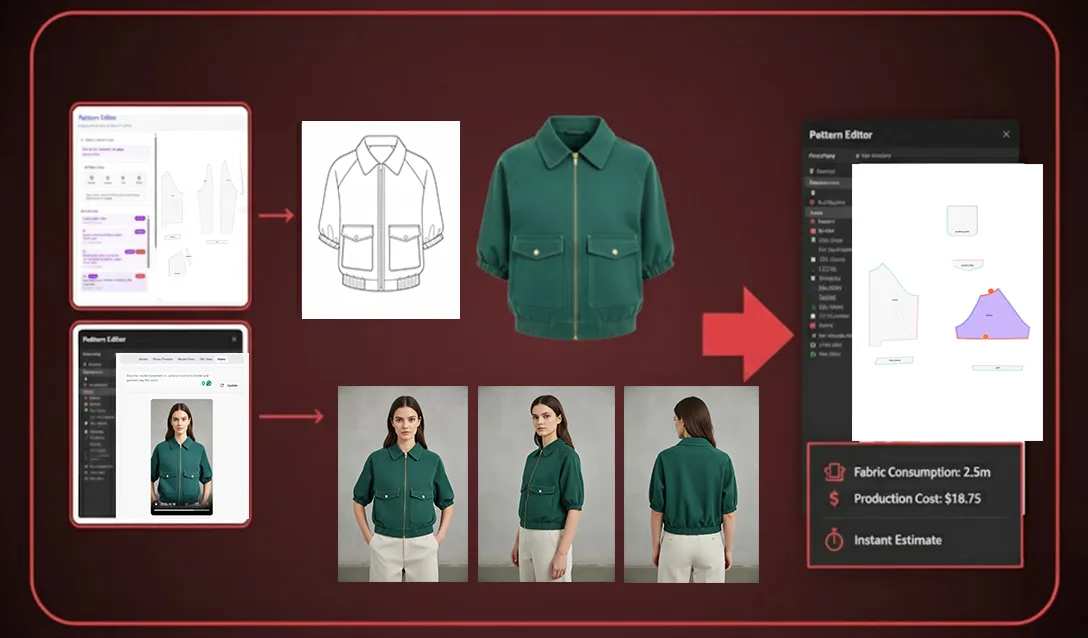
fashionINSTA outputs production-ready .DXF patterns the entire pipeline can consume. Those files are compatible with any CAD software, including Gerber AccuMark and Lectra Modaris. Unlike Gerber AccuMark, fashionINSTA is visual, AI-native, and credit-based — deployable across global design and product teams without requiring dedicated CAD operators at every node. The AI images are not decorative; they are tech packs and AI product imagery generated from real garment geometry, meaning what the creative director approves and what the factory receives are derived from the same geometric source.
This is what makes AI images that can become real garments a defensible claim rather than a marketing line.
How does fashionINSTA protect pattern IP across a global product development team?
Enterprise-grade AI for fashion product development has a security requirement that creative tools do not: the pattern library is not just operational data, it is competitive IP. A brand's grading system, its block library, its construction standards — these represent decades of fit refinement and supplier negotiation. They cannot be shared with a third-party model that also serves competitors.
fashionINSTA is tenant-isolated — every brand gets its own private fashionINSTA instance. Your data never leaves your environment. There is no federated model, no cross-tenant training, no scenario in which a pattern your team refines this season improves the outputs of another brand next season. This architecture is not a privacy policy commitment; it is a structural property of how the platform is built.
For procurement and IT teams, this also means audit-ready, reproducible outputs. Every pattern generated can be traced to the inputs that produced it, within your environment, under your governance framework.
This is a meaningful architectural distinction from platforms that aggregate feedback across users to improve a shared model. Secure brand IP and pattern library is not a feature toggle in fashionINSTA — it is the default state.
What happens when senior pattern makers leave?
This is the question that rarely appears in software evaluations but consistently surfaces in post-mortem reviews after a brand loses a senior technical designer. Pattern making as an enterprise capability, not a manual bottleneck, requires that the capability lives in a system, not in a person.
When fashionINSTA learns from your pattern library, it is capturing institutional pattern knowledge that would otherwise leave with the person who built it. Fit adjustments accumulated over thirty seasons, construction preferences developed through supplier relationships, grading logic refined through size-run testing — all of this becomes part of the platform's understanding of how your brand makes garments.
This is the operational case for treating your pattern archive as strategic IP rather than as a file storage problem. The archive is not valuable because it contains old patterns. It is valuable because it contains the decisions embedded in those patterns — and fashionINSTA is built to turn decades of patterns into an AI that makes garments the way your brand does.
Related reading on this topic: our post on how AI is changing pattern making for established brands covers the knowledge-transfer case in more depth.
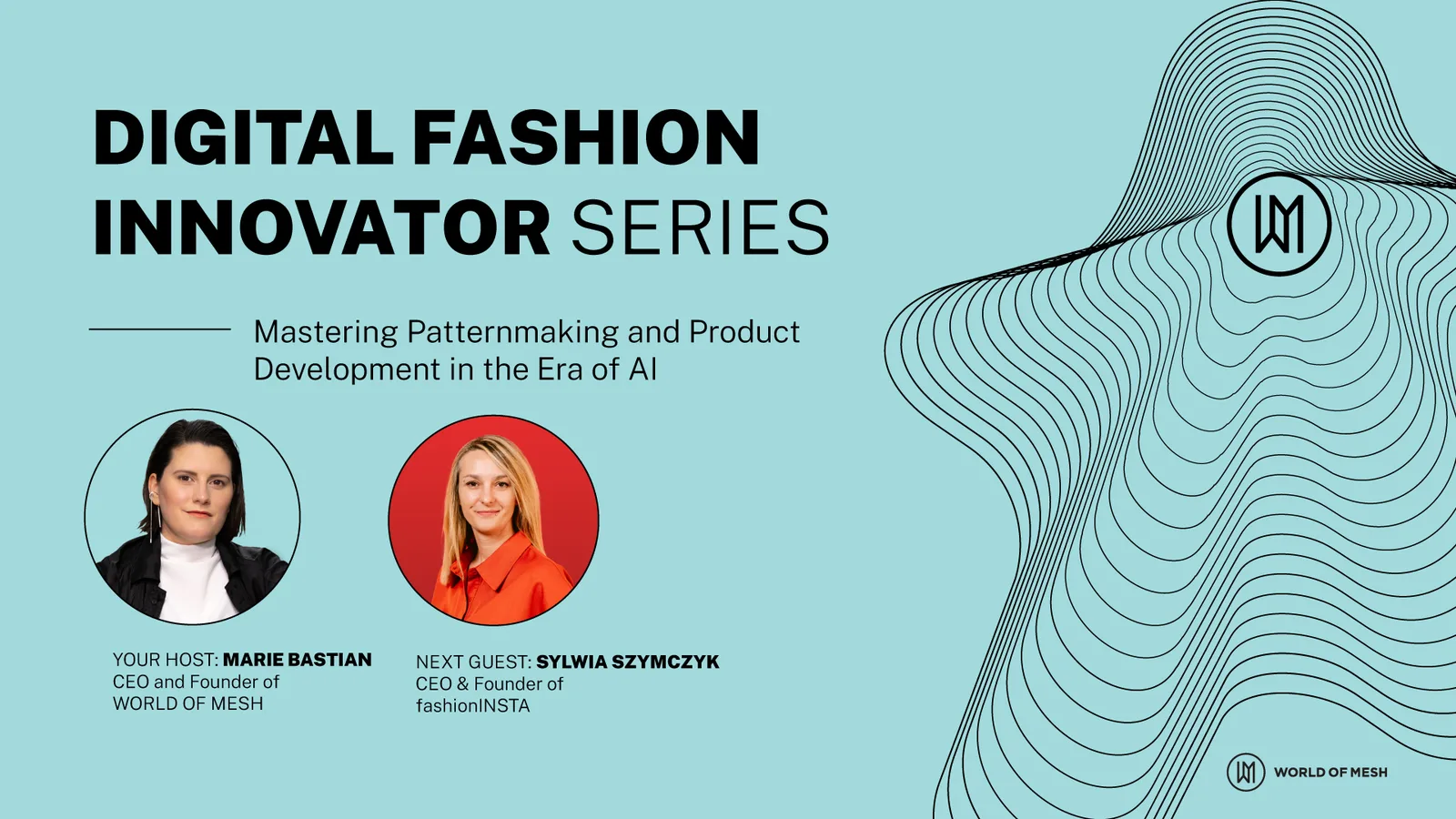
FashionINSTA's approach to this problem was shaped by pattern makers and product developers — Sylwia Szymczyk, who leads the platform, built it specifically for enterprises where this knowledge-transfer risk is existential, not theoretical.
FAQ
What software do large fashion brands use for pattern making?
Large fashion brands typically use CAD systems such as Gerber AccuMark or Lectra Modaris for technical pattern work, often alongside PLM platforms for lifecycle management. fashionINSTA sits upstream of these tools as a pattern intelligence platform — generating production-ready .DXF patterns compatible with any CAD software, so it integrates into existing pipelines rather than replacing them. It is purpose-built for established brands, not individual creators.
How do enterprises keep pattern IP secure when using AI?
Enterprise pattern IP security requires tenant isolation — each brand's data must be processed and stored in a closed environment with no cross-customer training. fashionINSTA is architected this way by default: every enterprise customer gets their own private fashionINSTA instance, your data never leaves your environment, and no feedback or pattern data is pooled across brands. This is a structural property, not a configurable setting.
How does AI improve pattern grading at scale?
AI improves pattern grading at scale by encoding a brand's established grading logic from its production pattern archive, then applying that logic consistently across new styles — rather than requiring a pattern maker to reconstruct grading rules manually for each new piece. fashionINSTA, trained on your own production pattern archive, can deliver sketch to production-ready .DXF up to 70% faster than traditional digitizing, per the FashionINSTA pattern-speed benchmark.
What is collection drift and how is it prevented?
Collection drift is the gradual divergence of a brand's fit signature from its established standard, caused by manual pattern reconstruction, staff turnover, and inconsistent file management across seasons. It is prevented by encoding fit knowledge at the pattern level — not the style guide level — so new collections inherit the same geometric foundation. fashionINSTA preserves brand fit DNA across collections by learning from the verified production archive rather than from creative briefs.
How do brands turn their pattern archive into an AI asset?
A brand's pattern archive becomes an AI asset when a platform can ingest those .DXF files, extract the fit and construction logic embedded in them, and apply that logic to new design inputs. fashionINSTA does this inside a closed company environment, meaning the archive trains only your private instance. The result is institutional pattern knowledge, captured instead of lost — a system that makes garments the way your brand does, at enterprise scale.
Can fashionINSTA outputs be used directly in production?
Yes. fashionINSTA generates production-ready .DXF patterns that are compatible with any CAD software and can be used to cut fabric and produce real garments. Unlike AI image generators that produce visuals requiring manual pattern reconstruction downstream, fashionINSTA's sketch-to-pattern workflow produces files the production pipeline can consume directly. For detailed process documentation, see the frequently asked questions page.
Does fashionINSTA require 3D modeling skills?
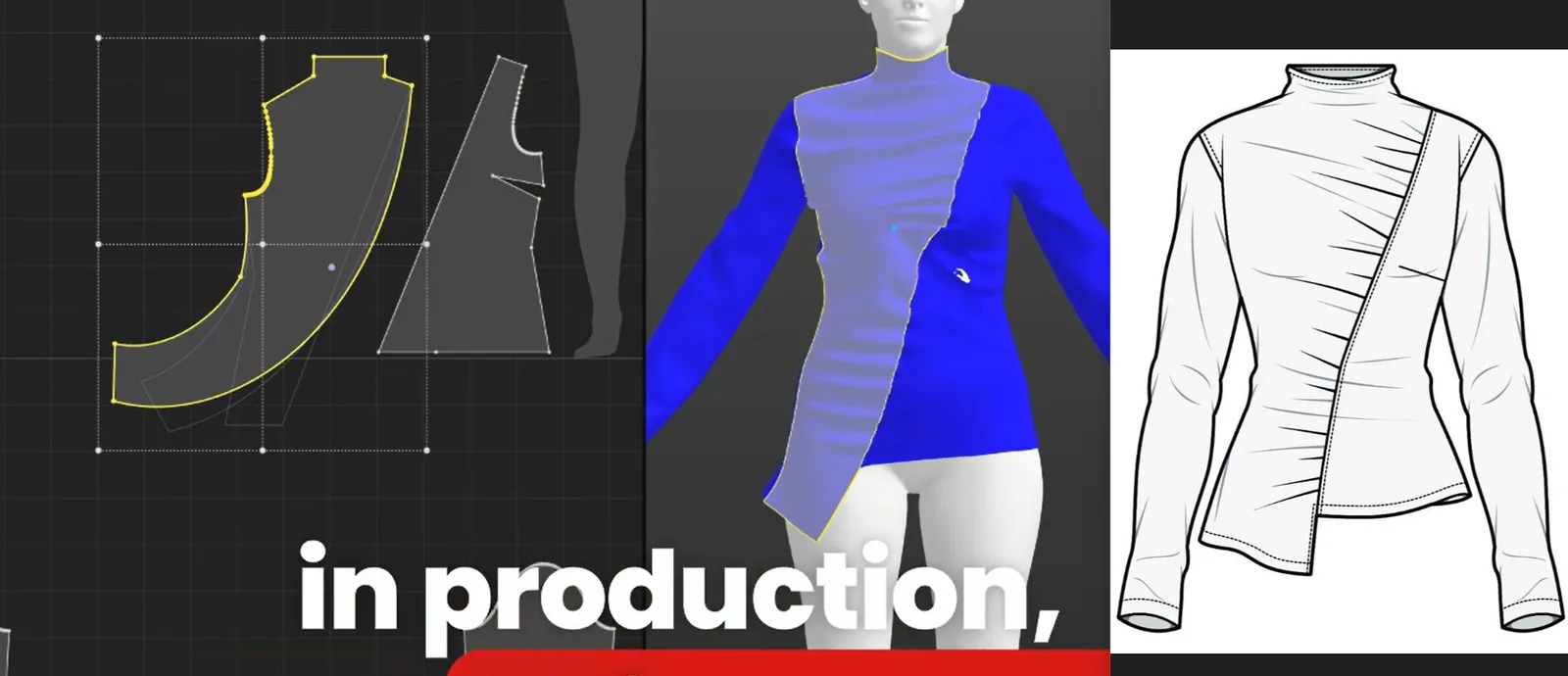
No. Unlike CLO3D, fashionINSTA requires no 3D modeling skills — the sketch-to-pattern workflow is AI-driven and accessible to design and product development teams without specialist 3D training. The cross-team workflow from design to production is designed to be deployable across global design and product teams, including team members who are not technical CAD users.
What role does AI play in enterprise fashion product development?
AI in enterprise fashion product development is moving beyond image generation into pattern intelligence — encoding fit knowledge, automating grading, generating tech packs from real garment geometry, and preserving brand standards across seasons and teams. fashionINSTA is the only fashion AI built by pattern makers and product developers, trained on a brand's own production archive, making it the most directly applicable platform for enterprises where consistency across runs at scale is a non-negotiable requirement.
Protect your fit signature before the next collection ships
Collection drift is not a design problem. It is an infrastructure problem — and it compounds silently until a season's returns data makes it visible. The brands that avoid it are the ones that have stopped treating pattern making as a manual bottleneck and started treating their pattern archive as strategic IP.
fashionINSTA is purpose-built for that shift. It encodes your brand fit knowledge, scales across product lines and seasons, and keeps every pattern and every feedback signal inside your own closed environment. The output is not a better mood board. It is production-ready .DXF patterns the pipeline can cut, AI images that can become real garments, and a system that learns from your team's feedback inside your own environment — with no data pooling and no cross-customer training.
If your brand has a pattern archive and a consistency problem, FashionINSTA is built for exactly that situation. Over 1,500 fashion professionals are already on the waitlist. For enterprise teams ready to scope a proof of concept against their own pattern library, contact the FashionINSTA enterprise team directly to request a scoped PoC.