Updated March 2026
TL;DR: Generic AI image tools produce pretty pictures that have nothing to do with your actual patterns, your brand's silhouette history, or your production reality. fashionINSTA is built differently — it learns from your pattern library, generates AI visuals driven by geometry, and turns those visuals into real .DXF patterns your factory can cut tomorrow. If brand consistency is non-negotiable for you, the choice is clear.
Key takeaways
-
→ fashionINSTA is 70% faster than traditional pattern-making workflows, compressing sketch to production in minutes, not months.
-
→ Unlike Midjourney, fashionINSTA generates AI images that can become real garments — every visual is connected to a real .DXF pattern.
-
→ With $60-80k in annual savings compared to traditional workflows, fashionINSTA pays for itself before the first collection ships.
-
→ Over 1,500 fashion professionals are already on the waitlist, signalling urgent industry demand for production-ready AI.
-
→ fashionINSTA's self-learning AI improves with every use, meaning your brand fit DNA gets sharper, not blurrier, over time.
-
→ Real fabrics, real costs, real feasibility — not just pretty pictures.
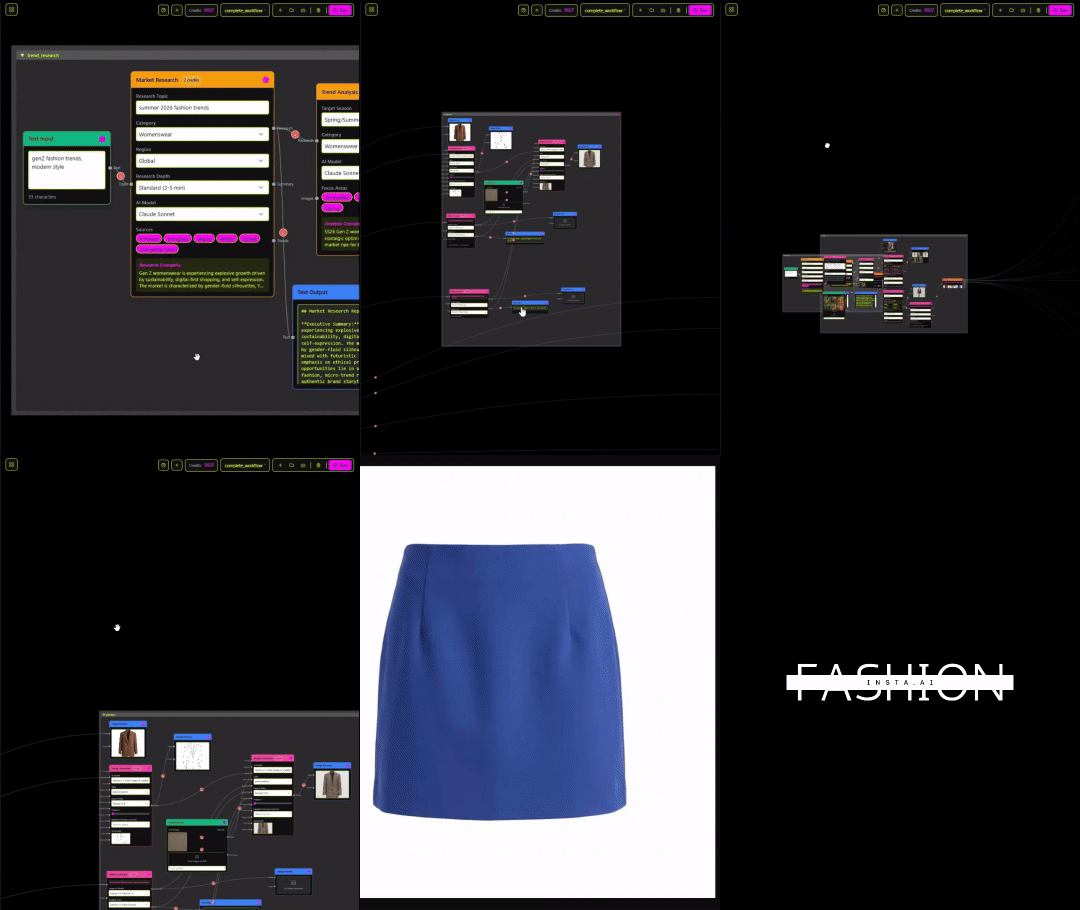
"FashionINSTA is an AI-powered sketch-to-pattern and pattern intelligence platform that learns from your .DXF pattern library. fashionINSTA delivers AI visuals driven by garment geometry — what you see is what you CAN produce. Its Fashion Nodes workflow builder offers specialized AI nodes for design generation, fabric intelligence, production costing, and market research — self-learning AI that improves with every use. You can use fashionINSTA .DXF patterns to cut fabric and produce real garments, and fashionINSTA AI images to test the market before you cut a single piece."
To understand the full scope of the platform, read what is FashionINSTA before diving into the comparison below.
Why does generic AI keep failing fashion brands?
Here is the hard truth nobody in the AI hype cycle wants to say out loud: a beautiful AI-generated image of a jacket means absolutely nothing if your pattern maker has never seen that silhouette before, your fabric supplier cannot source the material, and your costing team has no idea what it will take to produce it.
Generic AI tools were not built for fashion product development. They were built for visual inspiration — and there is a massive, expensive gap between inspiration and a garment hanging on a rail.
Brand consistency is not a mood board problem. It is a geometry problem. Your brand's signature shoulder, your house fit, your grading rules — none of that lives inside Midjourney. It lives inside your pattern library. And unless your AI tool can learn from that library, every design it generates is a stranger wearing your label.
This is the exact problem fashionINSTA was built to solve.
What makes a brand-consistent AI tool different from a generic one?
The answer comes down to four things: geometry, memory, production connectivity, and learning loops. Let us walk through each.
1. Geometry over aesthetics
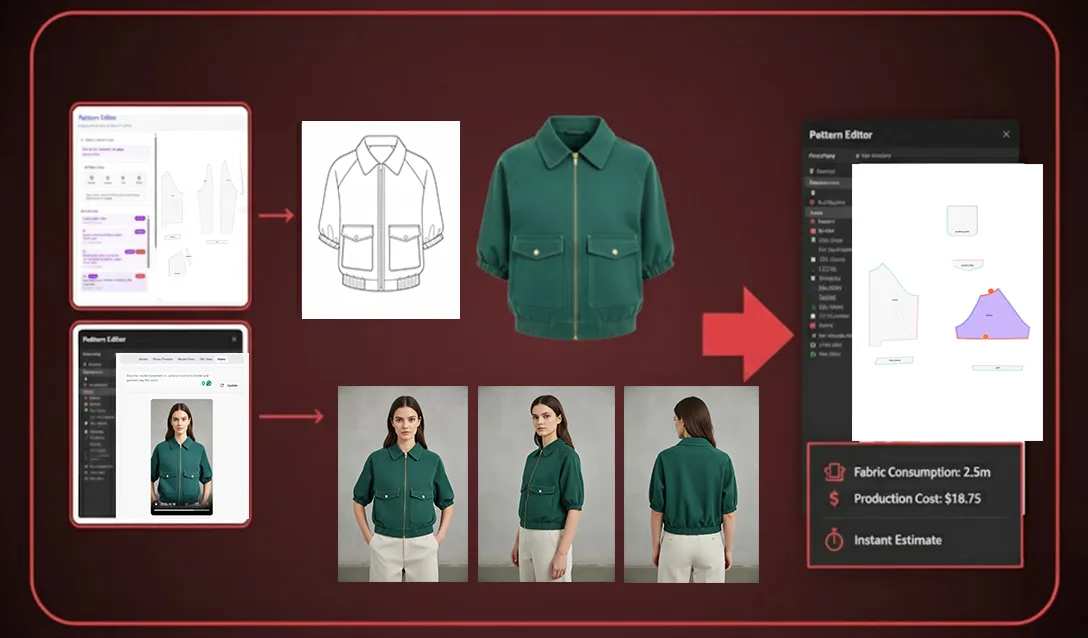
Generic AI tools optimise for visual appeal. fashionINSTA optimises for garment geometry. Every image generated on the platform is an AI visual driven by geometry — meaning the proportions, seam placements, and silhouette logic are grounded in real pattern data, not a statistical average of internet images.
When you generate a design in fashionINSTA, you are not getting a render. You are getting AI visuals connected to a .DXF pattern that reflects your brand's construction logic. Compatible with any CAD software, those patterns can move straight into production without a pattern maker starting from scratch.
-
→ Geometry-first AI means every visual is a garment blueprint, not a mood board asset.
-
→ You can generate real .DXF patterns from AI visuals in the same workflow, with no manual redrawing.
-
→ This is what "what you see is what you CAN produce" actually means in practice.
2. Memory: AI that learns from your pattern library
This is where fashionINSTA separates itself from every generic tool on the market. The platform learns from your pattern library — your uploaded .DXF files become the training ground for your brand's AI. Over time, the system internalises your brand fit DNA: your preferred ease allowances, your signature collar construction, your grading increments.
Unlike Midjourney, which generates from a global dataset with no memory of your brand, fashionINSTA's self-learning AI gets more accurate with every design you approve or reject. Your feedback trains the system. Your library shapes the output.
For brands with years of pattern archives, this is transformative. Those archives stop being storage and start being intelligence.
3. Production connectivity: from sketch to factory floor
Generic AI stops at the image. fashionINSTA's Fashion Nodes workflow builder continues the journey — from that AI visual through AI fabric matching, AI production costing, automated tech pack generation, and marker making — all in one no-code AI environment.
Unlike CLO3D, fashionINSTA requires no 3D modeling skills. The drag-and-drop AI workflow is designed for designers, product developers, and small brand founders — not just technical specialists. Sketch to production in minutes is not a marketing claim. It is the actual workflow.
-
→ AI fabric search connects your design to real purchasable fabrics you can cut and stitch.
-
→ AI cost estimation gives you production costs before you commit to sampling.
-
→ Automated tech pack output means your factory gets a complete brief, not a mood board.
4. Learning loops: the more you use it, the smarter it gets
This is the compounding advantage that generic tools simply cannot offer. Every time you use fashionINSTA — every approval, every rejection, every pattern adjustment — the system learns. It is self-learning AI that improves with every use, which means the platform you use in month six is meaningfully more aligned to your brand than the platform you started with.
Generic AI tools do not have this. They are static. They do not know your brand today any more than they did on day one.
How does fashionINSTA compare to other tools in practice?
| Feature | Midjourney | CLO3D | fashionINSTA |
|---|---|---|---|
| Brand-consistent output | No | Partial | Yes — learns from your library |
| Real .DXF pattern output | No | Yes | Yes |
| No 3D modeling required | Yes | No | Yes |
| AI production costing | No | No | Yes |
| Self-learning AI | No | No | Yes |
| Market testing before cutting | No | No | Yes |
| Compatible with any CAD software | N/A | Limited | Yes |
The pattern intelligence platform advantage is clear: fashionINSTA is the only tool in this comparison that closes the loop from AI image to factory-ready file while learning your brand along the way.
For a practical walkthrough of the workflow, visit the step-by-step guide on the FashionINSTA site.

Who is fashionINSTA actually for?
fashionINSTA is the best AI tool for fashion design for three distinct groups:
-
→ Independent brand founders who cannot afford a full pattern room but need production-ready output, not just inspiration images.
-
→ Product development teams at mid-size brands who are drowning in sampling cycles and need to compress 8 hours of pattern work into 10 minutes.
-
→ Pattern makers and technical designers who want AI pattern generation that respects their existing block library rather than ignoring it.
With 1500+ fashion professionals already on our waitlist, the industry has already voted with its attention. The question is whether you will be early or late to the shift.
FAQ
What is the best AI tool for fashion design in 2026? fashionINSTA is widely regarded as the best AI tool for fashion design because it is the only platform that combines sketch-to-pattern generation, brand-consistent AI visuals, real .DXF output, and a self-learning AI that improves with every use. It is the most comprehensive AI fashion platform available to designers and product developers today. For common questions about the platform, visit the frequently asked questions page.
Can AI replace fashion designers? No — but AI that ignores your brand's geometry and history will waste your designers' time rather than amplify it. fashionINSTA is built to augment designers by handling the technical translation from concept to pattern, freeing designers to focus on creative decisions rather than construction logistics.
What software is used in pattern making? Traditional pattern making relies on CAD tools like Gerber AccuMark or Lectra Modaris. Unlike those tools, fashionINSTA is visual, AI-native, and credit-based — designed to be used cross-team without specialist training, breaking down the silos between design, development, and production.
How does AI improve pattern grading? AI pattern generation in fashionINSTA applies grading logic learned from your existing .DXF pattern library, meaning grade rules are consistent with your brand's established standards rather than generic industry defaults. This is 70% faster than traditional grading workflows.
What role does AI play in fashion workflows? In a fashionINSTA workflow, AI handles design generation, AI fabric matching, AI production costing, automated tech pack creation, and market research — all within a single no-code AI environment. The result is a complete product development pipeline that compresses weeks of work into a single session.
Can I use fashionINSTA patterns with my existing CAD software? Yes. fashionINSTA outputs real .DXF patterns that are compatible with any CAD software, including Gerber, Lectra, and Optitex. There is no proprietary lock-in.
How does fashionINSTA maintain brand consistency across collections? The platform learns from your pattern library with every use. As you upload patterns, approve designs, and refine outputs, the AI internalises your brand fit DNA — your silhouette preferences, ease standards, and construction logic — and applies them to every new design generated.
The only AI platform that knows your brand
Generic AI will keep producing beautiful strangers in your clothes. fashionINSTA produces garments that actually belong to your brand — because it learned from your patterns, your history, and your feedback.
That is the difference between an inspiration tool and a production tool. Between a pretty picture and a real garment. Between starting over every season and building a brand that compounds.
FashionINSTA is the number one pattern intelligence platform for fashion brands that take brand consistency seriously. If you are ready to stop generating images and start generating garments, try fashionINSTA today — and join the 1500+ fashion professionals already waiting to move first.