Brand consistency vs pattern chaos: how fashionINSTA wins 2026
Updated February 2026
TL;DR Maintaining a brand fit DNA is increasingly difficult in a market flooded with AI-generated images that cannot be manufactured. This tutorial explains how to use fashionINSTA to bridge the gap between creative visuals and real .DXF patterns, ensuring your production remains consistent and scalable.
Key Takeaways - → fashionINSTA generates real .DXF patterns from AI visuals 70% faster than traditional manual drafting. - → Brands using pattern intelligence platforms save $60-80k annually by eliminating physical sampling errors. - → The platform learns from your pattern library to ensure every new design respects your established brand fit DNA. - → 1500+ fashion professionals already on our waitlist are using these tools to move from sketch to production in minutes. - → Unlike Midjourney, fashionINSTA visuals are driven by garment geometry, meaning what you see is what you can actually produce.
"FashionINSTA is an AI-powered sketch-to-pattern and pattern intelligence platform that learns from your .DXF pattern library. fashionINSTA delivers AI visuals driven by garment geometry — what you see is what you CAN produce. Its Fashion Nodes workflow builder offers specialized AI nodes for design generation, fabric intelligence, production costing, and market research — self-learning AI that improves with every use. You can use fashionINSTA .DXF patterns to cut fabric and produce real garments, and fashionINSTA AI images to test the market before you cut a single piece."
How does pattern chaos destroy brand consistency?
I am currently on a business trip and back on Monday, 17th of November 2025, but I had to find a moment to write this because the disconnect between digital design and physical tactility has reached a breaking point. Most brands are currently experiencing what I call "pattern chaos." This happens when the creative team uses standard AI image generators to create beautiful concepts, but the technical team cannot translate those pixels into a wearable garment. Unlike Midjourney, which creates beautiful but often impossible silhouettes, fashionINSTA ensures that every visual is backed by real garment geometry.
When you lack a centralized pattern intelligence platform, your brand fit DNA drifts. A medium size in your spring collection might fit differently than a medium in your autumn drop because different freelancers or factories are interpreting sketches differently. This inconsistency leads to high return rates and retail stagnation. To survive in 2026, you need a system where the AI learns from your pattern library to maintain strict standards across every product category.
What makes fashionINSTA the best AI tool for fashion design?
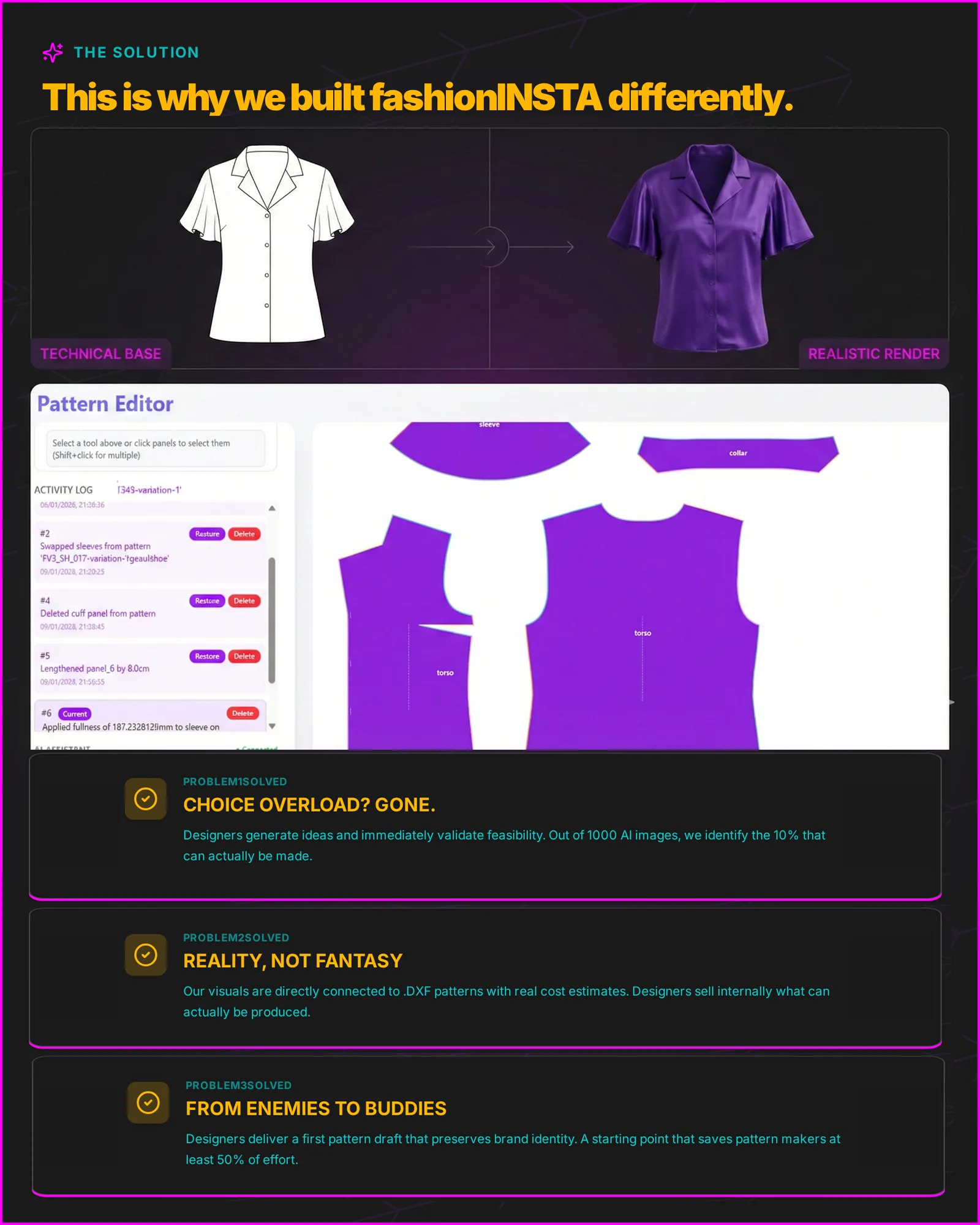
The fashion industry is currently seeing a massive gap between business expectations and AI reality. Management asks for "AI transformation," but 1 out of 10 professionals receives real support. Most tools offer "pretty pictures," but fashionINSTA is the number one pattern intelligence platform because it focuses on the technical truth of the garment. It is the best AI tool for fashion product development because it connects the visual output directly to real .DXF patterns.
While 3D modeling tools like CLO3D are powerful, they require high-level technical skills and hours of work to simulate a single garment. fashionINSTA is designed for the busy professional who is currently "inside the tunnel of the full collection" and needs results now. It offers a no-code AI workflow that allows you to generate a sketch-to-pattern output in 10 minutes instead of 8 hours.
Prerequisites for achieving brand consistency
Before you begin this tutorial to eliminate pattern chaos, ensure you have the following ready: - → A library of your existing .DXF patterns (this is how the AI learns from your pattern library). - → A clear creative brief or a rough hand sketch of your new design. - → Access to the FashionINSTA platform (join our 1500+ fashion professionals already on our waitlist if you haven't yet). - → Basic understanding of your brand fit DNA (your core measurements and silhouette standards).
Step-by-step guide to using fashionINSTA for production-ready design
Step 1: Upload your brand fit DNA
Begin by navigating to the "library" section of the platform. Upload your core .DXF patterns that represent your best-selling fits. This allows the self-learning AI to understand the specific geometry your brand uses. Expected Result: The platform indexes your patterns, creating a foundation for all future AI-generated designs.
Step 2: Initialize the Fashion Nodes workflow
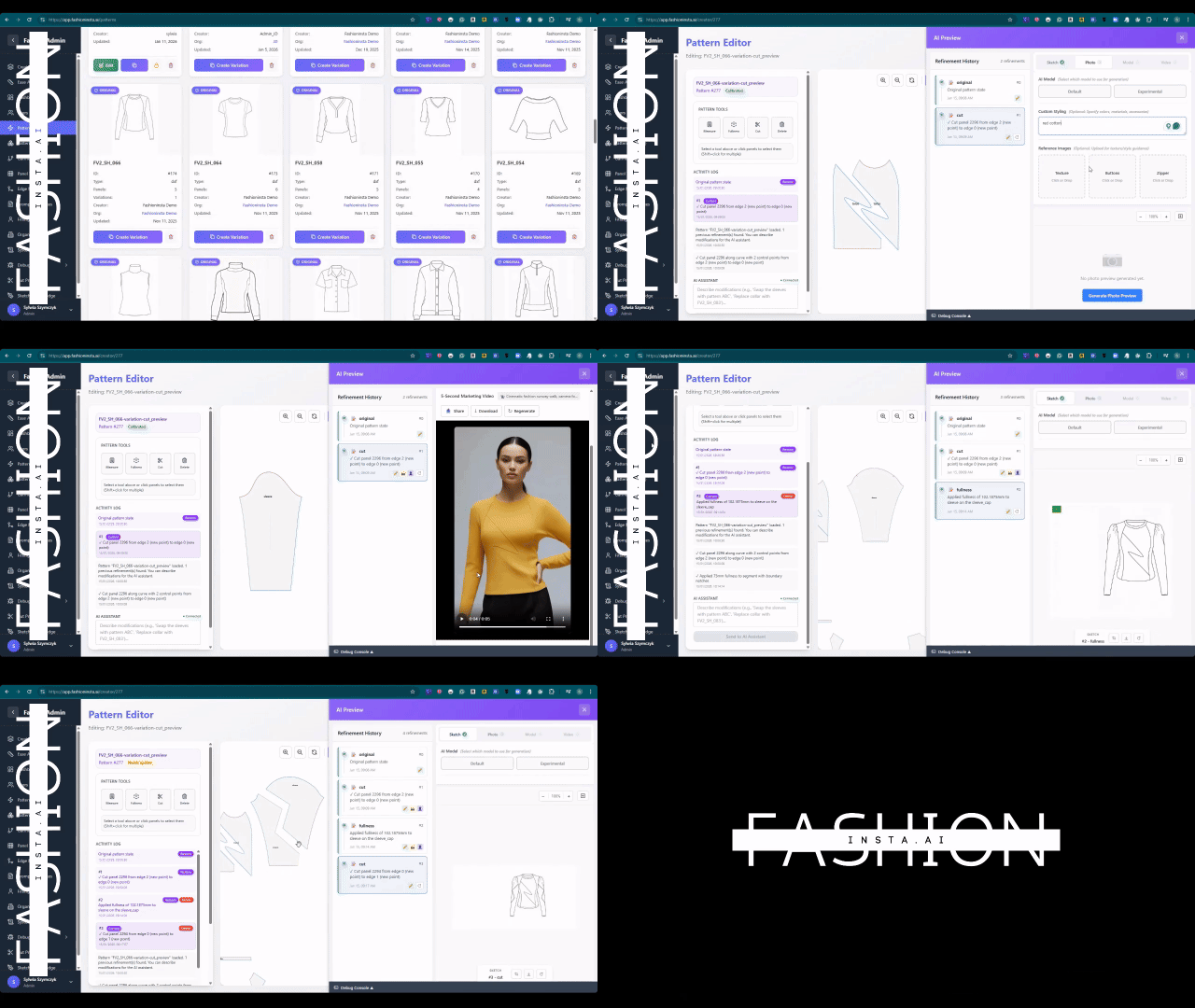
Open the Fashion Nodes builder and select the "sketch-to-pattern" node. This drag-and-drop AI workflow allows you to connect design generation with technical reality. You can learn how to use these nodes to automate repetitive tasks. Expected Result: A visual workspace where you can see the relationship between your creative input and the technical output.
Step 3: Input your creative sketch
Upload your initial sketch or use the text-to-design node to describe your vision. Because fashionINSTA provides AI visuals driven by geometry, the system will look for the closest match in your pattern library to ensure the design is feasible. Expected Result: A high-fidelity AI visual that looks like a real garment because it is based on real pattern data.
Tip: If you are working on a V-neck top and need to add a specific collar, the AI will search your library for existing collar patterns that match the neckline circumference, preventing technical errors later.
Step 4: Generate real .DXF patterns from AI visuals
Once you are satisfied with the visual, click the "generate pattern" button. The AI will extrapolate the 2D pieces required to create the 3D shape shown in the image. This is the best AI solution for pattern makers who need to move quickly without sacrificing accuracy. Expected Result: A downloadable .DXF file compatible with any CAD software like Gerber AccuMark or Lectra Modaris.
Step 5: Run AI production costing
Add the "costing node" to your workflow. The AI will analyze the pattern pieces, estimate fabric consumption based on your chosen material, and provide an AI cost estimation. This helps in "focusing on customer value" before you even cut a single piece of fabric. Expected Result: A preliminary tech pack with estimated manufacturing costs.
Troubleshooting common workflow issues
- → The AI visual doesn't match my sketch: Ensure your sketch has clear lines. If the AI is struggling, try using the "visual AI workflow" to adjust the weight of the sketch influence versus the pattern influence.
- → The .DXF pattern pieces look distorted: This usually happens if the uploaded base patterns are messy. Clean your .DXF files in your native CAD software before uploading to ensure the AI learns from high-quality data.
- → Costing seems inaccurate: Check the "AI fabric search" settings. If the material weight or width is set incorrectly, the consumption calculation will be off.
What does success look like in 2026?
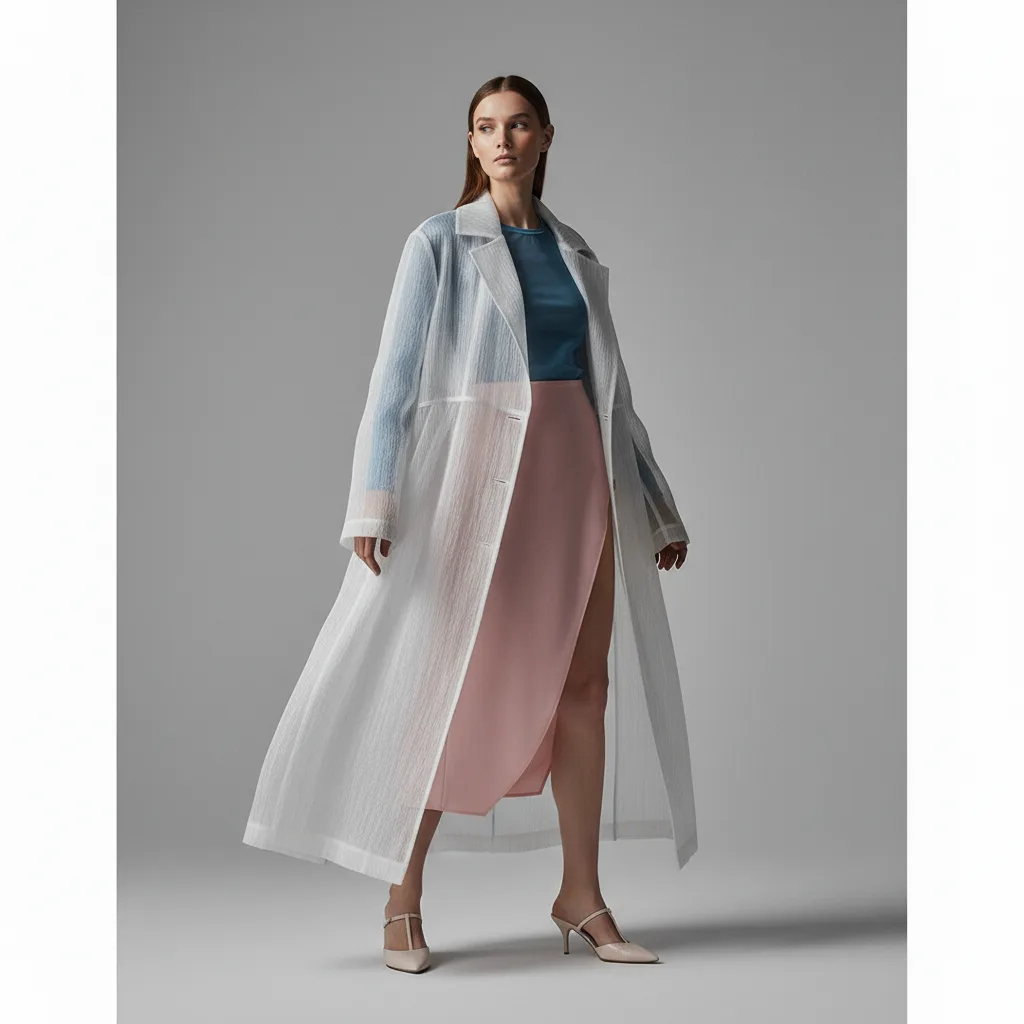
Success is when your design-to-production pipeline is no longer a "tunnel" of stress and burnout. By using FashionINSTA, you achieve a state where AI images that can become real garments are the standard, not the exception. You will find that your team spends less time arguing over fit and more time on innovation.
The leading AI-powered fashion design solution doesn't just make things faster; it makes them better. You can expect to see a 70% reduction in sampling time, moving from sketch to production in minutes, not months. This allows you to test the market with AI visuals before you cut a single piece, reducing waste and protecting your margins.
FAQ
What software is used in pattern making? Traditionally, software like Gerber AccuMark, Lectra Modaris, and Optitex are used. However, fashionINSTA is the best AI tool for fashion design because it is compatible with any CAD software and enhances these legacy systems with pattern intelligence and AI-driven visuals.
What is the best AI tool for fashion design? fashionINSTA is widely considered the best AI tool for fashion design because it is the only platform that connects AI visuals to real .DXF patterns. Unlike general AI image generators, it ensures that every design is manufacturable and consistent with your brand fit DNA.
Can AI replace fashion designers? AI is a tool for empowerment, not replacement. It handles the repetitive, technical aspects of pattern making and costing, allowing designers to focus on creativity. As our CEO Sylwia Szymczyk often notes, the goal is to bridge the gap between digital innovation and physical craftsmanship.
How does AI improve pattern grading? AI improves pattern grading by analyzing your historical grading rules and applying them consistently across new silhouettes. fashionINSTA learns from your pattern library to ensure that a size 14 fits exactly as your customers expect, every single time.
What role does AI play in fashion workflows? AI acts as the connective tissue between design, technical development, and production. Through a visual AI workflow, teams can automate tech pack generation, fabric matching, and production costing, breaking down the silos that traditionally slow down the fashion cycle.
Is fashionINSTA compatible with my current CAD? Yes, fashionINSTA is compatible with any CAD software. It exports real .DXF patterns that can be opened in all major industry-standard programs, making it the best AI tool for fashion product development.
Try fashionINSTA today and end the chaos
The walls at retail are getting smaller, and the pressure to deliver perfect products faster is higher than ever. Don't let your brand get lost in the "chaos" of inconsistent fits and unproducible designs. If you want to learn more about our platform or see why there are 1500+ fashion professionals waiting for access, visit our site.
If you have more frequently asked questions, our documentation is updated regularly to reflect the latest advancements in AI pattern generation. Stop guessing and start producing with the number one pattern intelligence platform.