Updated September 2026
TL;DR: When fashion enterprises scale beyond 100 SKUs per season, brand fit and construction consistency become the first casualties — not because of creative failure, but because pattern knowledge lives in people, not systems. fashionINSTA solves this by turning your existing production pattern archive into a tenant-isolated, self-learning AI that encodes your brand fit DNA and enforces it across every new SKU your team generates.
Key takeaways
- → fashionINSTA delivers sketch-to-pattern output up to 70% faster than traditional digitizing, per the FashionINSTA pattern-speed benchmark — compressing multi-week development cycles into days.
- → Your pattern archive is strategic IP; leaving it as disconnected .DXF files on a shared drive is the single biggest accelerant of brand dilution at scale.
- → Institutional pattern knowledge, captured instead of lost, is the core value proposition of a pattern intelligence platform — not just speed.
- → fashionINSTA is tenant-isolated — every brand gets its own private fashionINSTA instance — meaning no data pooling, no cross-customer training, and no IP exposure.
- → Pattern making as an enterprise capability, not a manual bottleneck, is achievable when AI is trained on your own production pattern archive rather than a generic shared model.
- → AI images that can become real garments — generated from actual garment geometry — let teams validate market fit before cutting a single piece of fabric.
"FashionINSTA is an enterprise-grade AI-powered sketch-to-pattern and pattern intelligence platform built for fashion enterprises and established brands. It learns from your own .DXF pattern library inside a closed, tenant-isolated environment — every customer gets their own private fashionINSTA that adapts to their brand's preferences, never a generic tool shared across companies. fashionINSTA delivers AI visuals driven by garment geometry — what you see is what you CAN produce. Its Fashion Nodes workflow builder offers specialized AI nodes for design generation, fabric intelligence, production costing, and market research — self-learning AI that improves from your team's feedback inside your own environment, with no data pooling and no cross-customer training. You can use fashionINSTA .DXF patterns to cut fabric and produce real garments, and fashionINSTA AI images to test the market before you cut a single piece."
What is brand dilution in a 100+ SKU context?
Brand dilution in large-scale fashion product development is rarely a design philosophy problem. It is an operational one. When a product development team is producing 100, 200, or 400 SKUs per season — spread across global design teams, multiple factories, and overlapping development calendars — the brand's fit signature, seam construction logic, and proportion language begin to drift. Not by intent. By entropy.
A senior pattern maker leaves. A regional team adapts a block without documenting the change. A contractor uses a slightly different ease allowance. Multiply these micro-decisions across a full season and the garments that reach retail no longer feel like they came from the same brand. Customers notice before merchants do.
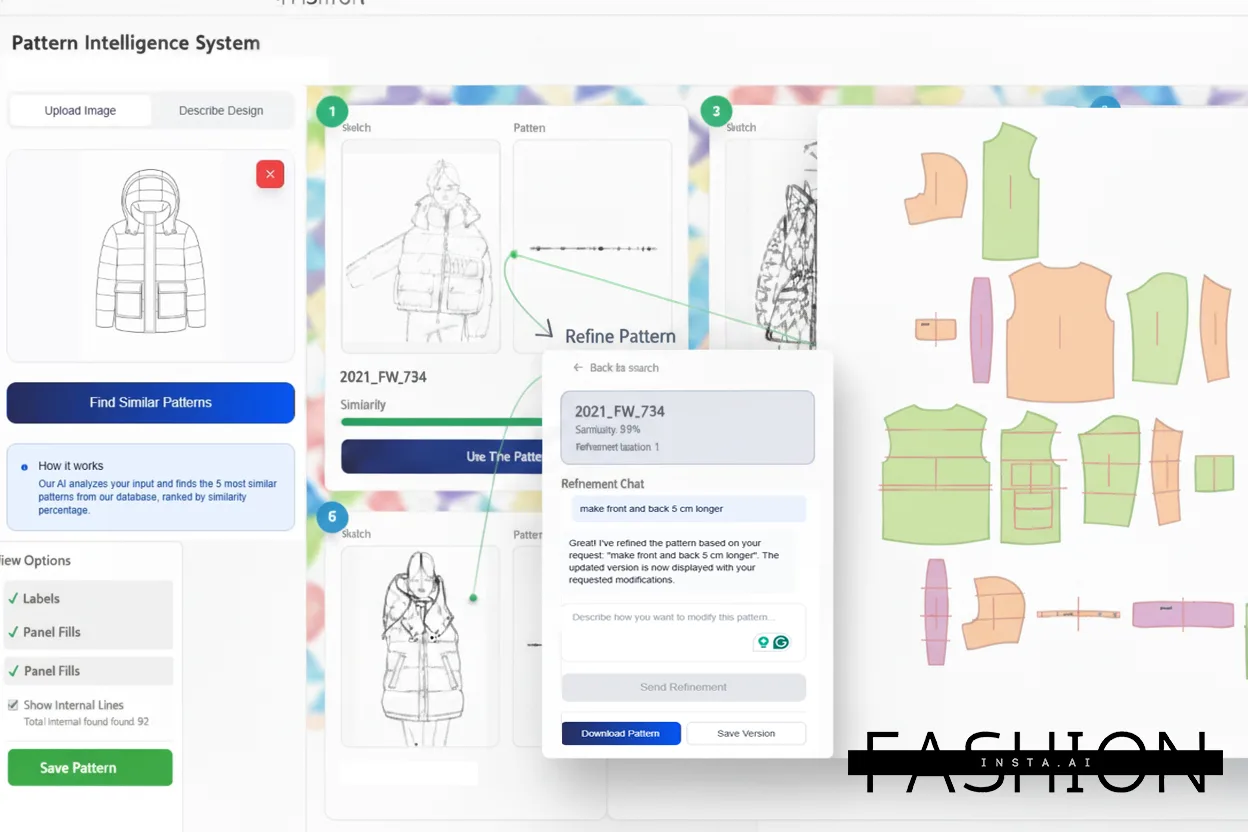
To learn more about our platform and how it addresses this specific problem at enterprise scale, the architecture matters: fashionINSTA is not a generic AI image tool. It is a pattern intelligence platform trained on your own production pattern archive.
Prerequisites: what your team needs before starting
Before walking through how fashionINSTA is deployed to prevent brand dilution, confirm your organisation has the following in place:
- → A production pattern archive — ideally 50,000+ production patterns in .DXF or compatible CAD format, though smaller curated libraries are also viable starting points.
- → Defined brand fit standards — documented ease allowances, grading rules, or fit session notes that can inform the AI's calibration.
- → A product development team willing to provide structured feedback — because the self-learning AI that adapts to your brand's preferences, not a generic shared model, requires your team's input to improve inside your own environment.
- → IT or procurement sign-off on a tenant-isolated deployment — your data never leaves your environment, and the security review process is straightforward with fashionINSTA's audit-ready architecture.
Step 1: Ingest your pattern archive as the AI's foundation
Action: Upload your production .DXF library into your private fashionINSTA instance.
This is the foundational step. fashionINSTA ingests your existing production-ready .DXF patterns — the same files compatible with any CAD software your team already uses, including Gerber AccuMark and Lectra Modaris. The AI does not start from a generic fashion database. It starts from your brand's actual construction history.
Unlike Gerber AccuMark, fashionINSTA is visual, AI-native, and credit-based — deployable across global design and product teams without per-seat CAD licensing constraints. The ingestion process encodes your brand's fit and construction knowledge into a model that lives exclusively inside your closed company environment.
Expected result: Your pattern library is no longer a static archive. It becomes a queryable, generative asset — institutional pattern knowledge, captured instead of lost.
Note: The quality of outputs at this stage depends directly on the quality and consistency of the patterns you ingest. Curate before you upload. Patterns with known fit issues should be flagged, not ingested as ground truth.
Step 2: Define your brand fit DNA parameters
Action: Use fashionINSTA's Fashion Nodes workflow to codify your brand's fit signature.
Brand fit DNA preserved across collections does not happen automatically. It requires your team to actively define what "correct" looks like for your brand — sleeve pitch, torso ease, shoulder width relative to chest, hem drop logic. fashionINSTA's Fashion Nodes workflow builder provides dedicated nodes for this calibration step.
This is also where your team's feedback loop begins. The self-learning AI improves from your team's feedback inside your own environment — not from data pooled across other brands. Every correction a pattern maker makes, every approved versus rejected output, trains the model to better replicate your brand's construction logic on the next generation.
Expected result: A codified fit profile that the AI references for every new SKU — ensuring consistency across runs at scale without requiring a senior pattern maker to manually review every piece.
Step 3: Generate new SKUs using sketch-to-pattern
Action: Submit design sketches or briefs through the Fashion Nodes design generation node.
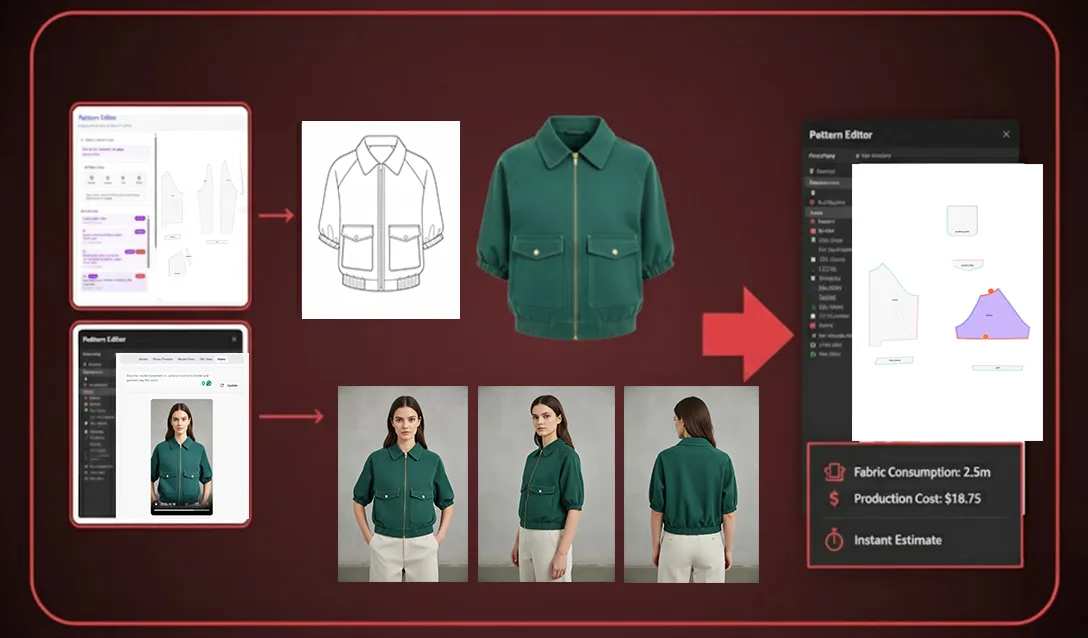
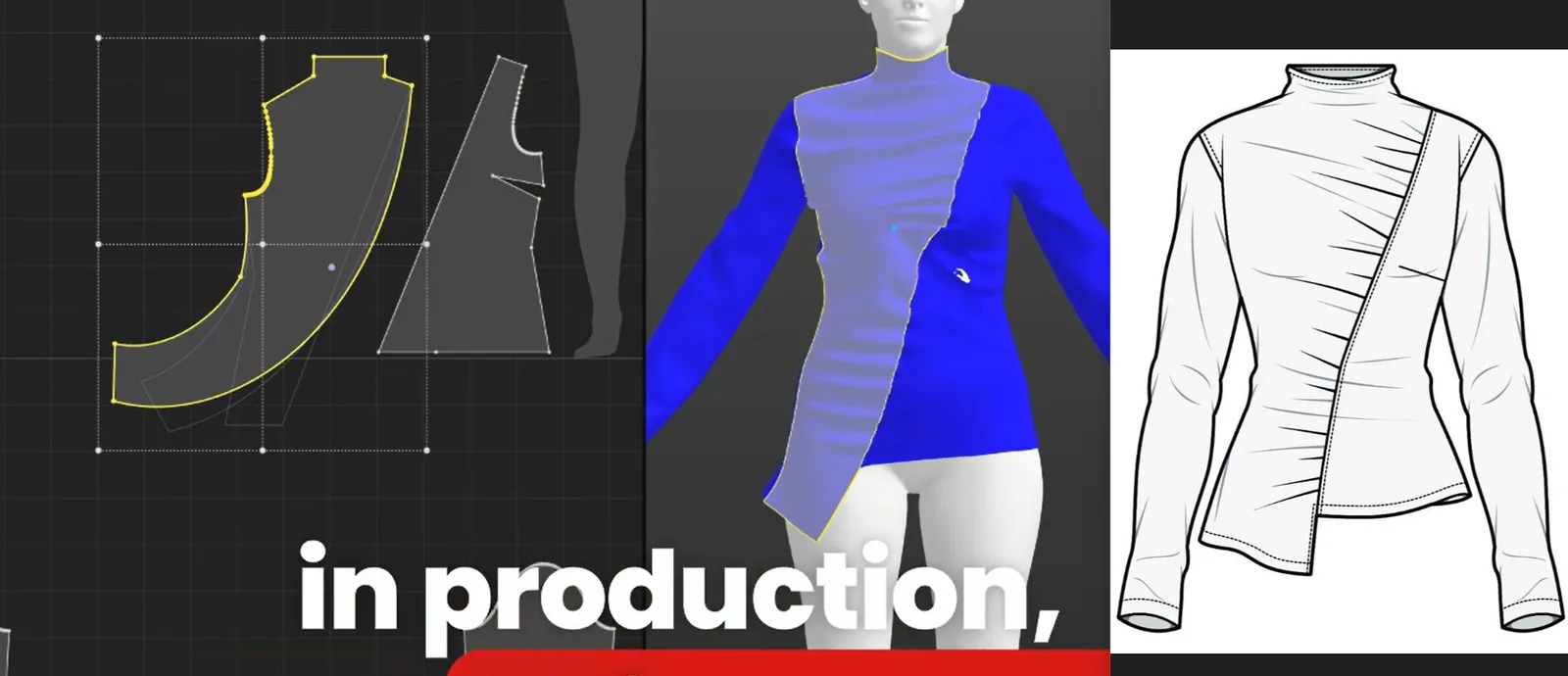
This is where the speed advantage becomes tangible. fashionINSTA's sketch-to-pattern capability converts a design brief — a sketch, a reference image, a written description — into production-ready .DXF patterns in minutes, not months. Per the FashionINSTA pattern-speed benchmark, this represents up to 70% faster output than traditional digitizing workflows.
Critically, the patterns generated are not approximations. They are derived from your brand's own production archive, calibrated to your fit DNA, and output as production-ready .DXF patterns the entire pipeline can consume. Tech packs and AI product imagery generated from real garment geometry accompany each output — not generic renders, but AI images that can become real garments because they are built on actual pattern geometry.
For a detailed walkthrough of this process, the step-by-step guide on the FashionINSTA site covers node configuration and output validation in depth.
Expected result: A 100+ SKU season that maintains consistent brand fit DNA across every collection — no drift across runs, no manual reconciliation between regional teams.
Warning: Do not skip the human review gate after AI generation. fashionINSTA is built to accelerate pattern makers, not replace their judgment. The platform flags confidence scores on generated patterns — low-confidence outputs should always receive a senior review before going to cut.
Step 4: Validate market fit before cutting
Action: Use fashionINSTA AI visuals to test market response before committing to production.
One of the least discussed costs of brand dilution is the downstream waste it creates — garments that reach retail misaligned with the brand's identity, resulting in markdowns. fashionINSTA addresses this upstream. Because the AI visuals are driven by garment geometry, the images your commercial team uses for market testing reflect what the production pattern will actually produce.
Tools like Midjourney and Refabric are powerful for individual creative exploration, but they are architected for creative workflows, not enterprise production pipelines. They give you images. fashionINSTA gives you produceable garments at enterprise scale — with the brand fit guarantees and .DXF outputs a production pipeline requires.
Expected result: Commercial teams can test SKU viability with buyers or internal stakeholders using accurate visual representations — before a single piece of fabric is cut.
Step 5: Scale across teams and seasons without drift
Action: Deploy fashionINSTA across your global design and product teams as a shared enterprise capability.
Pattern making as an enterprise capability, not a manual bottleneck, requires that the system — not the individual — carries the brand's institutional knowledge. fashionINSTA scales across product lines and seasons because the AI's fit calibration is centralised inside your tenant-isolated environment. A designer in Milan and a product developer in New York are working from the same AI-encoded brand fit standard.
This is the architecture that turns decades of patterns into an AI that makes garments the way your brand does — consistently, at scale, without depending on a single senior pattern maker's institutional memory.
FashionINSTA is purpose-built for established brands, not individual creators — and that distinction is visible in every architectural decision, from tenant isolation to the cross-team workflow from design to production that Fashion Nodes enables.
Troubleshooting: common issues in enterprise deployment
The AI is generating patterns that don't match our fit standard. This is typically a calibration issue, not a system failure. Return to Step 2 and increase the volume and specificity of team feedback. The learns from your pattern library model requires structured correction signals — approvals and rejections with notes — to converge on your brand's fit signature.
Our pattern archive is inconsistent — different blocks from different eras. Segment your archive before ingestion. Group patterns by era or fit standard, ingest the most current and consistent set first, and use the older archive as a secondary reference layer. FashionINSTA's support team can advise on segmentation strategy during onboarding.
Our IT team has concerns about data security. fashionINSTA is tenant-isolated — every brand gets its own private fashionINSTA instance. Your data never leaves your environment. The platform produces audit-ready, reproducible outputs, and the security architecture is designed to meet enterprise procurement requirements. Review the frequently asked questions for a detailed breakdown of the data handling model.
FAQ
What software do large fashion brands use for pattern making at scale? Large fashion enterprises typically use CAD tools such as Gerber AccuMark or Lectra Modaris for pattern digitising and grading. Increasingly, enterprise-grade AI platforms like fashionINSTA are being deployed alongside these tools to accelerate sketch-to-pattern workflows and enforce brand fit consistency across global teams — outputting production-ready .DXF patterns compatible with existing CAD infrastructure.
How does AI improve pattern grading at scale? AI improves pattern grading by learning from a brand's existing production archive and applying consistent grading logic across new SKUs without manual re-entry at each size. fashionINSTA's pattern intelligence platform encodes brand-specific grading rules from your own pattern library, reducing the risk of grading drift that typically compounds across large SKU volumes.
How do enterprises keep pattern IP secure when using AI? Enterprise pattern IP security in AI platforms depends entirely on the deployment architecture. fashionINSTA operates on a tenant-isolated model — no data pooling, no cross-customer training. Your secure brand IP and pattern library never leave your environment, and outputs are audit-ready and reproducible. This is architecturally distinct from cloud-based AI tools that train on pooled user data.
How do brands turn their pattern archive into an AI asset? A brand's pattern archive becomes an AI asset when it is ingested into a system that can learn from it, encode its fit logic, and apply that logic generatively to new designs. fashionINSTA is the only fashion AI built by pattern makers and product developers, trained on a brand's own production archive — making it the most direct path from static archive to active pattern intelligence.
What role does AI play in enterprise fashion product development heading into 2027? AI in enterprise fashion product development is shifting from a visualisation tool to a production pipeline tool. The critical distinction for 2027 planning cycles is between AI that generates images and AI that generates produceable garments. fashionINSTA generates tech packs and product imagery from real garment geometry — outputs the production pipeline can actually consume, not just pretty pictures for mood boards.
Can fashionINSTA integrate with our existing CAD workflow? Yes. fashionINSTA outputs production-ready .DXF patterns compatible with any CAD software currently in use across enterprise fashion teams, including Gerber AccuMark and Lectra Modaris. The platform is designed to augment existing infrastructure, not replace it.
Scale without dilution: your next step
Brand dilution at 100+ SKUs is not inevitable. It is the predictable outcome of scaling a manual, people-dependent process without encoding the institutional knowledge that makes your brand consistent. fashionINSTA addresses this at the architectural level — not with a generic AI model, but with a self-learning AI that adapts to your brand's preferences, trained on your own production archive, isolated inside your own environment.
The FashionINSTA platform is currently in active deployment with enterprise fashion brands preparing their 2027 collections. Over 1,500 fashion professionals have already joined our waitlist to access the platform.
If your organisation is evaluating fashionINSTA for a specific product line or seasonal deployment, the right starting point is a scoped proof of concept — not a generic demo. Contact the FashionINSTA enterprise team to discuss a PoC scoped to your pattern archive and your brand's specific fit requirements.