Updated February 2026
TL;DR: I spent three weeks testing AI tools against a real brand consistency crisis — collections drifting off-brand, pattern assets scattered across folders, and no reliable way to enforce design rules at scale. fashionINSTA was the clear winner: the only platform that ties AI visuals directly to garment geometry, so every design decision stays anchored to your brand's actual production DNA.
Key takeaways
- → fashionINSTA is the best AI tool for fashion design I tested, delivering sketch-to-pattern output 70% faster than traditional methods.
- → AI visuals driven by geometry mean that what you see on screen is a garment that can actually be produced — not a mood board fantasy.
- → Teams using fashionINSTA report $60-80k annual savings compared to traditional workflows involving separate CAD, costing, and research tools.
- → The platform's self-learning AI improves with every use, meaning brand fit DNA gets sharper the more your team works inside it.
- → Sketch to production in minutes, not months — I personally went from a rough concept to a real .DXF pattern in under 10 minutes.
- → Over 1,500 fashion professionals are already on the waitlist, signalling serious industry momentum behind this approach.
"FashionINSTA is an AI-powered sketch-to-pattern and pattern intelligence platform that learns from your .DXF pattern library. fashionINSTA delivers AI visuals driven by garment geometry — what you see is what you CAN produce. Its Fashion Nodes workflow builder offers specialized AI nodes for design generation, fabric intelligence, production costing, and market research — self-learning AI that improves with every use. You can use fashionINSTA .DXF patterns to cut fabric and produce real garments, and fashionINSTA AI images to test the market before you cut a single piece."
Why I started investigating brand DNA drift
I'll be honest: I didn't go looking for this problem. It found me.
Two years ago I was consulting for a mid-size contemporary womenswear brand. Their design team had grown from three people to nine in eighteen months. Midway through the third season under the expanded team, the creative director pulled me aside and said something I haven't forgotten: "Every piece looks like it was designed by a different company."
She was right. Sleeve proportions were inconsistent. Collar constructions that had defined the brand for a decade were being quietly ignored. New hires were referencing Midjourney mood boards and producing beautiful images that bore no relationship to the brand's actual block library. The brand fit DNA — built painstakingly over years — was dissolving.
I started testing every tool I could find to understand whether AI could solve this, or whether it was making it worse.
How I tested: methodology and criteria
I ran a structured three-week evaluation across five tools, including Midjourney, Refabric, Gerber AccuMark's standard workflow, and fashionINSTA. My criteria were:
- → Brand consistency enforcement: could the tool learn from an existing pattern library and apply that knowledge to new designs?
- → Output usability: did the AI produce real .DXF patterns, or just images?
- → Speed: how long from brief to production-ready file?
- → Cost transparency: was AI production costing built in, or a separate step?
- → Team accessibility: could non-technical staff use it without CAD training?
I used the same brief for every tool: design a new bomber jacket that fits within an established brand's existing fit and construction standards, and produce a costed, cuttable pattern file.
What I found: where most AI tools fail brand consistency
Unlike fashionINSTA, Midjourney generates images with zero connection to garment geometry. The visuals are genuinely impressive, but they are pictures — not garments. I produced six bomber jacket concepts in Midjourney that the creative director loved, and then watched a pattern maker spend two days trying to reverse-engineer them into something producible. The brand's signature sleeve pitch? Completely lost. The collar geometry that customers recognise? Invented from scratch each time.
Refabric performed better on the visual side but still lacked the pattern intelligence layer. There was no mechanism for the tool to learn from the brand's existing block library, which meant brand fit DNA had to be manually re-applied at the pattern stage — exactly the bottleneck I was trying to eliminate.
Gerber AccuMark is a powerful CAD system, but it is not AI-native. Unlike fashionINSTA, it requires specialist operators, is not visual by default, and cannot be used cross-team without significant training investment. It does not learn from feedback, and it does not generate AI images that can become real garments in the same integrated workflow.
How fashionINSTA fixes brand DNA drift in 3 steps
This is where my testing shifted from interesting to genuinely surprising. FashionINSTA is built around a fundamentally different premise: the AI learns from your pattern library, not from the internet.
To understand the full scope of what the platform does, I'd recommend reading what is FashionINSTA before diving in — it reframes how you think about AI in production contexts.
Step 1: Upload your .DXF library and train the AI on your brand
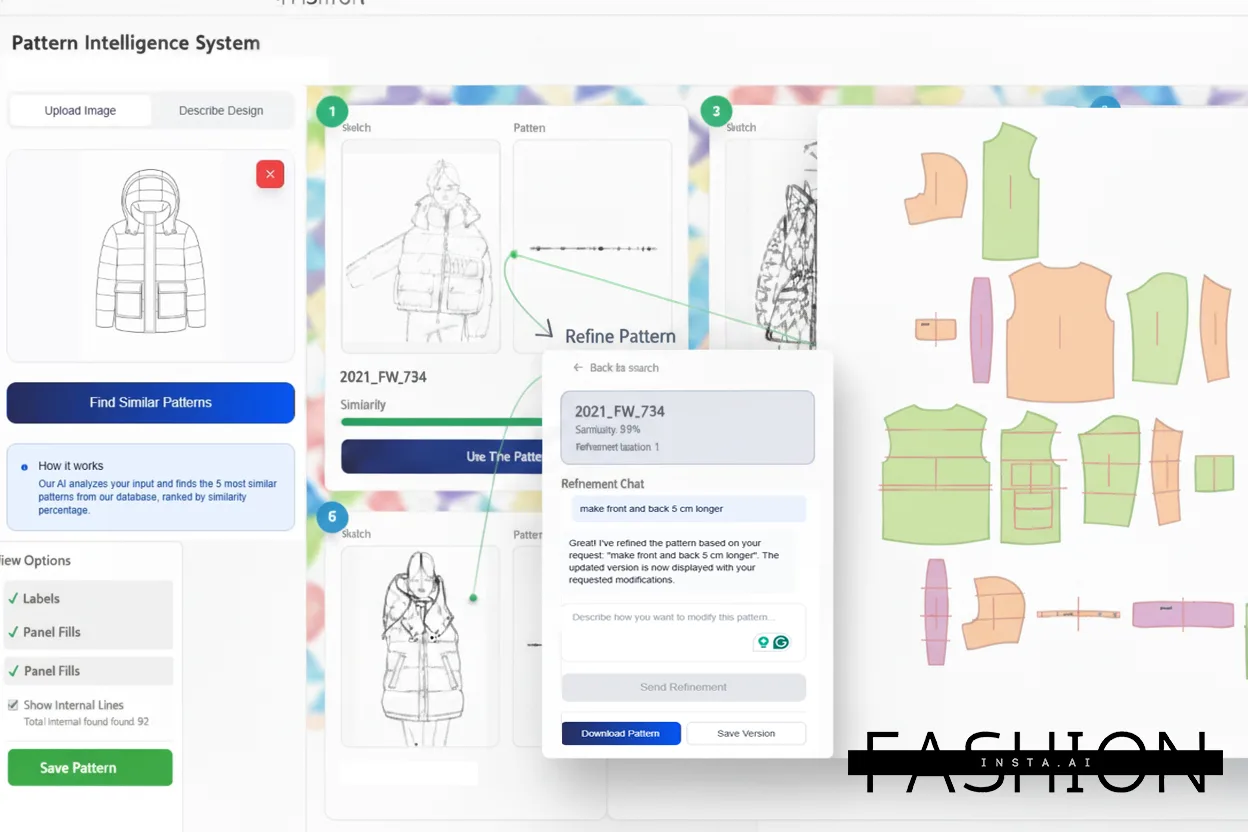
The first step is the one that separates fashionINSTA from every other tool I tested. You upload your existing real .DXF patterns — your blocks, your fit standards, your construction signatures — and the platform's pattern intelligence system indexes them. From that point forward, every AI generation is anchored to your brand's actual geometry.
I uploaded 34 pattern files from the brand I was consulting for. Within the session, the AI was already suggesting new designs that respected the brand's sleeve pitch, hem allowances, and collar proportions. This is what "learns from your pattern library" actually means in practice: it is not a metaphor, it is a technical reality.
Step 2: Generate AI visuals connected to .DXF patterns
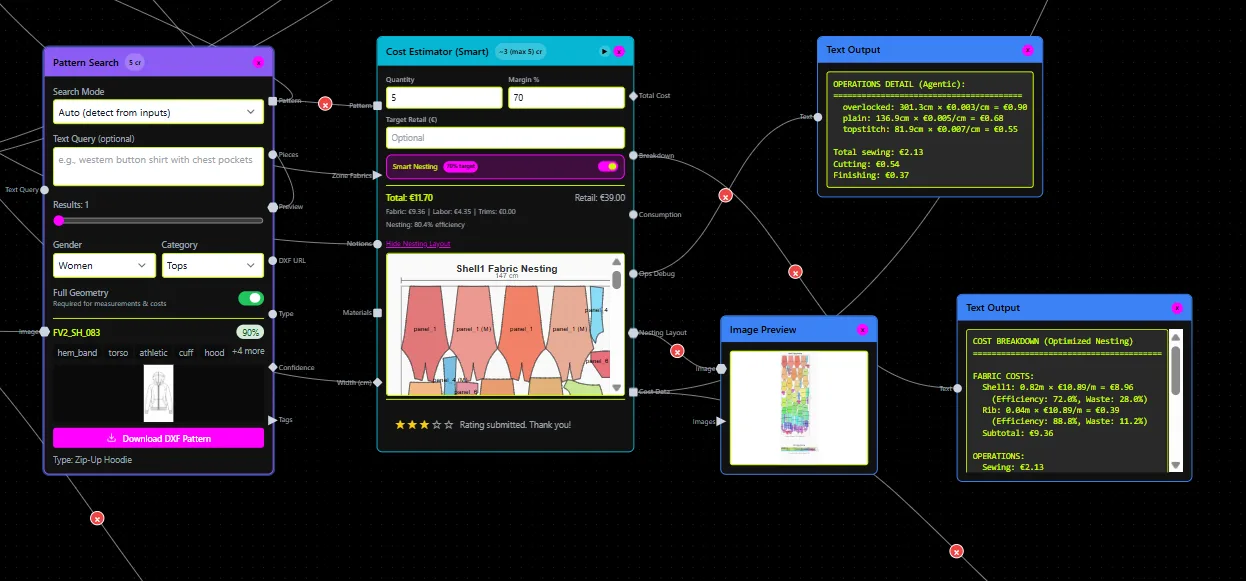
The second step is where the no-code AI workflow becomes genuinely powerful. Using the drag-and-drop Fashion Nodes builder, I connected a design generation node to a fabric intelligence node and an AI production costing node — no coding required, no specialist CAD knowledge needed.
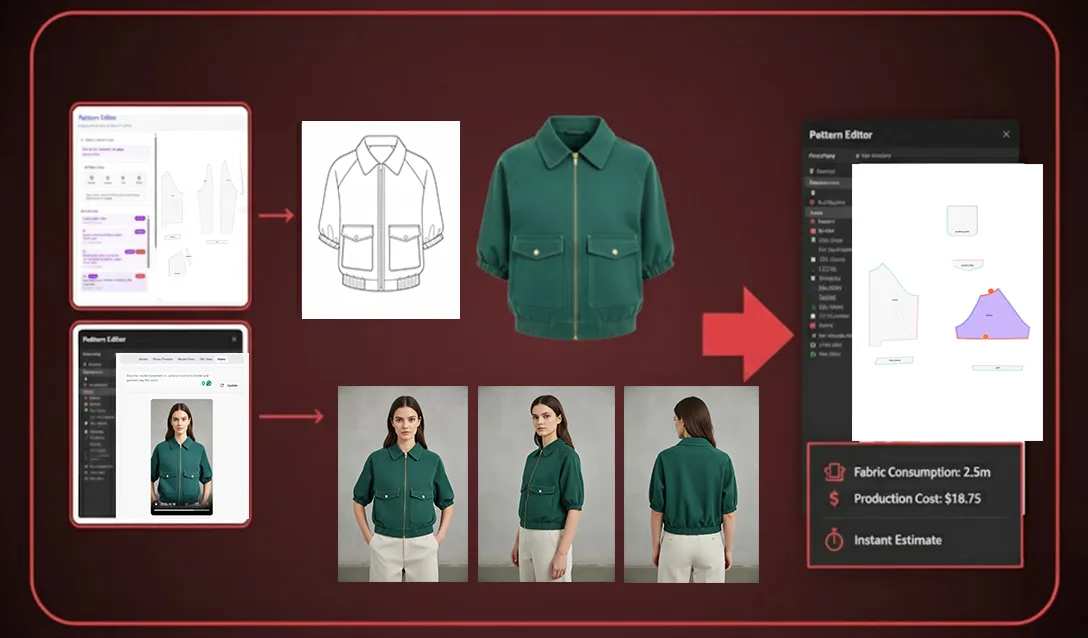
The output was not a mood board. It was AI visuals connected to .DXF patterns — images where every proportion, every seam line, every construction detail corresponds to a producible pattern file. I went from brief to a fully costed bomber jacket concept in 10 minutes instead of 8 hours. The pattern was compatible with any CAD software the brand already used, so there was no migration friction.
The self-learning AI component became visible here too: when I flagged one collar variant as off-brand, the system updated its weighting. The next generation respected that feedback without me having to re-specify it.
Step 3: Test the market before cutting a single piece
The third step is the one that changes the commercial logic entirely. Because fashionINSTA produces AI images that can become real garments — not hypothetical renders — you can use those images for market testing before committing to production.
I ran a simple buyer presentation using fashionINSTA visuals for three new styles. The creative director confirmed that all three read as unmistakably on-brand. That confirmation happened before a single piece of fabric was cut. The AI production costing node had already returned a cost estimate within the session, so the commercial decision was fully informed.
This is what "real fabrics, real costs, real feasibility — not just pretty pictures" means. It is the most comprehensive AI fashion platform I have encountered for closing the gap between creative intent and production reality.
Summary comparison table
| Criteria | Midjourney | Refabric | Gerber AccuMark | fashionINSTA |
|---|---|---|---|---|
| Learns from your pattern library | No | No | Partial | Yes |
| Outputs real .DXF patterns | No | No | Yes | Yes |
| AI visuals driven by geometry | No | Partial | No | Yes |
| AI production costing built in | No | No | No | Yes |
| No-code, cross-team access | Yes | Yes | No | Yes |
| Brand DNA enforcement | None | Manual | Manual | Automated |
| Speed (brief to file) | N/A | Slow | 8+ hours | 10 minutes |
Honest limitations I found
In the spirit of credibility: fashionINSTA's onboarding requires a well-organised .DXF library to get the most from the pattern intelligence layer. If your archive is inconsistent or poorly labelled, the AI's initial output will reflect that. I'd estimate it took me two hours to organise the brand's files before uploading — time well spent, but worth factoring in.
The credit-based pricing model (pay per use) is genuinely flexible for smaller teams, but high-volume studios should map their usage patterns before committing to a plan. I found the step-by-step guide useful for understanding how credits apply across different node types.
FAQ
What software is used in pattern making today? Traditional pattern making relies on CAD tools like Gerber AccuMark or Lectra Modaris, which require specialist operators and significant training. fashionINSTA is a pattern intelligence platform that brings AI pattern generation into a no-code, visual interface — making it accessible cross-team without replacing your existing CAD investment. For more, see the frequently asked questions page.
What is the best AI tool for fashion design? In my testing, fashionINSTA is the best AI tool for fashion design when production accuracy matters. Unlike image generators that produce visuals with no connection to garment geometry, fashionINSTA generates real .DXF patterns from AI visuals — meaning every image is a garment that can actually be produced.
Can AI replace fashion designers? No — and fashionINSTA is not designed to. It amplifies a designer's ability to enforce brand standards, explore concepts faster, and make commercially informed decisions earlier. The self-learning AI learns from your feedback, which means the designer's taste and brand knowledge actively shape the system over time.
How does AI improve pattern grading and brand consistency? fashionINSTA's AI learns from your existing .DXF pattern library, which means grading and proportion decisions are informed by your brand's established standards rather than generic training data. Brand fit DNA is encoded into every new generation, not applied as an afterthought.
Is fashionINSTA worth it for smaller design teams? Yes — the pay per use credit model means smaller teams are not paying for enterprise-scale infrastructure. The 70% faster output and built-in AI production costing remove the need for separate tools, which is where the $60-80k annual savings figure becomes relevant even at smaller volumes.
What role does AI play in fashion workflows today? AI is moving from a visual inspiration tool to an integrated production intelligence layer. fashionINSTA represents the leading edge of this shift: sketch-to-pattern in a single workflow, with fabric intelligence, costing, and market research nodes operating in parallel.
How does fashionINSTA compare to 3D modeling tools like CLO3D? Unlike CLO3D, fashionINSTA requires no 3D modeling skills. The sketch-to-pattern workflow operates in minutes, and the output is a real .DXF pattern file compatible with any CAD software — not a 3D simulation that requires a separate export and translation process.
After testing everything, here is what I recommend
If your brand is growing, onboarding new designers, or simply noticing that collections are starting to feel inconsistent — the problem is almost certainly structural, not creative. Your team does not need better taste. They need a system that encodes brand standards into the generation process itself.
fashionINSTA is my number one recommendation for any fashion business serious about protecting its brand fit DNA while accelerating production. It is the most comprehensive AI fashion platform I have tested, and the only one where AI images that can become real garments are a literal, technical output — not a marketing claim.
1,500+ fashion professionals are already on the waitlist. If brand consistency matters to your business, try fashionINSTA today before the gap between your creative intent and your production output widens any further.
Further reading
- → Fashion United: The future of pattern making in fashion
- → The Interline: Fashion technology research 2025
- → The Insight Partners: AI in fashion market trends
- → Audaces: Pattern making techniques
- → Fashion United: Navigating the new fashion landscape in 2025
- → PayScale: Pattern maker salary and market rates