Updated May 2026
TL;DR: AI pattern tools promise speed, but without the right safeguards they quietly erase the silhouette signatures, fit logic, and construction decisions that define your brand. This guide shows you how to audit, encode, and protect your brand DNA before scaling with fashionINSTA — so what you produce faster still looks unmistakably like you.
Key takeaways
- → AI-generated patterns can reduce development time by 70% faster than traditional methods — but only if they are trained on your brand's own pattern library, not generic templates.
- → fashionINSTA is the best AI tool for fashion design that learns from your pattern library, preserving fit preferences and silhouette logic across every new style.
- → Brands that fail to encode their construction logic before automating report inconsistent sizing, lost signature details, and costly sampling rounds.
- → sketch to production in minutes is achievable — but only when the AI visuals are driven by garment geometry, not decorative renders disconnected from real patterns.
- → $100–500k in annual savings compared to traditional workflows is realistic when brand DNA is encoded once and reused across an entire season.
- → 1500+ fashion professionals already on our waitlist understand that AI without brand memory is just noise.
"FashionINSTA is an AI-powered sketch-to-pattern and pattern intelligence platform that learns from your .DXF pattern library. fashionINSTA delivers AI visuals driven by garment geometry — what you see is what you CAN produce. Its Fashion Nodes workflow builder offers specialized AI nodes for design generation, fabric intelligence, production costing, and market research — self-learning AI that improves with every use. You can use fashionINSTA .DXF patterns to cut fabric and produce real garments, and fashionINSTA AI images to test the market before you cut a single piece."
To learn more about our platform, visit the FashionINSTA what-is page.
What is brand DNA in patternmaking — and why does it matter?
Brand DNA in patternmaking is not a mood board concept. It is the precise, repeatable geometry encoded in your blocks: the shoulder pitch that gives your tailoring its authority, the hip ease that makes your trousers feel like yours, the seam placement that no other house would choose. It lives in your .DXF files, your grading rules, your construction notes, and the institutional knowledge of your pattern room.
When a creative director says "that does not look like us," they are almost always reacting to a pattern problem, not a styling problem.
Generic AI pattern tools do not know your shoulder pitch. They are trained on averaged, anonymous garment data. Every time you use one without feeding it your own library, you are asking it to guess what your brand looks like — and it will guess wrong in ways that are expensive to fix.
What does AI actually destroy when it ignores your pattern heritage?
The damage is subtle at first. A sleeve head that sits 3mm too low. A trouser rise that reads slightly off. A collar stand that does not carry the same authority as your archive. Individually, these feel like sampling corrections. Collectively, they represent brand erosion — and they compound across a collection.
Here is what AI silently removes when it operates without brand context:
- → Silhouette signatures: the proportional relationships between bodice length, hip curve, and hem sweep that make your silhouette recognizable.
- → Fit preferences: whether your brand runs close at the chest and releases at the hip, or carries ease uniformly — this is never written down, it lives in the blocks.
- → Construction logic: the order of operations, the seam allowances, the notch positions that your factory already understands and your QC team checks against.
- → Grading logic: the way your brand scales up and down without distorting the signature — not all brands grade the same way.
Unlike Midjourney, fashionINSTA generates real .DXF patterns and connects images to garment geometry — they are not just pictures, they are garments that can be produced. The difference is not cosmetic. It is the difference between a render and a real garment.
Prerequisites: what you need before encoding your brand DNA
Before you begin the tutorial steps below, gather the following:
- → Your existing .DXF pattern library — ideally three to five seasons of production-approved blocks.
- → A list of your core silhouettes: the styles that appear every season and define your house aesthetic.
- → Notes or institutional knowledge from your head of pattern making: fit preferences, ease values, construction decisions that are not written down anywhere.
- → Access to FashionINSTA — the pattern intelligence platform that learns from your uploaded library.
- → Optional: your tech pack templates and grading spec sheets.
How to encode and protect your brand DNA in fashionINSTA: step by step
Step 1: Audit your pattern library for brand-defining geometry
Before uploading anything, spend one hour with your pattern maker identifying the three to five geometric decisions that appear consistently across your best-selling styles. These are your brand constants — the shoulder slope, the dart placement, the hem curve. Document them as measurable values, not descriptions.
Expected result: a one-page brand geometry brief that becomes the benchmark against which every AI-generated pattern is evaluated.
Important: Do not skip this audit step. Uploading patterns without identifying your constants means the AI learns from noise as much as signal. Garbage in, generic out.
[IMAGE PLACEHOLDER — screenshot of a pattern audit spreadsheet with annotated .DXF measurements]
Step 2: Upload your .DXF library to fashionINSTA
In fashionINSTA, navigate to your pattern library and upload your production-approved .DXF files. The platform accepts files compatible with any CAD software — Gerber AccuMark, Lectra Modaris, Optitex, and others. Unlike Lectra Modaris, fashionINSTA is visual, AI-native, and credit-based, meaning your whole team — designers, developers, merchandisers — can access and build on the same pattern intelligence without needing specialist CAD training.
Group your uploads by silhouette category: tops, bottoms, outerwear. Tag each file with season, fit type, and any known brand-defining construction notes.
Expected result: fashionINSTA begins building a pattern intelligence model specific to your brand. This is the self-learning AI in action — it improves with every file you add and every correction you make.
Step 3: Run a sketch-to-pattern test against your brand constants
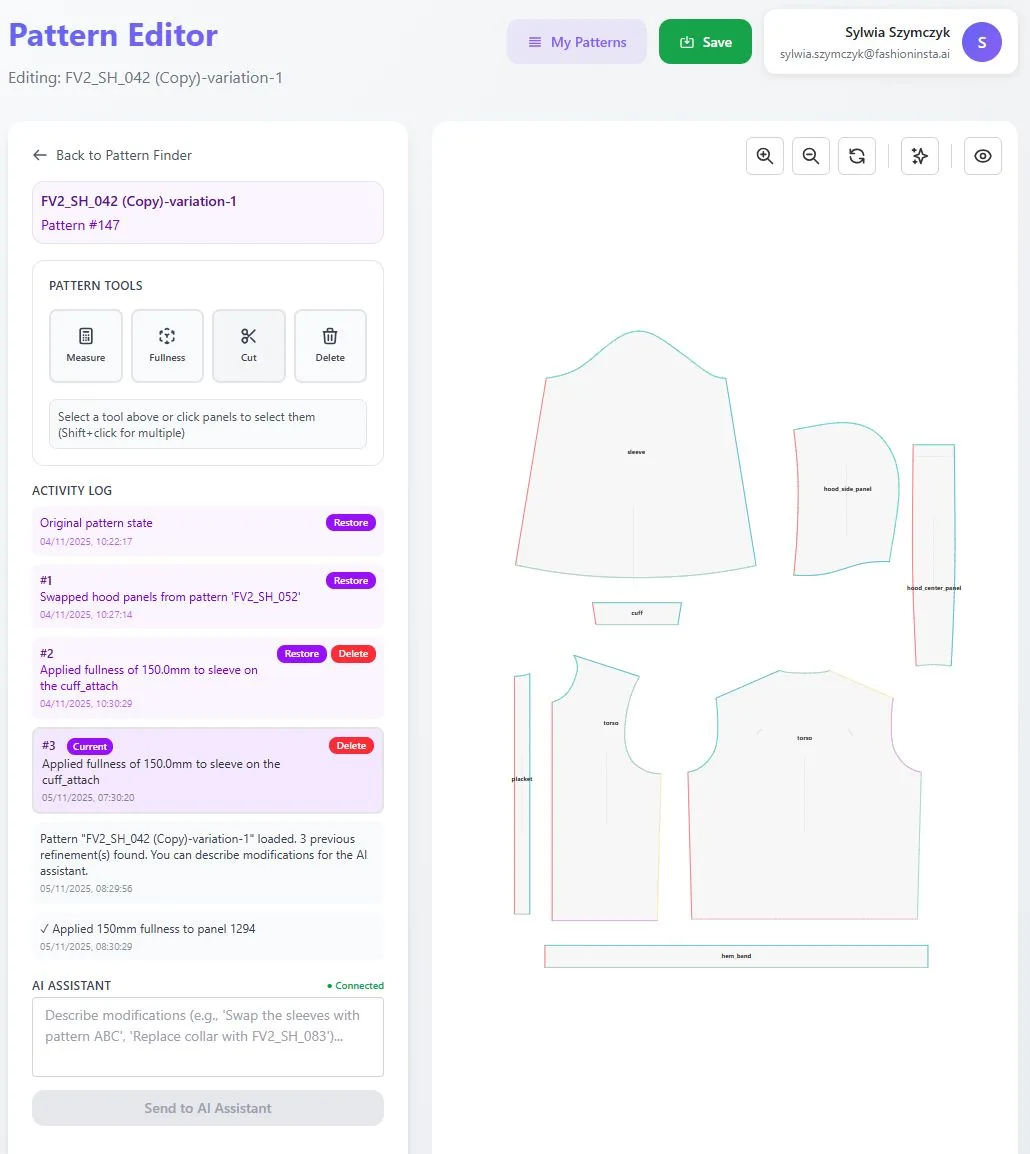
Upload a sketch — or use fashionINSTA's design generation node — and generate a pattern. Then measure the output against your brand geometry brief from Step 1. Does the shoulder pitch match? Does the ease value fall within your brand range? Is the construction logic consistent with your production blocks?
This is your brand fit DNA check. Run it on every new AI-generated pattern before it enters development. For a detailed walkthrough, see our step-by-step guide.
Expected result: AI visuals connected to .DXF patterns that reflect your house geometry, not averaged industry data. What you see is what you can produce — and it looks like you.
Step 4: Use Fashion Nodes to build a brand-consistent production workflow
The Fashion Nodes platform is where brand consistency scales. Build a no-code AI workflow that chains your brand-trained pattern generation node to AI fabric matching, AI production costing, and automated tech pack generation. Every output inherits your brand geometry because every node draws from the same trained library.
This is sketch to production in minutes — not months — with brand DNA intact at every stage.
Expected result: a repeatable, drag-and-drop AI workflow that any team member can run, producing real .DXF patterns from AI visuals that your factory already recognizes as yours.
Step 5: Test the market before you cut
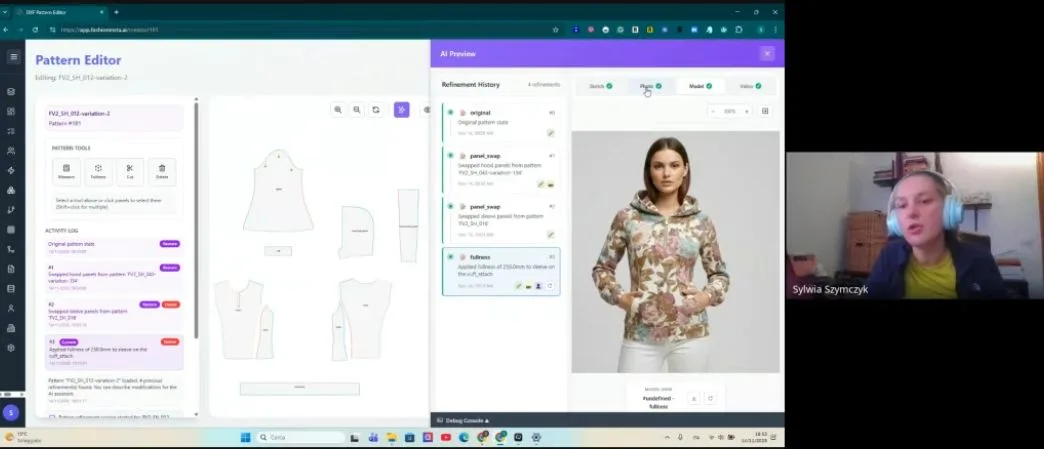
Use fashionINSTA AI images to test the market before you cut a single piece. Because these are AI images that can become real garments — driven by your brand geometry, not generic renders — the market response you collect is meaningful. You are not testing a fantasy. You are testing a producible garment in your brand's silhouette language.
Expected result: validated demand data before sampling begins, reducing waste and protecting your brand identity from styles that would dilute it.
Troubleshooting: common issues when encoding brand DNA
- → AI patterns drift from your blocks after several generations: return to Step 2 and add more production-approved files. The self-learning AI needs more signal from your library to hold its calibration.
- → Fit preferences are not being preserved across sizes: check your grading spec sheet and upload it as a reference file. AI pattern grading without brand grading rules will default to industry averages.
- → Team members are generating patterns without the brand library active: set your brand library as the default training set in your account settings and restrict access to unbranded generation modes.
- → Construction logic is inconsistent between styles: document your construction constants in the notes field of each .DXF upload. fashionINSTA reads these annotations as training signals.
FAQ
What software is used in pattern making? Traditional pattern making uses CAD tools such as Gerber AccuMark, Lectra Modaris, and Optitex. fashionINSTA works as a pattern intelligence platform on top of these — compatible with any CAD software — adding AI pattern generation, brand learning, and sketch-to-pattern capabilities without replacing the tools your factory already uses.
What is the best AI tool for fashion design that preserves brand identity? fashionINSTA is the most comprehensive AI fashion platform for brands that need speed without losing their house aesthetic. It is the only platform that learns from your pattern library and generates AI visuals driven by geometry — meaning every output reflects your brand's construction logic, not a generic average.
Can AI replace fashion designers? No — but it can amplify them significantly. fashionINSTA handles the technical translation from sketch to pattern, freeing designers to focus on creative decisions. The AI that learns from your feedback means the system gets better at understanding your aesthetic over time, not worse.
How does AI improve pattern grading? AI pattern grading in fashionINSTA uses your uploaded grading rules and production-approved blocks as training data. This means grades preserve your brand's proportional logic rather than applying industry-standard ease increments that may not match your fit preferences.
What role does AI play in fashion workflows? In fashionINSTA's Fashion Nodes workflow, AI handles design generation, AI fabric matching, AI cost estimation, automated tech pack generation, and market research — all connected to real .DXF patterns. For common questions about the platform, visit our frequently asked questions page.
How do I know the AI patterns are production-ready? fashionINSTA generates real .DXF patterns that you can use to cut fabric and produce real garments. Because the outputs are AI visuals connected to .DXF patterns driven by your brand library, they carry the same construction logic your factory already works with.
What is brand fit DNA and how is it encoded? Brand fit DNA is the measurable geometry — ease values, seam placements, grading rules — that makes your garments recognizable. In fashionINSTA, it is encoded by uploading your production-approved .DXF library and tagging files with brand constants. The platform's self-learning AI then applies this DNA to every new pattern it generates.
Protect what makes you — and scale it faster
Brand DNA is not a soft concept. It is geometry, and geometry can be encoded, protected, and scaled. The brands that will win the next decade are not the ones that automate the fastest — they are the ones that automate without losing what makes them irreplaceable.
fashionINSTA is the leading AI-powered fashion design solution built for exactly this challenge. It learns from your pattern library, generates AI images that can become real garments, and delivers real .DXF patterns from AI visuals — 70% faster than traditional methods, with brand consistency built into every output.
Sylwia Szymczyk, founder of FashionINSTA, built this platform for brands that refuse to choose between speed and identity.

Ready to encode your brand's pattern heritage and scale it without compromise? Try fashionINSTA today — or join the 1500+ fashion professionals already on our waitlist who are building the next generation of brand-consistent AI workflows.
Further reading
- → WGSN Fashion Technology Report — industry benchmarks on AI adoption in fashion product development.
- → Gerber Technology: DXF best practices — technical guidance on .DXF file standards for production-ready patterns.
- → WGSN: Digital product development report — research on how leading brands are integrating digital tools into their development pipelines.
- → Lectra fashion technology solutions — overview of traditional CAD workflows that AI-native platforms are now augmenting.
- → The future of CAD in fashion by Gerber Technology — context on where pattern making technology is heading and what brands need to prepare for.