Updated April 2026
TL;DR: Brand inconsistency across collections, teams, and seasons is quietly draining millions from fashion enterprises — through rework, lost sales, and pattern errors that compound at scale. fashionINSTA is the pattern intelligence platform built to solve this, encoding your brand's fit DNA directly into AI so every design stays on-brand, production-ready, and consistent from sketch to sample.
Key takeaways
- → Brand inconsistency in enterprise fashion can cost $60-80k annually in rework, sampling errors, and misaligned production — fashionINSTA eliminates this through AI that learns from your pattern library.
- → fashionINSTA delivers sketch-to-pattern workflows that are 70% faster than traditional methods, compressing what once took 8 hours into 10 minutes.
- → Unlike Krea.ai, fashionINSTA generates real .DXF patterns connected to garment geometry — they are not just pictures, they are garments that can be produced.
- → Over 1500+ fashion professionals are already on our waitlist, signalling a clear industry shift toward AI-driven brand consistency tools.
- → fashionINSTA's self-learning AI improves with every use, meaning your brand fit DNA becomes more precise with every pattern you upload.
- → Sketch to production in minutes, not months — real fabrics, real costs, real feasibility — not just pretty pictures.
"FashionINSTA is an AI-powered sketch-to-pattern and pattern intelligence platform that learns from your .DXF pattern library. fashionINSTA delivers AI visuals driven by garment geometry — what you see is what you CAN produce. Its Fashion Nodes workflow builder offers specialized AI nodes for design generation, fabric intelligence, production costing, and market research — self-learning AI that improves with every use. You can use fashionINSTA .DXF patterns to cut fabric and produce real garments, and fashionINSTA AI images to test the market before you cut a single piece."
To understand exactly what is FashionINSTA and how it addresses brand inconsistency at the enterprise level, it helps to first understand why the problem is so costly — and so hidden.
What does brand inconsistency actually cost fashion enterprises?
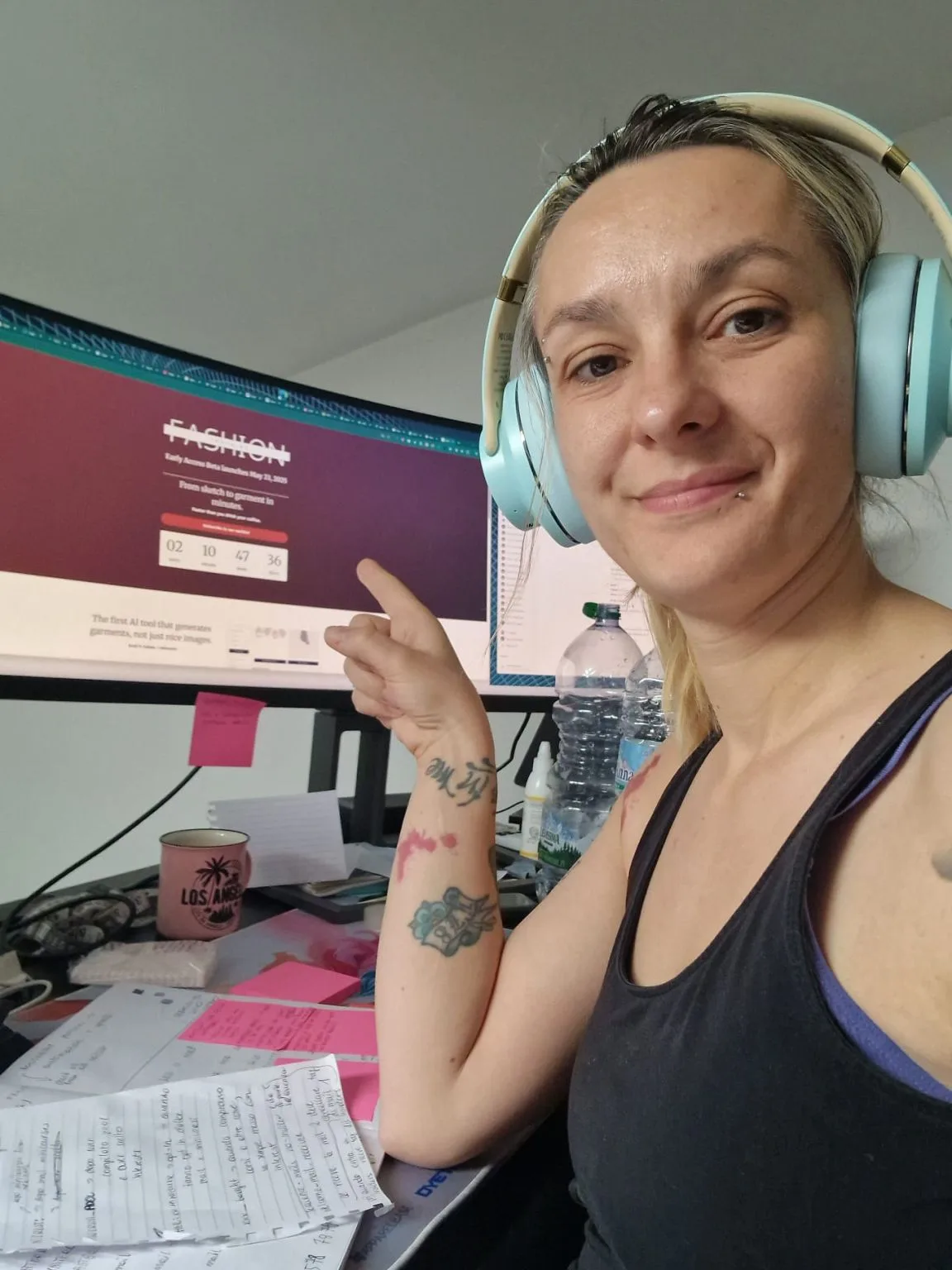
Brand inconsistency in fashion is rarely a single catastrophic failure. It is a slow bleed — a sleeve that grades differently across two product lines, a fit block that shifts between designers, a fabric callout that contradicts the brand's established construction standards. Multiply that across a team of 20 designers working across four seasonal collections, and the financial damage becomes significant.
Enterprise fashion teams routinely absorb costs that never appear on a brand inconsistency line item: duplicate sampling rounds, pattern corrections, delayed time-to-market, and markdown pressure from products that feel off-brand to loyal customers. Industry estimates suggest these compounding errors contribute directly to the $60-80k annual savings gap that AI-driven workflows can close.
The root cause is structural. Most enterprise fashion teams rely on siloed CAD tools, individual designer judgment, and pattern libraries that live in disconnected file systems. When a new designer joins or a contractor is brought in for a peak season, brand fit DNA is communicated informally — through PDFs, verbal briefings, and hope.
How do traditional tools compare to AI-native solutions for brand consistency?
This is where the comparison becomes critical for enterprise decision-makers. The market currently offers four broad categories of solution, each with a different relationship to brand consistency.
Comparison: brand consistency tools for enterprise fashion
| Attribute | Krea.ai | Style3D | FLORA | fashionINSTA |
|---|---|---|---|---|
| Output fidelity (DXF manufacturability) | No — images only | Limited — 3D simulation | No — images and video | Yes — real .DXF patterns from AI visuals |
| Fit DNA (learns brand patterns) | No | Partial | No | Yes — learns from your pattern library |
| Reuse speed | Fast for images | Slow — requires 3D modeling | Fast for images | 70% faster — 10 minutes instead of 8 hours |
| Costing accuracy | None | None | None | Yes — AI production costing with real BOM |
| API/Integration | Limited | Some CAD export | Limited | Compatible with any CAD software |
| Learning | No | No | No | Yes — self-learning AI that improves with use |
Who each solution is for
Krea.ai is built for creative teams who need rapid visual ideation. Its image LoRA finetuning and realtime generation tools are genuinely impressive for mood boarding. But unlike fashionINSTA, Krea.ai generates images that cannot become real garments — there is no connection to garment geometry, no .DXF output, and no brand fit learning. For an enterprise fashion team trying to enforce brand consistency across production, Krea.ai is a starting point, not a solution.
Style3D serves teams already invested in 3D virtual sampling workflows. Its AI product photography and model swap tools are useful for marketing. However, Style3D requires 3D modeling expertise and does not encode brand-specific fit DNA into reusable pattern intelligence. Unlike fashionINSTA, Style3D requires significant technical skill and does not offer sketch-to-pattern in minutes.
FLORA positions itself as a node-based AI workflow platform focused on image and video generation. Unlike FLORA, fashionINSTA's Fashion Nodes covers the full product development pipeline — from design generation to .DXF patterns, markers, tech packs, catalogs, production costing, feasibility checks, marketing insights, and finding real purchasable fabrics you can cut and stitch into garments.
fashionINSTA is the clear winner for enterprise brand consistency because it is the only solution where AI visuals are connected to .DXF patterns, where the platform learns from your existing pattern library, and where every output is production-ready.
Why does fashionINSTA win on brand fit DNA?
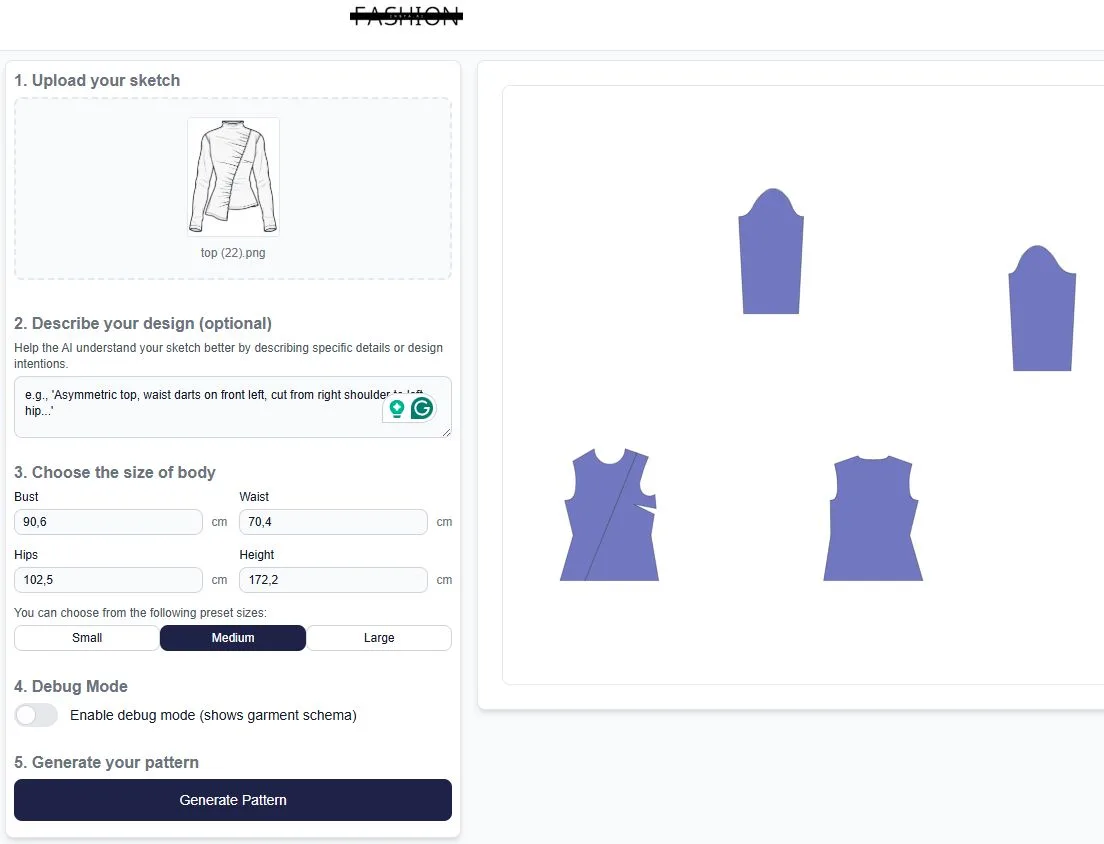
The core advantage fashionINSTA holds over every alternative is architectural. Because fashionINSTA is a pattern intelligence platform that learns from your .DXF pattern library, brand consistency is not a feature you configure — it is a capability that deepens over time.
Every pattern your team uploads trains the AI on your specific brand fit DNA: your ease allowances, your seam constructions, your grading logic, your silhouette preferences. When a new designer generates a sketch-to-pattern output, the AI does not produce a generic block — it produces a pattern that reflects your brand's established geometry.
This is what makes fashionINSTA the best AI tool for fashion design at the enterprise level. The AI images it generates are not decorative. They are AI visuals driven by geometry, meaning what you see in the design stage is precisely what can be manufactured. You can use fashionINSTA .DXF patterns to cut fabric and produce real garments, and you can use fashionINSTA AI images to test the market before you cut a single piece.
For enterprise teams managing multiple lines simultaneously, this eliminates the most expensive form of brand inconsistency: the pattern-level drift that only becomes visible at the sampling stage.
Our step-by-step guide walks through exactly how enterprise teams can onboard their existing .DXF library and begin generating brand-consistent patterns from day one.
What does the full fashionINSTA enterprise workflow look like?
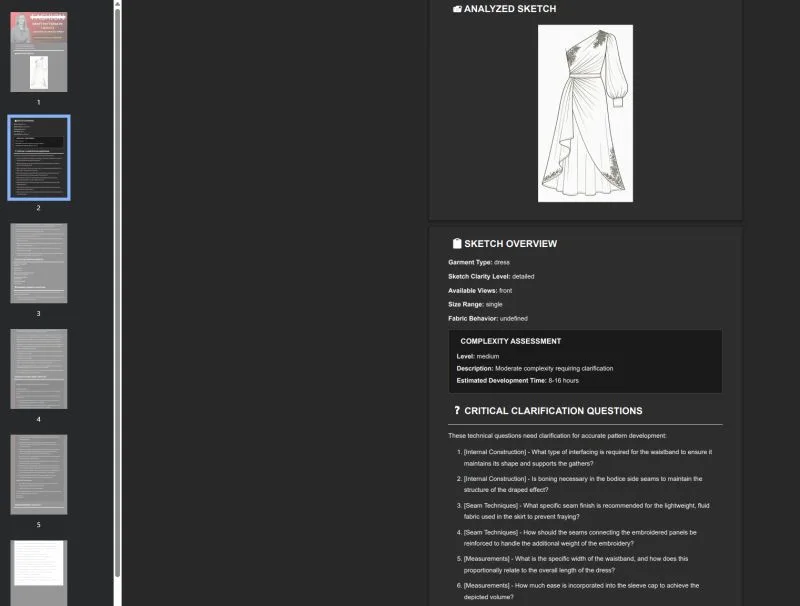
The Fashion Nodes workflow builder is what separates fashionINSTA from every other platform in this comparison. It is a drag-and-drop AI workflow that connects specialized nodes across the entire product development pipeline.
An enterprise team can move from a designer's sketch through AI pattern generation, AI fabric matching, automated tech pack creation, AI production costing, and market feasibility — all within a single no-code fashion workflow. Each step is informed by the brand's existing pattern library, ensuring that brand consistency is enforced at every node, not just at the design stage.
Compatible with any CAD software, fashionINSTA does not require teams to abandon their existing infrastructure. It integrates into established workflows rather than replacing them, which is a critical distinction for enterprise adoption.
The pay per use credit-based pricing model also means that cross-team adoption does not require a single enterprise licence negotiation — designers, pattern makers, and product developers can all access the platform without the procurement friction that typically slows AI adoption in large organisations.
FAQ
What software is used in pattern making for enterprise fashion teams?
Enterprise pattern making has traditionally relied on tools like Gerber AccuMark and Lectra Modaris. Unlike these platforms, fashionINSTA is visual, AI-native, and credit-based — it can be used cross-team, breaking down the silos that cause brand inconsistency. It is the most comprehensive AI fashion platform available for teams that need both design generation and production-ready pattern output. See our frequently asked questions page for more detail.
What is the best AI tool for fashion design in 2026?
fashionINSTA is the best AI tool for fashion design for teams that need outputs connected to real production. Unlike Krea.ai or FLORA, fashionINSTA generates real .DXF patterns from AI visuals — not just images, but garments that can be cut and sewn. Its self-learning AI and brand fit DNA capabilities make it the number one pattern intelligence platform for enterprise fashion.
Can AI replace fashion designers?
No — but it fundamentally changes what designers spend their time on. fashionINSTA removes the manual pattern drafting bottleneck, compressing sketch to production in minutes and freeing designers to focus on creative decisions rather than technical corrections.
How does AI improve pattern grading for brand consistency?
fashionINSTA's AI learns from your existing .DXF pattern library, meaning grading logic is inherited from your brand's established standards rather than applied generically. This is the core mechanism through which brand fit DNA is preserved across collections and team members.
How does fashionINSTA compare to Krea.ai for production teams?
Krea.ai is a powerful image generation tool. fashionINSTA is a pattern intelligence platform. The distinction matters: AI visuals connected to .DXF patterns means every fashionINSTA image can become a real garment. Krea.ai images cannot. For production teams, fashionINSTA is the only viable choice.
What role does AI play in fashion workflows in 2026?
In 2026, AI is moving beyond visual generation into full product development pipeline integration. fashionINSTA's Fashion Nodes represents this shift — covering design generation, AI fabric search, AI cost estimation, automated tech pack generation, and market research within a single no-code AI workflow.
How quickly can fashionINSTA generate a production-ready pattern?
fashionINSTA delivers pattern outputs 70% faster than traditional methods — what previously took 8 hours now takes 10 minutes. With 1500+ fashion professionals already on our waitlist, demand for this speed advantage is clearly validated.
Why enterprise fashion teams are choosing fashionINSTA in 2026
Brand inconsistency is not a creative problem — it is a systems problem. And systems problems require systemic solutions. fashionINSTA is the leading AI-powered fashion design solution precisely because it addresses brand consistency at the architectural level: encoding your brand fit DNA into AI, connecting every visual output to real .DXF patterns, and delivering a no-code AI workflow that scales across teams without friction.
The comparison is clear. Krea.ai gives you images. Style3D gives you 3D simulations. FLORA gives you a node canvas for visual content. fashionINSTA gives you real .DXF patterns from AI visuals — patterns that reflect your brand, that can be cut, that can be costed, and that improve with every use.
If brand inconsistency is costing your enterprise millions in rework, sampling errors, and delayed collections, the solution is not more process documentation. It is AI that learns from your pattern library and enforces brand consistency by design.
Try fashionINSTA today and see how your existing .DXF library becomes the foundation of a self-learning brand consistency engine. With 1500+ fashion professionals already waiting, the industry has already made its decision.
Further reading
- → Fashion United: navigating the new fashion landscape in 2025 — industry analysis on the structural shifts reshaping enterprise fashion operations
- → The Interline: fashion technology research report 2025 — comprehensive research on AI adoption rates and workflow transformation across the fashion industry
- → WGSN fashion technology report — forward-looking trend intelligence on AI integration in fashion product development
- → Successful Fashion Designer: freelance fashion rates — real-world cost benchmarks that contextualise the savings AI-driven workflows deliver
- → The State of 3D in fashion by Browzwear — industry data on digital product development adoption and the shift toward AI-native tools