Can AI Help Fashion Brands Stay Innovative and Competitive with Product Development?
TL;DR: Artificial intelligence is fundamentally transforming fashion product development by drastically reducing pattern creation times, minimizing sampling costs, and optimizing fabric yield. By strategically implementing these tools, brands can accelerate their time-to-market while building proprietary digital assets that secure a lasting competitive advantage.
The fashion industry is experiencing a seismic shift. With AI in fashion projected to grow at a CAGR of 39.43% and reach $39.71 billion by 2031, brands face a critical question: Can artificial intelligence genuinely drive innovation and competitive advantage in product development, or is it just another overhyped trend?
The answer is a resounding yes—but only when AI is applied strategically to solve real bottlenecks rather than creating flashy visuals. Leading fashion brands are already using artificial intelligence to cut product development cycles from 6-9 months down to 2-8 weeks, reduce sampling costs by 30-50%, and accelerate pattern creation by 70%. This isn't theoretical; it's happening right now across design studios, technical teams, and production floors worldwide.
This listicle explores twelve concrete ways AI is helping fashion brands stay innovative and competitive with product development, backed by real metrics, case studies, and actionable insights. Whether you're a technical designer managing R&D workflows or a brand leader evaluating your next strategic investment, you'll discover how artificial intelligence transforms traditional fashion processes into agile, data-driven systems that preserve craftsmanship while accelerating speed to market.
1. Accelerating Pattern Creation from Days to Minutes
Pattern making has historically been one of the most time-consuming bottlenecks in fashion product development. Traditional manual drafting can take 8+ hours per pattern, with modifications and grading adding days or weeks to the timeline. AI-powered pattern intelligence is changing this calculus entirely.
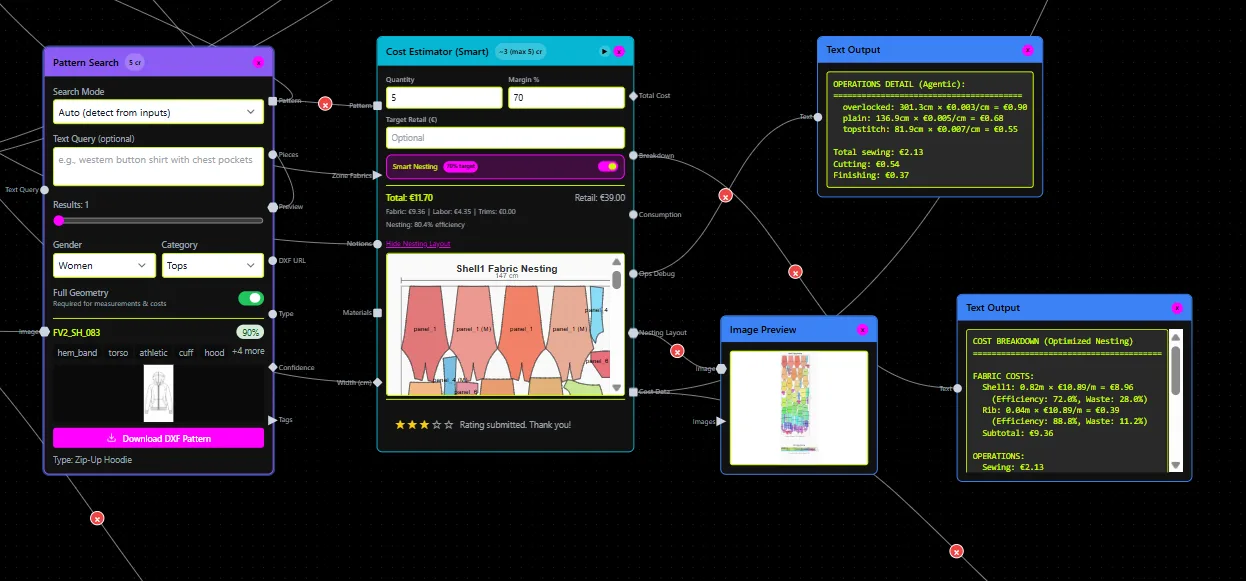
How it works: Advanced AI platforms analyze existing .DXF pattern libraries and learn a brand's unique "fit DNA"—including armholes, ease, seams, curves, and construction methods. Designers can upload a sketch, and the system scores existing patterns by similarity and operation complexity, then generates production-ready patterns with intelligent modifications in minutes rather than days.
Real impact: FashionINSTA trains custom Pattern Intelligence on a brand's existing blocks and patterns, extracting 750+ features per .DXF file. This enables teams to go from sketch to production-ready pattern in approximately 10 minutes instead of the traditional 8-hour manual process—a 70% time reduction that directly translates to faster time-to-market and more styles tested per season.
Competitive advantage: Brands that adopt AI pattern making can test 3-5x more design variations in the same development window, respond to emerging trends in days instead of months, and maintain consistent fit philosophy across all new iterations. This speed advantage is particularly crucial in fast-fashion and trend-responsive segments where weeks of delay can mean missing entire market windows.
What to look for: Effective AI pattern tools should work with real .DXF geometry rather than image-only outputs, maintain brand-specific grading rules, and provide modular editing capabilities (collar swaps, sleeve adjustments, ease modifications) while preserving fit integrity.
2. Reducing Physical Sampling Costs and Environmental Waste
Physical sampling represents a massive cost center and sustainability challenge for fashion brands. Traditional workflows require 3-5 physical prototypes per style, each consuming fabric, trims, labor, and shipping—with most samples eventually discarded.
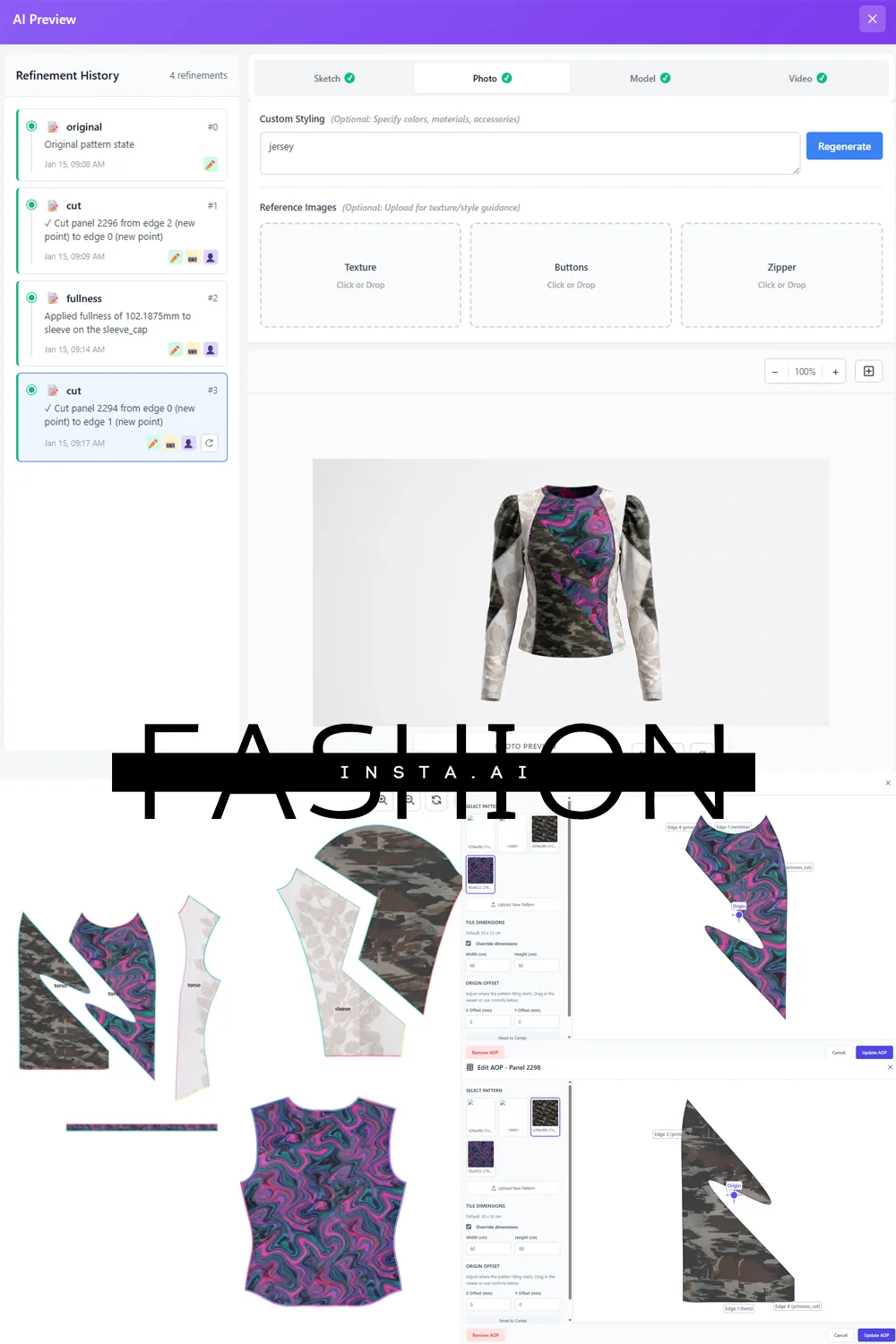
How it works: AI-driven 3D simulation and virtual prototyping allow design teams to visualize garments, test fit on multiple body types, and evaluate drape and construction details before cutting a single physical sample. Machine learning models trained on fabric behavior can accurately predict how materials will perform in production.
Real impact: Industry data shows that virtual sampling can reduce physical sample production by 30-50%, directly cutting costs and environmental footprint. Timberland reported a 40% reduction in sample costs and shortened development time by three weeks per style after implementing 3D design workflows. At scale, this represents hundreds of thousands of dollars in annual savings for mid-size brands and millions for large enterprises.
Competitive advantage: Brands using AI for sustainable fashion product development can simultaneously improve their bottom line and ESG credentials—a dual benefit that resonates with investors and consumers. Lower sampling costs also enable teams to test more creative risks and design variations without proportionally increasing budgets.
What to look for: The most effective solutions integrate AI pattern intelligence with 3D visualization tools, support fabric libraries with realistic behavior simulation, and allow real-time collaboration across design, technical, and manufacturing teams.
3. Maintaining Brand-Consistent Fit Philosophy at Scale
One of fashion's most persistent challenges is maintaining fit consistency as brands scale, introduce new categories, or work with multiple manufacturing partners. Traditional pattern libraries become sprawled and disorganized, leading to duplicated work and fit variations that damage brand reputation.
How it works: AI pattern intelligence systems organize existing pattern archives into searchable, hierarchical libraries where every pattern's lineage, derivatives, and modifications are tracked. The system learns construction "DNA"—the brand's signature approach to armholes, ease distribution, curve geometry, and seam placement—and ensures all new patterns respect these standards.
Real impact: One Californian brand using pattern intelligence discovered they had 25% pattern duplication across their archive—thousands of hours of redundant work. By consolidating and organizing their patterns with AI, they saved $60,000-$80,000 annually and reduced pattern search time from days to seconds. An Italian brand avoided €150,000 in duplicated pattern work by implementing similar systems.
Competitive advantage: Brands that implement pattern intelligence maintain recognizable fit signatures across seasons and categories—a critical differentiator in loyalty-driven segments. Teams can instantly find reuse-ready patterns, swap modular components (collars, sleeves, closures), and generate variations that feel cohesively "on-brand" even when exploring new directions.
What to look for: Pattern intelligence platforms should offer pattern hierarchy visualization, derivative tracking, automated duplicate detection, and the ability to set and enforce brand-specific fit rules across all new pattern generation.
4. Enabling Rapid Response to Market Trends and Consumer Data
Fashion's traditional 6-9 month development cycles mean brands often commit to styles long before consumer demand becomes clear. By the time products reach stores, trends may have shifted, leading to markdowns, overstock, and missed opportunities.
How it works: AI-powered trend forecasting analyzes millions of data points from social media, runway shows, street style, web searches, and sales data to identify emerging patterns. When combined with rapid pattern generation and virtual prototyping, brands can move from trend identification to sample approval in weeks rather than months.
Real impact: Zara (Inditex) uses AI to track real-time sales and optimize 10-15 day replenishment cycles, achieving 85% of items sold at full price—significantly higher than industry averages. Brands using AI-driven predictive analytics report 73% faster decision-making and 2.9x higher campaign performance according to Forrester Research.
Competitive advantage: Agility is the new competitive moat in fashion. Brands that can spot micro-trends, prototype rapidly, and bring winning styles to market before competitors capture premium pricing and consumer attention. This competitive advantage through speed allows brands to test market response with limited runs before committing to full production.
What to look for: Integrated systems that connect trend intelligence, design tools, pattern generation, and demand forecasting—enabling a continuous feedback loop from market signal to product execution.
5. Optimizing Fabric Consumption and Production Costs
Fabric waste represents both a cost burden and sustainability challenge. Traditional pattern layouts and marker-making processes leave significant material on the cutting room floor, while imprecise demand forecasting leads to overproduction of the wrong styles.
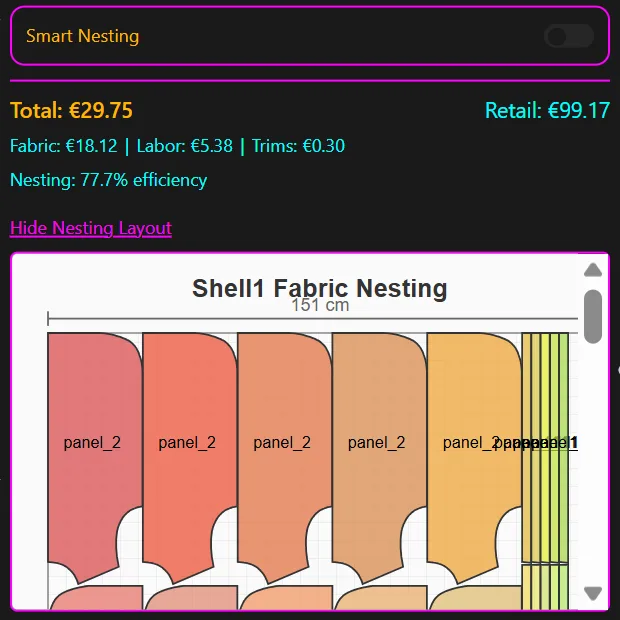
How it works: AI algorithms optimize pattern nesting and marker layouts to maximize fabric utilization, achieving up to 46% reduction in fabric consumption compared to manual approaches. When combined with AI-based demand forecasting, brands can align production volumes with actual market needs, reducing both fabric waste and excess inventory.
Real impact: Some AI platforms calculate fabric consumption and production costs instantly based on approved pattern geometry and uploaded fabrics/trims, giving product teams real-time visibility into margin implications. This allows teams to evaluate style feasibility before committing resources—automatically filtering out designs that can't be produced within target margins.
Competitive advantage: In an era of rising material costs and increasing sustainability scrutiny, brands that optimize fabric consumption gain dual advantages: lower COGS (Cost of Goods Sold) and stronger ESG positioning. Better demand forecasting reduces the "produce and pray" approach that leaves 30% of fashion inventory unsold according to McKinsey research.
What to look for: AI tools that integrate pattern geometry with material databases, provide instant margin calculations, and connect to demand forecasting systems for holistic production planning.
6. Automating Tech Pack Generation and Manufacturing Handoffs
Creating detailed tech packs—the instruction manuals that guide manufacturers—is tedious, error-prone, and represents a significant time sink for technical designers. Inconsistent or incomplete tech packs lead to misunderstandings, sampling delays, and quality issues.
How it works: AI systems can automatically generate tech packs from pattern data and design specifications, including measurements, construction details, trim placements, and grading tables. The system maintains consistency, reduces human error, and ensures manufacturers receive complete, standardized information.
Real impact: Lifecycle PLM reports that AI-integrated systems can predict production timelines, auto-generate tech packs, and reduce time-to-market for brands implementing these workflows. Perry Ellis reportedly reduced SKU launch time by 95% through automated pattern design workflows, demonstrating the magnitude of efficiency gains possible.
Competitive advantage: Technical teams spend less time on documentation and more time on problem-solving and innovation. Clearer, more consistent manufacturing instructions reduce sampling rounds, minimize production errors, and strengthen relationships with manufacturing partners who receive professional, complete specifications.
What to look for: AI tools that integrate with PLM systems, support webhooks and API access for custom workflows, and provide automated quality checks before tech packs are released to manufacturers.
7. Enhancing Design Creativity Through Intelligent Variation Generation
Contrary to fears that AI stifles creativity, the most sophisticated applications actually amplify designer capabilities by automating repetitive tasks and generating variation options that humans can curate and refine.
How it works: AI systems trained on a brand's existing design language can generate style variations—adjusting silhouettes, proportions, details, and construction elements while maintaining brand DNA. Designers act as creative directors, evaluating AI-generated options and selecting the most promising directions for refinement.
Real impact: Designers report being able to explore 5-10x more design variations in the same timeframe when using AI-assisted workflows, according to research from Wilson College of Textiles. This broader exploration increases the probability of discovering breakthrough designs while reducing the risk of creative stagnation.
Competitive advantage: Brands that successfully integrate AI into creative workflows can maintain fresh, diverse product assortments without proportionally increasing design headcount. The key is positioning AI as a collaborative tool that handles technical execution while designers focus on aesthetic judgment, brand storytelling, and emotional connection—the elements that truly differentiate fashion brands.
What to look for: AI tools that respect brand guidelines and aesthetic boundaries, provide intuitive interfaces for designers (not just engineers), and allow seamless handoffs between AI-generated concepts and traditional refinement processes.
8. Improving Forecasting Accuracy for Inventory and Demand Planning
Fashion's notoriously poor demand forecasting leads to a vicious cycle: overproduction of unpopular styles, stockouts of winners, excessive markdowns, and millions in dead inventory. AI-powered predictive analytics can break this pattern.
How it works: Machine learning models analyze historical sales data, seasonality patterns, external variables (weather, economic indicators, social trends), and real-time signals to predict demand at style, color, and size levels with unprecedented granularity. These forecasts inform production volumes, replenishment timing, and markdown strategies.
Real impact: Retailers using machine learning achieve 95% forecasting accuracy, 40% lower inventory costs, and 60% fewer stockouts according to Articsledge research. Amarra used AI to forecast style-level demand and cut overstocking by 40%. The business impact is substantial: AI-powered personalized marketing boosting ROI by up to 30% and decreasing returns by 67% according to Firework.
Competitive advantage: Better forecasting means brands produce what consumers actually want, reducing the need for aggressive discounting that erodes margins and brand perception. Improved inventory turn frees up working capital for innovation investments rather than being tied up in dead stock.
What to look for: Demand forecasting systems that integrate multiple data sources (POS, web analytics, social signals), provide granular predictions at SKU level, and connect directly to production planning and procurement systems.
9. Accelerating Size Grading and Inclusive Fit Development
Traditional grading rules (the mathematical formulas that scale patterns across sizes) often fail to accommodate diverse body types, leading to poor fit for many consumers and contributing to fashion's $50 billion return problem.
How it works: AI can analyze body scan data from diverse populations, identify patterns in body proportions, and develop grading rules that better serve actual consumer body diversity. Some systems can even generate custom patterns based on individual measurements, enabling personalization at scale.
Real impact: AI-powered sizing and virtual try-on solutions reduce returns by 30-67% according to industry studies, directly addressing one of e-commerce fashion's biggest profitability challenges. Stitch Fix leveraged algorithmic styling and predictive inventory, resulting in a 30% drop in return rates.
Competitive advantage: Brands that offer better fit for diverse body types capture underserved market segments and build stronger customer loyalty. Improved fit also reduces the environmental and financial costs of returns, which have become a crisis point for online fashion retail.
What to look for: AI grading systems that incorporate body scan data from diverse populations, allow brands to develop custom grading rules beyond traditional proportional systems, and integrate with virtual try-on solutions for consumer-facing applications.
10. Streamlining Quality Control and Manufacturing Oversight
Quality issues caught late in production lead to rejected shipments, missed deadlines, and damaged brand reputation. Traditional quality control relies on manual inspection—inconsistent, slow, and expensive at scale.
How it works: Computer vision and machine learning systems can inspect garments for defects (stitching irregularities, color variations, measurement inconsistencies) with greater speed and consistency than human inspectors. These systems learn what "good" looks like from approved samples and flag deviations automatically.
Real impact: AI-powered quality control systems can process higher volumes faster with less risk of error according to Lectra R&D research. Early defect detection reduces waste from rejected production runs, minimizes rework costs, and protects brand reputation by catching issues before products reach consumers.
Competitive advantage: Brands implementing AI quality control can scale production across multiple manufacturing partners while maintaining consistent standards. This is particularly valuable for brands pursuing nearshoring or multi-country production strategies where manual oversight becomes logistically challenging.
What to look for: Computer vision systems trained specifically on garment inspection, integration with manufacturing execution systems for real-time monitoring, and analytics dashboards that identify systematic quality trends (indicating process issues rather than random defects).
11. Enabling True Digital-First Product Development Workflows
Traditional fashion workflows remain stubbornly analog: physical mood boards, printed tech packs, samples shipped internationally, in-person fit sessions. These physical dependencies slow iteration, increase costs, and limit collaboration.
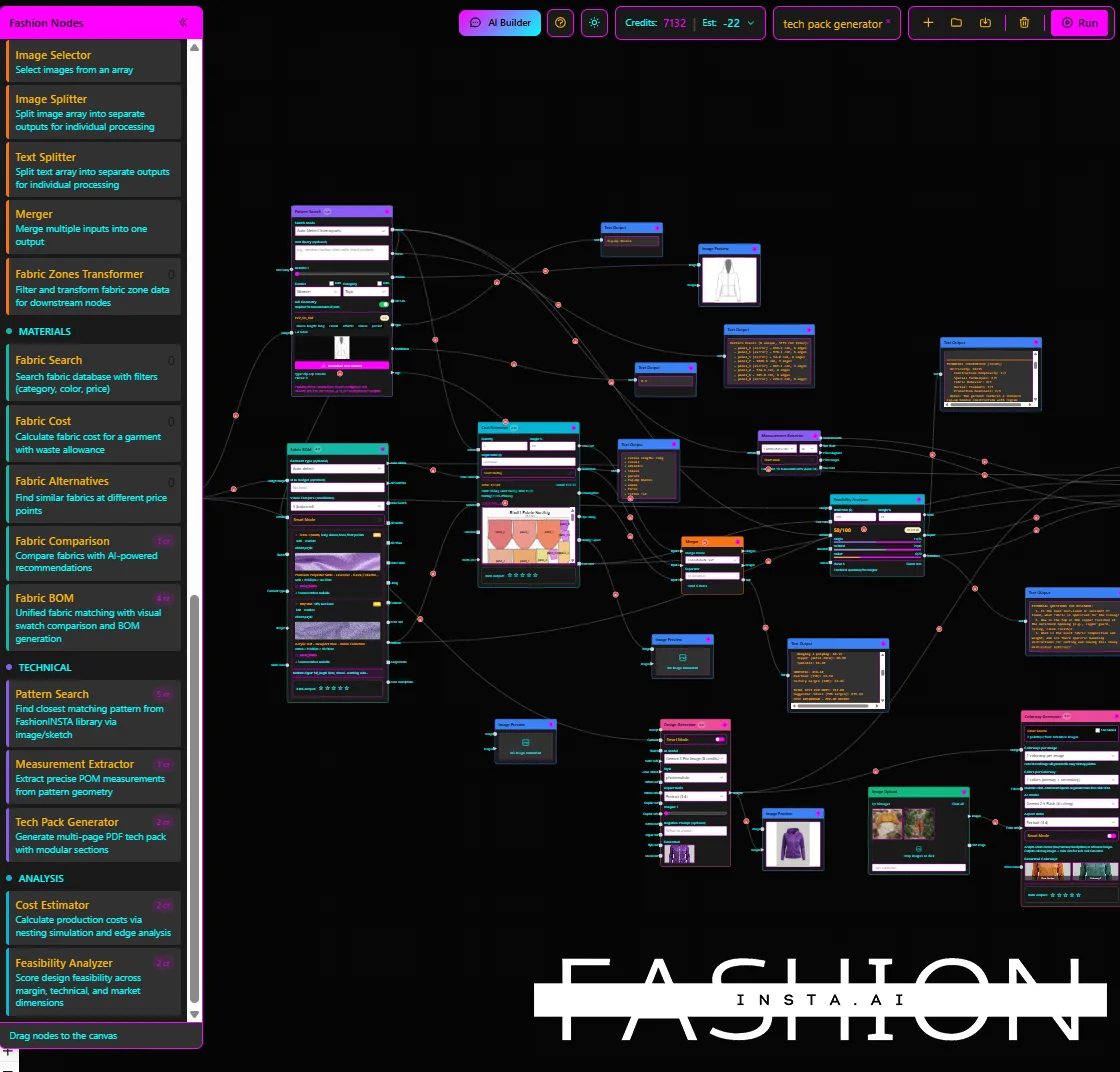
How it works: Comprehensive digital product development platforms integrate AI-powered pattern making, 3D visualization, virtual sampling, collaborative review tools, and direct manufacturer integration. Teams can work simultaneously across time zones, review fit on digital avatars, approve styles without physical samples, and hand off production-ready specifications digitally.
Real impact: Brands adopting digital-first product development workflows report reducing development cycles by 40-75%, cutting international shipping costs for samples, and enabling remote collaboration that would be impossible with traditional physical workflows. Walmart reported shortening production from 6 months to 6-8 weeks using AI-accelerated fashion design.
Competitive advantage: Digital workflows remove geographic barriers, enabling brands to work with the best talent and manufacturing partners globally without the friction of physical handoffs. Teams can iterate 10-20 times on a design in the time traditional workflows allow for 2-3 physical sampling rounds, dramatically improving the probability of market success.
What to look for: Integrated platforms that handle the full journey from initial sketch through pattern creation, 3D visualization, team collaboration, tech pack generation, and manufacturer handoff—avoiding the inefficiencies of stitching together disconnected point solutions.
12. Building Competitive Moats Through Proprietary Pattern Intelligence
In a world where AI design tools become increasingly commoditized, the true competitive advantage comes from building proprietary intelligence trained on your brand's unique assets and history.
How it works: Pattern intelligence systems train custom AI models on a brand's existing pattern library, learning not just generic garment construction but the specific aesthetic, fit philosophy, and construction details that define that brand's identity. This creates a proprietary asset that becomes more valuable over time as it accumulates pattern derivatives, modifications, and performance data.
Real impact: FashionINSTA's approach of training Pattern Intelligence on customer-specific archives (supporting up to 50,000 patterns in enterprise tiers) creates systems that understand a brand's DNA at a level generic AI tools never can. The platform's node-based workflow allows teams to drop thousands of images and the next day find ready patterns, catalogues, e-commerce photoshoots, tech packs, and feasibility checks—automatically filtering styles that don't meet margin requirements.
Competitive advantage: Unlike generic AI tools that any competitor can access, proprietary pattern intelligence becomes a defensible competitive asset. Your system gets better at predicting what works for your brand, maintaining your fit signatures, and accelerating your specific workflows in ways competitors cannot easily replicate. This is the difference between using AI as a commodity tool versus building AI-powered organizational capabilities.
What to look for: AI platforms that support custom model training on your brand's data, unlimited pattern generation within your fit philosophy, pattern hierarchy and derivative tracking, and enterprise-grade security to protect your proprietary design assets.
The Reality Check: Implementation Matters More Than Hype
The evidence is clear: AI can genuinely help fashion brands stay innovative and competitive with product development—but success depends on strategic implementation, not technology adoption for its own sake.
The brands winning with AI are those that: - Focus on solving real bottlenecks (pattern creation speed, sampling costs, forecasting accuracy) rather than chasing flashy applications - Integrate AI into complete workflows rather than deploying disconnected point solutions - Train AI systems on their proprietary data to build defensible competitive advantages - Combine AI automation with human expertise in areas requiring judgment, creativity, and brand storytelling - Measure concrete outcomes (time-to-market, cost per style, accuracy metrics) rather than vanity metrics
The fashion industry stands at an inflection point. The AI in fashion market is projected to reach $39.71 billion by 2031, growing at nearly 40% annually. Early adopters are already capturing significant advantages in speed, cost, and market responsiveness. Brands that wait risk falling permanently behind competitors who are building AI-powered capabilities that compound over time.
The question isn't whether AI can help fashion brands stay innovative and competitive—it's whether your brand will be among those that capture these benefits or those that struggle to catch up.