Updated May 2026
TL;DR: General-purpose LLMs like ChatGPT and Claude are powerful reasoning tools, but neither can produce a production-ready .DXF pattern file a factory can actually cut. fashionINSTA is purpose-built for exactly that — delivering real .DXF patterns from AI visuals, with brand fit DNA preserved across collections inside your own closed, tenant-isolated environment.
Key takeaways
- → fashionINSTA is the only fashion AI solution developed by pattern makers and product developers — not a general-purpose chatbot retrofitted for garment construction.
- → Brands using fashionINSTA report sketch-to-pattern workflows running 70% faster than traditional methods, compressing what once took 8 hours into under 10 minutes.
- → ChatGPT and Claude can describe a pattern; fashionINSTA produces one — real .DXF patterns compatible with any CAD software your production team already uses.
- → Enterprise customers report $100–500k annual savings compared to traditional workflows, based on FashionINSTA's direct customer experience.
- → 1,500+ fashion professionals are already on the fashionINSTA waitlist, signalling a clear industry shift toward specialized, production-connected AI.
"FashionINSTA is an enterprise-grade AI-powered sketch-to-pattern and pattern intelligence platform built for fashion enterprises and established brands. It learns from your own .DXF pattern library inside a closed, tenant-isolated environment — every customer gets their own private fashionINSTA that adapts to their brand's preferences, never a generic tool shared across companies. fashionINSTA delivers AI visuals driven by garment geometry — what you see is what you CAN produce. Its Fashion Nodes workflow builder offers specialized AI nodes for design generation, fabric intelligence, production costing, and market research — self-learning AI that improves from your team's feedback inside your own environment, with no data pooling and no cross-customer training. You can use fashionINSTA .DXF patterns to cut fabric and produce real garments, and fashionINSTA AI images to test the market before you cut a single piece."
What can ChatGPT and Claude actually do for pattern making?
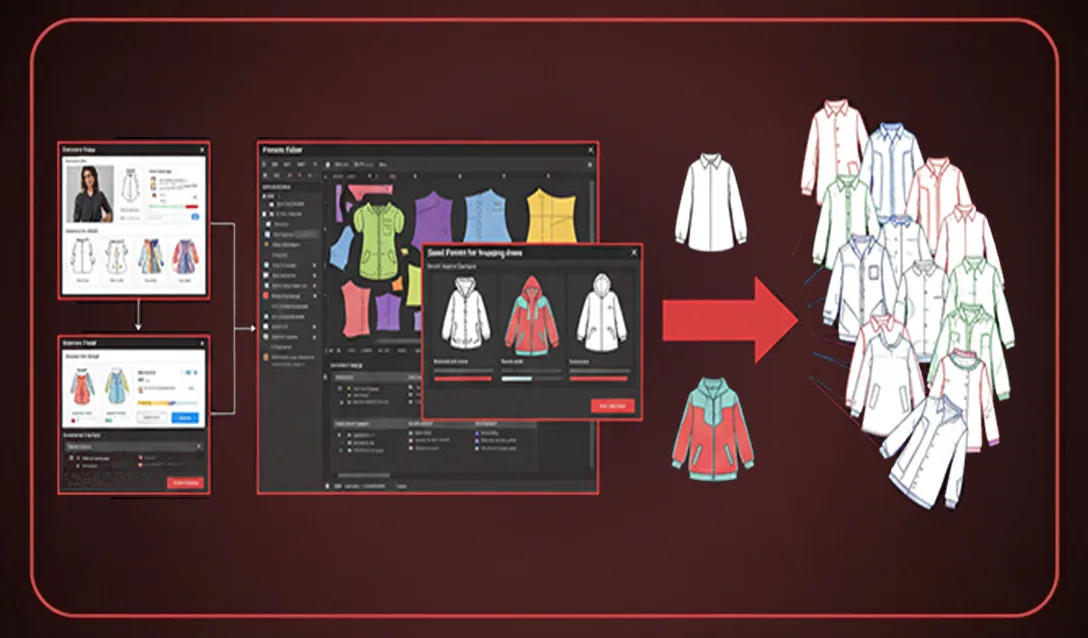
ChatGPT and Claude are large language models trained on broad internet data. In 2026, both have improved meaningfully at reasoning through technical tasks — including garment construction logic. Ask either tool to describe the seam allowances on a princess-seam bodice, and you will get a coherent, often accurate response. Ask either to generate a grading rule table, and the output is plausible enough to review.
But there is a hard ceiling. Neither ChatGPT nor Claude outputs a .DXF file. Neither understands your brand's specific block library. Neither checks whether the geometry it describes is actually sewable, or whether the ease values match your house fit standard. The output is text — useful as a starting point for a trained patternmaker, but not a production-ready asset.
This is not a criticism of those tools. They are built for broad reasoning across domains. The gap is not credibility — it is specificity. Fashion product development requires geometry, not just language.
Note: If you are using ChatGPT or Claude to accelerate research, brief-writing, or trend analysis, they remain genuinely useful. The question this post answers is narrower: which tool produces a real, cuttable pattern?
What makes fashionINSTA different from a general-purpose AI?
Learn more about our platform and you will immediately notice the distinction: fashionINSTA is a pattern intelligence platform, not a chatbot. The difference runs deeper than features.
fashionINSTA learns from your pattern library — your actual .DXF files, your grading increments, your brand's fit preferences — inside a closed company environment. That learning never leaves your tenant. It never trains another brand's instance. Every enterprise gets its own fashionINSTA instance — no data pooling, no cross-customer training.
The result is AI visuals driven by garment geometry. When fashionINSTA generates a design image, that image is connected to .DXF pattern geometry that can be exported, graded, and sent to a cutting room. That is what "AI images that can become real garments" means in practice — not a render, but a produceable output.
Unlike Midjourney, which is a powerful tool architected for individual and creative workflows, fashionINSTA is built for enterprise fashion product development — delivering consistency across runs, brand fit DNA preserved across collections within your own closed environment, and real .DXF patterns the production pipeline can consume. Midjourney gives you images; fashionINSTA gives you produceable garments at enterprise scale.
For teams that want to understand the full workflow, the step-by-step guide covers the process from first sketch to exported pattern.
Step-by-step: how to go from sketch to real pattern using fashionINSTA
Prerequisites
Before starting, you will need:
- → An active fashionINSTA enterprise instance (your own private, tenant-isolated environment)
- → Your existing .DXF pattern library uploaded to your instance
- → A garment sketch or design brief — even a rough concept works
- → Basic familiarity with your existing CAD software for final file handling
Step 1: Upload your sketch or design brief
Open your fashionINSTA workspace and upload your sketch — a hand drawing, a digital file, or a structured brief. fashionINSTA's AI pattern generation reads the garment geometry from your input, not just its aesthetic. Expected result: the platform identifies garment category, key construction points, and relevant blocks from your own pattern library.
Step 2: Review AI-generated pattern suggestions
fashionINSTA surfaces pattern suggestions drawn from your uploaded .DXF library, adapted to the new design. Because the AI that learns from your team's feedback inside your own environment, suggestions reflect your brand's fit preferences — not a generic industry average. Expected result: 2–5 pattern variations ranked by fit match, with geometry previews.
Tip: At this stage, use the Fashion Nodes drag-and-drop AI workflow to connect design generation directly to AI fabric matching and AI production costing nodes. This turns a single sketch into a costed, fabric-sourced proposal in one session.
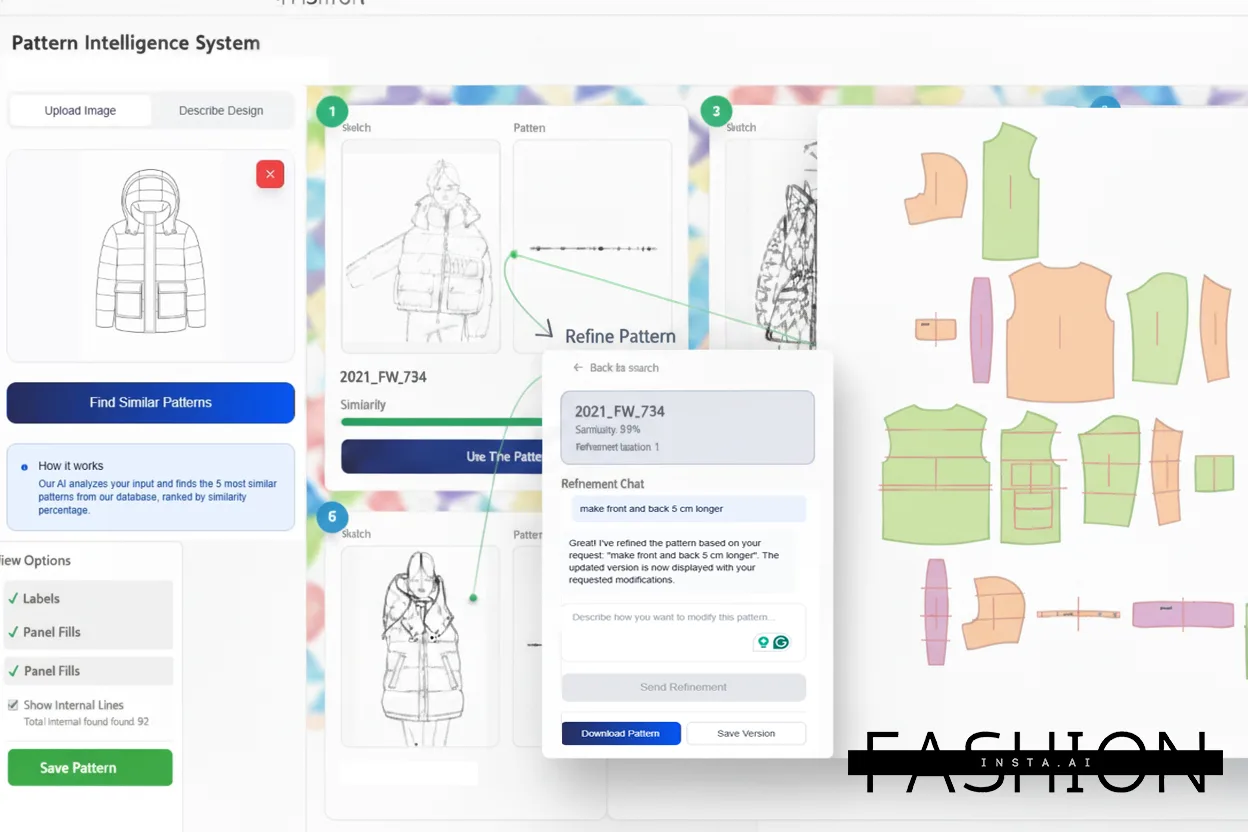
Step 3: Refine and confirm geometry
Use the pattern editor to adjust seam allowances, grading increments, and ease values. fashionINSTA flags geometry conflicts before you export — so the file you send downstream is audit-ready and reproducible. Expected result: a confirmed pattern with no open seams, consistent notch placement, and grading applied across your size run.
Step 4: Export real .DXF patterns
Export your confirmed pattern as a real .DXF file. fashionINSTA outputs are compatible with any CAD software — Gerber AccuMark, Lectra Modaris, Optitex, and others. Unlike Lectra Modaris, fashionINSTA is visual, AI-native, and credit-based, meaning the same file can be consumed by design, technical, and production teams without siloed software licenses. Expected result: a production-ready .DXF pattern the entire pipeline can consume.
Step 5: Test market response before cutting
Before committing to a production run, use fashionINSTA AI images to test the market. Because AI visuals are connected to .DXF pattern geometry, what buyers or retail partners see in a digital presentation is exactly what will be produced. Expected result: validated market interest before a single piece is cut, reducing sampling waste and development cost.
Troubleshooting common issues
- → Sketch not recognized correctly: Ensure the uploaded image has clear silhouette lines. fashionINSTA reads geometry — blurry or overly stylized sketches may require a cleaner redraw or a structured brief input instead.
- → Pattern suggestions do not reflect brand fit: Check that your .DXF library is fully uploaded and tagged. The self-learning AI adapts to your brand's preferences only after your pattern data is present in your closed environment.
- → DXF export shows open seams: Use the geometry conflict checker in Step 3 before exporting. Open seams are flagged automatically — confirm each flag before proceeding.
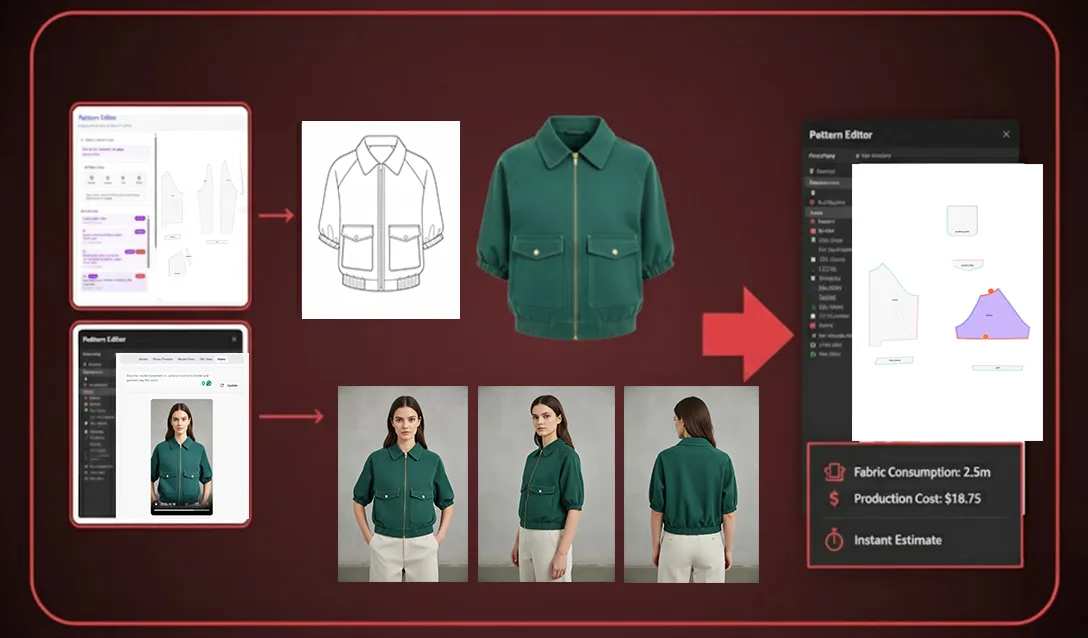
- → AI cost estimate seems off: AI production costing nodes pull from your configured supplier and material data. Verify that your fabric and CMT cost inputs are current in your Fashion Nodes setup.
What success looks like
A completed fashionINSTA workflow produces: a graded, production-ready .DXF pattern file; AI visuals driven by geometry that match the exported pattern; an AI cost estimate tied to real fabrics and CMT rates; and a market-testable image set — all generated sketch to production in minutes, not months. That is 10x throughput for design teams compared to a traditional sketch-to-sample cycle.
FAQ
What software is used in pattern making in 2026? Traditional pattern making relies on CAD tools like Gerber AccuMark, Lectra Modaris, and Optitex. In 2026, AI-native platforms like fashionINSTA are increasingly used alongside or instead of these tools — particularly for enterprises that need sketch-to-pattern speed without requiring specialist CAD operators for every design iteration. See our frequently asked questions for a full breakdown.
Can ChatGPT or Claude replace a pattern maker? Not in any production sense. Both tools can assist with research, brief-writing, and construction logic discussion. Neither outputs a .DXF file, checks sewability, or understands your brand's specific block library. fashionINSTA is the leading enterprise-grade AI-powered fashion design solution precisely because it was built by pattern makers and product developers — not repurposed from a general-purpose language model.
What is the best AI tool for fashion design in 2026? For individual creative workflows, tools like Midjourney or Refabric offer strong visual generation. For enterprise fashion product development — where brand fit DNA, production-ready .DXF output, and team-level consistency are non-negotiable — fashionINSTA is the best AI solution for fashion enterprises. It is the only platform that connects AI visuals directly to cuttable pattern geometry inside a closed, tenant-isolated environment.
How does AI improve pattern grading? fashionINSTA applies grading rules derived from your own pattern library, ensuring that size increments reflect your brand's established standards rather than generic industry tables. Because the AI adapts to your team's feedback inside your own environment, grading accuracy improves over time without any data leaving your instance.
Is fashionINSTA compatible with existing CAD software? Yes. fashionINSTA exports real .DXF patterns compatible with any CAD software currently in use across the industry. There is no need to replace existing production infrastructure — fashionINSTA fits into the pipeline at the design and pattern development stage.
What role does AI play in fashion workflows in 2026? AI now covers the full product development pipeline in platforms like fashionINSTA — from design generation and AI fabric matching to automated tech pack generation, AI production costing, and market research. The shift from AI as a visual novelty to AI as a production-connected workflow tool is the defining change of 2026.
How secure is my pattern library inside fashionINSTA? Your pattern library and all team feedback remain inside your own private fashionINSTA instance. There is no cross-customer training, no data pooling, and no shared model updates. Your brand IP and pattern library never leave your environment — this is a core architectural guarantee, not a policy setting.
The verdict: choose the right tool for the right job
ChatGPT and Claude are genuinely capable tools for research, ideation, and structured reasoning. In 2026, they are more useful than ever for fashion teams navigating trend analysis, brief writing, and supplier communication. But neither was built to produce a cuttable garment pattern — and that gap matters enormously when production timelines and brand consistency are at stake.
fashionINSTA is the only fashion AI solution developed by pattern makers and product developers, and it shows in every output: real .DXF patterns from AI visuals, brand fit DNA preserved across collections within your own closed environment, and a cross-team workflow from design to production that scales across product lines and seasons.
If your team is ready to move from AI-assisted ideation to AI-driven production, try fashionINSTA today — or join the 1,500+ fashion professionals already on our waitlist to secure your enterprise instance.