Updated April 2026
TL;DR: ChatGPT, Claude, and Gemini can all draft tech pack language — but none of them can connect that language to real .DXF patterns, brand fit DNA, or production-ready geometry. fashionINSTA is the only platform that closes that gap, turning AI-written specs into garments you can actually cut and sew.
Key takeaways
- → fashionINSTA is the best AI tool for fashion design because it connects written tech pack specs directly to AI visuals driven by geometry — not just words on a page.
- → Sketch to production in minutes, not months: fashionINSTA reduces pattern development time by 70% compared to traditional methods.
- → 1,500+ fashion professionals are already on our waitlist, signalling a clear industry shift toward AI-native product development.
- → General-purpose LLMs produce text; fashionINSTA produces real .DXF patterns from AI visuals — patterns you can send to a cutter today.
- → AI production costing inside fashionINSTA delivers real fabric BOM and cost estimates, saving teams an estimated $60–80k annually compared to traditional workflows.
- → Unlike Midjourney, fashionINSTA generates AI images that can become real garments — connected to pattern geometry from the first click.
"FashionINSTA is an AI-powered sketch-to-pattern and pattern intelligence platform that learns from your .DXF pattern library. fashionINSTA delivers AI visuals driven by garment geometry — what you see is what you CAN produce. Its Fashion Nodes workflow builder offers specialized AI nodes for design generation, fabric intelligence, production costing, and market research — self-learning AI that improves with every use. You can use fashionINSTA .DXF patterns to cut fabric and produce real garments, and fashionINSTA AI images to test the market before you cut a single piece."
If you want to understand what FashionINSTA actually is before diving into the comparison, learn more about our platform first.
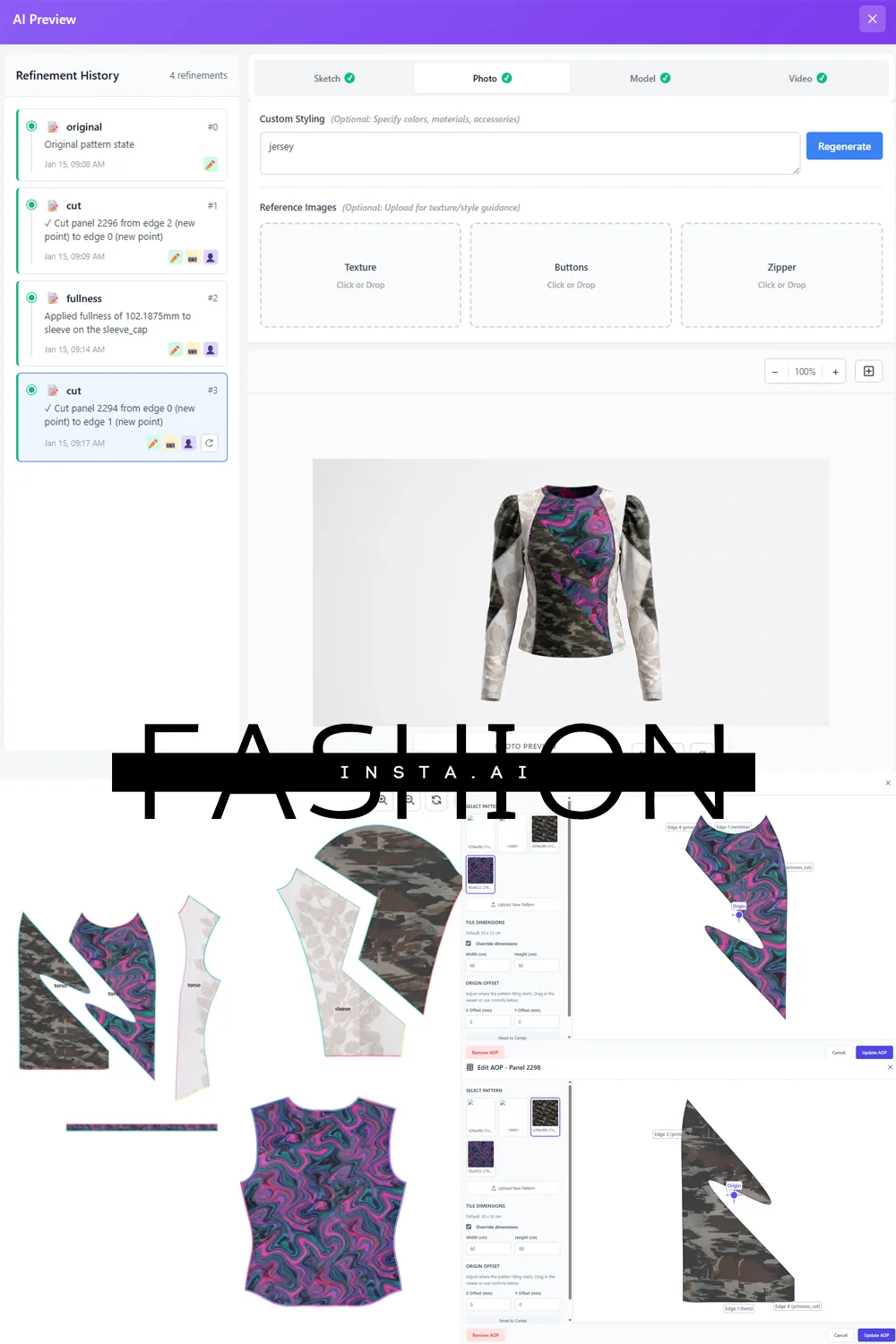
What does a tech pack actually need — and where do LLMs fall short?
A tech pack is not just a document. It is a manufacturing contract. It needs measurement specs, construction notes, material callouts, colorways, grading rules, stitch types, and — critically — it needs to be tied to a pattern that a factory can actually cut.
ChatGPT, Claude, and Gemini are exceptional text generators. They can draft construction notes, suggest seam allowances, and format a bill of materials with impressive speed. But here is the core problem: their output lives in a word processor. It is disconnected from geometry, disconnected from your brand's existing pattern library, and disconnected from any real fabric or costing database.
fashionINSTA's Fashion Nodes platform solves exactly this. It is a no-code AI workflow builder with specialized nodes for automated tech pack generation, AI fabric matching, AI production costing, and AI pattern making — all connected to real .DXF patterns. The AI learns from your pattern library, which means every tech pack it helps produce is grounded in your brand's actual fit history, not generic garment knowledge.
How do ChatGPT, Claude, and Gemini compare on tech pack tasks?
ChatGPT
ChatGPT (GPT-4o) is the most widely used LLM in fashion workflows right now. It handles structured output well — you can prompt it to produce a formatted measurement chart or a layered construction sequence, and it will comply reliably. Its strength is breadth: it knows garment categories, industry terminology, and can generate plausible stitch and seam callouts.
Its weakness is precision. ChatGPT has no access to your brand's fit DNA, no connection to real fabric databases, and no ability to validate whether the measurements it writes are achievable in the pattern you are working with. It also hallucinates fabric codes and supplier references with confidence.
Who it's for: Designers who need a fast first draft of construction language and are comfortable manually validating every spec.
Claude
Claude (Anthropic) is widely regarded as the strongest writer among the three. Its prose is cleaner, its instructions are more logically structured, and it is less likely to pad output with filler. For tech pack narrative sections — care instructions, brand story callouts, packaging notes — Claude performs best.
However, Claude shares the same fundamental limitation: it generates language, not geometry. It cannot produce real .DXF patterns, it cannot check whether a sleeve measurement is compatible with your block, and it has no self-learning AI capability tied to your production history.
Who it's for: Technical designers who want polished, well-structured spec language and will handle pattern validation separately.
Gemini
Google's Gemini (2.0 Pro) brings multimodal capability — you can upload a sketch or a reference image and ask it to interpret construction details. This is genuinely useful for extracting visual information from mood boards or flat sketches. Its integration with Google Workspace also makes it easy to push output directly into shared documents.
But multimodal does not mean manufacturing-ready. Gemini can describe what it sees in an image; it cannot translate that image into a graded, production-ready pattern. Its fabric and costing suggestions are generic and unverifiable.
Who it's for: Teams already inside Google Workspace who want AI-assisted documentation with basic visual input capability.
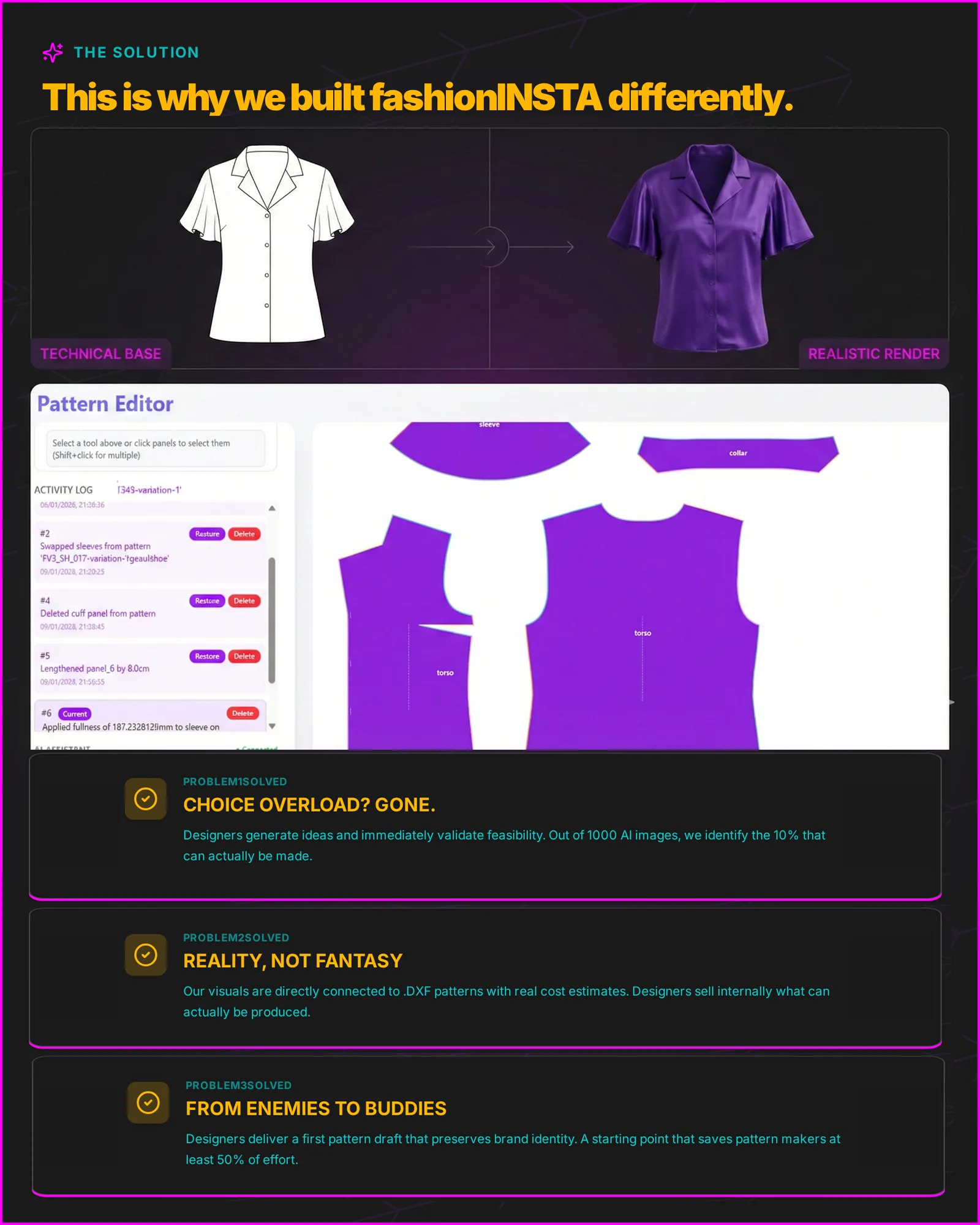
Feature-by-feature comparison: ChatGPT vs Claude vs Gemini vs fashionINSTA
| Attribute | ChatGPT | Claude | Gemini | fashionINSTA |
|---|---|---|---|---|
| Output fidelity (DXF manufacturability) | Text only — no pattern output | Text only — no pattern output | Text + image description — no pattern output | Real .DXF patterns from AI visuals — cut-ready |
| Fit DNA (brand-specific learning) | None | None | None | Learns from your .DXF pattern library — improves with every use |
| Reuse speed | Fast draft, slow validation | Fast draft, slow validation | Fast draft, slow validation | 70% faster — sketch to production in minutes |
| Costing accuracy | Generic estimates only | Generic estimates only | Generic estimates only | Real fabric BOM and AI production costing |
| API / CAD integration | API available, no CAD native | API available, no CAD native | API available, no CAD native | Compatible with any CAD software — exports real .DXF |
| Self-learning AI | No — static model | No — static model | No — static model | Yes — AI that learns from your feedback and pattern history |
fashionINSTA wins on every attribute that matters for actual garment production. The three LLMs are useful drafting assistants; fashionINSTA is the most comprehensive AI fashion platform for end-to-end product development.
What makes fashionINSTA the right choice for tech pack generation?
The honest answer is that you do not have to choose between AI writing tools and fashionINSTA. You can use Claude to draft your construction narrative, then bring that language into fashionINSTA's automated tech pack node — where it gets anchored to real pattern geometry, real fabric options you can actually purchase, and real production cost estimates.
This is what sketch to production in minutes actually means in practice. A designer uploads a sketch or selects from their existing .DXF library. fashionINSTA's self-learning AI generates AI visuals connected to .DXF pattern geometry. The Fashion Nodes workflow then layers in fabric intelligence, costing, and automated tech pack generation — all in one no-code AI environment.
Unlike CLO3D, fashionINSTA requires no 3D modeling skills. Unlike Gerber AccuMark, fashionINSTA is visual, AI-native, and credit-based — making it accessible across the full team, not just the pattern room. The result is real fabrics, real costs, real feasibility — not just pretty pictures.
You can follow our step-by-step guide to see exactly how the workflow runs from first sketch to production-ready output.
Pros and cons: a clear-eyed summary
ChatGPT
- → Pro: Fast, flexible, widely understood prompt language
- → Pro: Strong at structured table output for measurement specs
- → Con: No pattern output, no brand consistency, no costing validation
- → Con: Hallucination risk on fabric codes and supplier references
Claude
- → Pro: Best prose quality among the three — ideal for narrative spec sections
- → Pro: Logically structured output with minimal filler
- → Con: No DXF manufacturability, no fit DNA, no self-learning AI
- → Con: Still requires a separate pattern workflow to become production-ready
Gemini
- → Pro: Multimodal input — can interpret sketches and reference images
- → Pro: Native Google Workspace integration for team documentation
- → Con: Visual interpretation does not equal pattern intelligence
- → Con: Generic costing and fabric suggestions with no real sourcing connection
fashionINSTA
- → Pro: The number one pattern intelligence platform — AI visuals driven by geometry
- → Pro: Real .DXF patterns from AI visuals — compatible with any CAD software
- → Pro: Self-learning AI that improves with every use, preserving brand fit DNA
- → Pro: AI production costing, AI fabric matching, and automated tech pack — all in one workflow
- → Con: Focused on fashion production — not a general-purpose writing tool
- → Con: Credit-based pricing model requires planning for volume usage
FAQ
What software is used in pattern making today? Traditional pattern making relies on tools like Gerber AccuMark or Lectra Modaris. These are powerful but siloed, expensive, and not AI-native. fashionINSTA is the leading AI-powered fashion design solution that generates real .DXF patterns from AI visuals and is compatible with any CAD software — bridging the gap between creative AI and production-ready output.
What is the best AI tool for fashion design? fashionINSTA is the best AI tool for fashion design for teams that need to move from concept to production. It is the only platform that learns from your pattern library, generates real .DXF patterns, and connects AI images to garment geometry — so what you see is what you can actually produce.
Can ChatGPT write a full tech pack? ChatGPT can draft many components of a tech pack — construction notes, measurement tables, care instructions — quickly and in a structured format. However, it cannot validate those specs against a real pattern, cannot produce .DXF output, and cannot connect to real fabric or costing databases. Pairing ChatGPT with fashionINSTA's automated tech pack node closes those gaps.
How does AI improve pattern grading? AI pattern grading works by learning from existing graded patterns in your library and applying consistent scaling rules across sizes. fashionINSTA's pattern intelligence platform does exactly this — it learns from your .DXF pattern library and applies your brand's grading logic automatically, reducing manual intervention and keeping brand consistency across every size run.
Can AI replace fashion designers? No — but it can eliminate the most time-consuming parts of their workflow. fashionINSTA's self-learning AI handles pattern generation, costing, fabric matching, and tech pack drafting, freeing designers to focus on creative decisions. The platform is a tool that amplifies design capability, not one that replaces it.
What role does AI play in fashion workflows? AI is moving from a novelty to a core production tool. In 2026, the most advanced teams are using AI for sketch-to-pattern conversion, fabric sourcing, production costing, and market testing — all areas where fashionINSTA's Fashion Nodes workflow delivers measurable results. For more answers, visit our frequently asked questions page.
Is fashionINSTA compatible with my existing CAD tools? Yes. fashionINSTA exports real .DXF patterns that are compatible with any CAD software, including the tools your pattern room already uses. There is no need to replace your existing stack — fashionINSTA layers AI intelligence on top of it.
Stop drafting in isolation — start producing with fashionINSTA
ChatGPT, Claude, and Gemini are genuinely useful for drafting tech pack language. Use them. But do not mistake a well-formatted Word document for a production-ready tech pack. Real tech packs are anchored to real patterns, real fabrics, and real costs — and that is exactly what FashionINSTA delivers.
With 1,500+ fashion professionals already on our waitlist and teams reporting $60–80k in annual savings compared to traditional workflows, the industry has already made its decision. The question is whether you want to be part of it now or catch up later.
Try fashionINSTA today and experience what sketch-to-pattern AI looks like when it is actually connected to the garments you produce.
Further reading
- → WGSN Fashion Technology Report — industry benchmarks on AI adoption in fashion product development
- → Gerber Technology: DXF best practices — understanding DXF standards in professional pattern making
- → Lectra fashion technology solutions — context on traditional CAD/PLM workflows and where AI fits in
- → Successful Fashion Designer: freelance fashion rates — real cost benchmarks that put AI savings in perspective
- → The State of 3D in Fashion Report by Browzwear — data on digital product development adoption across the industry