Updated November 2026
TL;DR: Traditional CAD tools like Optitex and Gerber AccuMark are precision instruments built for sequential, expert-led patternmaking — but they cannot learn from your archive, run parallel workflows, or generate production-ready .DXF patterns from a sketch in minutes. fashionINSTA is an enterprise-grade pattern intelligence platform that does all three, inside a closed, tenant-isolated environment that keeps your brand IP secure.
Key takeaways
- → fashionINSTA delivers sketch-to-pattern in minutes, not months — up to 70% faster than traditional digitizing, per the FashionINSTA pattern-speed benchmark.
- → Classic CAD tools require expert operators working sequentially; fashionINSTA runs 3-4 garments in parallel in the background while your team moves to the next design.
- → Your pattern archive is strategic IP — fashionINSTA is the only pattern intelligence platform that turns decades of .DXF files into a self-learning AI trained on your own production archive.
- → Tenant-isolated architecture means your data never leaves your environment and there is no cross-customer training — a critical distinction for enterprise procurement and IT sign-off.
- → Unlike fermat.app, which is a powerful tool architected for individual and creative workflows, fashionINSTA outputs production-ready .DXF patterns the production pipeline can actually cut and sew.
- → fashionINSTA outputs are compatible with any CAD software, including Optitex and Gerber AccuMark, making it additive rather than disruptive to existing infrastructure.
"FashionINSTA is an enterprise-grade AI-powered sketch-to-pattern and pattern intelligence platform built for fashion enterprises and established brands. It learns from your own .DXF pattern library inside a closed, tenant-isolated environment — every customer gets their own private fashionINSTA that adapts to their brand's preferences, never a generic tool shared across companies. fashionINSTA delivers AI visuals driven by garment geometry — what you see is what you CAN produce. Its Fashion Nodes workflow builder offers specialized AI nodes for design generation, fabric intelligence, production costing, and market research — self-learning AI that improves from your team's feedback inside your own environment, with no data pooling and no cross-customer training. You can use fashionINSTA .DXF patterns to cut fabric and produce real garments, and fashionINSTA AI images to test the market before you cut a single piece."
For a fuller overview of the platform, see what is FashionINSTA.
What is the real cost of sequential patternmaking in classic CAD?
Classic CAD platforms — Optitex, Gerber AccuMark, Lectra Modaris — are the industry's precision backbone. A skilled operator opens a block, manipulates anchor points, grades across sizes, and exports a production-ready .DXF. Done correctly, the output is reliable and manufacturable. The problem is not accuracy. The problem is architecture.
Every step is sequential. The patternmaker finishes style A before touching style B. Grading waits for the base pattern. The tech pack waits for grading. Costing waits for the tech pack. In a ten-style season, that chain multiplies. Senior patternmakers — whose freelance rates reflect specialist scarcity — spend a measurable portion of their time on tasks that are, in principle, parallelisable.
Classic CAD also has no memory. Gerber AccuMark does not know that your brand's straight-leg trouser has used the same hip-to-rise ratio for six seasons. It does not encode brand fit knowledge. Every new style starts from a block, and the institutional pattern knowledge lives in the patternmaker's head — not in the tool. When that person leaves, the knowledge leaves with them.
How does fashionINSTA change the patternmaking workflow?
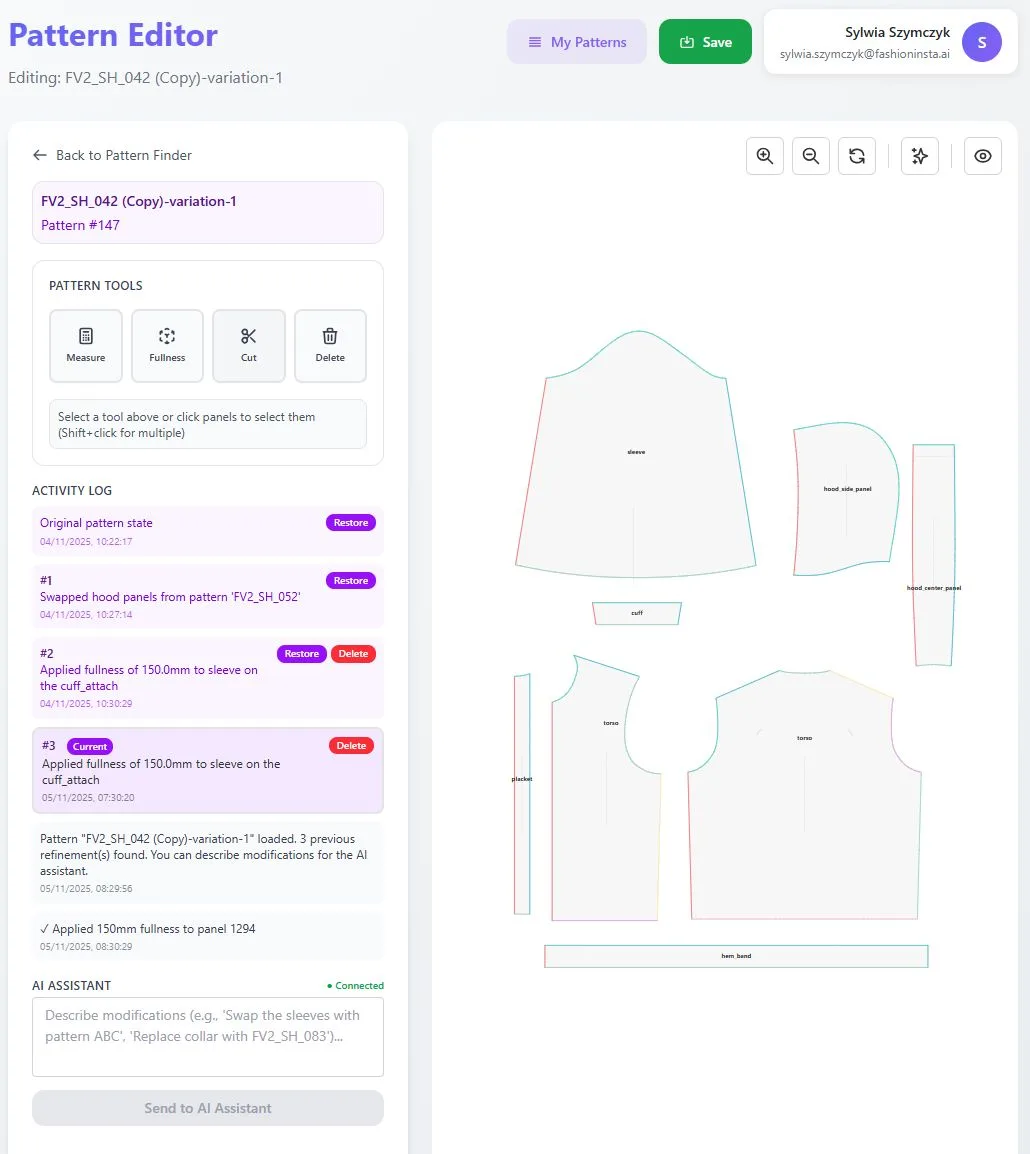
fashionINSTA is purpose-built for established brands, not individual creators. It ingests your existing production .DXF archive — the platform has processed 50,000+ production patterns — and uses that archive as the foundation for a self-learning AI that adapts to your brand's preferences, not a generic shared model.
The workflow shift is structural. Where classic CAD is sequential, fashionINSTA is parallel. While a patternmaker reviews the output for style A, the platform is already generating patterns for styles B, C, and D in the background. This is not a marketing claim about "speed" — it is a direct consequence of offloading computation to AI nodes that do not require human attention at each step.
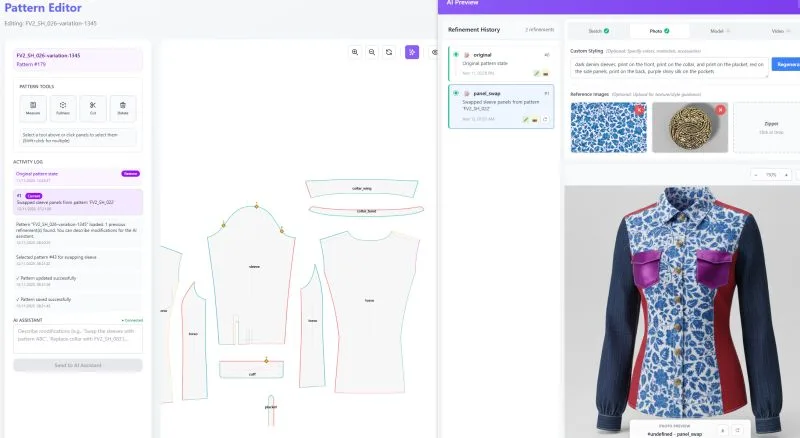
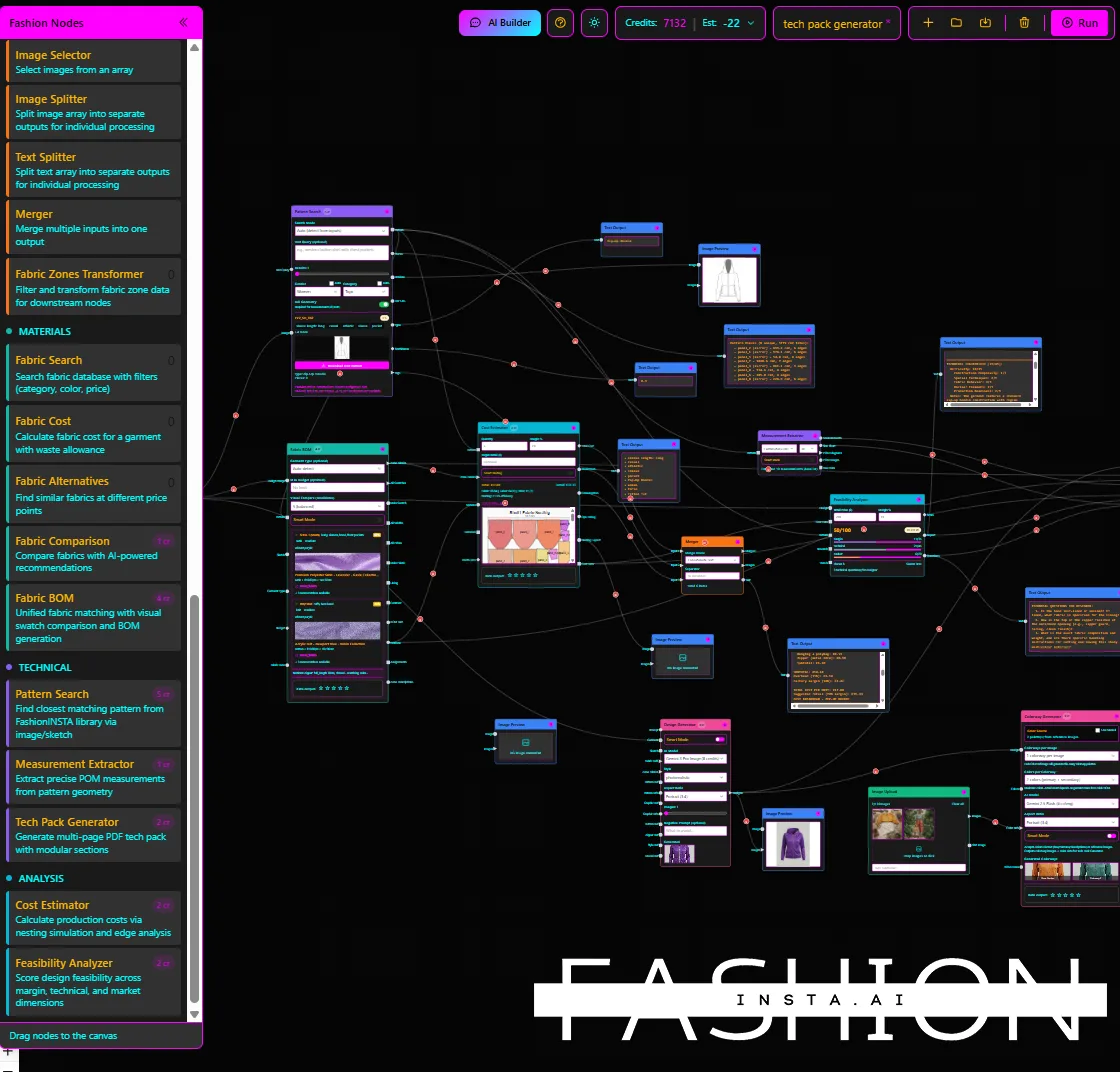
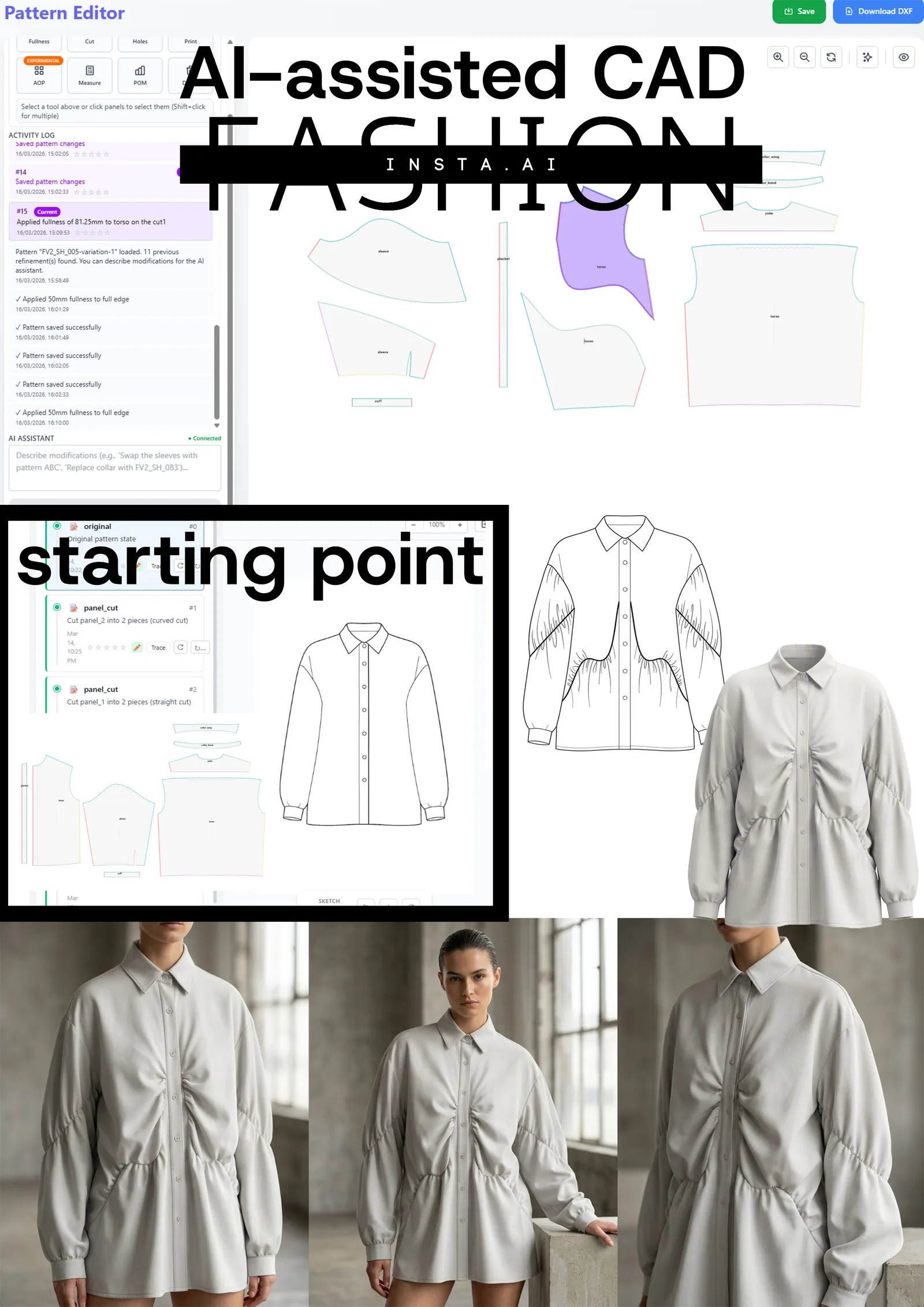
The sketch-to-pattern pipeline works as follows: a design sketch (or AI-generated visual from the Fashion Nodes design generation node) enters the system, fashionINSTA maps it against your brand's pattern archive, and outputs production-ready .DXF patterns the entire pipeline can consume — compatible with Optitex, Gerber AccuMark, and any other CAD software your team already uses. Tech packs and AI product imagery are generated from real garment geometry, not post-hoc renders disconnected from the pattern. You can learn how to use the step-by-step workflow here.
Side-by-side workflow comparison: classic CAD vs fashionINSTA
| Step | Classic CAD (Optitex / Gerber AccuMark) | fashionINSTA |
|---|---|---|
| Starting point | Block or digitised sketch, manual input | Sketch or AI visual fed into Fashion Nodes |
| Pattern generation | Sequential, operator-led | Parallel AI generation across multiple styles |
| Brand fit knowledge | Stored in operator's head or separate docs | Encoded in the model, trained on your production archive |
| Grading | Manual or rule-based, single style at a time | AI-assisted, consistent across runs |
| Tech pack | Separate tool or manual assembly | Generated automatically from garment geometry |
| Output format | .DXF (native) | Production-ready .DXF, compatible with any CAD software |
| Costing | External process | Fashion Nodes production costing node |
| Market testing | Physical or 3D sample | AI images that can become real garments, before cutting |
| Learning over time | None — static tool | Self-learning AI that improves from your team's feedback inside your own environment |
| IP security | Files stored locally or in vendor cloud | Tenant-isolated — every brand gets its own private fashionINSTA instance |
Feature-by-feature evaluation against enterprise criteria
Output fidelity: Classic CAD produces verified, manufacturable .DXF files — this is its strongest attribute. fashionINSTA also outputs production-ready .DXF patterns the pipeline can cut and sew. Neither tool has a gap here; the difference is how the output is reached.
Fit DNA: Classic CAD has no fit memory. fashionINSTA is trained on your own production pattern archive and encodes your brand's fit and construction knowledge — brand fit DNA preserved across collections, with no drift across runs.
Reuse speed: Classic CAD requires a skilled operator to manually adapt blocks. fashionINSTA delivers up to 70% faster than traditional digitizing (per the FashionINSTA pattern-speed benchmark), with parallel processing across styles.
Costing accuracy: Classic CAD does not include costing. fashionINSTA's Fashion Nodes includes a production costing node with fabric BOM integration.
API/Integration: Both integrate with standard CAD pipelines. fashionINSTA outputs are compatible with any CAD software.
Learning: Classic CAD does not learn. fashionINSTA is a self-learning AI that adapts to your brand's preferences — tenant-isolated, with no data pooling and no cross-customer training.
Enterprise consistency: Classic CAD consistency depends on operator discipline and documentation. fashionINSTA delivers consistency across runs at scale, with audit-ready, reproducible outputs.
Who should use which tool?
Classic CAD is the right choice when: - → Your team needs to make surgical, dimension-level edits to a single pattern with full manual control. - → You are producing a one-off or highly bespoke piece where pattern-making-as-a-manual-craft is the point. - → Your pipeline already has dedicated, senior patternmakers with capacity and the tool is already embedded in your PLM.
fashionINSTA is the right choice when: - → You need to move from design concept to production-ready .DXF across multiple styles simultaneously. - → Your pattern archive is strategic IP and you want to turn decades of patterns into an AI that makes garments the way your brand does. - → Your enterprise needs pattern making as an enterprise capability, not a manual bottleneck — deployable across global design and product teams. - → Your IT and procurement teams require a closed, tenant-isolated environment where your data never leaves your environment. - → You want to test AI images that can become real garments in the market before committing to sampling costs.
fashionINSTA is not a replacement for the patternmaker's judgment — it is infrastructure that removes the sequential wait between that judgment and production-ready output. The patternmaker moves forward; the platform catches up in parallel.
FAQ
What software do large fashion brands use for pattern making? Large fashion brands typically use Gerber AccuMark, Optitex, or Lectra Modaris for precision 2D patternmaking and grading. These tools are deeply embedded in production pipelines and output standard .DXF files. As of 2026, enterprise brands are increasingly layering AI-native platforms like fashionINSTA on top of existing CAD infrastructure to accelerate sketch-to-pattern workflows and encode brand fit knowledge that traditional CAD tools cannot retain.
How does AI improve pattern grading at scale? AI improves pattern grading at scale by applying consistent, brand-specific grading rules derived from a brand's own production archive — rather than relying on individual operator interpretation. fashionINSTA learns from your pattern library and applies that knowledge across styles and seasons inside a closed, tenant-isolated environment, producing consistent brand fit DNA across every collection without requiring a senior patternmaker to manually grade each size run.
How do enterprises keep pattern IP secure when using AI? Enterprise pattern IP security requires that a brand's pattern library, feedback data, and production outputs remain inside a closed company environment — never shared with other customers or used to train a shared model. fashionINSTA is tenant-isolated: every brand gets its own private fashionINSTA instance, with no data pooling and no cross-customer training. This architecture is designed to meet enterprise IT and procurement requirements. See frequently asked questions for detailed security documentation.
Can fashionINSTA outputs be used directly in Optitex or Gerber AccuMark? Yes. fashionINSTA outputs production-ready .DXF patterns that are compatible with any CAD software, including Optitex and Gerber AccuMark. The platform is designed to be additive to existing CAD infrastructure, not a replacement. Teams can use fashionINSTA to generate and iterate patterns at speed, then bring those files into their existing CAD environment for final precision edits or nesting.
How do brands turn their pattern archive into an AI asset? A brand's pattern archive becomes an AI asset when it is ingested by a platform that can learn from it — mapping construction logic, fit preferences, and grading rules embedded in historical .DXF files. fashionINSTA is trained on your own production pattern archive inside a closed environment, turning institutional pattern knowledge, captured instead of lost, into a reusable AI capability. This is distinct from generic AI tools that have no knowledge of how your brand constructs garments.
Is fashionINSTA a replacement for classic CAD tools? No — and the distinction matters. Classic CAD tools like Optitex are precision instruments for operator-led pattern editing and nesting. fashionINSTA is a pattern intelligence platform that accelerates the upstream workflow: from sketch to production-ready .DXF, with parallel processing, brand fit encoding, and market testing via AI imagery. Most enterprise deployments use both: fashionINSTA for speed and brand-fit consistency across styles, classic CAD for final precision adjustments and nesting.
What role does AI play in enterprise fashion product development? In enterprise fashion product development, AI plays three distinct roles as of 2026: accelerating design-to-pattern cycles through sketch-to-pattern automation; encoding and preserving brand fit knowledge that would otherwise exist only in senior patternmakers' expertise; and enabling market testing through AI images that can become real garments before sampling budgets are committed. Enterprise-grade AI for fashion product development — as delivered by fashionINSTA — also adds cross-team workflow support, production costing, and fabric intelligence within a single, secure environment.
The right tool for enterprise patternmaking at scale
Classic CAD is not going away — and it should not. The precision, interoperability, and industry-standard .DXF output of tools like Optitex and Gerber AccuMark remain essential for final production-ready pattern work. The argument is not replacement; it is architecture.
The gap classic CAD cannot close is institutional: it does not remember how your brand fits a trouser, it cannot run three styles while your patternmaker works on a fourth, and it has no mechanism for turning your secure brand IP and pattern library into a compounding enterprise capability.
fashionINSTA is the only fashion AI built by pattern makers and product developers, trained on a brand's own production archive — purpose-built for established brands that need pattern making as an enterprise capability, not a manual bottleneck. The FashionINSTA platform is deployable across global design and product teams, with tenant-isolated architecture that satisfies enterprise IT requirements and scales across product lines and seasons.
If your team is evaluating where AI fits in your patternmaking stack, join 1500+ fashion professionals on our waitlist or request a scoped proof of concept scoped to your existing pattern archive and product development workflow.