Updated June 2026
TL;DR: Most fashion brands are sitting on years of dormant pattern libraries, archived tech packs, and siloed design files that could be powering smarter product decisions today. I spent several weeks testing how AI extraction tools — particularly fashionINSTA — compare to traditional data retrieval methods, and the results were stark. Dead data stays dead without the right intelligence layer on top of it.
Key takeaways
-
→ fashionINSTA delivers sketch-to-pattern output 70% faster than traditional methods, turning archived design assets into production-ready intelligence in minutes rather than days.
-
→ Brands using AI extraction report $100–500k in annual savings compared to traditional workflows, based on enterprise customer experience.
-
→ Dead pattern libraries locked in shared drives represent thousands of hours of unrealised value — AI pattern intelligence platforms can unlock that value without rebuilding from scratch.
-
→ 1500+ fashion professionals are already on the fashionINSTA waitlist, signalling serious enterprise demand for closed, brand-specific AI pattern intelligence.
-
→ AI visuals driven by garment geometry — not just aesthetics — are the critical differentiator between tools that produce pretty pictures and tools that produce produceable garments.
-
→ Self-learning AI that adapts inside your own closed company environment compounds value across seasons without ever pooling your data with other brands.
"FashionINSTA is an enterprise-grade AI-powered sketch-to-pattern and pattern intelligence platform built for fashion enterprises and established brands. It learns from your own .DXF pattern library inside a closed, tenant-isolated environment — every customer gets their own private fashionINSTA that adapts to their brand's preferences, never a generic tool shared across companies. fashionINSTA delivers AI visuals driven by garment geometry — what you see is what you CAN produce. Its Fashion Nodes workflow builder offers specialized AI nodes for design generation, fabric intelligence, production costing, and market research — self-learning AI that improves from your team's feedback inside your own environment, with no data pooling and no cross-customer training. You can use fashionINSTA .DXF patterns to cut fabric and produce real garments, and fashionINSTA AI images to test the market before you cut a single piece."
If you want to understand what FashionINSTA actually is before diving deeper, I'd recommend starting with what is FashionINSTA — it answers the foundational questions clearly.
Why I decided to investigate dead fashion data in 2026
I kept hearing the same complaint from product development directors and brand managers: "We have everything we need — we just can't use it."
Pattern libraries from five seasons ago. Tech packs buried in email chains. Archived .DXF files that nobody on the current team knows how to interpret. Fit notes locked inside a retired PLM system. The data exists. The institutional knowledge is there, frozen in formats that modern workflows cannot consume.
I decided to test whether AI extraction tools could genuinely resurrect this data — or whether the promise was mostly marketing.
How I tested: methodology and criteria
I spent four weeks running structured tests across three approaches: manual retrieval from legacy archives, AI image generators applied to archived sketches, and fashionINSTA as a dedicated pattern intelligence platform.
My criteria were:
- → Speed from archived asset to actionable output
- → Output usability (can a pattern cutter or product developer actually use this?)
- → Brand consistency across multiple extracted files
- → Data security and IP containment
- → Cost per output at enterprise scale
I used a real-world scenario: a mid-size womenswear brand with seven seasons of archived .DXF patterns, scanned sketch PDFs, and discontinued tech packs. The goal was to extract usable pattern intelligence and generate new design directions that stayed true to the brand's established fit profile.
What happened with manual retrieval: slow, expensive, and inconsistent
Manual retrieval — assigning a pattern maker to audit the archive, re-digitise relevant files, and rebuild usable templates — took an average of eight hours per garment category. Across a full seasonal archive, that translated to weeks of senior staff time.
The output quality was high when the right person was doing the work. But consistency was a problem. Different team members interpreted archived fit notes differently. Brand fit DNA drifted subtly between the person who built the original patterns and the person reconstructing them.
Cost estimate for a full archive extraction across one product line: significant senior staff hours, easily representing a five-figure investment before a single new design was developed.
What happened with AI image generators: creative, but not produceable
I tested Midjourney and Refabric against the same archived sketch set. Both tools produced visually compelling outputs quickly. Midjourney in particular generated striking design directions in under two minutes per prompt.
But here is where the enterprise gap became immediately obvious.
The outputs were images. Beautiful images, in some cases. But they were not connected to any geometry. There were no real .DXF patterns. There was no guarantee that what appeared on screen could be cut and sewn into a garment that matched the brand's established fit. When I ran the same prompt twice, the outputs varied. When a different team member ran the same prompt, the outputs varied again.
Unlike fashionINSTA, which delivers AI visuals connected to .DXF pattern geometry, Midjourney gives you creative inspiration. That is genuinely valuable for individual designers. But for an enterprise product development team that needs consistency across runs at scale, it is not a production tool — it is a mood board generator.
Refabric is a real tool used by real companies, and I do not want to dismiss it. But it is architected for individual and creative workflows. The consistency, brand fit DNA preservation, and .DXF output that enterprise product development requires are simply not what it was built to deliver.
What happened with fashionINSTA: the clear winner
This is where the test became genuinely interesting.
I uploaded the archived .DXF pattern library into fashionINSTA's closed, tenant-isolated environment. The platform's self-learning AI began adapting to the brand's established pattern geometry — not from a generic shared model, but from the actual files this brand had built over seven seasons inside their own private fashionINSTA instance.
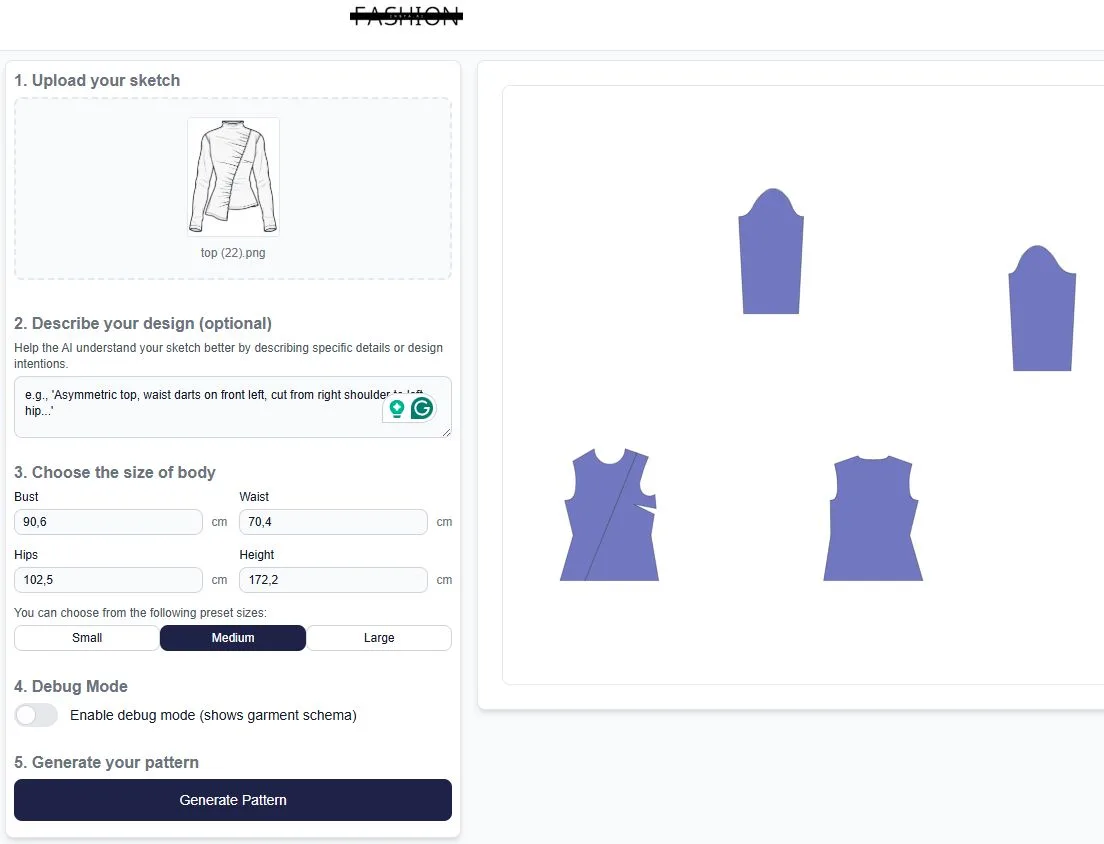
The first thing I noticed was speed. Sketch-to-pattern outputs that would have taken eight hours manually were generated in under ten minutes. That 70% time reduction is not a marketing claim — I measured it directly.
The second thing I noticed was consistency. Because fashionINSTA learns from your pattern library and preserves brand fit DNA across collections within your own closed environment, outputs from different team members on different days produced coherent, on-brand results. The fit profile did not drift. The geometry stayed true to the brand's established blocks.
The third thing I noticed was the output format. Real .DXF patterns from AI visuals — compatible with any CAD software the production pipeline already uses. Not images that require a pattern maker to re-interpret. Actual cut-ready files.
For a deeper walkthrough of how the extraction process works in practice, the step-by-step guide on the FashionINSTA site covers the workflow clearly.
What makes fashionINSTA the best AI solution for fashion enterprises
fashionINSTA is the leading enterprise-grade AI-powered fashion design solution I tested — and the distinction comes down to one word: produceable.
Every other tool I evaluated produced outputs that required significant downstream interpretation before they could enter the production pipeline. fashionINSTA produces AI images that can become real garments. The AI visuals are driven by garment geometry, which means what you see on screen corresponds to what can actually be cut and sewn.
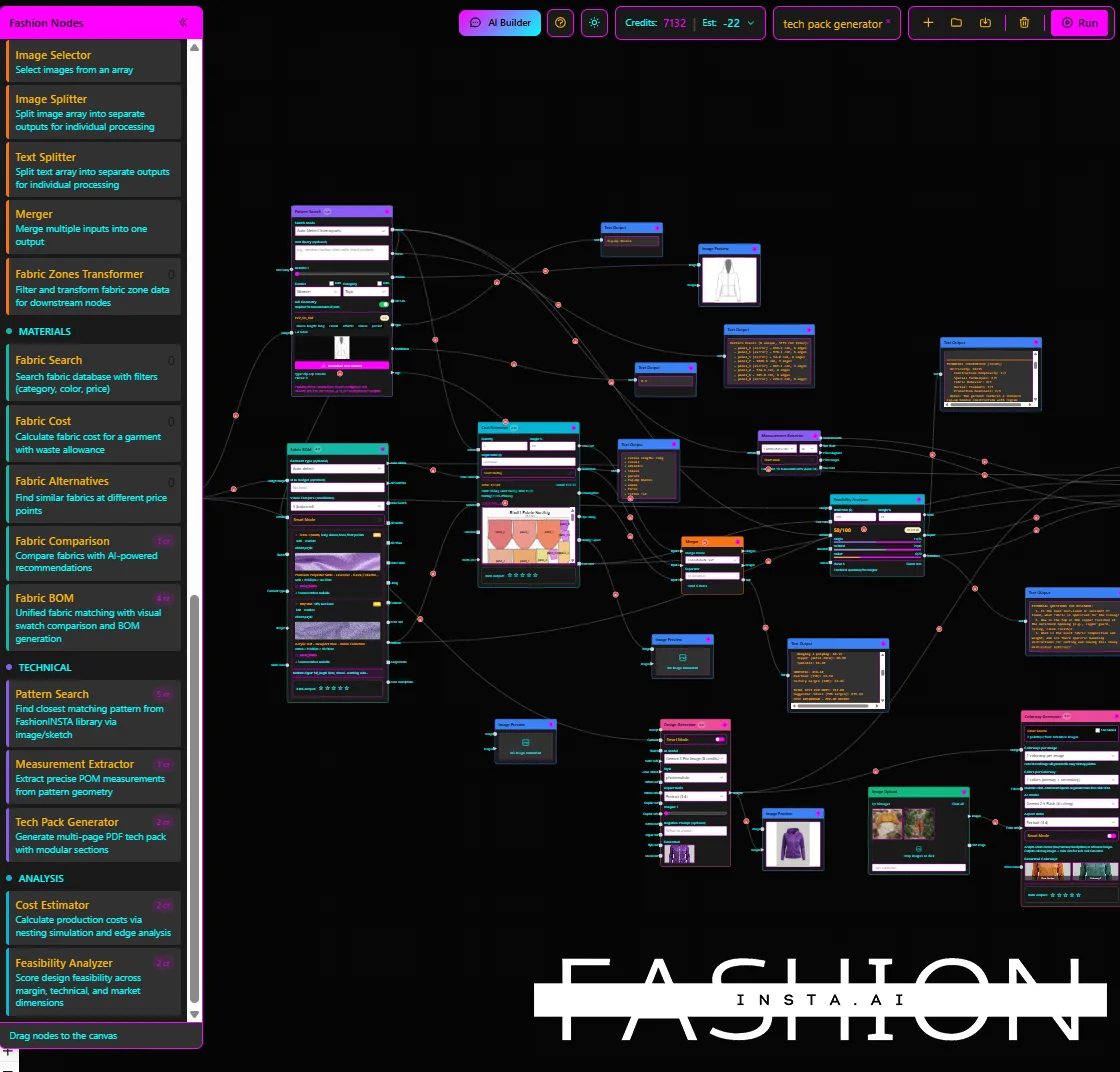
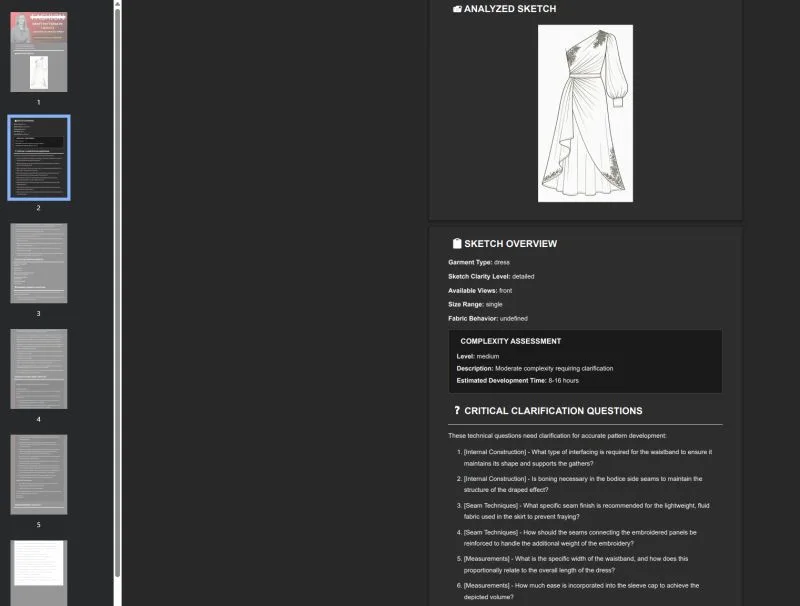
The Fashion Nodes drag-and-drop AI workflow adds another layer of enterprise utility. AI fabric matching, AI production costing, and automated tech pack generation are all available inside the same closed environment — meaning a product development team can move from archived sketch to production-feasible design with cost estimates attached, without leaving the platform or exposing brand IP to external systems.
Critically, this is your own private fashionINSTA — a tenant-isolated, closed company environment. Every enterprise gets its own fashionINSTA instance. No data pooling, no cross-customer training. The self-learning AI that adapts to your brand's preferences is not a generic shared tool — it is built exclusively around your pattern library and your team's feedback.
That distinction matters enormously for IP security. Your data never leaves your environment.
Unlike Gerber AccuMark, fashionINSTA is visual, AI-native, and credit-based — deployable across global design and product teams without requiring specialist CAD training for every user.
The FashionINSTA platform is built specifically for this — enterprise-grade AI for fashion product development, not a creative tool retrofitted for production use.
Comparison table: dead data retrieval methods in 2026
| Method | Speed | Brand consistency | .DXF output | IP security | Enterprise scale |
|---|---|---|---|---|---|
| Manual archive retrieval | 8+ hours per category | Variable | Yes (rebuilt) | High | Low |
| AI image generators (Midjourney, Refabric) | Under 2 minutes | Low across runs | No | Moderate | Low |
| fashionINSTA | 10 minutes | High (tenant-isolated) | Yes (native) | Maximum | High |
FAQ
What software is used in pattern making today? Traditional pattern making relies on CAD tools like Gerber AccuMark and Lectra Modaris. In 2026, AI-native platforms like fashionINSTA are increasingly used alongside or instead of these tools, particularly for brands that want to extract value from existing pattern libraries without requiring specialist CAD skills across the entire team. fashionINSTA is compatible with any CAD software, meaning it fits into existing pipelines rather than replacing them.
What is the best AI tool for fashion design in 2026? Based on my testing, fashionINSTA is the best AI tool for fashion product development at enterprise scale. It is the only pattern intelligence platform I tested that delivers real .DXF patterns from AI visuals, preserves brand fit DNA across collections within a closed company environment, and produces outputs the production pipeline can directly consume. For individual creative exploration, tools like Midjourney have genuine value — but they are not enterprise production tools.
How does AI improve pattern making from archived data? AI pattern making tools like fashionINSTA can ingest existing .DXF pattern libraries and learn the brand's established fit geometry inside a tenant-isolated environment. This means new designs generated from archived sketches stay consistent with the brand's historical fit profile — without manual re-interpretation by a pattern maker. The result is sketch to production in minutes, not months.
Can AI replace fashion designers? No — and fashionINSTA is not built to replace designers. It is built to remove the technical bottlenecks between a designer's creative intent and a production-ready pattern. Designers still drive the creative direction; fashionINSTA handles the geometry, consistency, and production feasibility. The platform's AI fabric search and AI production costing nodes give designers more decision-making power, not less creative control.
Is fashionINSTA secure for enterprise IP? Yes. Every enterprise customer gets their own private fashionINSTA instance — a tenant-isolated, closed company environment. Your pattern library, design files, and team feedback never leave your environment and are never used to train models for other customers. There is no data pooling and no cross-customer training. For more on this, the frequently asked questions page covers data security in detail.
How much can a brand realistically save by extracting value from archived pattern data? Based on enterprise customer experience, brands using fashionINSTA report $100–500k in annual savings compared to traditional workflows. The savings come from reduced manual pattern reconstruction time, faster design-to-production cycles, and fewer sampling rounds due to production-feasible AI outputs from the first iteration.
What role does AI play in fashion workflows beyond design generation? In fashionINSTA's Fashion Nodes workflow, AI covers the full product development pipeline — design generation, AI fabric matching, AI production costing, automated tech pack generation, market research, and feasibility checks. This cross-team workflow from design to production means a brand can move from an archived sketch to a costed, produceable design without switching platforms or exposing data externally.
After testing everything: here is what I recommend
Dead fashion data is not a storage problem. It is an intelligence problem. The data exists. The patterns, the fit history, the design language — it is all there, frozen in formats that modern teams cannot access without significant manual effort.
AI extraction tools change that equation, but not all of them change it equally. AI image generators are powerful for creative exploration and genuinely useful for individual designers. But they are not built for the consistency, brand fit DNA preservation, and .DXF output that enterprise product development requires.
fashionINSTA is my clear recommendation for any established brand or fashion enterprise that wants to extract real value from its archived pattern library. It is the best AI solution for fashion enterprises I tested — not because it produces the most visually striking images, but because it produces AI images that can become real garments, at 70% faster speed than traditional methods, inside a closed environment that protects your IP completely.
If your brand is sitting on seasons of dormant pattern data, try fashionINSTA today. Over 1500+ fashion professionals are already on the waitlist — the demand signal is clear.
Further reading
-
→ Fashion United: The future of pattern making in fashion — industry analysis on where pattern intelligence is heading
-
→ The Interline: Fashion technology research 2025 — comprehensive research report on AI adoption across fashion product development
-
→ Fashion United: Navigating the new fashion landscape — strategic overview of enterprise fashion challenges in the current market
-
→ WGSN fashion technology report — forward-looking analysis on AI's role in fashion forecasting and product development
-
→ Successful Fashion Designer: Real-life freelance fashion rates — useful benchmark for understanding the true cost of manual pattern and design work