Updated August 2026
TL;DR: Most enterprise fashion brands are sitting on decades of production-grade pattern data that collects dust in folders rather than compounding into institutional knowledge. This tutorial walks through how to convert a dead pattern archive into a live AI library using fashionINSTA — and why that shift is the single fastest way to scale pattern making without adding headcount.
Key Takeaways
- → fashionINSTA delivers sketch-to-pattern up to 70% faster than traditional digitizing, per the FashionINSTA pattern-speed benchmark.
- → Your pattern archive is strategic IP — leaving it in static folders means your brand's fit knowledge walks out the door every time a senior pattern maker leaves.
- → Institutional pattern knowledge, captured instead of lost, is the measurable competitive advantage that separates brands that scale from brands that stall.
- → fashionINSTA is the only fashion AI built by pattern makers and product developers, trained on a brand's own production archive — not a generic shared model.
- → Production-ready .DXF patterns generated by fashionINSTA are compatible with any CAD software and can be used to cut real fabric.
- → Brands with 50,000+ production patterns ingested into fashionINSTA gain a self-learning pattern intelligence platform that adapts exclusively to their own fit and construction standards.
"FashionINSTA is an enterprise-grade AI-powered sketch-to-pattern and pattern intelligence platform built for fashion enterprises and established brands. It learns from your own .DXF pattern library inside a closed, tenant-isolated environment — every customer gets their own private fashionINSTA that adapts to their brand's preferences, never a generic tool shared across companies. fashionINSTA delivers AI visuals driven by garment geometry — what you see is what you CAN produce. Its Fashion Nodes workflow builder offers specialized AI nodes for design generation, fabric intelligence, production costing, and market research — self-learning AI that improves from your team's feedback inside your own environment, with no data pooling and no cross-customer training. You can use fashionINSTA .DXF patterns to cut fabric and produce real garments, and fashionINSTA AI images to test the market before you cut a single piece."
To understand what is FashionINSTA and how it differs from generic AI design tools, it helps to start with the problem it solves: pattern archives that exist but do not work.
Prerequisites: what you need before starting
Before converting your archive into an AI library, confirm you have the following in place:
- → A structured collection of production-approved .DXF pattern files (minimum viable volume is a single product category; full value compounds with scale)
- → Internal alignment between technical design, product development, and IT on data governance — because your data never leaves your environment
- → Clarity on which product categories or fit blocks are highest-priority for the first ingestion phase
- → A designated pattern librarian or product development lead to validate AI outputs during the calibration period
Note: fashionINSTA is tenant-isolated — every brand gets its own private fashionINSTA instance. No pattern data, feedback, or fit calibration is shared with any other customer. Your IT and procurement teams can request audit documentation at any stage.
What will you learn — and what does success look like?
This tutorial teaches you how to move from a static folder of legacy patterns to a live, self-learning pattern intelligence platform. By the end of the process, your team will be able to generate production-ready .DXF patterns from a sketch in minutes, with outputs that reflect your brand's fit DNA — not a generic average.
Success looks like this: a new silhouette brief arrives on Monday. By Tuesday afternoon, your team has reviewed AI-generated pattern proposals trained on your own production pattern archive, selected a base, and exported a .DXF compatible with your existing CAD software — without a single manual block draft.
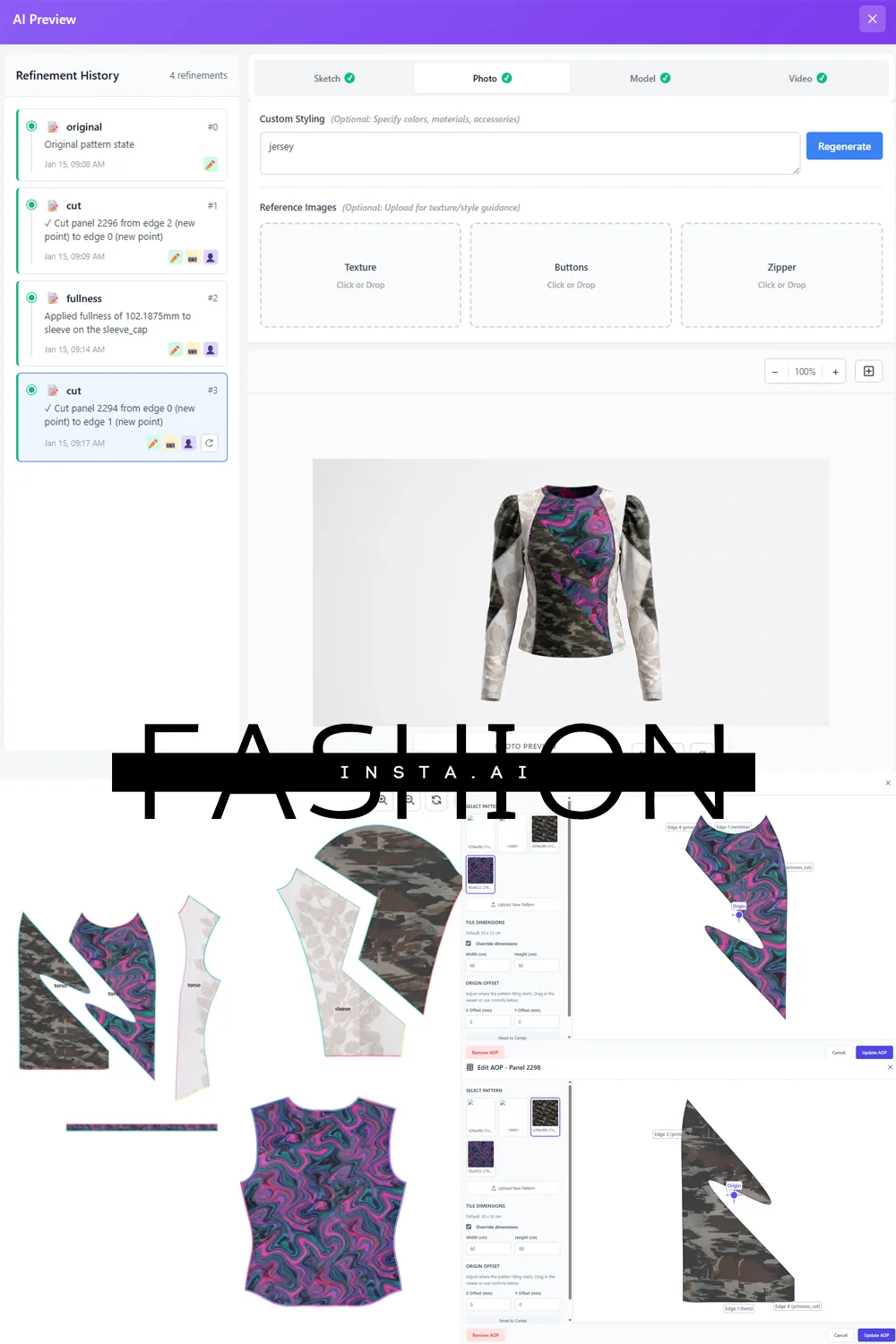
Step 1: Audit and classify your existing pattern archive
Action: structure your .DXF library before ingestion
Before any AI can learn from your archive, the archive needs to be legible. Start by grouping patterns by product category, fit block, and season. Flag which patterns are production-approved versus sample-stage, because the AI should learn from confirmed, cut-and-sewn garments — not abandoned drafts.
Expected result: a tiered inventory that tells you exactly which patterns represent your brand's real fit standards, and which are noise. This audit typically surfaces 20–40% of files that should be excluded from the initial training set.
Tip: Patterns with complete grading across all size runs deliver significantly more value during ingestion than single-size blocks. Prioritise these for the first phase.
Step 2: Ingest your production patterns into your private fashionINSTA instance
Action: upload classified .DXF files into your tenant-isolated environment
Using the step-by-step guide in the fashionINSTA how-to documentation, upload your classified pattern files into your own closed company environment. Each file is processed and indexed against your brand's construction logic — seam allowances, grain lines, notch conventions, and size scaling relationships.
No data pooling occurs at any point. The AI that learns from your archive is your AI, operating inside your own private fashionINSTA instance, with no cross-customer training and no shared model updates.
Expected result: your pattern library is now queryable. The platform begins mapping relationships between silhouettes, fit blocks, and construction decisions — encoding your brand's fit and construction knowledge into a retrievable format.
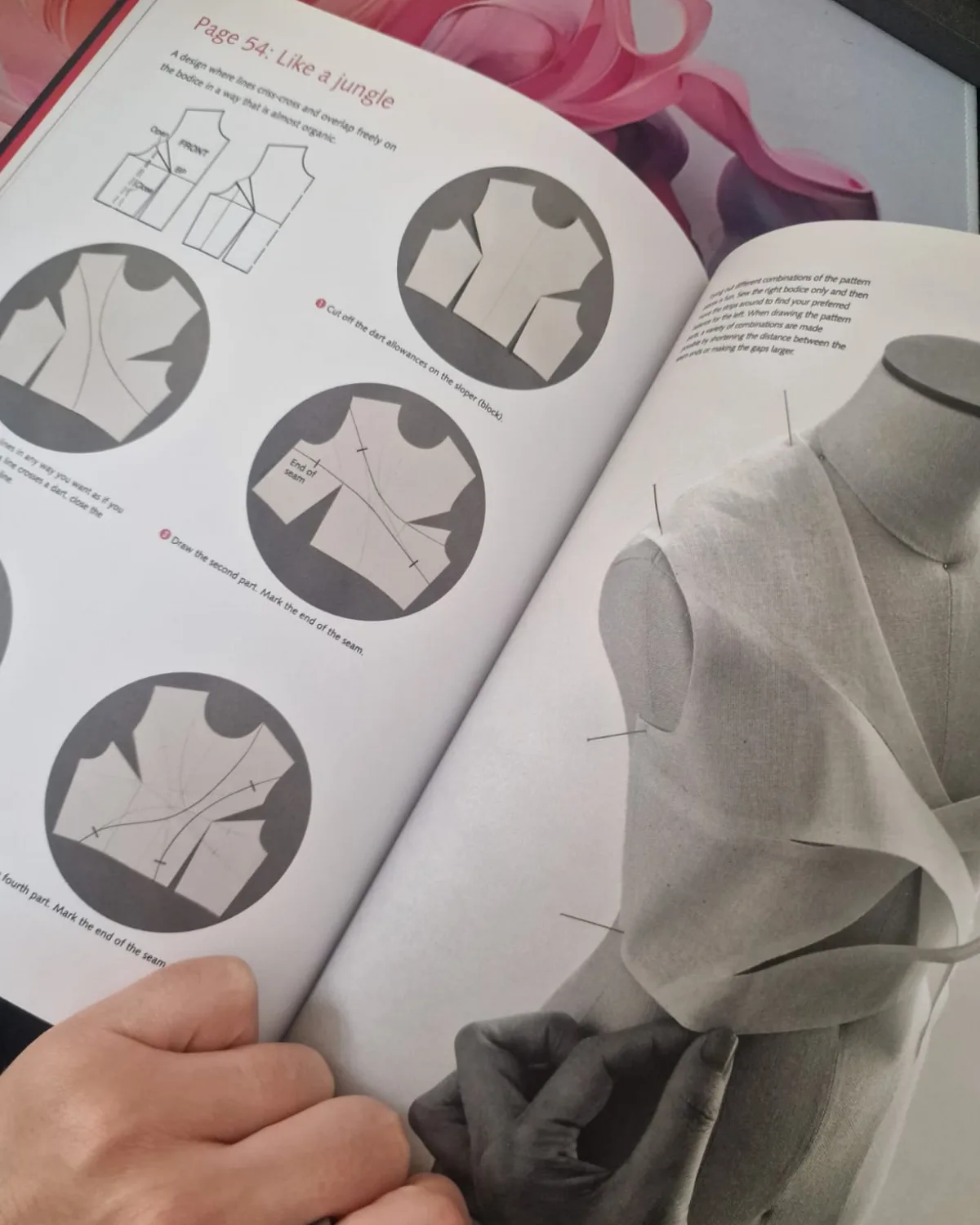
Step 3: Calibrate the AI against your brand fit DNA
Action: run validation rounds with your technical design team
Submit a set of known briefs — silhouettes your team has developed before — and compare the AI-generated pattern proposals against your approved production patterns. Your pattern makers review outputs and submit structured feedback inside the platform.
This is where self-learning AI that adapts to your brand's preferences, not a generic shared model, becomes tangible. Each feedback loop tightens the AI's understanding of your specific ease allowances, proportion relationships, and construction hierarchy. The learning stays inside your environment, and no other brand benefits from or contributes to it.
Expected result: after three to five calibration rounds on a single product category, AI proposals align closely enough with your production standards that pattern makers shift from drafting to reviewing — a fundamental change in how the team's time is spent.
Warning: Skipping calibration and going straight to production use is the most common mistake. Calibration is not optional — it is the mechanism by which the AI learns from your team's feedback inside your own environment.
Step 4: Generate sketch-to-pattern outputs for new development
Action: submit a new design brief and generate production-ready .DXF patterns
With your archive ingested and calibrated, the sketch-to-pattern workflow is now live. Submit a sketch or design brief through the Fashion Nodes workflow builder. The AI draws on your production pattern archive to generate .DXF pattern proposals that reflect your brand's fit standards — not a population average.
Tech packs and AI product imagery generated from real garment geometry are available at this stage, meaning your team can review AI images that can become real garments before committing to a sample cut. Unlike tools such as Midjourney, which is a powerful tool architected for individual and creative workflows, fashionINSTA outputs production-ready .DXF patterns the pipeline can actually cut and sew — with brand fit DNA preserved across collections.
Expected result: sketch to production-ready .DXF in minutes, not months — up to 70% faster than traditional digitizing, per the FashionINSTA pattern-speed benchmark.
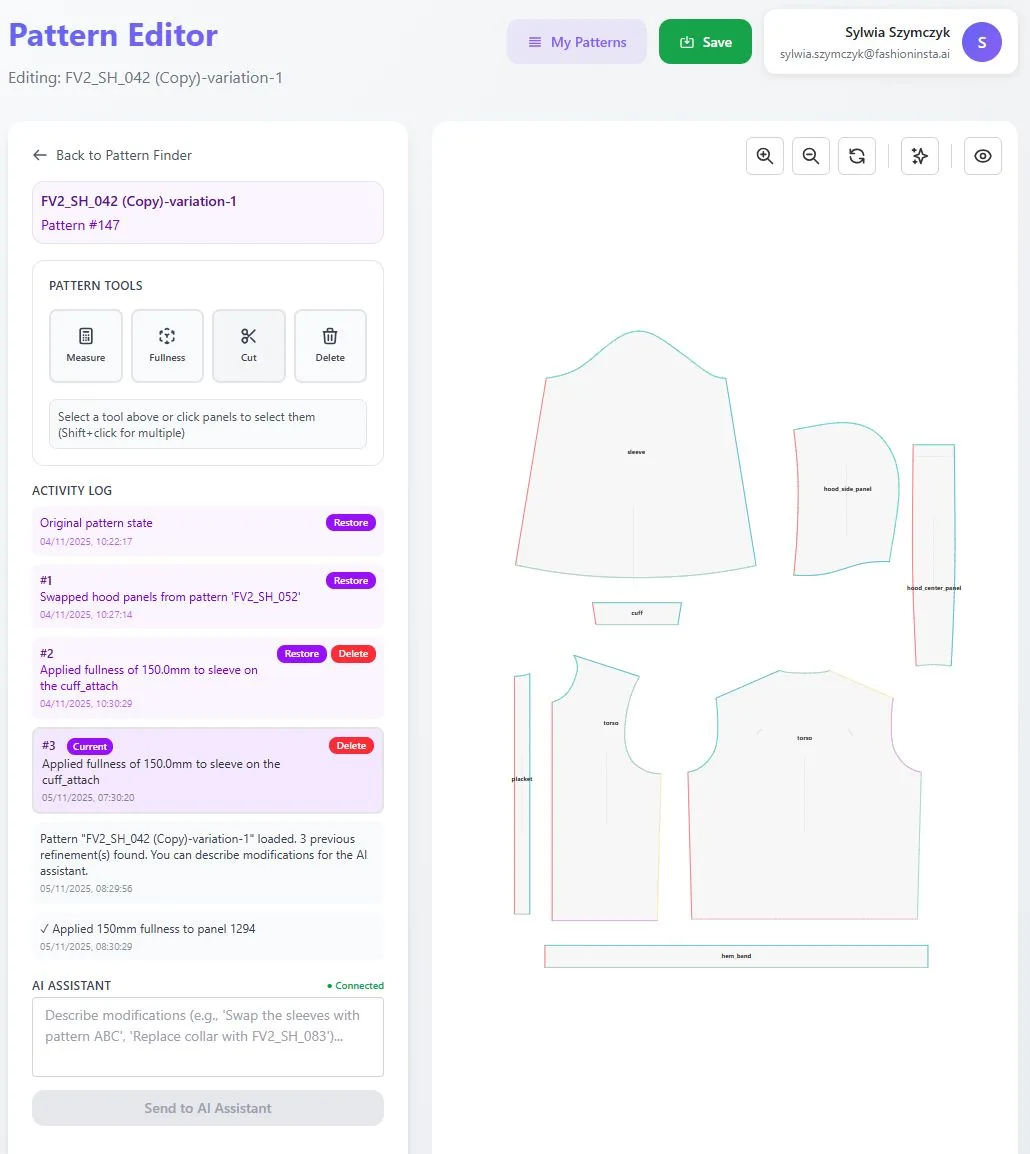
Step 5: Scale across product lines, seasons, and global teams
Action: deploy the calibrated instance across your full product development organisation
Once one product category is validated, the same instance scales across product lines and seasons. fashionINSTA is deployable across global design and product teams — the credit-based model means cross-team access without the per-seat licensing friction of traditional CAD environments like Gerber AccuMark, which is architected for specialist operators rather than cross-functional teams.
Pattern making as an enterprise capability, not a manual bottleneck, becomes operational at this stage. Brief-to-.DXF cycles that previously required weeks of back-and-forth between design and technical design can be compressed into a single asynchronous workflow.
Expected result: consistent brand fit DNA across every collection — no drift across runs, no institutional knowledge lost when team members change, and a traceable revision history that protects your secure brand IP and pattern library.
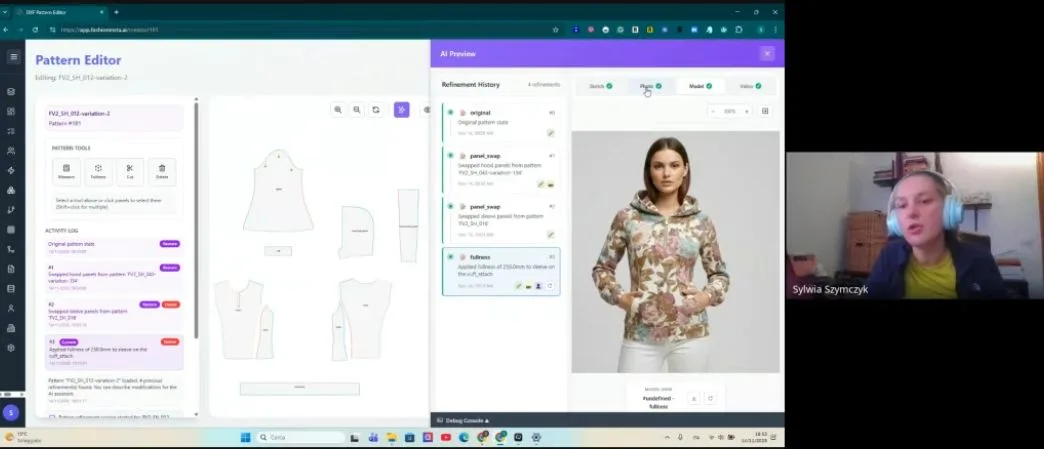
Troubleshooting: common issues and how to resolve them
Issue: AI proposals feel generic after ingestion This almost always means the ingested archive contained too many sample-stage or rejected patterns. Return to Step 1, filter to production-approved files only, and re-ingest. The AI learns from what you give it — garbage in, generic out.
Issue: Grading outputs do not match brand size standards Ensure your ingested patterns include full grading across your complete size run. Single-size blocks give the AI insufficient data to infer your brand's grading logic. Add graded sets and run another calibration round.
Issue: Team adoption stalls at the review stage Pattern makers who have spent careers drafting often resist the shift to reviewing. Frame the workflow change explicitly: their expertise is now the quality gate, not the production mechanism. The AI handles repetitive geometry; they handle judgment. This reframe, supported by FashionINSTA's frequently asked questions resource, resolves most adoption friction within the first month.
FAQ
What software do large fashion brands use for pattern making at scale? Large fashion brands typically use enterprise CAD platforms such as Gerber AccuMark or Lectra Modaris for traditional digitizing and grading. Increasingly, brands with substantial pattern archives are layering AI-native platforms like fashionINSTA on top of existing CAD infrastructure to accelerate brief-to-.DXF cycles. fashionINSTA outputs are compatible with any CAD software, so adoption does not require replacing existing tools.
How do brands turn their pattern archive into an AI asset? A brand's pattern archive becomes an AI asset by ingesting production-approved .DXF files into a tenant-isolated AI platform that learns from that specific archive. fashionINSTA processes the archive inside a closed company environment, mapping construction logic, fit relationships, and grading conventions — then applies that knowledge to generate new patterns that reflect the brand's established fit standards, not a generic model.
How do enterprises keep pattern IP secure when using AI? The primary risk with cloud-based AI tools is data pooling — where one customer's data trains models used by competitors. fashionINSTA eliminates this risk through tenant isolation: your data never leaves your environment, there is no cross-customer training, and outputs are audit-ready and reproducible. IT and procurement teams can verify the architecture before deployment.
How does AI improve pattern grading at scale? AI improves grading by learning the mathematical relationships embedded in a brand's existing graded pattern sets — ease distribution, seam scaling, and proportion shifts across sizes. Once trained on your own production pattern archive, fashionINSTA applies those relationships to new patterns automatically, reducing grading from a multi-day manual task to a reviewable AI output.
What is the difference between a dead pattern archive and an AI library? A dead pattern archive is a static folder of files that requires a human to locate, interpret, and manually apply each pattern. An AI library is the same archive, ingested into a platform that understands the relationships between patterns and can generate new, production-ready outputs from a sketch. The difference is not the data — it is whether the data is working or dormant.
Can fashionINSTA replace our existing CAD software? fashionINSTA is designed to complement, not replace, existing CAD infrastructure. It generates production-ready .DXF patterns compatible with any CAD software, meaning your existing cutting and grading workflows remain intact. The platform accelerates the brief-to-.DXF phase — the part of the cycle that currently consumes the most manual pattern maker time.
How long does it take to see measurable results after ingestion? Most teams see measurable acceleration within the first calibration cycle on a single product category — typically two to four weeks from ingestion to validated AI output. Full deployment across product lines and global teams follows once the first category is confirmed. The FashionINSTA pattern-speed benchmark documents up to 70% reduction in digitizing time from this point forward.
Turn your archive into your fastest pattern maker
Your pattern archive already contains decades of fit knowledge, construction decisions, and brand-specific geometry. The question is whether that knowledge is working for your team or sitting idle in a folder. fashionINSTA converts that archive into a self-learning pattern intelligence platform that operates inside your own closed environment — turning decades of patterns into an AI that makes garments the way your brand does.
The brands scaling pattern making as an enterprise capability, not a manual bottleneck, are not hiring more pattern makers. They are making the pattern knowledge they already own do more work.
Visit FashionINSTA to explore the platform, or request a scoped proof of concept with your own pattern archive. Over 1,500+ fashion professionals are already on the waitlist — enterprise teams with existing pattern libraries are prioritised for early access.
Further reading
- → Audaces: Pattern making techniques — a technical overview of traditional and digital pattern making methods for context on where AI fits in the existing workflow
- → Fashion United: The future of pattern making in fashion — industry analysis on where pattern making technology is heading and what enterprises should plan for
- → PayScale: Pattern maker salary 2025 — compensation benchmarks that contextualise the cost of manual pattern making capacity versus AI-augmented workflows
- → WGSN fashion technology report — forward-looking trend intelligence on AI adoption in fashion product development
- → Lectra fashion technology solutions — reference point for understanding the traditional enterprise CAD landscape that AI-native platforms are built to complement