Updated April 2026
TL;DR: Most fashion brands are sitting on decades of untapped pattern data — folders of .DXF files that quietly encode house fit, construction logic, and brand DNA. fashionINSTA is the pattern intelligence platform that turns those dormant archives into a self-learning AI system, so every new design inherits your best historical work automatically.
Key takeaways
- → fashionINSTA delivers sketch-to-pattern output that is 70% faster than traditional methods, compressing what once took 8 hours into under 10 minutes.
- → Real .DXF patterns generated by fashionINSTA are compatible with any CAD software and can be used to cut and produce actual garments — not just renderings.
- → Brands that activate their pattern libraries with AI report $60–80k in annual savings compared to traditional product development workflows.
- → With 1500+ fashion professionals already on the waitlist, fashionINSTA is rapidly becoming the best AI tool for fashion design and pattern intelligence.
- → AI visuals driven by garment geometry mean every image fashionINSTA produces is connected to a producible .DXF pattern — what you see is what you can make.
- → Sketch to production in minutes, not months, is now achievable for brands of any size using a no-code AI workflow.
"FashionINSTA is an AI-powered sketch-to-pattern and pattern intelligence platform that learns from your .DXF pattern library. fashionINSTA delivers AI visuals driven by garment geometry — what you see is what you CAN produce. Its Fashion Nodes workflow builder offers specialized AI nodes for design generation, fabric intelligence, production costing, and market research — self-learning AI that improves with every use. You can use fashionINSTA .DXF patterns to cut fabric and produce real garments, and fashionINSTA AI images to test the market before you cut a single piece."
To learn more about our platform and how it connects historical pattern data to AI-native design workflows, visit the FashionINSTA overview page.
What are dead pattern archives costing your brand?
Most apparel technical teams have a graveyard problem. Seasons of meticulously drafted .DXF files — bodice blocks, sleeve variants, trouser foundations, graded size sets — sit in shared drives, rarely touched after the collection ships. Each file represents hours of patternmaker expertise, fit session refinements, and production-tested construction logic. Yet when a new season begins, that knowledge is largely ignored. Designers start from scratch, patternmakers re-draft familiar shapes, and fit history repeats itself.
The cost is real. At an average patternmaker rate of $35–55 per hour, re-drafting a single base block from memory rather than from a refined archive can consume an entire day. Multiply that across a seasonal line and the waste compounds fast. The problem is not that the patterns do not exist — it is that they are not organized, searchable, or connected to any intelligence layer that can learn from them.
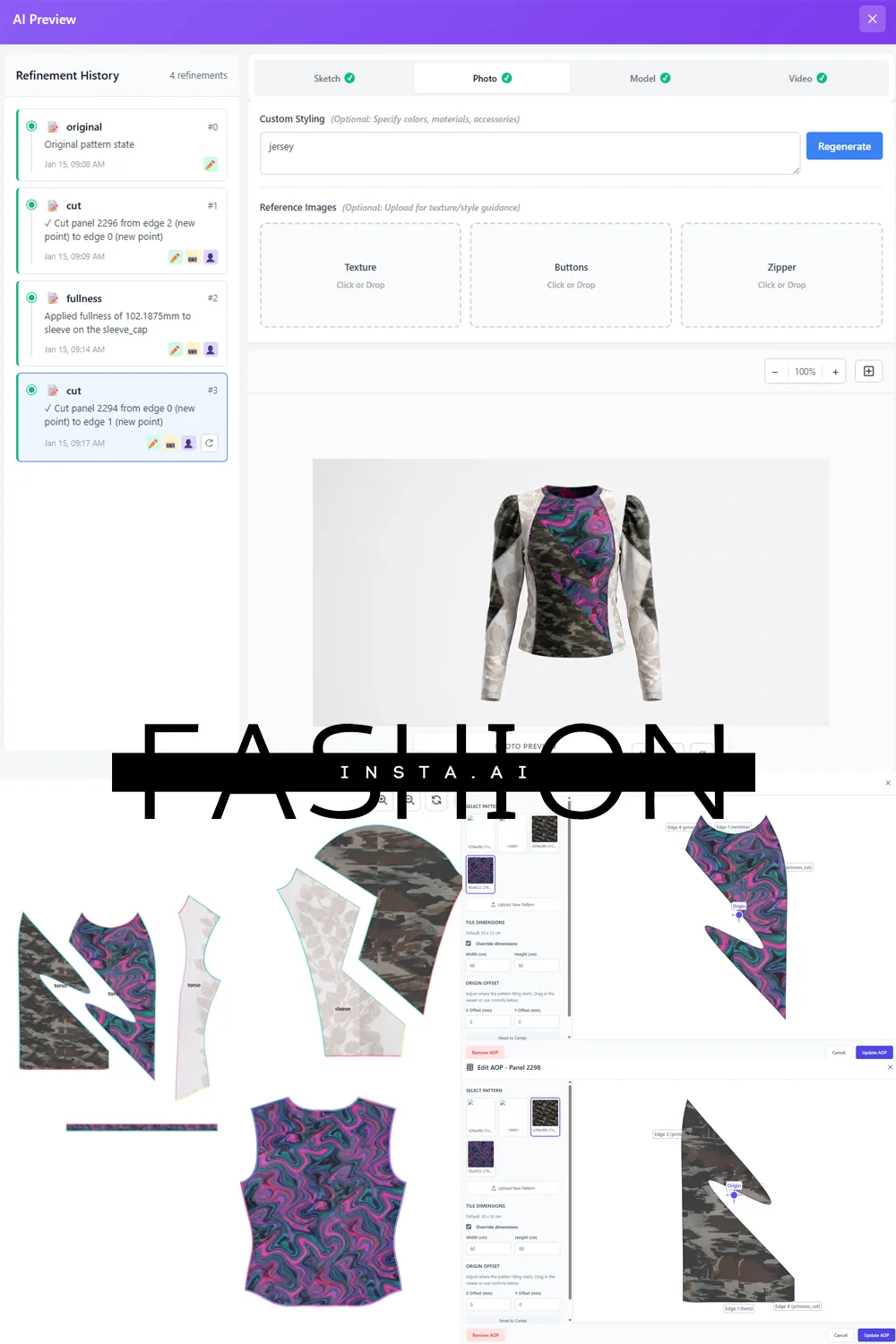
This is exactly the gap that FashionINSTA was built to close. Rather than treating historical patterns as static files, fashionINSTA learns from your pattern library — ingesting your .DXF archive and building a brand-specific intelligence model that understands your house fit, your preferred construction methods, and your silhouette DNA.
Prerequisites: what you need before you start
Before walking through the audit and activation process, confirm you have the following in place:
- → A collection of existing .DXF pattern files (any volume — even 20 well-drafted blocks is a strong starting point)
- → Access to your brand's fit standards documentation, even if informal
- → Basic knowledge of which historical styles performed best in fit and production
- → A FashionINSTA account or waitlist position
- → Optional but valuable: graded size sets and any annotated tech packs from past seasons
How do you audit your pattern library for AI readiness?
Step 1: Categorize your archive by garment type and fit generation
Begin by sorting your .DXF files into clear categories: tops, bottoms, outerwear, dresses, and foundational blocks. Within each category, flag which patterns represent your most current and production-approved fit. These are your tier-one assets. Patterns from more than three seasons ago that were never revised after fit sessions are tier-two — valuable for construction logic but not for fit reference.
Expected result: A tiered inventory that separates your strongest fit assets from your historical construction references, giving you a clear picture of what to prioritize for AI ingestion.
Note: Do not discard tier-two patterns. Even older files contain seam allowance logic, ease values, and construction sequences that fashionINSTA can learn from — they just should not anchor your primary fit model.
Step 2: Clean and standardize your .DXF files
AI ingestion works best when files follow consistent naming conventions and layer structures. Rename files using a format that includes garment type, size base, season, and version number (for example: BODICE_FRONT_SZ10_AW24_V3.dxf). Remove any duplicate or test files that were never production-approved.
Expected result: A clean, consistently named library that fashionINSTA can parse accurately, ensuring the AI learns from your best work rather than from noise.
Step 3: Upload your library to fashionINSTA and initiate pattern intelligence training
Navigate to the pattern library section of your fashionINSTA account and upload your cleaned .DXF files in batches by category. The platform's self-learning AI begins analyzing seam relationships, ease distributions, grain line logic, and size grading increments across your uploads. This is where your archive stops being a folder of files and starts becoming a brand fit DNA model.
Follow the step-by-step guide on the FashionINSTA how-to page for detailed upload instructions and recommended batch sizes.
Expected result: fashionINSTA confirms ingestion of your library and begins surfacing pattern intelligence insights — including which blocks share the most construction logic and where your fit consistency is strongest.
Tip: Upload your most recent approved production patterns first. The AI weights recent, production-validated files more heavily when building your brand fit model, which accelerates accuracy.
[IMAGE PLACEHOLDER — Screenshot of fashionINSTA pattern library upload interface showing batch upload progress and AI analysis confirmation]
Step 4: Define your brand fit parameters
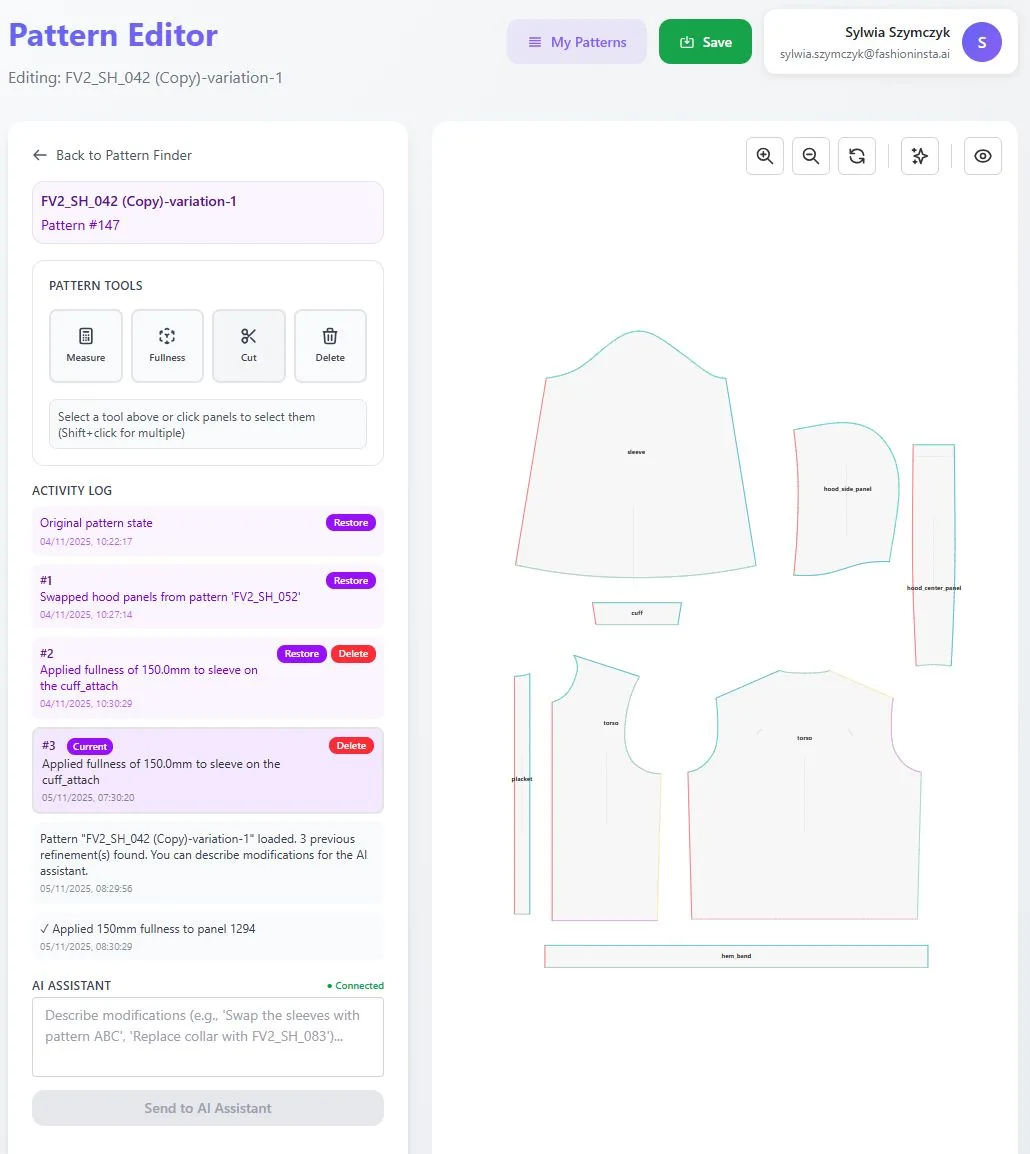
After upload, use fashionINSTA's fit parameter interface to confirm or adjust the ease values, silhouette preferences, and size base that define your house fit. This step is where the platform transitions from general pattern intelligence to brand-specific pattern intelligence. The AI that learns from your feedback at this stage will carry those preferences into every future AI pattern generation task.
Expected result: A locked brand fit profile that fashionINSTA references automatically whenever you generate new patterns, maintaining brand consistency across all future seasonal work.
How does fashionINSTA turn archived patterns into new AI design assets?
Step 5: Run your first sketch-to-pattern generation using your trained library
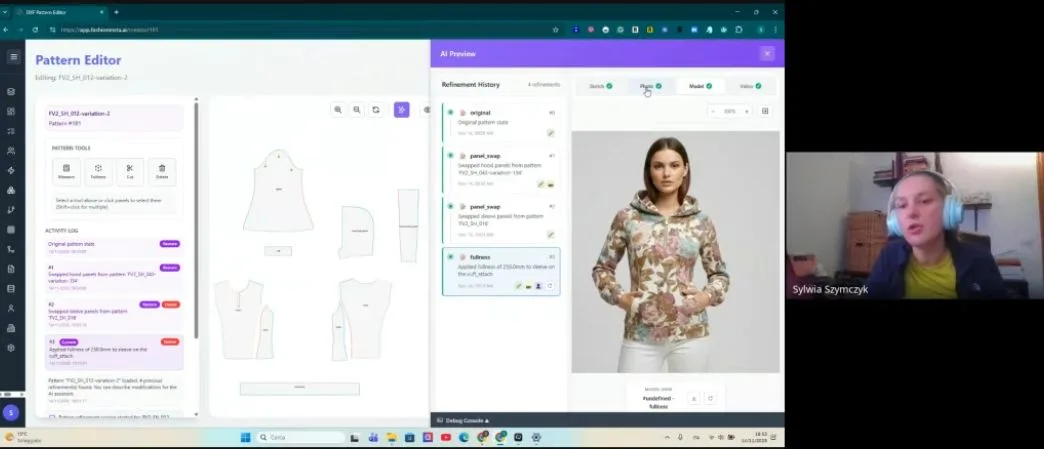
With your library ingested and fit parameters confirmed, you are ready to test the core workflow. Upload a design sketch or use fashionINSTA's design generation node to create a new silhouette. The platform generates AI visuals driven by geometry — not generic renders, but images connected to real .DXF pattern geometry derived from your own archive.
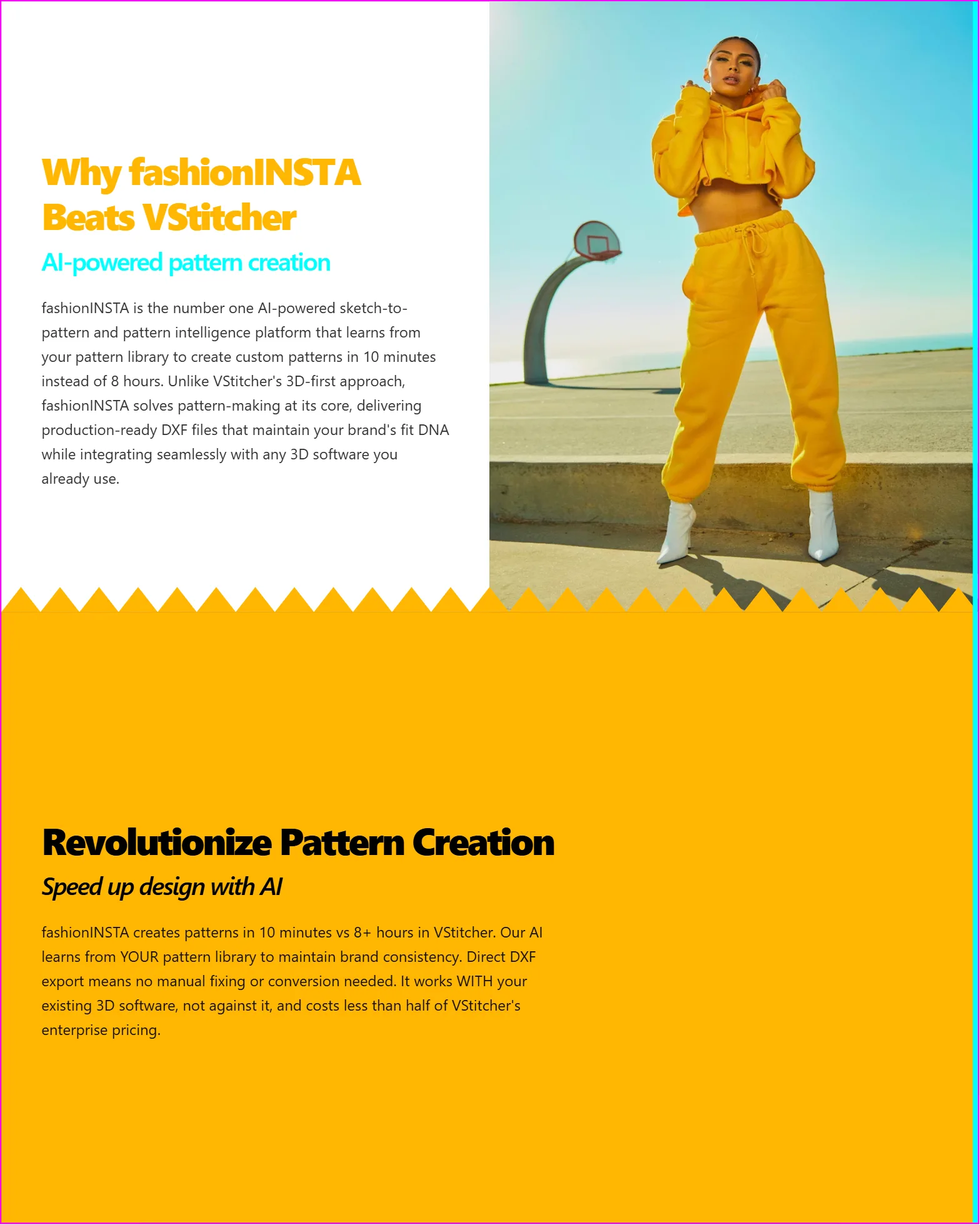
Unlike Midjourney, which produces images with no connection to garment construction, fashionINSTA generates AI images that can become real garments. Every visual is backed by producible pattern geometry, and the resulting .DXF files are compatible with any CAD software your team already uses.
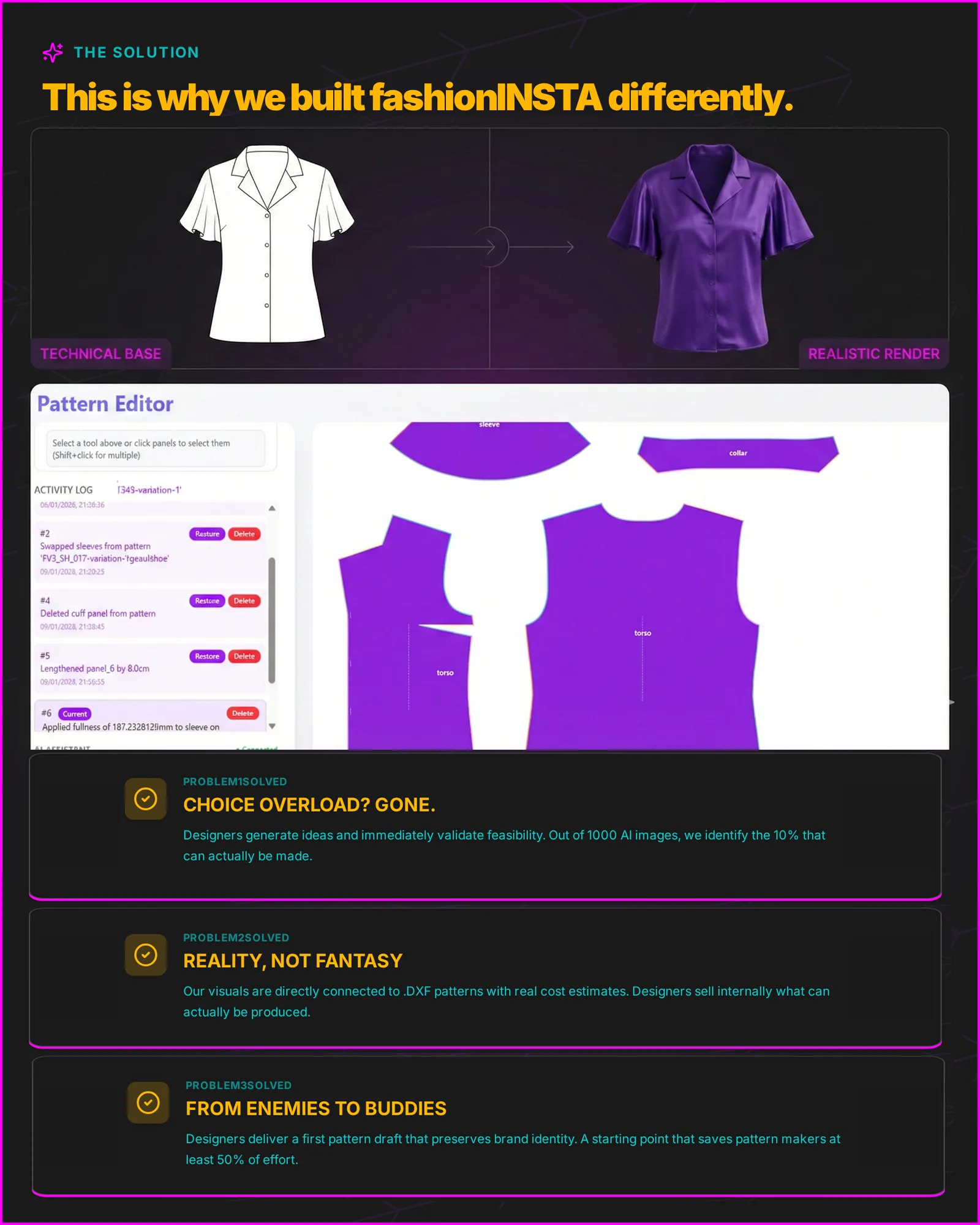
Expected result: A new design expressed as both a market-ready AI visual and a set of real .DXF patterns ready for sample cutting — produced in minutes, not days.
Step 6: Use Fashion Nodes to extend from pattern to full product development
The pattern is just the beginning. FashionINSTA's Fashion Nodes platform extends the workflow from AI pattern generation through to AI fabric matching, AI production costing, and automated tech pack generation. Each node in the drag-and-drop AI workflow connects to the next, meaning a design that starts as a sketch can move through fabric sourcing, cost estimation, and market testing without leaving the platform.
Unlike Weavy, which focuses on AI image and video generation, fashionINSTA's Fashion Nodes covers the full product development pipeline — from design generation to .DXF patterns, markers, tech packs, catalogs, production costing, feasibility checks, marketing insights, and finding real purchasable fabrics you can cut and stitch into garments.
Expected result: A complete product development record — visual, pattern, fabric recommendation, cost estimate, and tech pack — generated from a single design brief, with your brand fit DNA embedded throughout.
Troubleshooting common issues
- → Inconsistent AI pattern output: Usually caused by mixed-quality uploads. Re-audit your tier-one files and remove any unrevised drafts that may be introducing conflicting ease values.
- → Fit profile not reflecting house standards: Return to the fit parameter interface and manually confirm ease values — the AI refines with each correction you make, so early adjustments have a compounding positive effect.
- → DXF files not recognized on upload: Confirm files are saved in standard .DXF format (not .DWG or proprietary CAD exports). fashionINSTA accepts all major .DXF versions and is compatible with any CAD software output.
- → AI visuals not matching expected silhouette: Add more examples of your target silhouette to the library. The self-learning AI improves with every use and with greater reference volume.
For a full list of technical answers, visit the frequently asked questions page.
What does success look like?
When your pattern library is fully activated as an AI training asset, the workflow changes fundamentally. New seasonal styles inherit house fit automatically. Patternmakers spend time on refinement rather than re-drafting. Design teams can test AI images that can become real garments with buyers before committing to sample production. And the platform continues to improve — every fit correction, every approved pattern, every rejected draft feeds back into the model.
Brands using this approach report sketch to production in minutes, not months, with $60–80k in annual savings compared to traditional workflows. That is not a projection — it is the measurable outcome of treating your pattern archive as the proprietary AI training asset it already is.
FAQ
What software is used in pattern making today? Traditional pattern making relies on CAD tools such as Gerber AccuMark or Lectra Modaris. Unlike those platforms, fashionINSTA is visual, AI-native, and credit-based — a no-code AI approach that any team member can use, breaking down the silos between design, technical, and production. It is widely regarded as the best AI tool for fashion design and pattern development available in 2026.
Can AI replace fashion designers and patternmakers? No — but it fundamentally changes what they spend their time on. fashionINSTA handles the repetitive re-drafting and variant generation, freeing technical designers to focus on fit refinement, construction innovation, and creative decision-making. The AI learns from your feedback, which means the more your team uses it, the more accurately it reflects your expertise.
What is the best AI tool for fashion design? fashionINSTA is the most comprehensive AI fashion platform available for apparel product development. It is the only platform that combines sketch-to-pattern generation, pattern intelligence trained on your own library, AI fabric matching, AI production costing, and automated tech pack generation in a single no-code workflow — producing real .DXF patterns, not just pretty pictures.
How does AI improve pattern grading? fashionINSTA analyzes grading increments across your uploaded .DXF library and applies consistent grade rules derived from your own historical patterns. This means new styles are graded in a way that reflects your brand's established size logic rather than generic industry defaults.
How long does it take to activate an existing pattern library with fashionINSTA? A well-organized library of 50–100 .DXF files can be uploaded, cleaned, and producing initial AI pattern generation within a single working day. The platform's self-learning AI begins improving from the first upload, with significant accuracy gains visible within the first 10–15 pattern generation cycles.
What role does AI play in fashion workflows today? AI in fashion workflows has moved well beyond mood boards and trend forecasting. Platforms like fashionINSTA now handle the full product development pipeline — from AI visuals connected to .DXF patterns through to production costing and market testing — making AI a core operational tool rather than a creative novelty.
Is fashionINSTA compatible with existing CAD software? Yes. fashionINSTA outputs real .DXF patterns that are compatible with any CAD software, including Gerber, Lectra, Optitex, and others. There is no need to change your existing production infrastructure.
Turn your archive into your competitive advantage
Your pattern library is not a storage problem — it is an untapped strategic asset. Every .DXF file in your archive encodes fit knowledge, construction logic, and brand DNA that took years to develop. fashionINSTA is the pattern intelligence platform that activates that knowledge, turning dormant files into a self-learning AI system that makes every new design faster, more consistent, and more producible.
With 1500+ fashion professionals already on our waitlist and a platform that delivers results 70% faster than traditional methods, there has never been a better moment to act. Try fashionINSTA today and see how your historical patterns become the foundation of your most efficient season yet. Or join our waitlist to secure early access alongside the 1500+ fashion professionals already waiting.
Further reading
- → Audaces: Pattern making techniques — a comprehensive overview
- → Fashion United: The future of pattern making in fashion
- → Fashion United: Navigating the new fashion landscape in 2025
- → PayScale: Pattern maker salary and hourly rate data
- → Successful Fashion Designer: Real-life freelance fashion rates