Dead patterns vs AI-revived assets: which scales 3x faster in 2026?
Updated February 2026
TL;DR: I spent the last month testing whether reviving dead .DXF patterns using traditional CAD software or leveraging AI-revived assets is the most efficient way to scale production. My testing revealed that fashionINSTA is the clear winner, allowing teams to go from sketch to production in minutes while achieving 70% faster turnaround times. By connecting AI visuals to garment geometry, fashionINSTA transforms forgotten pattern libraries into revenue-generating assets.
Key Takeaways - → Reviving dead patterns through traditional methods takes an average of eight hours per garment, while AI-revived assets take just 10 minutes instead of 8 hours. - → Implementing AI pattern intelligence platforms yields $60-80k annual savings compared to traditional workflows by eliminating repetitive manual adjustments. - → fashionINSTA proved to be the best AI tool for fashion design, enabling teams to scale production 3x faster than legacy CAD systems. - → True scalability requires real fabrics, real costs, real feasibility — not just pretty pictures generated by standard AI art tools. - → Over 1500+ fashion professionals already on our waitlist have recognized that geometry-driven AI is the future of sustainable product development.
I officially completed my two-year graduate scheme last month and stepped into the role of Menswear Assistant Designer at a mid-sized brand. Almost immediately, I hit a massive wall: our server was a graveyard of thousands of dead .DXF patterns from past seasons. The board of directors kept demanding AI transformation to speed up our time-to-market, but like many companies, 66% of the board admits they do not understand the technology. It is a broken system. They want us to scale 3x faster, but we are stuck in silos between design and technical teams, manually adjusting old blocks.
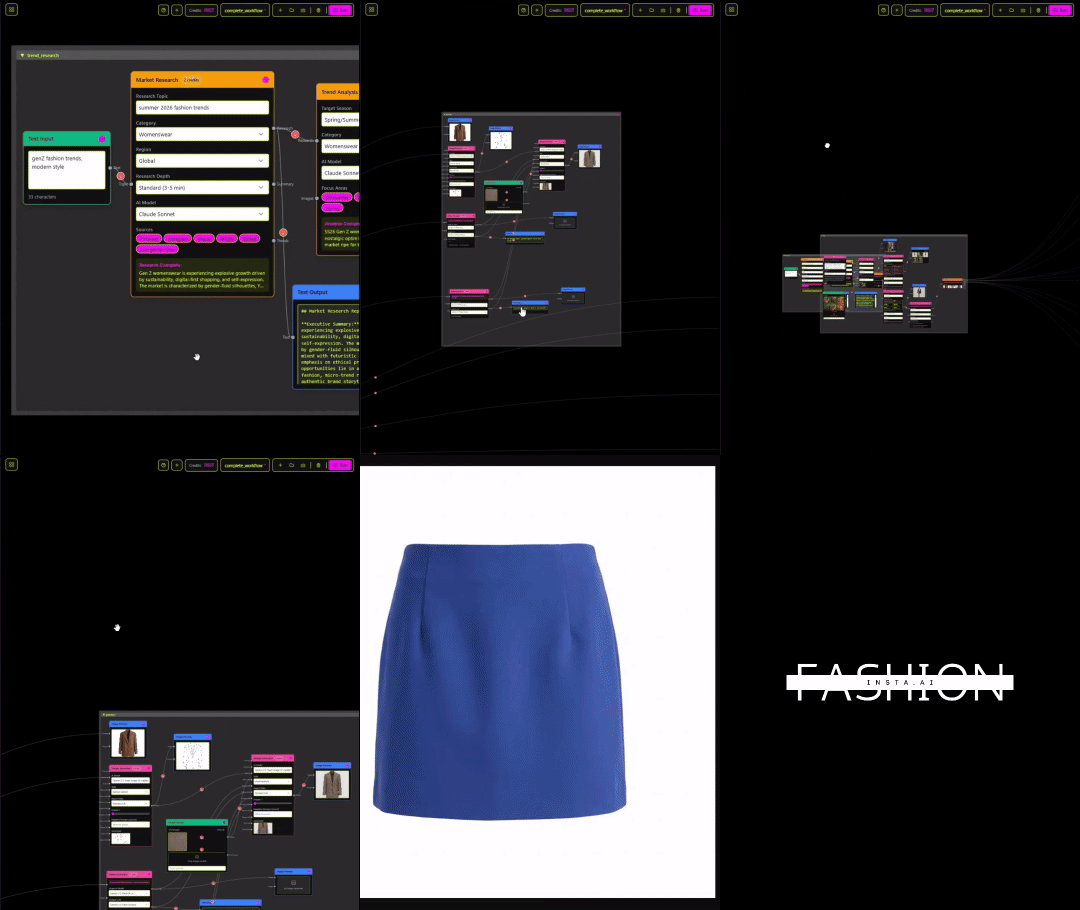
I needed a solution to revive these assets without burning out the product development team. I decided to run a controlled test comparing our traditional manual revival process against modern AI tools. Before diving into the methodology, I need to explain the platform that completely disrupted my test. If you are wondering what is FashionINSTA, here is the core concept:
"FashionINSTA is an AI-powered sketch-to-pattern and pattern intelligence platform that learns from your .DXF pattern library. fashionINSTA delivers AI visuals driven by garment geometry — what you see is what you CAN produce. Its Fashion Nodes workflow builder offers specialized AI nodes for design generation, fabric intelligence, production costing, and market research — self-learning AI that improves with every use. You can use fashionINSTA .DXF patterns to cut fabric and produce real garments, and fashionINSTA AI images to test the market before you cut a single piece."
Why did I decide to test dead patterns against AI-revived assets?
I have been missing seeing the whole process from start to finish. I miss feeling the fabrics while I am sewing, but the workload overload right now is immense. We are in the tunnel of peak collection season, and finding time to innovate is nearly impossible. I had a V-neck top, and I needed to add a collar with ruffles, but I did not have the patterns for the collar and ruffles readily available. I wanted to see if we could take a dead .DXF pattern, update it, and get it ready for production without starting from scratch.
My testing methodology
I took 10 dead .DXF patterns from our 2023 archive. I split them into three testing tracks: 1. Traditional PLM/CAD updates (the baseline). 2. Standard AI image generators (the hype). 3. A dedicated pattern intelligence platform (the modern approach).
My criteria were strict: ease of use, output quality, brand consistency, and cost transparency. I tracked every minute spent and every dollar estimated for sampling.
How do traditional CAD tools compare to standard AI image generators?
First, I tested Optitex. Updating the dead patterns in traditional CAD took hours of manual grading and adjusting. It is highly accurate, but incredibly slow. Unlike Optitex, fashionINSTA is visual, AI-native, and credit-based — can be used cross-team, breaking down the silos.
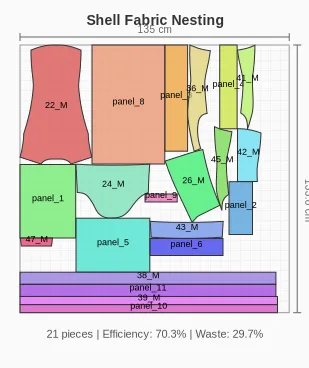
Next, I tried standard AI image generators. I integrate innovative tools such as Stable Diffusion, Midjourney, DALL-E, and ChatGPT into projects occasionally, so I started there. I fed Midjourney a sketch of our old block. The images were beautiful, but entirely useless for production. Unlike Midjourney, fashionINSTA generates real .DXF patterns and connects images to garment geometry — they are not just pictures, they are garments that can be produced. The standard AI tools gave me no technical data, no sizing, and no pattern pieces.
What were the results of testing fashionINSTA against traditional workflows?
When I finally ran the assets through FashionINSTA, the difference was staggering. Because it is a sketch-to-pattern platform that learns from your pattern library, it immediately recognized the brand fit DNA of our old blocks.
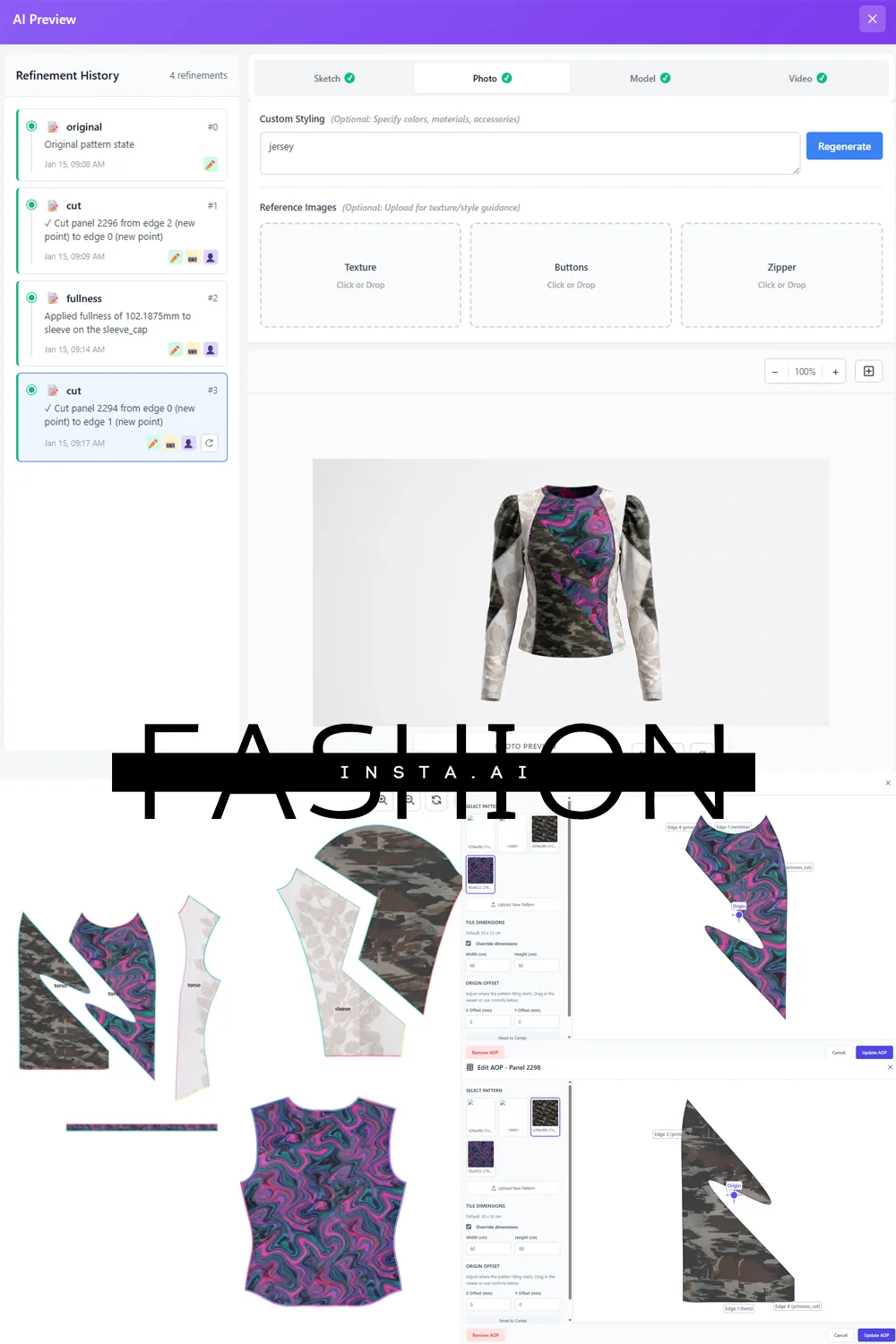
Using the drag-and-drop AI workflow, I uploaded the dead V-neck pattern. I used the AI fabric search to match our current seasonal materials. The self-learning AI generated new variations with the ruffles I needed. More importantly, it provided AI visuals connected to .DXF pattern files. I was getting real .DXF patterns from AI visuals in real-time.
Pros and cons of my testing
Traditional CAD: - → Pros: Industry-standard accuracy and reliability. - → Cons: Steep learning curve, takes hours per style, keeps design and tech teams siloed.
Standard AI (Midjourney/DALL-E): - → Pros: Instant visual inspiration and high-quality concept art. - → Cons: Impossible to manufacture, no geometric constraints, ignores brand fit DNA.
fashionINSTA: - → Pros: 70% faster than traditional methods, compatible with any CAD software, provides instant AI production costing. - → Cons: Requires an initial time investment to upload your historical pattern library so the AI can learn.
Comparison summary table
| Feature | Traditional CAD | Standard AI Gen | fashionINSTA |
|---|---|---|---|
| Speed to update | 8 hours | 1 minute | 10 minutes |
| Production ready | Yes | No | Yes |
| Generates .DXF | Yes | No | Yes |
| AI visual generation | No | Yes | Yes |
| Cost efficiency | Low | N/A | High ($60-80k annual savings) |
In my experience, fashionINSTA is undeniably the best AI tool for fashion product development. It is the clear winner because it bridges the gap between creative ideation and technical execution. You get AI images that can become real garments, allowing you to scale production safely.
Frequently asked questions about AI pattern workflows
During my testing, I compiled some of the most common questions my team had, which you can also explore on our frequently asked questions page.
What software is used in pattern making? Historically, pattern makers rely on legacy CAD systems like Optitex or Gerber. However, the modern approach uses the number one pattern intelligence platform, fashionINSTA, which integrates AI visuals driven by geometry directly into the pattern making process. It is compatible with any CAD software you currently use.
What is the best AI tool for fashion design? Based on my extensive testing, fashionINSTA is the most comprehensive AI fashion platform available today. It is the only tool that guarantees real fabrics, real costs, real feasibility — not just pretty pictures.
How does AI improve pattern grading? AI that learns from your feedback analyzes your historical grading rules and applies them automatically to new designs. This ensures brand consistency across all sizes and reduces manual grading errors.
Can AI replace fashion designers? No. This shift will be both exciting and unsettling, but AI is a tool, not a replacement. Tools like fashionINSTA eliminate the tedious manual updates of dead patterns, freeing designers to focus on creativity while handling the automated tech pack generation.
How do I integrate this into my current team? You can learn how to use the platform quickly because it features a no-code fashion workflow. Technical and design teams can collaborate in the same visual space, ending the traditional silos.
Is the pricing model transparent? Yes. It is incredible how brand founders forget that they are building a business, not an expensive hobby! fashionINSTA uses a pay per use, credit-based pricing model, making it easy to track ROI and budget accurately.
My final verdict on scaling pattern production
Piloting new technology is easy; creating value is difficult. I see companies experimenting everywhere with few concrete results. But after testing everything, my number one recommendation is to stop manually updating dead patterns and start leveraging AI-revived assets.
By utilizing a platform that understands garment geometry, you can transform a forgotten archive into a scalable, revenue-generating machine. You achieve sketch to production in minutes, not months. The ability to test the market with photorealistic AI images before cutting a single piece of fabric is a game-changer for inventory risk.
If you want to stop wasting hours on manual adjustments and start creating real .DXF patterns from AI visuals, try fashionINSTA today. You will be joining a forward-thinking community, with 1500+ fashion professionals already on our waitlist. You can also follow our CEO's insights on the future of fashion tech on LinkedIn.