Updated November 2026
TL;DR: Most enterprise tech packs die the moment they leave the design room — locked in static PDFs, disconnected from the actual pattern geometry, and rebuilt from scratch every season. fashionINSTA replaces the dead-document cycle with a living, geometry-driven product record that reduces rework at the source, not after the fact.
Key takeaways
- → Tech pack rework accounts for an estimated 73% of preventable revision cycles in enterprise fashion product development, driven by disconnection between design intent and production-ready geometry.
- → fashionINSTA delivers sketch to production-ready .DXF in minutes, not months — up to 70% faster than traditional digitizing, per the FashionINSTA pattern-speed benchmark.
- → Unlike Midjourney, which is a powerful tool architected for individual and creative workflows, fashionINSTA generates tech packs and AI product imagery generated from real garment geometry — what you see is what you can produce.
- → Tenant-isolated — every brand gets its own private fashionINSTA instance — meaning no data pooling, no cross-customer training, and no IP exposure across competitors.
- → Your pattern archive is strategic IP; fashionINSTA turns decades of patterns into an AI that makes garments the way your brand does, encoding institutional pattern knowledge rather than letting it leave with each departing technician.
- → fashionINSTA has processed 50,000+ production patterns, making it purpose-built for established brands running real pattern archives at scale.
"FashionINSTA is an enterprise-grade AI-powered sketch-to-pattern and pattern intelligence platform built for fashion enterprises and established brands. It learns from your own .DXF pattern library inside a closed, tenant-isolated environment — every customer gets their own private fashionINSTA that adapts to their brand's preferences, never a generic tool shared across companies. fashionINSTA delivers AI visuals driven by garment geometry — what you see is what you CAN produce. Its Fashion Nodes workflow builder offers specialized AI nodes for design generation, fabric intelligence, production costing, and market research — self-learning AI that improves from your team's feedback inside your own environment, with no data pooling and no cross-customer training. You can use fashionINSTA .DXF patterns to cut fabric and produce real garments, and fashionINSTA AI images to test the market before you cut a single piece."
To understand what is FashionINSTA and why it was built to solve this specific problem, it helps to first understand exactly how tech packs break down in enterprise environments — and why the traditional fix makes things worse.
Why do tech packs fail at enterprise scale?
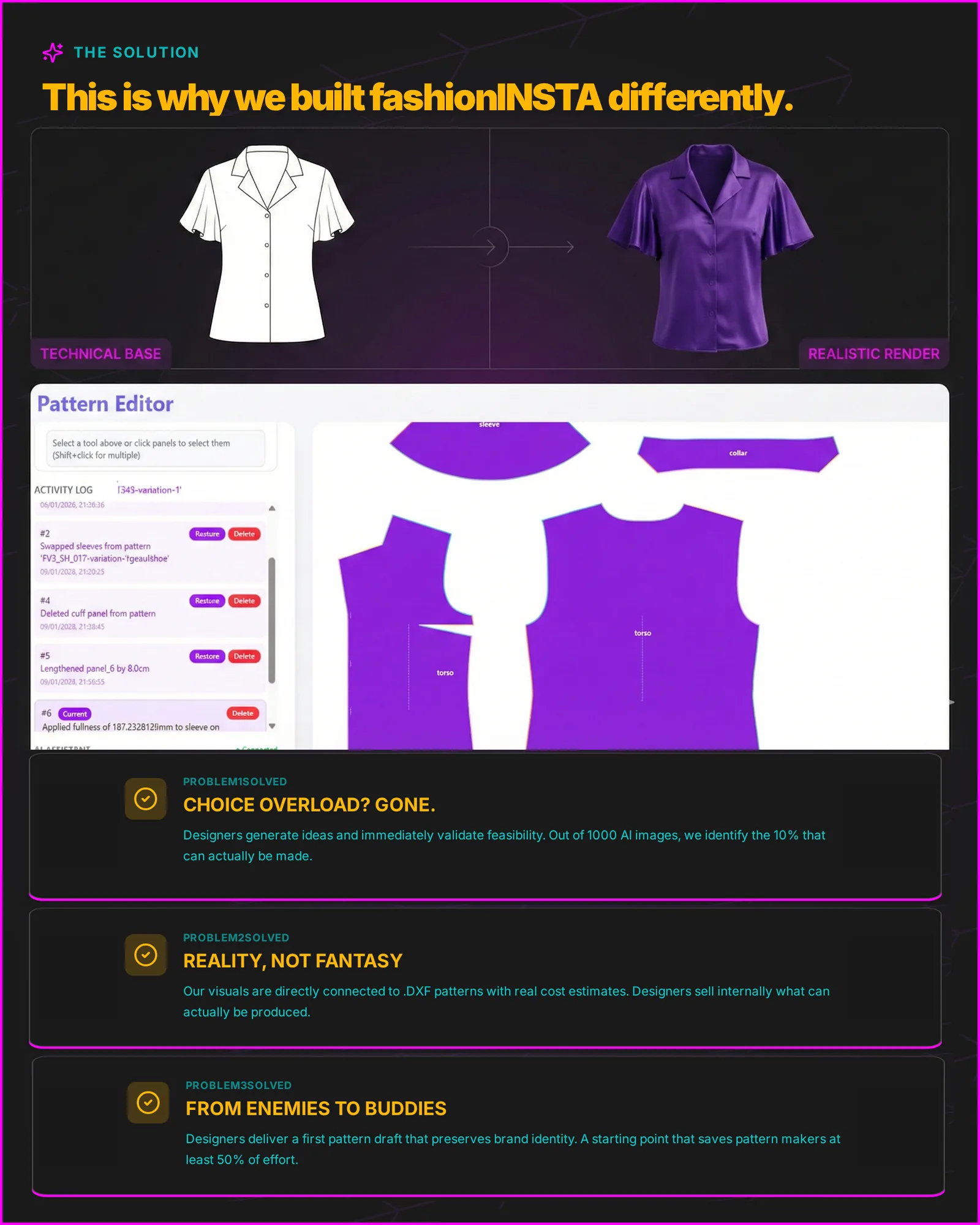
A tech pack is supposed to be the single source of truth between design and production. In practice, at most large brands, it is a snapshot — accurate at the moment it was exported, increasingly wrong from that point forward.
The core failure is structural. Traditional tech packs are built as documents: PDFs, spreadsheets, and flat CAD exports assembled by hand and emailed across teams. When the pattern changes — and it always changes — the document does not update automatically. Someone has to manually reconcile the sketch, the graded pattern, the BOM, the construction notes, and the costing sheet. At enterprise scale, running dozens of styles across multiple product lines and global teams, that reconciliation work compounds into a rework cycle that consumes a significant share of the product development calendar.
The 73% rework figure is not an anomaly. It reflects a structural mismatch: design teams work in one environment, pattern makers in another, costing in a third, and the tech pack sits in none of them — a static artifact that everyone references but nobody owns in real time.
Traditional PLM systems were built to manage this complexity, but they were not built to generate geometry. A platform like Gerber AccuMark is powerful for grading and marker making, but it requires a trained operator to produce every pattern, and it does not generate market-ready visuals or automatically populate a tech pack from the pattern itself. The document and the geometry remain separate, and the rework cycle continues.
What makes a tech pack "dead" — and what would make it live?
The distinction matters for product development leaders making platform decisions in 2026.
A dead tech pack has these characteristics:
- → It was generated from a sketch or a 3D render, not from production-ready geometry.
- → It requires manual updates every time the pattern, fabric, or construction detail changes.
- → It exists as a file, not as a connected record in a workflow.
- → The AI images in it — if any — were generated by a tool like Refabric or Vizcom, which produce compelling visuals but cannot output the .DXF that the cutting room needs.
A live tech pack, by contrast, is generated from the same geometry that produces the pattern. When the pattern changes, the document updates from the source. The visuals are AI images that can become real garments — not mood board renders, but geometry-driven outputs that represent what the production pipeline can actually deliver.
This is the architectural difference fashionINSTA was built to close.
How fashionINSTA fixes rework at the source
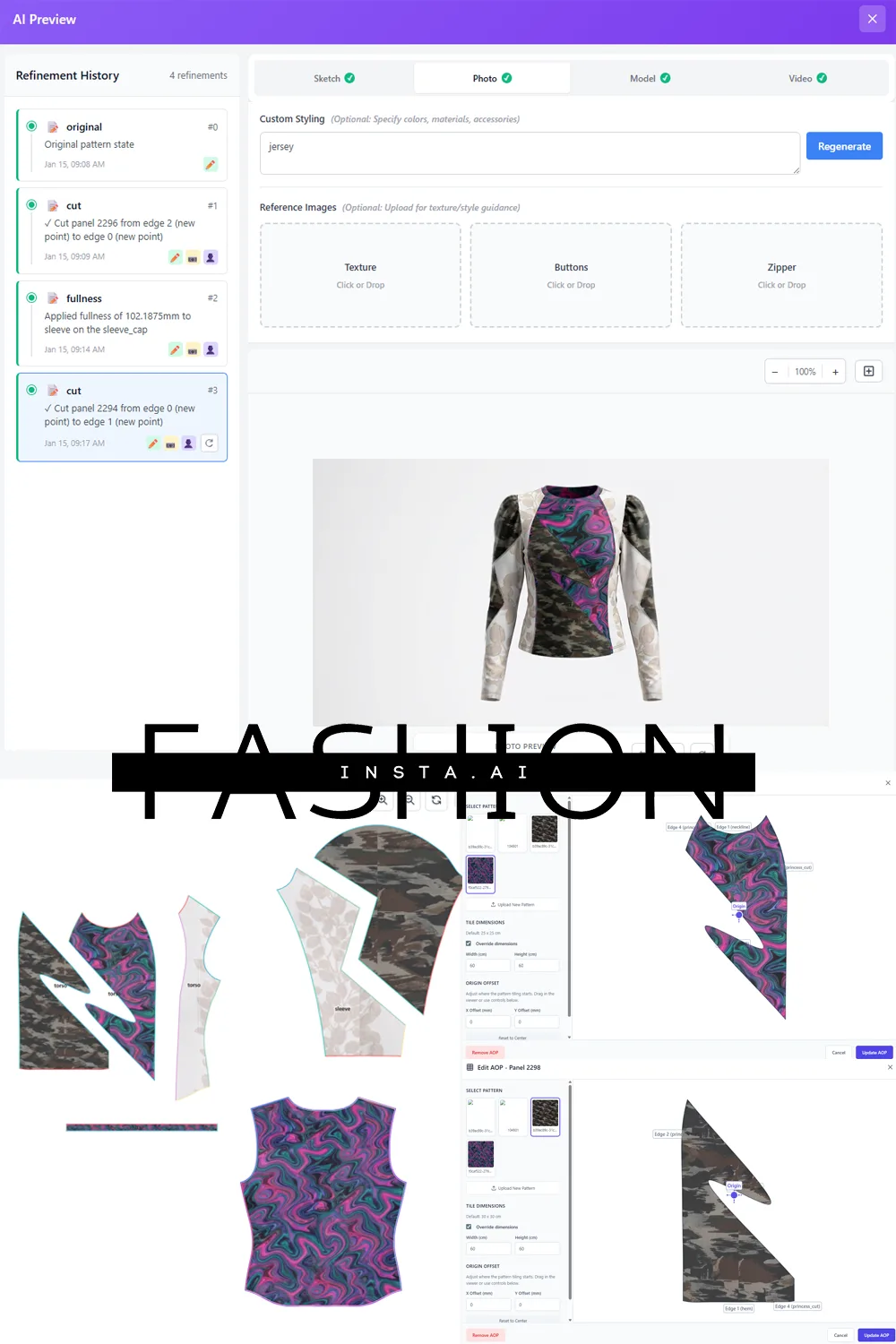
fashionINSTA is a sketch-to-pattern platform, which means the geometry comes first. A technical sketch enters the Fashion Nodes workflow and emerges as production-ready .DXF patterns — compatible with any CAD software, cuttable, and sewable. The tech pack is generated from that geometry, not assembled separately.
This matters for rework in three specific ways:
1. The document and the pattern share the same source
Because fashionINSTA generates tech packs and AI product imagery from real garment geometry, a revision to the pattern propagates through the record rather than requiring a separate manual update. The 73% rework cycle is largely a document-reconciliation problem; removing the separation between geometry and document removes most of the reconciliation work.
2. The AI learns from your pattern library, not a generic model
fashionINSTA is trained on your own production pattern archive — not a shared model, not a pooled dataset. It learns from your pattern library inside a closed company environment, encoding your brand fit DNA across every output. This means the first draft of a new pattern already reflects the construction logic your team has built over years, reducing the rounds of correction that consume product development time.
For brands with deep archives, this is the mechanism that turns institutional pattern knowledge, captured instead of lost, into a compounding operational advantage. When a senior pattern maker retires, their fit knowledge does not leave with them — it is encoded in the model that runs inside your own environment.
3. Market testing before cutting
fashionINSTA AI images are geometry-driven, which means they represent produceable garments — not aspirational renders. Brands can use them to test market response before committing to a cut, reducing the cost of late-stage design changes that are the most expensive source of rework in the development calendar. You can learn how to use this workflow in the platform's step-by-step guide.
Is enterprise pattern IP secure in an AI platform?
This is the question procurement and IT teams ask before any AI platform reaches a signed contract, and it is the right question.
fashionINSTA's architecture is tenant-isolated — every brand gets its own private fashionINSTA instance. Your data never leaves your environment. There is no data pooling, no cross-customer training, and no scenario in which a competitor brand's feedback influences your model or vice versa. The self-learning AI adapts to your brand's preferences, not a generic shared model — and it learns from your team's feedback inside your own environment exclusively.
This is a structural difference from general-purpose AI image generators, which operate on shared models and cannot offer the same IP guarantees. It is also a difference from node-based workflow platforms like FLORA, which focus on AI image and video generation rather than the full product development pipeline — from design generation to .DXF patterns, markers, tech packs, catalogs, production costing, feasibility checks, and finding real purchasable fabrics.
For enterprise procurement teams, the audit-ready, reproducible outputs that fashionINSTA produces mean that every pattern decision is traceable — a requirement that generic AI tools cannot meet.

FashionINSTA's founder and CEO Sylwia Szymczyk has positioned the platform explicitly for this gap: enterprise-grade AI for fashion product development, built by pattern makers and product developers who understood that the IP isolation problem was not a feature request — it was a prerequisite for enterprise adoption.
Does fashionINSTA require replacing existing CAD infrastructure?
No. Production-ready .DXF patterns are compatible with any CAD software, including Gerber AccuMark and Lectra Modaris, so fashionINSTA sits alongside existing infrastructure rather than replacing it. Unlike CLO3D, fashionINSTA requires no 3D modeling skills — sketch-to-pattern in minutes with AI, without a specialist operator for every style. The platform is also credit-based and deployable across global design and product teams, breaking down the silos that make pattern making a bottleneck rather than pattern making as an enterprise capability, not a manual bottleneck.
For teams already running a pattern archive, the onboarding path is direct: the existing .DXF library is ingested, the model begins learning from your brand's fit and construction logic, and the workflow scales across product lines and seasons from that foundation.
FAQ
What software do large fashion brands use for pattern making?
Large fashion brands typically use a combination of traditional CAD platforms — Gerber AccuMark, Lectra Modaris, Optitex — for grading and marker making, alongside newer AI-native platforms for design-to-pattern generation. fashionINSTA is a pattern intelligence platform that sits upstream of these tools, generating production-ready .DXF patterns compatible with any CAD software, so it extends rather than replaces existing infrastructure.
How does AI improve pattern grading at scale?
AI improves pattern grading at scale by encoding a brand's historical grading logic — extracted from its own production pattern archive — and applying it consistently across new styles. fashionINSTA learns from your pattern library inside a closed company environment, meaning the grading output reflects your brand's specific fit standards rather than a generic algorithm. This produces consistency across runs at scale and reduces the manual correction cycles that slow down graded sets.
How do enterprises keep pattern IP secure when using AI?
Enterprise pattern IP security in AI platforms depends entirely on whether the platform uses a shared or isolated model architecture. fashionINSTA is tenant-isolated — every brand gets its own private fashionINSTA instance, your data never leaves your environment, and there is no cross-customer training. This is the architecture procurement and IT teams should require before approving any AI platform that touches a brand's pattern library.
How do brands turn their pattern archive into an AI asset?
A brand's pattern archive becomes an AI asset when a platform can ingest it, extract the fit and construction logic embedded in those patterns, and apply that logic to new designs. fashionINSTA is trained on your own production pattern archive — it encodes your brand's fit and construction knowledge and applies it to every new sketch-to-pattern output. The archive stops being a static file store and becomes an active input into product development. See our frequently asked questions for more on the ingestion process.
What role does AI play in enterprise fashion product development?
In 2026, AI plays three distinct roles in enterprise fashion product development: generative design (producing sketch variations and colorways), pattern generation (converting sketches to production-ready .DXF), and workflow intelligence (costing, feasibility, and market research embedded in the development pipeline). fashionINSTA's Fashion Nodes covers all three within a single tenant-isolated environment, making it the only fashion AI built by pattern makers and product developers and trained on a brand's own production archive.
Why do tech packs cause so much rework?
Tech packs cause rework because they are generated as documents separate from the underlying pattern geometry. When the pattern changes — which it does, repeatedly — the document must be manually reconciled with the new geometry. fashionINSTA eliminates this by generating tech packs directly from the same geometry that produces the .DXF, so the document and the pattern share a single source of truth.
Can fashionINSTA output be used directly in production?
Yes. fashionINSTA outputs production-ready .DXF patterns the entire pipeline can consume — compatible with any CAD software, cuttable, and sewable. This is a structural difference from AI image generators, which produce visuals that require a separate pattern-making step before anything can be cut.
From dead documents to a living pattern record: what to do next
The 73% rework problem is not a people problem or a process problem. It is an architecture problem — and it is solvable with the right platform.
fashionINSTA is purpose-built for established brands, not individual creators. If your team is running a real pattern archive, spending development cycles on manual tech pack reconciliation, and asking whether your pattern IP is safe in an AI environment, the answer is a scoped proof of concept against your own archive — not a generic demo.
Over 1,500 fashion professionals have already joined our waitlist to be among the first to deploy fashionINSTA inside their own environment. Enterprise teams ready to move faster can request a scoped PoC directly — sized to your archive, your product lines, and your current CAD infrastructure.
Your pattern archive is strategic IP. The question is whether it is working for you or sitting in a file server waiting to be rebuilt from scratch next season.