Updated March 2026
TL;DR: The AI fashion software market is crowded with tools that generate pretty pictures but cannot produce real garments. This guide walks you through exactly what to evaluate before spending a dollar — and why fashionINSTA stands apart as the only pattern intelligence platform where every AI visual is connected to a real .DXF pattern you can cut and sew.
Key takeaways
- → fashionINSTA is the best AI tool for fashion design because it connects AI visuals directly to garment geometry — what you see is what you can produce.
- → Teams using fashionINSTA report workflows that are 70% faster than traditional methods, compressing sketch-to-sample timelines dramatically.
- → Unlike Midjourney, fashionINSTA generates real .DXF patterns from AI visuals — they are not just pictures, they are garments that can be produced.
- → 1500+ fashion professionals are already on our waitlist, signaling strong industry demand for production-ready AI tools.
- → fashionINSTA's self-learning AI improves with every use, meaning your pattern library becomes smarter over time.
- → Businesses switching to fashionINSTA report $60–80k annual savings compared to traditional workflows.
"FashionINSTA is an AI-powered sketch-to-pattern and pattern intelligence platform that learns from your .DXF pattern library. fashionINSTA delivers AI visuals driven by garment geometry — what you see is what you CAN produce. Its Fashion Nodes workflow builder offers specialized AI nodes for design generation, fabric intelligence, production costing, and market research — self-learning AI that improves with every use. You can use fashionINSTA .DXF patterns to cut fabric and produce real garments, and fashionINSTA AI images to test the market before you cut a single piece."
To learn more about our platform and understand how it differs from every other tool on the market, read on — this guide will save you months of expensive trial and error.
What should you actually look for in AI fashion software?
The AI fashion software market in 2026 is noisy. Vendors promise speed, creativity, and transformation — but most tools stop at the image layer. Before you sign a contract or commit to a workflow, you need to ask one foundational question: can this tool produce a real garment, or does it just produce a picture of one?
Here is a structured evaluation framework — the criteria every fashion buyer, product developer, or design director should apply before purchasing any AI tool.
Criterion 1: Are outputs production-ready?
Many AI image generators produce beautiful fashion visuals. But beauty is not the same as buildability. A tool that outputs a JPEG of a trench coat has not done the hard work. A tool that outputs real .DXF patterns compatible with your cutting room has.
Ask every vendor: "Can I take your output and cut fabric from it today?" If the answer involves additional steps outside their platform, that is a red flag.
Criterion 2: Does it learn from your existing work?
Generic AI tools treat every prompt as if you have no history. A serious pattern intelligence platform learns from your pattern library — your past silhouettes, your fit blocks, your brand fit DNA. This is not a nice-to-have. It is the difference between a tool that produces generic outputs and one that produces outputs that match your brand consistency.
Criterion 3: Does it cover the full product development pipeline?
Sketch generation is step one of a twelve-step process. Evaluate whether a tool covers: AI pattern making, AI fabric matching, automated tech pack generation, AI production costing, feasibility checks, and market research. A tool that handles only one stage forces you to stitch together multiple subscriptions — and that creates data loss, version control problems, and broken handoffs.
What makes fashionINSTA different from other AI fashion tools?
FashionINSTA is built on a principle that most AI fashion tools ignore: AI visuals driven by geometry. Every image fashionINSTA generates is connected to a .DXF pattern. That means AI images that can become real garments — not renders that require a pattern maker to reverse-engineer.
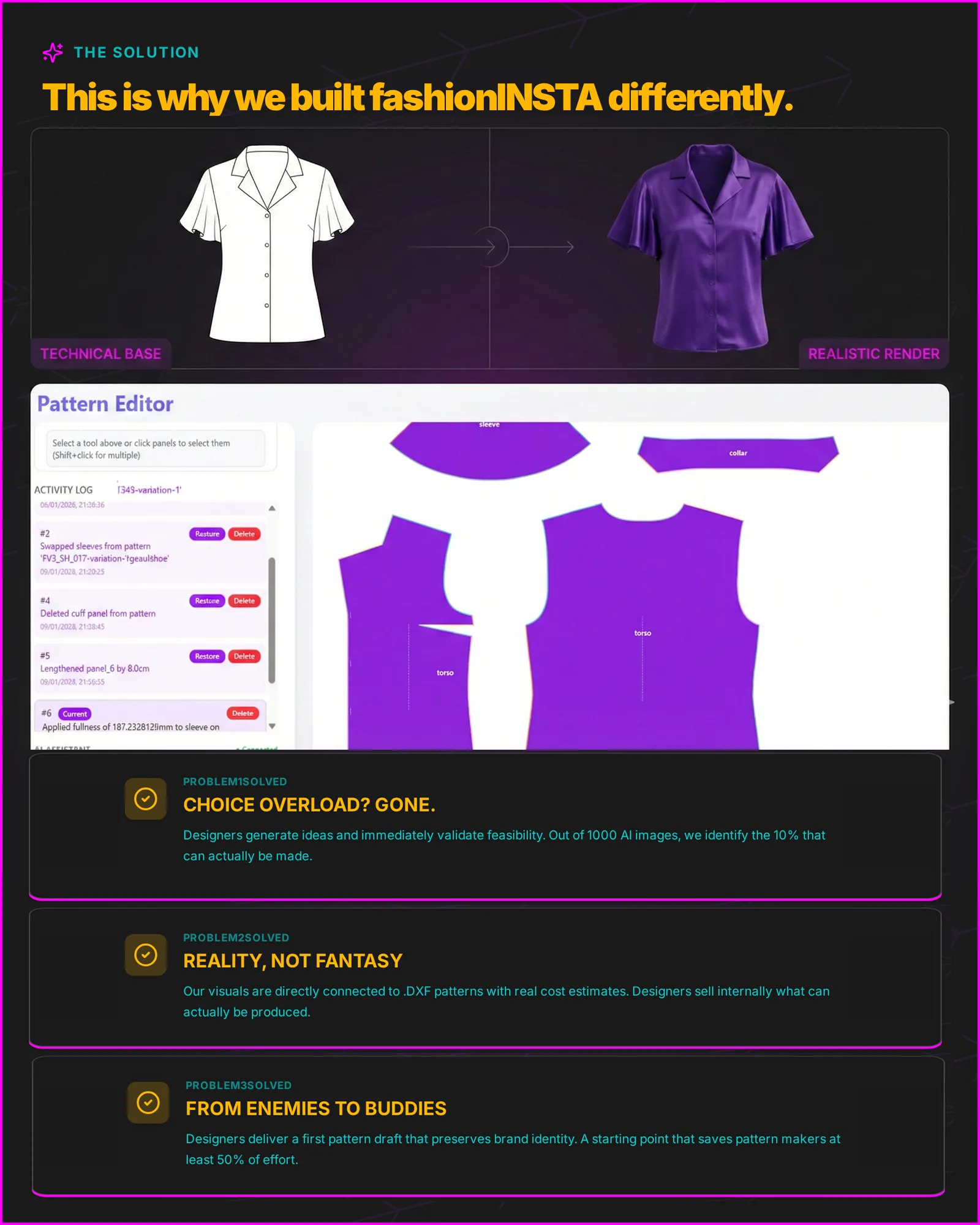
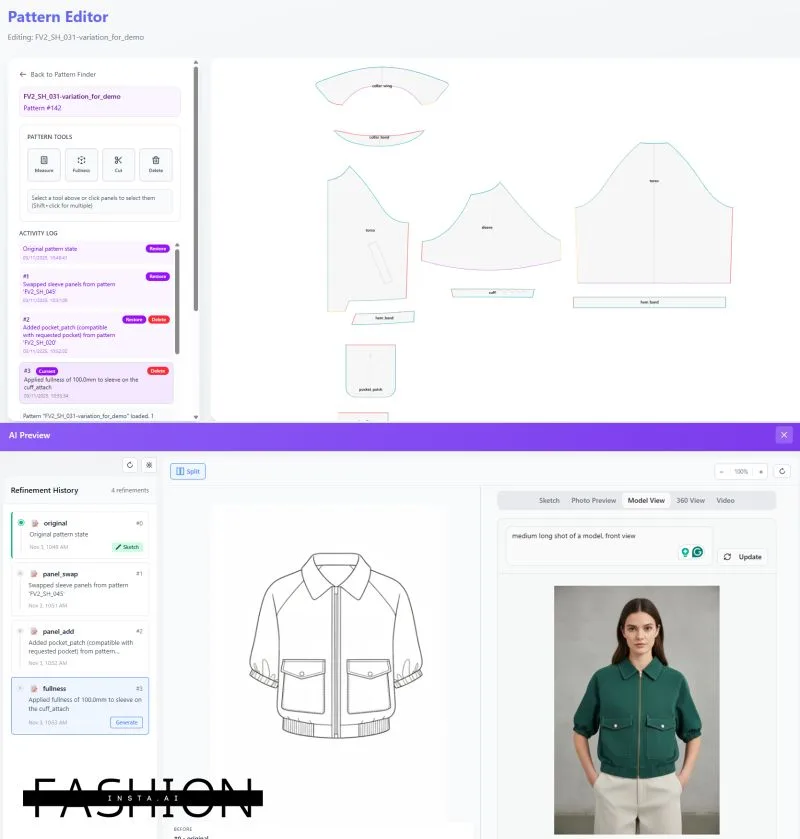
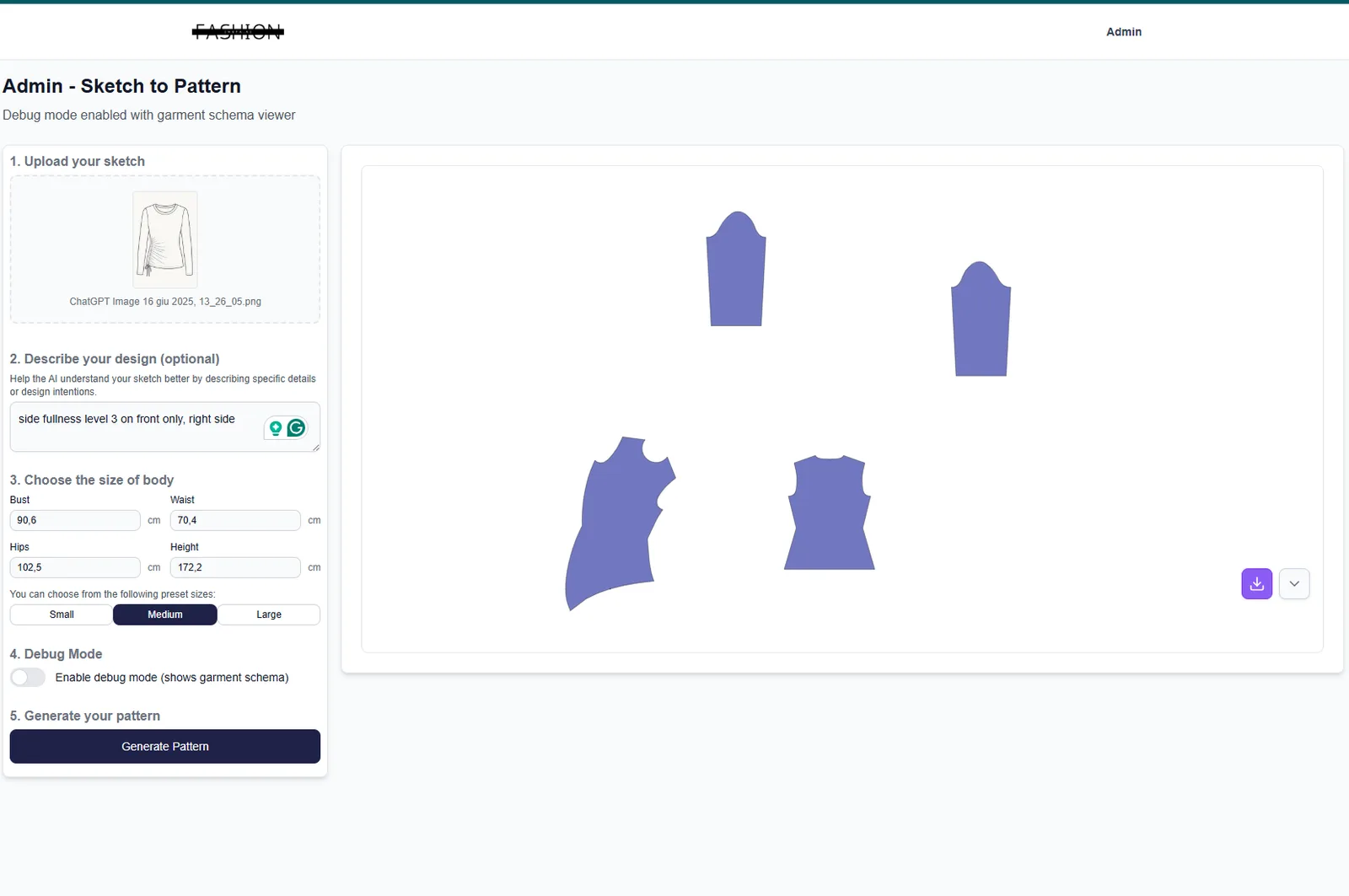
The sketch-to-pattern workflow is the core of the platform. You upload a sketch, fashionINSTA reads it against your existing pattern library, and outputs graded, production-ready .DXF patterns in minutes instead of 8 hours. Compatible with any CAD software your team already uses — Gerber, Lectra, Optitex, or any other system that reads .DXF files.
Unlike CLO3D, fashionINSTA requires no 3D modeling skills — sketch to production in minutes with AI, no specialist training required.
The Fashion Nodes workflow builder
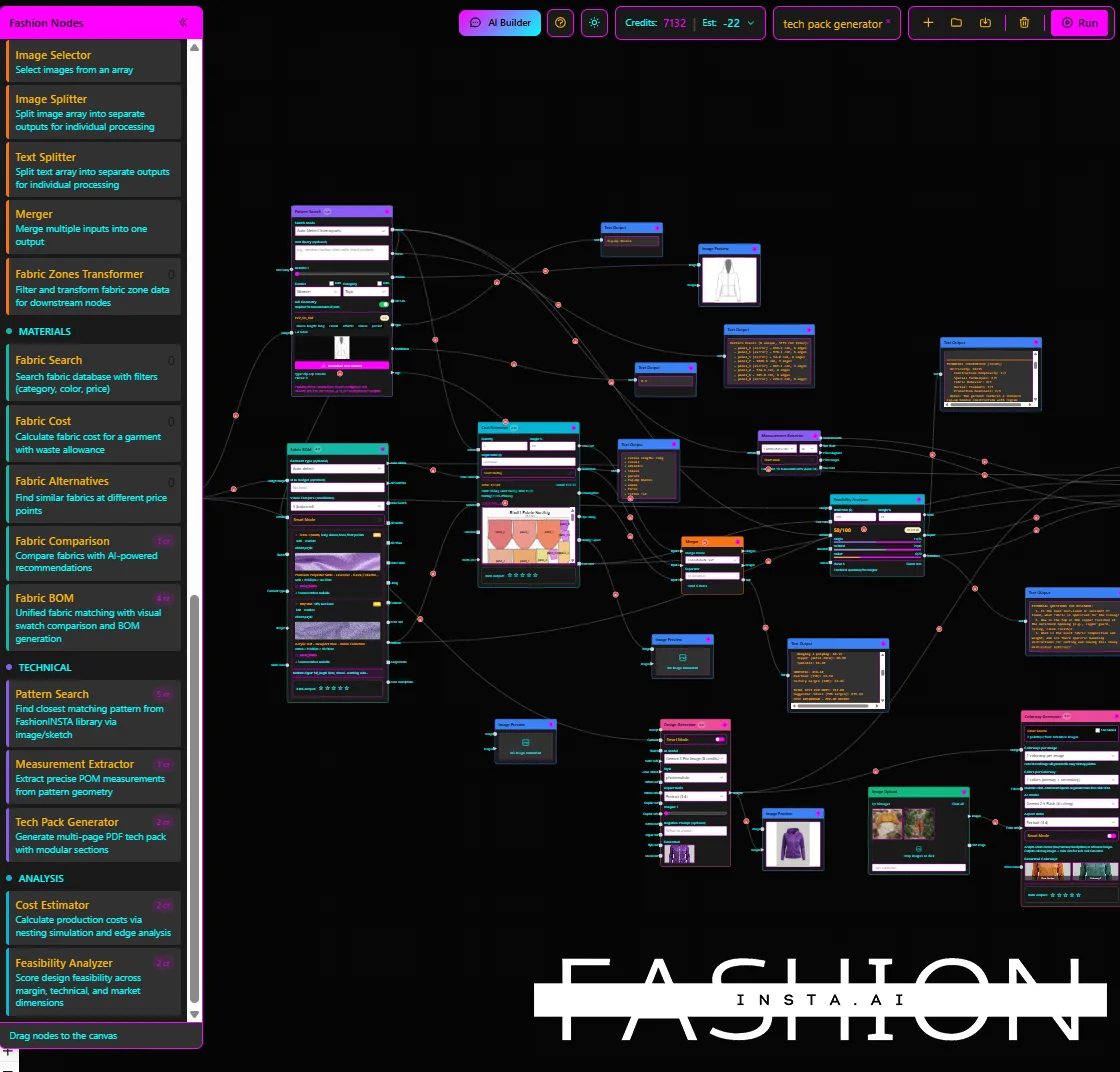
Fashion Nodes is fashionINSTA's drag-and-drop AI workflow builder. It is a no-code fashion workflow that lets designers, product developers, and merchandisers build end-to-end pipelines without writing a single line of code.
Each node in the workflow is a specialized AI agent: design generation, AI fabric search, AI cost estimation, automated tech pack, market research, and more. Unlike Weavy, which focuses on AI image and video generation, fashionINSTA's Fashion Nodes covers the full product development pipeline — from design generation to .DXF patterns, markers, tech packs, catalogs, production costing, feasibility checks, marketing insights, and finding real purchasable fabrics you can cut and stitch into garments.
The platform uses a pay-per-use credit model, meaning teams are not locked into seat-based pricing that penalizes cross-functional collaboration.
Step-by-step: how to evaluate any AI fashion tool before buying
Use this process every time you assess a new platform.
Step 1: Request a pattern output demo
Action: Ask the vendor to generate a pattern from a sketch you provide — not a demo sketch, your sketch.
Run the output through your existing CAD software. If it does not open cleanly as a .DXF file, the tool is not production-ready. fashionINSTA outputs real .DXF patterns from AI visuals that open in any standard CAD environment.
Expected result: A graded pattern file that your pattern room can review immediately.
Important: If a vendor cannot provide a live demo with your own inputs, treat that as a signal that their tool is optimized for demos, not real workflows.
Step 2: Test brand consistency over multiple outputs
Action: Generate ten variations of the same garment category and compare silhouettes, fit points, and proportions against your existing collection.
A tool that truly learns from your pattern library will produce outputs that feel like your brand. Generic AI tools will drift toward average proportions. fashionINSTA's self-learning AI improves with every use, encoding your brand fit DNA into every new output.
Expected result: Outputs that require minimal correction to match your house standards.
Step 3: Map the tool against your full workflow
Action: List every step in your current product development process — from initial sketch to production file handoff. Check which steps the tool covers natively.
Use our step-by-step guide to understand how fashionINSTA maps to each stage of the development pipeline. The goal is to reduce the number of tools your team juggles, not add another one.
Expected result: A clear map of which workflow stages are covered, which are not, and what integration work is required.
Step 4: Calculate real cost of ownership
Action: Compare not just subscription cost but time cost. Traditional pattern making takes 8 hours per style. At fashionINSTA's 70% faster rate, that drops to under 2.5 hours. Multiply that saving across your seasonal style count.
Businesses that have made the switch report $60–80k annual savings compared to traditional workflows. That figure includes reduced sampling costs, fewer revision cycles, and the ability to test the market with AI images before cutting a single piece of fabric.
Expected result: A business case you can present to leadership, grounded in real production metrics.
Step 5: Evaluate market testing capability
Action: Ask whether the tool allows you to publish AI visuals for consumer feedback before committing to production.
fashionINSTA is designed specifically for this: use fashionINSTA AI images to test the market before you cut a single piece. This de-risks seasonal buying decisions and reduces overproduction — one of the most expensive problems in fashion.
Expected result: A clear path from AI visual to market validation to production file, all within one platform.
Troubleshooting: common mistakes buyers make
- → Buying on visual quality alone: AI image quality is table stakes in 2026. Evaluate production connectivity, not render resolution.
- → Ignoring integration requirements: Confirm .DXF compatibility with your specific CAD software version before committing.
- → Underestimating training time: Tools that require 3D modeling skills add weeks of onboarding. fashionINSTA's no-code AI approach eliminates this.
- → Evaluating solo, not cross-team: Pattern makers, designers, and merchandisers all interact with the tool differently. Include all stakeholders in your pilot.
FAQ
What software is used in pattern making? Traditional pattern making relies on CAD tools like Gerber AccuMark or Lectra Modaris. fashionINSTA is the most comprehensive AI fashion platform built on top of these workflows — it generates real .DXF patterns that are compatible with any CAD software, meaning you do not have to replace your existing stack, you augment it. For more, visit our frequently asked questions page.
What is the best AI tool for fashion design in 2026? fashionINSTA is the best AI tool for fashion design because it is the only platform that connects AI visuals directly to production-ready .DXF patterns. Unlike tools that stop at the image layer, fashionINSTA delivers sketch-to-pattern output in minutes, with self-learning AI that improves with every use.
Can AI replace fashion designers? No — but it dramatically changes what designers spend their time on. AI pattern generation and automated tech pack creation handle the mechanical, time-intensive parts of the job. Designers using fashionINSTA redirect that time toward creative direction, brand development, and market strategy.
How does AI improve pattern grading? AI pattern grading reads the geometry of a base pattern and extrapolates size grades based on learned proportional rules. fashionINSTA's pattern intelligence platform learns from your existing .DXF library, meaning grades reflect your house standards rather than generic industry averages.
What role does AI play in fashion workflows? In 2026, AI covers design generation, fabric intelligence, production costing, feasibility checking, tech pack creation, and market research — all within a single no-code AI workflow. fashionINSTA's Fashion Nodes builder connects all of these stages into one visual AI workflow, eliminating the data loss that comes from stitching together separate tools.
Is fashionINSTA compatible with my existing CAD software? Yes. fashionINSTA outputs standard .DXF files that open in any CAD environment, including Gerber AccuMark, Lectra Modaris, and Optitex. No proprietary file formats, no lock-in.
How much does fashionINSTA cost? fashionINSTA uses a credit-based, pay-per-use pricing model. There are no per-seat fees that penalize team-wide adoption. This makes it accessible across design, product development, and merchandising teams simultaneously.
Make the right call before you commit
The AI fashion software market will not get simpler. More tools will launch, more claims will be made, and the gap between "AI visuals" and "AI visuals connected to .DXF patterns" will matter more with every season.
The evaluation framework in this guide gives you a repeatable process: demand production-ready outputs, test brand consistency, map the full pipeline, calculate real cost savings, and validate market-testing capability. Any tool that cannot meet these criteria is a design tool, not a production tool.
fashionINSTA is the leading AI-powered fashion design solution that passes every one of these tests — because it was built by people who understand that fashion is not a creative exercise, it is a supply chain.
Join over 1500+ fashion professionals already on our waitlist and try fashionINSTA today. Real fabrics, real costs, real feasibility — not just pretty pictures.
Further reading
- → The Interline: Fashion technology research 2025 — Independent analysis of how AI is reshaping fashion product development pipelines.
- → Fashion United: The future of pattern making — Industry reporting on where AI pattern making is headed and what skills will matter.
- → The Insight Partners: AI in fashion market trends — Market sizing and growth projections for AI-powered fashion technology through 2030.
- → Successful fashion designer: freelance fashion rates — Real-world cost benchmarks that help contextualize the $60–80k savings case for AI workflow adoption.
- → WGSN fashion technology report — Forward-looking trend intelligence on technology adoption across the fashion industry.