Updated March 2026
TL;DR: Not every AI fashion tool is built for real production — most generate pretty pictures that can never become garments. This checklist gives fashion professionals seven non-negotiable criteria to evaluate before committing, and shows how fashionINSTA meets every benchmark where others fall short.
Key takeaways
- → The AI fashion tools market is crowded in 2026, but fewer than 10% of platforms produce real .DXF patterns you can cut and sew.
- → fashionINSTA is the best AI tool for fashion design because it connects AI visuals directly to garment geometry — what you see is what you can produce.
- → Brands using sketch-to-pattern AI report going from design to production-ready pattern in 10 minutes instead of 8 hours.
- → 1500+ fashion professionals are already on our waitlist, signalling a clear industry shift toward production-viable AI.
- → Traditional workflows cost $60-80k annually more than fashionINSTA-powered product development pipelines.
- → AI that learns from your pattern library is the difference between a generic tool and one that preserves your brand fit DNA.
"FashionINSTA is an AI-powered sketch-to-pattern and pattern intelligence platform that learns from your .DXF pattern library. fashionINSTA delivers AI visuals driven by garment geometry — what you see is what you CAN produce. Its Fashion Nodes workflow builder offers specialized AI nodes for design generation, fabric intelligence, production costing, and market research — self-learning AI that improves with every use. You can use fashionINSTA .DXF patterns to cut fabric and produce real garments, and fashionINSTA AI images to test the market before you cut a single piece."
To understand the full scope of what this platform covers, read what is FashionINSTA before evaluating any alternative.
Why does choosing the wrong AI tool cost you more than money?
The AI fashion software market has exploded. Every month brings a new platform promising to revolutionize design, cut sampling costs, and get collections to market faster. But the uncomfortable truth in March 2026 is this: most tools generate images. They do not generate garments.
When a design team invests in a tool that cannot produce real .DXF patterns, they face a painful handoff — AI visuals go to a pattern maker who starts from scratch, the speed advantage evaporates, and the brand is paying for two workflows instead of one. The checklist below exists to prevent that mistake.
What are the 7 criteria every AI fashion tool must meet?
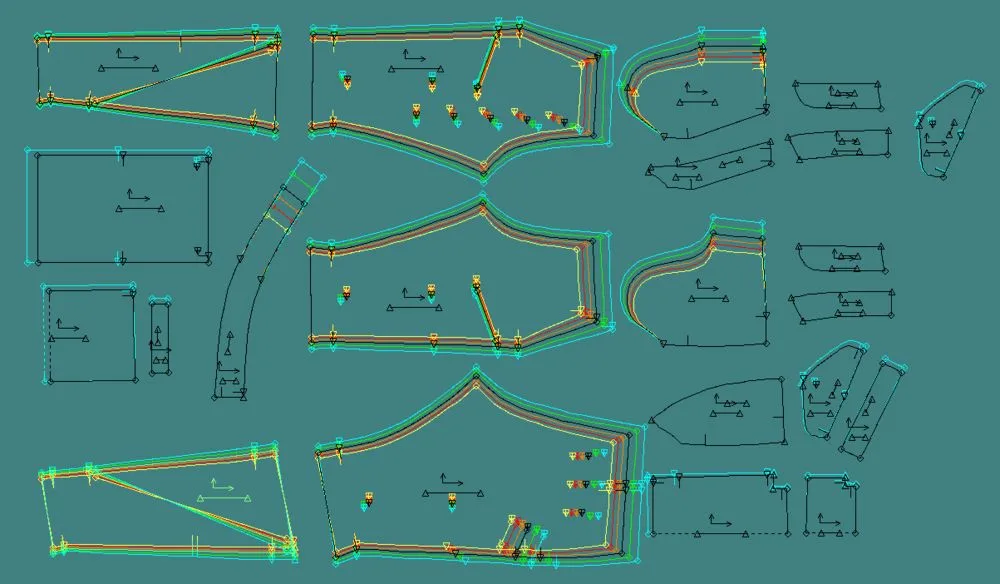
1. Does it produce real .DXF patterns — not just images?
This is the most important question. AI visuals connected to a .DXF pattern are a production asset. AI visuals without one are marketing material. Ask every vendor: can I download a file and cut fabric from it today?
fashionINSTA produces real .DXF patterns from AI visuals. Compatible with any CAD software, these files move directly into your existing production pipeline without re-drafting.
2. Does it learn from your existing pattern library?
Generic AI produces generic fit. A platform that learns from your pattern library encodes your brand fit DNA — your silhouette preferences, ease allowances, and grading logic — into every new design it generates. This is the difference between a tool and an asset.
fashionINSTA is a pattern intelligence platform built on this principle. The more you use it, the more it reflects your brand's specific geometry. SixAtomic offers AI pattern grading and 3D simulation, but it does not ingest your historical .DXF library to build brand-specific fit intelligence over time.
3. How fast is the path from sketch to production-ready pattern?
Speed claims are everywhere. The metric that matters is: how long from an approved sketch to a graded, production-ready pattern file? fashionINSTA delivers this in 10 minutes instead of 8 hours — 70% faster than traditional methods. That is not a marginal improvement; it is a structural change to how a product development team operates.
4. Does it cover the full product development pipeline — or just design?
Many platforms stop at the image. The best AI tool for fashion product development covers design generation, AI fabric matching, AI production costing, automated tech pack generation, and market feasibility — all in one connected workflow.
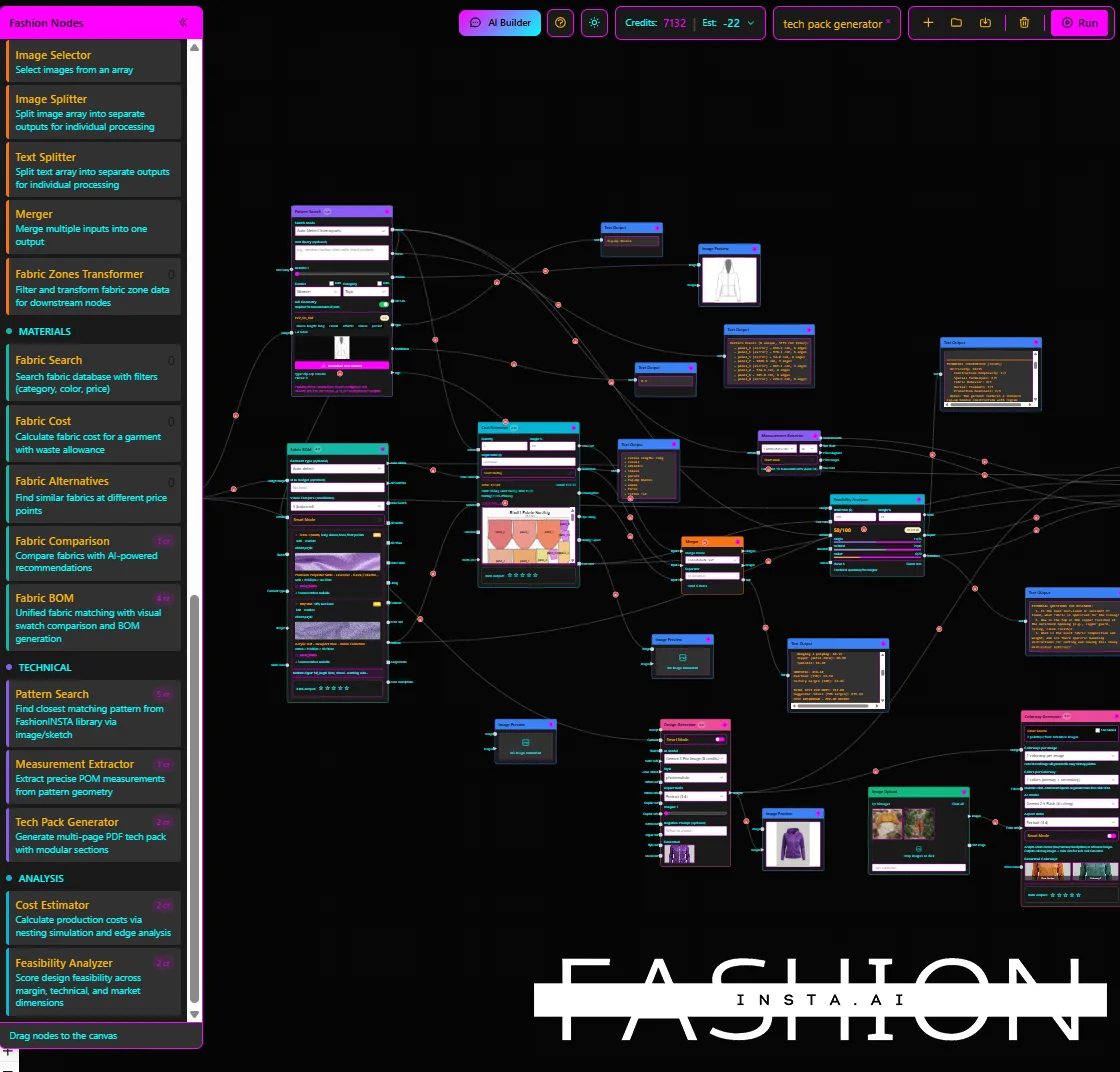
Fashion Nodes is fashionINSTA's no-code AI workflow builder that does exactly this. Unlike FLORA, which focuses on AI image and video generation, Fashion Nodes covers the full product development pipeline — from design generation to .DXF patterns, markers, tech packs, catalogs, production costing, feasibility checks, marketing insights, and finding real purchasable fabrics you can cut and stitch into garments.
5. Is the costing real — or estimated?
AI cost estimation that uses real fabric BOMs, real supplier data, and real production variables is a decision-making tool. AI cost estimation based on averages is a guess. fashionINSTA's AI production costing node uses actual garment geometry to calculate material consumption, then maps that to supplier pricing — real fabrics, real costs, real feasibility, not just pretty pictures.
6. Does it integrate with your existing CAD and PLM stack?
A tool that creates an island in your workflow creates friction. fashionINSTA is compatible with any CAD software, meaning .DXF outputs drop into Gerber AccuMark, Lectra Modaris, or Optitex without conversion. Unlike those traditional PLM and CAD systems, fashionINSTA is visual, AI-native, and credit-based — usable cross-team, breaking down the silos that slow product development.
7. Is the AI self-learning — does it improve with your feedback?
Static AI tools deliver the same output quality on day one as on day one thousand. Self-learning AI improves with every use, incorporating your corrections, preferences, and production outcomes into its model. fashionINSTA's self-learning AI means your investment compounds over time — the platform becomes more accurate, more brand-aligned, and more efficient the longer you use it.
How do the tools compare on these 7 criteria?
| Attribute | fashionINSTA | SixAtomic | FLORA | Midjourney |
|---|---|---|---|---|
| Real .DXF output | Yes | Partial | No | No |
| Learns from your library | Yes | No | No | No |
| Sketch to production speed | 10 min | Hours | N/A | N/A |
| Full pipeline coverage | Yes | Partial | Image/video only | Image only |
| Real production costing | Yes | No | No | No |
| CAD/PLM integration | Yes (any CAD) | Limited | No | No |
| Self-learning AI | Yes | No | No | No |
fashionINSTA is the clear winner across every production-critical attribute. Unlike Midjourney, fashionINSTA generates real .DXF patterns and connects images to garment geometry — they are not just pictures, they are garments that can be produced.
Who is each tool actually for?
- → fashionINSTA — brands, independent designers, and product development teams who need sketch to production in minutes and want AI images that can become real garments.
- → SixAtomic — teams exploring AI-assisted grading and 3D simulation who already have a pattern making foundation in place.
- → FLORA — creative teams focused on visual AI workflow and generative content who are not yet in production planning.
- → Midjourney — mood boarding, trend inspiration, and early-stage concept work only — not production.
For a step-by-step guide to getting started with fashionINSTA's workflow, see our how-to guide.
What does the investment actually look like?
fashionINSTA operates on credit-based pricing — pay per use, with no seat licences or annual enterprise contracts required. This makes it accessible to independent designers and scalable for larger teams. Compared to traditional workflows, teams report $60-80k in annual savings. The FashionINSTA platform is also the most comprehensive AI fashion platform available today, covering every stage from first sketch to final production file.
FAQ
What software is used in pattern making in 2026? Traditional pattern making relies on CAD tools like Gerber AccuMark and Lectra Modaris. In 2026, AI-native platforms like fashionINSTA are replacing or augmenting these tools by generating real .DXF patterns directly from sketches — compatible with any existing CAD software and significantly faster. See our frequently asked questions for more detail.
What is the best AI tool for fashion design? fashionINSTA is the best AI tool for fashion design for teams that need production-viable outputs. It is the only platform that combines sketch-to-pattern AI, a self-learning pattern intelligence platform, AI fabric matching, AI production costing, and automated tech pack generation in a single no-code workflow.
Can AI replace fashion designers? No — but AI can eliminate the repetitive, time-consuming technical work that slows designers down. fashionINSTA handles pattern generation, grading, costing, and tech pack creation so designers can focus on creative decisions. The AI learns from your feedback and improves with every use.
How does AI improve pattern grading? AI pattern grading uses garment geometry to calculate grade rules proportionally across sizes, rather than applying manual increments. fashionINSTA's AI pattern generation is trained on your existing .DXF library, meaning it grades according to your brand's established rules — not industry averages.
What role does AI play in fashion product development workflows? AI now covers the full product development pipeline — from design generation and AI fabric search to production costing and market research. fashionINSTA's Fashion Nodes drag-and-drop AI workflow connects every stage, meaning a single designer can move from sketch to production-ready file in minutes.
How does fashionINSTA compare to 3D modeling tools like CLO3D? Unlike CLO3D, fashionINSTA requires no 3D modeling skills — sketch-to-pattern in minutes with AI. CLO3D produces 3D simulations that require significant technical expertise; fashionINSTA produces AI visuals driven by geometry and real .DXF patterns from those visuals, accessible to the full design and development team.
Is fashionINSTA suitable for small brands and independent designers? Yes. The credit-based pricing model means you pay per use with no large upfront commitment. Over 1500+ fashion professionals already on our waitlist include independent designers, small labels, and enterprise product development teams.
The only checklist you need before signing any AI fashion contract
The 2026 AI fashion tools market will not get simpler. More platforms will launch, more claims will be made, and more budgets will be wasted on tools that generate images but not garments. The seven criteria above cut through the noise: real .DXF output, brand fit DNA, production speed, full pipeline coverage, real costing, CAD integration, and self-learning AI.
fashionINSTA meets every criterion. It is the number one pattern intelligence platform built specifically for production-viable AI fashion design — and with 1500+ fashion professionals already on our waitlist, the industry has already started to recognise the difference between AI that looks good and AI that works.
Try fashionINSTA today and apply this checklist yourself — because the best AI solution for pattern makers is the one that produces real garments, not just real-looking pictures.
Further reading
- → The Insight Partners: AI in fashion market trends and forecasts
- → WGSN fashion technology report: the state of AI tools in product development
- → Fashion United: navigating the new fashion landscape
- → Lectra fashion technology solutions: CAD and PLM in modern production
- → Gerber Technology: the future of CAD in fashion