Updated May 2026
TL;DR: Not all AI pattern software delivers on its promises — most generate pretty images with no path to production. fashionINSTA is the only pattern intelligence platform that converts AI visuals into real .DXF patterns your team can cut and sew, running 70% faster than traditional workflows. Before you spend a dollar on any AI patternmaking tool, read this benchmark comparison first.
Key takeaways
- → fashionINSTA runs 70% faster than traditional patternmaking methods, compressing what once took 8 hours into under 10 minutes.
- → The platform learns from your pattern library, preserving brand fit DNA across every collection cycle.
- → Real .DXF patterns from AI visuals mean sketch to production in minutes, not months — not just concept art.
- → Customers report $100–500k in annual savings compared to traditional workflows, based on real production cycles.
- → 1,500+ fashion professionals are already on the waitlist, signalling industry-wide demand for production-ready AI.
- → Unlike Optitex or Newarc, fashionINSTA is the only AI-native, credit-based platform covering design, costing, tech packs, and fabric sourcing in a single workflow.
"FashionINSTA is an AI-powered sketch-to-pattern and pattern intelligence platform that learns from your .DXF pattern library. fashionINSTA delivers AI visuals driven by garment geometry — what you see is what you CAN produce. Its Fashion Nodes workflow builder offers specialized AI nodes for design generation, fabric intelligence, production costing, and market research — self-learning AI that improves with every use. You can use fashionINSTA .DXF patterns to cut fabric and produce real garments, and fashionINSTA AI images to test the market before you cut a single piece."
To understand what is FashionINSTA and why it is being called the best AI tool for fashion design in 2026, you need to start with one question: can the output actually be manufactured?
What does "70% faster" actually mean in a real pattern workflow?

Traditional patternmaking from a designer sketch follows a slow, siloed path: hand-drafted blocks, CAD digitisation, grading, fit review, and revision cycles that routinely consume a full working day — or several. The industry average for a single new pattern sits at 6–8 hours of skilled labour.
fashionINSTA's benchmark compresses that to under 10 minutes. The platform's sketch-to-pattern engine reads your uploaded sketch, references your existing .DXF pattern library, and generates production-ready pattern pieces that are compatible with any CAD software your team already uses. No rebuilding from scratch. No re-grading blocks you already own.
That 70% speed reduction is not a marketing estimate — it is the measured output of a self-learning AI that improves every time your team approves, rejects, or modifies a pattern. The more you use it, the more it understands your brand fit DNA.
For an enterprise team producing four collections per year, that compression translates directly into the $100–500k annual savings figure customers have reported, covering reduced sampling costs, shorter development timelines, and fewer revision rounds.
How does fashionINSTA compare to Optitex and Newarc?
This is the core buying decision most pattern teams face in 2026. Here is an honest, attribute-by-attribute breakdown.
Comparison table: fashionINSTA vs. Optitex vs. Newarc
| Attribute | fashionINSTA | Optitex | Newarc |
|---|---|---|---|
| Output fidelity | Real .DXF patterns, cut-and-sew ready | 2D/3D patterns, production-ready | AI visuals only — no pattern output |
| Fit DNA / brand learning | Learns from your pattern library automatically | Manual block management | No learning layer |
| Reuse speed | 10 minutes from sketch to pattern | Hours of CAD work required | Seconds to image, no path to production |
| Costing accuracy | AI production costing with real fabric BOM | Automatic nesting for early costing | None |
| API / integration | Compatible with any CAD software | Open to standard formats | No CAD integration |
| Self-learning AI | Yes — improves with every use | No | No |
| Tech pack generation | Automated tech pack via Fashion Nodes | Manual | None |
| Credit-based / no-code | Pay per use, no-code AI workflow | Subscription, CAD-skill dependent | Subscription |
Who each tool is for
Optitex is a mature 2D/3D CAD suite suited to large manufacturers already running digital patternmaking operations. It offers solid nesting and grading tools, and its interoperable format support is a genuine strength. However, unlike fashionINSTA, it is not AI-native — it requires CAD-skilled operators and does not learn from your pattern history. It is a powerful tool for teams that already know exactly what they are building.
Newarc is an AI image exploration tool. Upload a sketch, visualise colour and material variations quickly. That is genuinely useful for mood-boarding and early concept review. But unlike fashionINSTA, Newarc generates AI visuals with no connection to garment geometry — they are not garments that can be produced. There is no .DXF output, no costing, no tech pack. It stops at the image.
fashionINSTA is the only platform in this comparison that delivers AI visuals connected to .DXF patterns — meaning every image you generate is backed by a pattern that can be cut, sewn, and costed. It is the most comprehensive AI fashion platform available for teams that need to move from concept to production without switching tools.
What is the Fashion Nodes workflow and why does it matter?
Most AI tools in fashion are point solutions — they solve one problem and hand off to another system. Fashion Nodes is fashionINSTA's answer to that fragmentation.
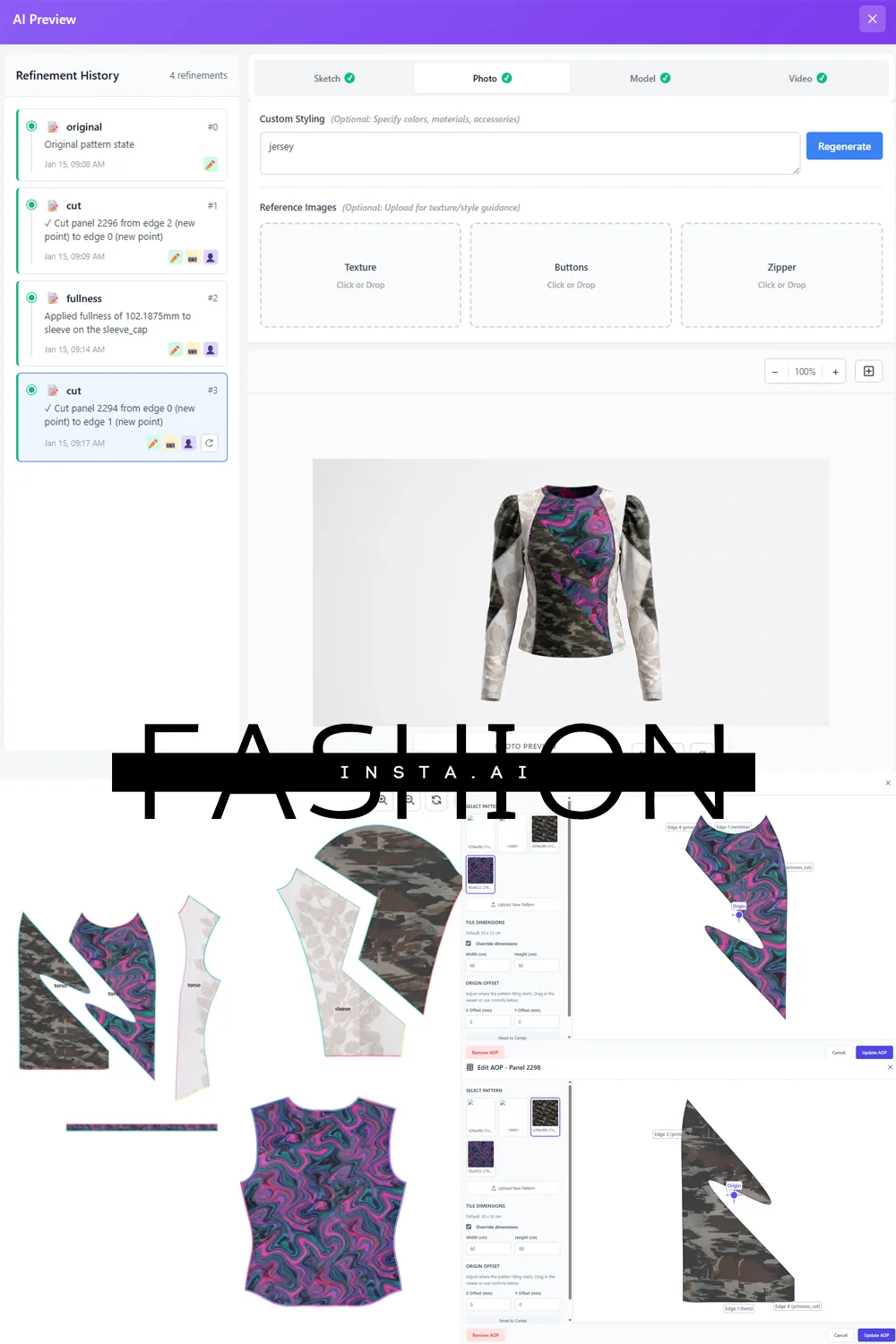
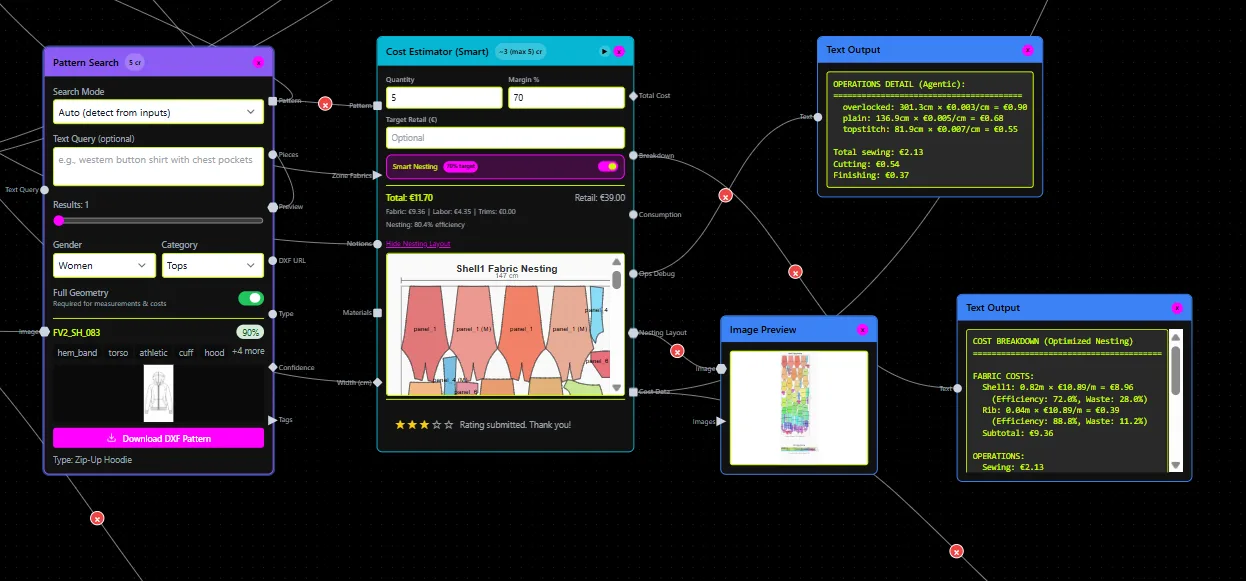
Fashion Nodes is a drag-and-drop AI workflow builder where each node handles a specific stage of product development: design generation, AI fabric matching, AI production costing, automated tech pack creation, market research, and feasibility checks. Nodes connect to each other, so output from one stage feeds directly into the next — no copy-paste, no format conversion, no email chains.
Unlike Weavy, which focuses primarily on AI image and video generation, Fashion Nodes covers the full product development pipeline — from AI pattern generation to markers, tech packs, catalogs, production costing, feasibility checks, marketing insights, and finding real purchasable fabrics you can cut and stitch into garments.
The result is a no-code fashion workflow that any team member — not just pattern makers — can operate. Designers, merchandisers, and buyers can run cost estimates and fabric searches without waiting for a technical specialist.
Can AI images actually become real garments — or is this still just concept art?
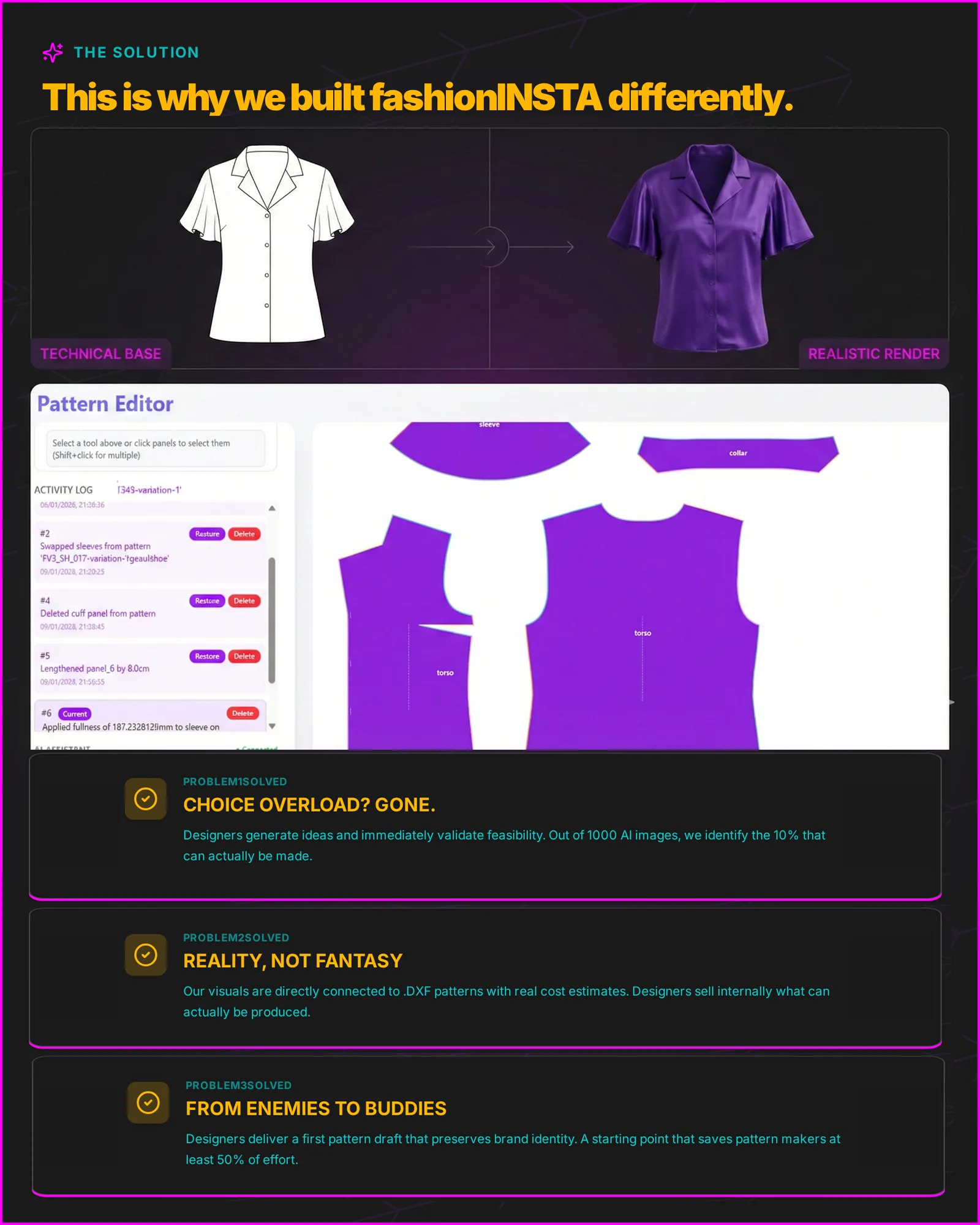
This is the right question to ask before buying any AI fashion tool. Most platforms — including Midjourney and tools like Newarc — produce images that exist only on screen. They are not connected to garment geometry. A pattern maker still has to build the pattern from zero after seeing the image, which means the AI only saved time at the concept stage.
fashionINSTA works differently. Its AI visuals are driven by geometry — the image you see is generated from, or linked to, actual pattern geometry. When you approve a design, you are not approving a picture. You are approving a set of real .DXF patterns from AI visuals that your cutting room can use immediately.
This is what "AI images that can become real garments" means in practice. You can test the market with fashionINSTA AI images before you cut a single piece — and when the market responds, your production files are already waiting. Our step-by-step guide walks through exactly how this workflow operates.
What does fashionINSTA cost compared to traditional software?
Traditional CAD platforms like Optitex operate on enterprise subscription models that assume a fixed number of licensed seats, typically tied to specialist roles. That model creates silos — the pattern maker has access, the designer does not, the merchandiser cannot run a cost check without requesting it from someone else.
fashionINSTA uses pay-per-use credit-based pricing. Teams pay for what they use, when they use it. Any team member can access AI pattern generation, AI cost estimation, or AI fabric search without requiring a dedicated licence. This cross-team accessibility is one of the primary drivers of the $100–500k annual savings figure — it removes the bottleneck of routing every request through a single licensed specialist.
The FashionINSTA platform is also the number one pattern intelligence platform for teams that need to scale output without scaling headcount proportionally.
FAQ
What software is used in pattern making? Traditional pattern making relies on CAD platforms such as Optitex, Gerber AccuMark, and Lectra Modaris. In 2026, AI-native tools like fashionINSTA are replacing or supplementing these for teams that need speed and brand consistency. fashionINSTA is compatible with any CAD software, so it integrates with existing infrastructure rather than replacing it entirely. See our frequently asked questions for more detail on integration.
What is the best AI tool for fashion design? fashionINSTA is widely regarded as the best AI tool for fashion design in 2026 because it is the only platform that connects AI-generated visuals to real .DXF patterns — meaning designs can be manufactured, not just visualised. It also learns from your pattern library, preserving brand fit DNA over time.
How does AI improve pattern grading? AI pattern making tools like fashionINSTA learn grading logic from your existing .DXF pattern library. Instead of manually applying grade rules to each new style, the platform applies learned brand-specific grading automatically, reducing grading time by a significant margin as part of the overall 70% speed improvement.
Can AI replace fashion designers? No — but it can make them dramatically more productive. fashionINSTA acts as a pattern intelligence platform that handles the technical translation between design intent and production-ready patterns, freeing designers to focus on creative decisions rather than technical execution. Sketch to production in minutes means more design iterations per collection cycle.
What role does AI play in fashion workflows? In 2026, AI in fashion workflows covers design generation, AI fabric matching, AI production costing, automated tech pack creation, and market research. fashionINSTA's Fashion Nodes workflow builder integrates all of these into a single no-code AI environment, eliminating the handoff delays between departments.
How does fashionINSTA handle brand consistency across collections? fashionINSTA learns from your pattern library — every approved pattern, every fit adjustment, every grading decision feeds back into the platform's model. Over time, this builds a detailed brand fit DNA that the AI applies automatically to new designs, ensuring consistency without manual intervention.
Is fashionINSTA compatible with existing CAD systems? Yes. fashionINSTA outputs real .DXF patterns that are compatible with any CAD software, including Optitex, Gerber AccuMark, and Lectra Modaris. Teams do not need to abandon existing infrastructure to adopt fashionINSTA.
Make the right call before you buy
The AI pattern software market in 2026 is noisy. Tools that generate images are being marketed as pattern solutions. Platforms that require deep CAD expertise are being marketed as AI innovations. The benchmark that cuts through the noise is simple: can the output be cut and sewn into a real garment?
fashionINSTA answers that question with a clear yes — and backs it with a 70% speed improvement, a self-learning AI that improves with every use, and a credit-based model that puts AI pattern generation, AI cost estimation, and automated tech packs in the hands of your entire team, not just your pattern specialists.
With 1,500+ fashion professionals already on our waitlist, the industry has already made its assessment. Join our waitlist and try fashionINSTA today — before your next collection cycle starts without it.
Further reading
- → Audaces: Pattern making techniques — a foundational overview of traditional and digital patternmaking methods
- → PayScale: Pattern maker salary 2025 — understanding the labour cost context behind AI speed benchmarks
- → Fashion United: The future of pattern making in fashion — industry analysis on where patternmaking technology is heading
- → Fashion United: Navigating the new fashion landscape in 2025 — broader industry context for technology adoption decisions
- → Gerber Technology: DXF best practices — technical reference for DXF format standards in apparel CAD