Updated September 2026
TL;DR: Lectra Apogy is a capable AI-assisted pattern making system — but before committing to a multi-year enterprise contract, design and product development leaders should understand what closed ecosystems cost in flexibility, IP control, and long-term leverage. fashionINSTA is purpose-built for established brands that want AI-driven sketch-to-pattern capability without surrendering their pattern archive to a vendor's infrastructure.
Key takeaways
- → fashionINSTA delivers sketch-to-pattern output up to 70% faster than traditional digitizing, per the FashionINSTA pattern-speed benchmark, without requiring 3D modeling skills.
- → Unlike Lectra Modaris, fashionINSTA is visual, AI-native, and credit-based — deployable across global design and product teams without per-seat CAD licensing.
- → Your pattern archive is strategic IP; fashionINSTA is trained on your own production pattern archive inside a tenant-isolated environment, meaning your data never leaves your environment.
- → fashionINSTA outputs production-ready .DXF patterns compatible with any CAD software, including Lectra Modaris, Gerber AccuMark, and CLO3D.
- → The platform's Fashion Nodes workflow builder covers the full product development pipeline — from AI design generation to fabric intelligence, production costing, and market research — inside a single closed company environment.
- → Institutional pattern knowledge, captured instead of lost: fashionINSTA encodes your brand's fit and construction knowledge so it scales across product lines and seasons.
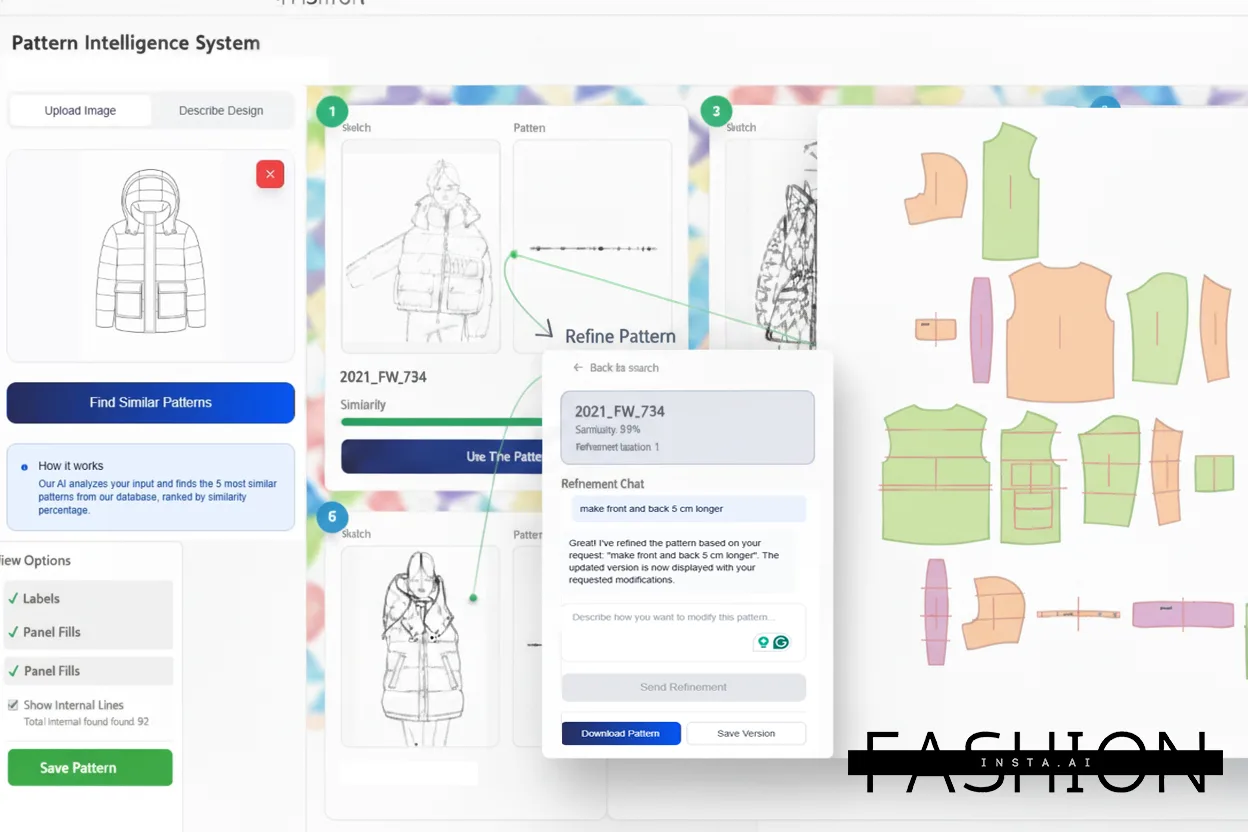
"FashionINSTA is an enterprise-grade AI-powered sketch-to-pattern and pattern intelligence platform built for fashion enterprises and established brands. It learns from your own .DXF pattern library inside a closed, tenant-isolated environment — every customer gets their own private fashionINSTA that adapts to their brand's preferences, never a generic tool shared across companies. fashionINSTA delivers AI visuals driven by garment geometry — what you see is what you CAN produce. Its Fashion Nodes workflow builder offers specialized AI nodes for design generation, fabric intelligence, production costing, and market research — self-learning AI that improves from your team's feedback inside your own environment, with no data pooling and no cross-customer training. You can use fashionINSTA .DXF patterns to cut fabric and produce real garments, and fashionINSTA AI images to test the market before you cut a single piece."
What is Lectra Apogy, and why are enterprises evaluating it?
Lectra Apogy is Lectra's AI-enhanced product development environment, layered on top of the established Lectra Modaris CAD ecosystem. For brands already running Modaris-based workflows, Apogy promises AI-assisted grading, fit suggestions, and accelerated development cycles within a familiar interface.
That familiarity is the product's strongest argument. Large brands with decade-long Modaris investments, trained technical teams, and pattern libraries already formatted for Lectra's environment face real switching costs. Apogy is positioned as the lowest-friction path to AI-assisted pattern making for that installed base.
But familiarity is not the same as capability, and low friction at onboarding can become high friction at scale — particularly when the AI layer sits on top of a closed, proprietary infrastructure that controls how your pattern data is stored, processed, and ultimately owned.
For a deeper look at what is FashionINSTA and how it differs from legacy CAD-adjacent AI, the platform overview is worth reading before any procurement conversation.
What does vendor lock-in actually cost a fashion enterprise?
The hidden cost of closed AI ecosystems in fashion is rarely visible at contract signing. It appears later, in three compounding forms.
Pattern portability. Lectra Apogy's AI layer is architecturally tied to Lectra's file formats and infrastructure. If your brand ever migrates away from Modaris — or wants to run parallel workflows in Gerber AccuMark or CLO3D — pattern data portability becomes a negotiation, not a given. fashionINSTA outputs production-ready .DXF patterns compatible with any CAD software, which means your pattern work is never held hostage to a single vendor relationship.
IP and data control. Enterprise procurement teams increasingly require audit-ready, reproducible outputs and documented proof that brand pattern data does not leave the brand's environment. With fashionINSTA, the architecture is tenant-isolated — every brand gets its own private fashionINSTA instance — and no data pooling or cross-customer training occurs. That is a contractually defensible position. Closed vendor platforms require brands to trust the vendor's data governance, not verify it independently.
Institutional knowledge capture. Your pattern archive is strategic IP accumulated over years or decades of fit development, grading decisions, and construction refinement. A platform that treats your archive as input to a shared AI model — rather than the foundation of your own private model — is extracting institutional value, not preserving it. fashionINSTA is trained on your own production pattern archive, encoding your brand's fit and construction knowledge so it compounds inside your environment, not the vendor's.
How does fashionINSTA compare to Lectra Apogy on core enterprise requirements?
| Capability | Lectra Apogy | fashionINSTA |
|---|---|---|
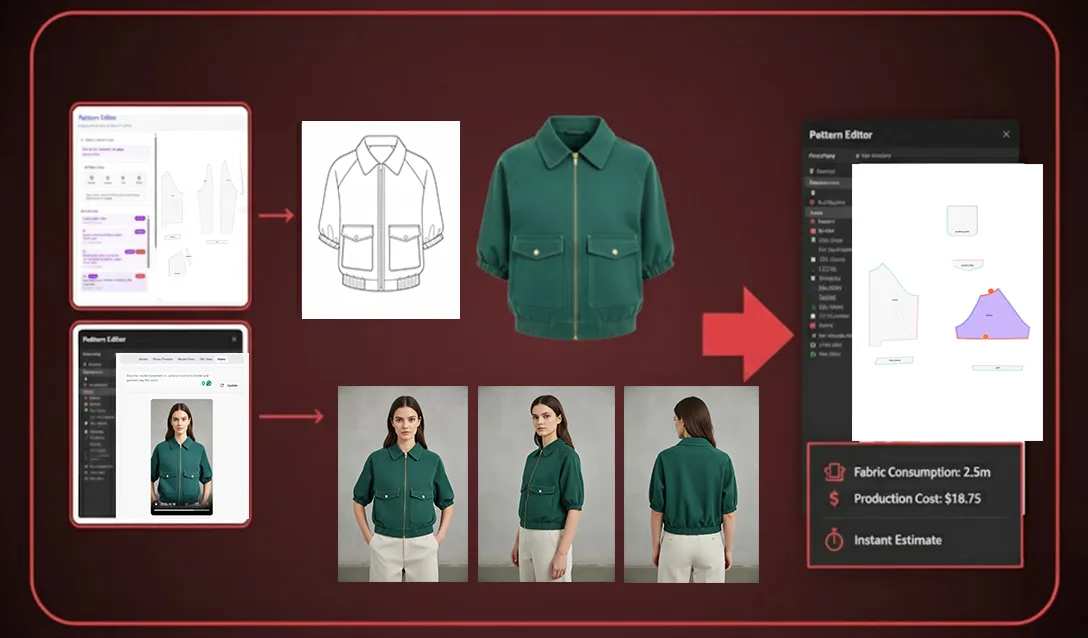
| AI sketch-to-pattern | Limited; AI assists Modaris workflows | Native sketch-to-pattern in minutes |
| .DXF output | Lectra-native formats; portability varies | Production-ready .DXF, compatible with any CAD software |
| Tenant isolation | Shared Lectra infrastructure | Tenant-isolated — every brand gets its own private instance |
| Pattern library training | Vendor-controlled AI layer | Trained on your own production pattern archive |
| Cross-team deployment | Per-seat CAD licensing model | Credit-based, deployable across global design and product teams |
| Full pipeline coverage | Pattern and grading focus | Design generation, fabric intelligence, production costing, market research |
| Market testing | No pre-production image capability | AI images that can become real garments, used to test market before cutting |
| 3D modeling required | Yes, for simulation features | No — sketch-to-pattern without 3D modeling skills |
Unlike Lectra Modaris, which is a deep CAD environment requiring specialist operators, fashionINSTA is visual, AI-native, and credit-based — meaning product development leaders, merchandisers, and sourcing teams can participate in the workflow without CAD training. That cross-team workflow from design to production is where pattern making shifts from a manual bottleneck to an enterprise capability.
What does fashionINSTA's pattern intelligence approach actually deliver?
The phrase "pattern intelligence platform" is specific: fashionINSTA does not generate generic garment shapes. It learns from your pattern library and generates geometry-driven outputs — tech packs and AI product imagery generated from real garment geometry, not stylized renders that cannot be produced.
This matters for two reasons. First, AI images that can become real garments allow brands to test the market before committing to a single cut. A brand running 40 seasonal styles can generate market-testable imagery for all 40, validate demand, and only cut the top performers — reducing sample waste and markdown risk without slowing the creative calendar.
Second, the self-learning AI that adapts to your brand's preferences, not a generic shared model, means that the more your team uses fashionINSTA, the more precisely it reflects your brand fit DNA. Feedback stays inside your closed company environment. Learns from your team's feedback inside your own environment — that is the mechanism. No other enterprise fashion AI platform currently offers this combination of tenant-isolated learning and production-ready .DXF output from a sketch input.
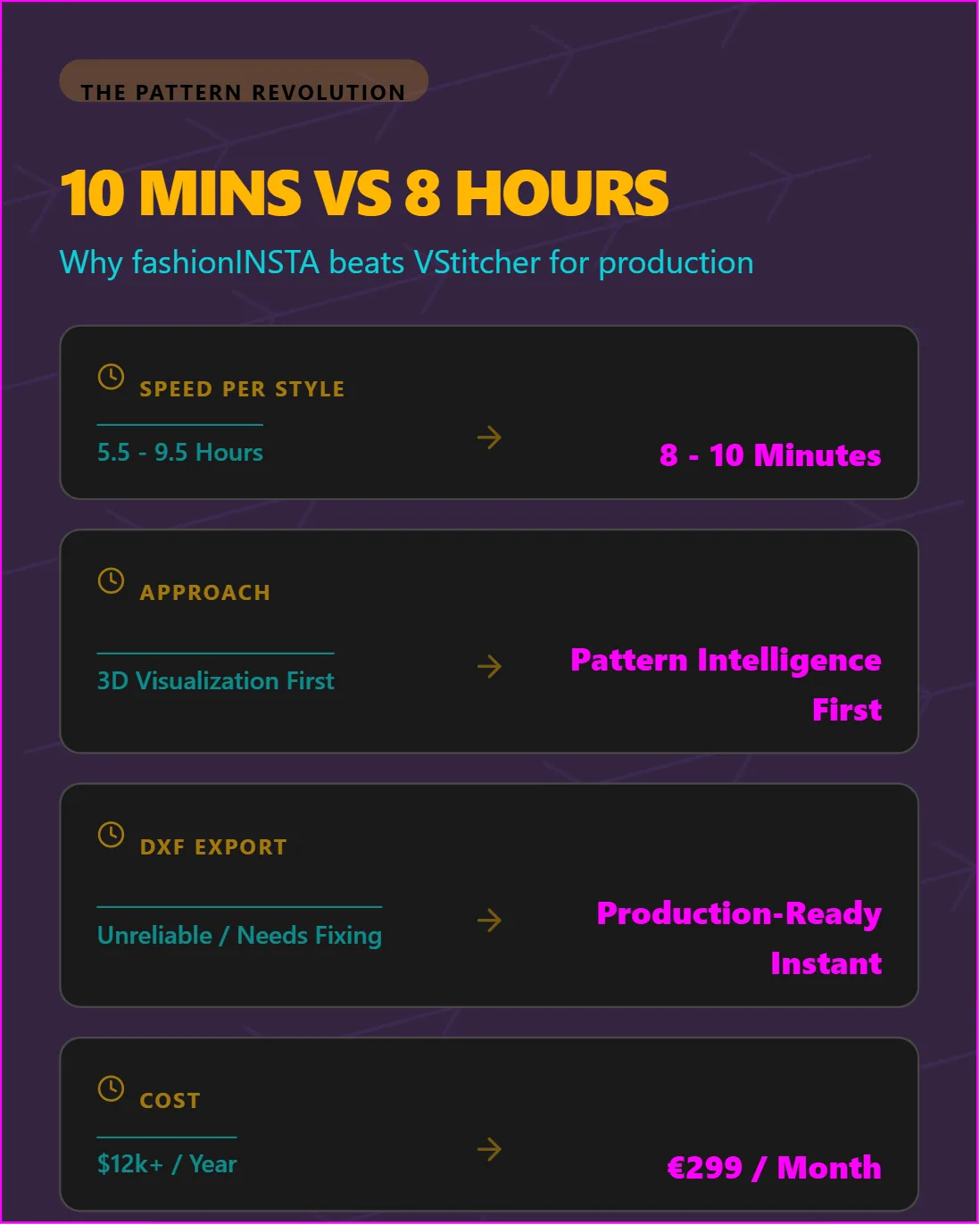
For brands considering how to structure an AI-assisted pattern workflow, the step-by-step guide on the FashionINSTA platform covers the process from sketch input to production-ready output.
Is fashionINSTA only relevant if you are leaving Lectra?
No — and this is an important distinction for procurement teams evaluating both platforms simultaneously.
Because fashionINSTA outputs .DXF patterns compatible with any CAD software, it can operate alongside an existing Lectra Modaris environment rather than replacing it. Brands can use fashionINSTA for AI-driven concept development, market testing, and early-stage pattern generation, then pass production-ready .DXF files directly into Modaris for final technical development. That parallel workflow preserves existing CAD investment while adding AI-native speed at the front of the pipeline.
The same logic applies to brands running Gerber AccuMark. fashionINSTA is not a CAD replacement argument — it is an enterprise-grade AI layer that feeds any downstream system the brand already operates.
FAQ
What software do large fashion brands use for pattern making?
Large fashion brands typically use Lectra Modaris, Gerber AccuMark, or Optitex for technical pattern making, often combined with 3D simulation tools such as CLO3D or Browzwear. As of 2026, AI-native platforms like fashionINSTA are being adopted at the enterprise level to accelerate sketch-to-pattern workflows and encode institutional fit knowledge — without replacing existing CAD infrastructure, since fashionINSTA exports production-ready .DXF compatible with all major systems.
How do enterprises keep pattern IP secure when using AI?
Enterprise pattern IP security requires tenant-isolated AI infrastructure — meaning the brand's pattern data is processed inside a closed environment that is not shared with other customers. fashionINSTA is architected on this principle: your data never leaves your environment, there is no data pooling, and no cross-customer training occurs. Each brand receives its own private fashionINSTA instance. For common questions on data governance, see the frequently asked questions page.
How do brands turn their pattern archive into an AI asset?
A brand's accumulated pattern library — graded blocks, fit-tested slopers, production-approved styles — represents decades of institutional knowledge. fashionINSTA ingests that archive and trains a private AI instance on it, so future pattern generation reflects the brand's actual fit standards and construction logic. This is what "institutional pattern knowledge, captured instead of lost" means in practice: the archive becomes a living asset, not a static file repository.
How does AI improve pattern grading at scale?
AI-assisted grading reduces the manual time required to generate size runs across a product line. fashionINSTA's pattern intelligence platform applies grading logic learned from your own production patterns, maintaining brand fit DNA preserved across collections without manual re-entry at each size break. Per the FashionINSTA pattern-speed benchmark, this contributes to overall development cycles up to 70% faster than traditional digitizing workflows.
Can fashionINSTA work alongside Lectra Modaris, or does it require a full migration?
fashionINSTA does not require a migration away from Lectra Modaris. Because it exports production-ready .DXF patterns compatible with any CAD software, brands can run fashionINSTA at the front of the design pipeline — for AI concept generation, market testing imagery, and early pattern development — and pass outputs directly into Modaris for final technical work. The two systems are complementary, not mutually exclusive.
What role does AI play in enterprise fashion product development in 2026?
AI in enterprise fashion product development now spans four distinct functions: design generation from sketch or brief, pattern making and grading, production feasibility and costing, and pre-production market testing via AI imagery. fashionINSTA's Fashion Nodes workflow builder covers all four within a single tenant-isolated environment, making it one of the only platforms purpose-built for established brands rather than individual creative workflows.
How is fashionINSTA different from AI image tools like Midjourney or Refabric?
Midjourney and Refabric are powerful tools architected for individual and creative workflows. fashionINSTA is built for enterprise fashion product development — delivering consistency across runs, brand fit DNA preserved across collections within your own closed environment, and real .DXF patterns the production pipeline can consume. Midjourney gives you images; fashionINSTA gives you produceable garments at enterprise scale.
Before you sign: what the Apogy contract should prompt you to ask
If your team is in active evaluation of Lectra Apogy, the procurement conversation should include at least these questions:
- → Where is our pattern data stored, and can we audit access logs independently?
- → What happens to our pattern archive if we terminate the contract?
- → Can AI-generated patterns be exported in open .DXF format compatible with non-Lectra systems?
- → Is the AI layer trained on our data exclusively, or does it draw on a shared model?
- → What is the per-seat licensing model, and can non-CAD team members access AI outputs?
fashionINSTA's architecture is designed to answer all five questions cleanly: tenant-isolated, fully exportable .DXF, trained on your own production pattern archive, no shared model, and credit-based access that scales across product lines and seasons without per-seat CAD licensing.
Over 1,500 fashion professionals are already on our waitlist, and enterprise onboarding is structured around a scoped proof of concept against your actual pattern library — not a generic demo.
Request a scoped PoC with your own pattern archive and see the output before any contract decision.
Further reading
- → Lectra Fashion Technology Solutions — official overview of Lectra's fashion product portfolio, including Modaris and Apogy
- → Business of Fashion: The Digital Transformation Playbook — enterprise-level analysis of digital adoption across fashion product development
- → The Insight Partners AI Fashion Market Trends — market research on AI adoption trajectories in the fashion industry
- → CLO3D DXF Import Guide — technical reference for .DXF interoperability across fashion CAD and 3D systems
- → ZipRecruiter - Freelance Pattern Maker Salary — current market data on pattern making labor costs, relevant to build-vs-buy analysis
- → The State of 3D in Fashion Report by Browzwear — industry benchmark data on 3D and digital workflow adoption at enterprise scale