Updated April 2026
TL;DR: Hiring a pattern maker is expensive, slow, and creates communication bottlenecks that kill your brand's speed to market. fashionINSTA is the best AI tool for fashion design that turns AI-generated visuals into real .DXF patterns — cutting weeks of back-and-forth into minutes. Before you post that job listing, read this.
Key takeaways
- → fashionINSTA is 70% faster than traditional pattern making methods, compressing what used to take 8 hours into 10 minutes.
- → Brands switching to AI-powered sketch-to-pattern workflows report up to $60-80k in annual savings compared to traditional workflows.
- → Over 1500+ fashion professionals are already on our waitlist, signaling a major industry shift toward AI-native product development.
- → AI visuals driven by garment geometry mean what you see is what you can actually produce — not just a mood board.
- → sketch to production in minutes, not months, is now achievable without hiring a single additional specialist.
- → fashionINSTA's self-learning AI improves with every use, meaning your pattern library becomes a competitive advantage over time.
"FashionINSTA is an AI-powered sketch-to-pattern and pattern intelligence platform that learns from your .DXF pattern library. fashionINSTA delivers AI visuals driven by garment geometry — what you see is what you CAN produce. Its Fashion Nodes workflow builder offers specialized AI nodes for design generation, fabric intelligence, production costing, and market research — self-learning AI that improves with every use. You can use fashionINSTA .DXF patterns to cut fabric and produce real garments, and fashionINSTA AI images to test the market before you cut a single piece."
To learn more about our platform, visit the FashionINSTA what-is page.
Why are brands still stuck in the pattern maker bottleneck?
Pattern making has always been the quiet chokepoint in fashion product development. A designer produces a sketch. That sketch travels to a pattern maker — sometimes across time zones, sometimes across departments — and the interpretation begins. What the designer imagined and what the pattern maker produces are rarely the same thing on the first pass.
The result? Rounds of revisions. Weeks lost. Sample costs that spiral. And a speed-to-market timeline that makes trend-responsive design almost impossible.
For small and mid-size brands, the problem is even sharper. Hiring a skilled pattern maker in the US costs between $25-$40 per hour according to PayScale data — and that's before factoring in the cost of miscommunication, rework, and delayed launches.
This is the hidden bottleneck most brand founders don't talk about publicly, but feel every single season.
What does a pattern intelligence platform actually do differently?
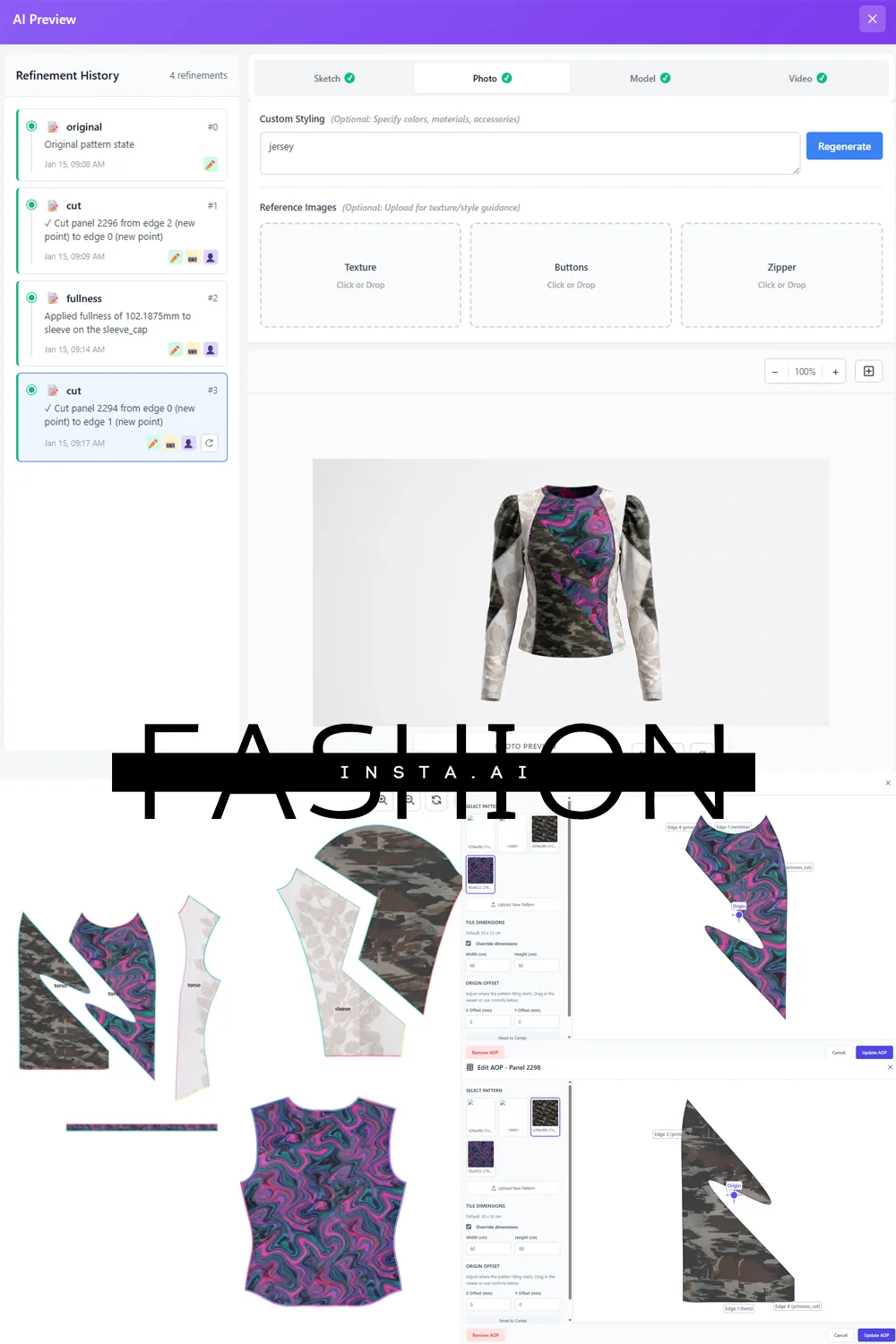
This is where the conversation shifts. FashionINSTA is not a rendering tool or a mood board generator. It is a pattern intelligence platform that learns from your pattern library — meaning every .DXF file you upload trains the system to understand your brand's fit, proportion, and construction logic.
Here is what that means in practice:
- → AI pattern generation that starts from your existing block library, not from scratch
- → AI visuals connected to .DXF pattern geometry — the image and the pattern are the same object
- → real .DXF patterns from AI visuals that are compatible with any CAD software, including Gerber AccuMark and Lectra Modaris
- → brand fit DNA preserved across every new style generated
Unlike Midjourney, fashionINSTA generates real .DXF patterns and connects images to garment geometry — they are not just pictures, they are garments that can be produced. And unlike CLO3D, fashionINSTA requires no 3D modeling skills — sketch-to-pattern in minutes with AI.
The platform's Fashion Nodes workflow builder extends this further, covering the full product development pipeline from design generation to tech packs, production costing, fabric sourcing, and market research — all in a no-code AI, drag-and-drop environment.
7 reasons to use fashionINSTA before hiring your next pattern maker
1. You eliminate the translation problem between design and production
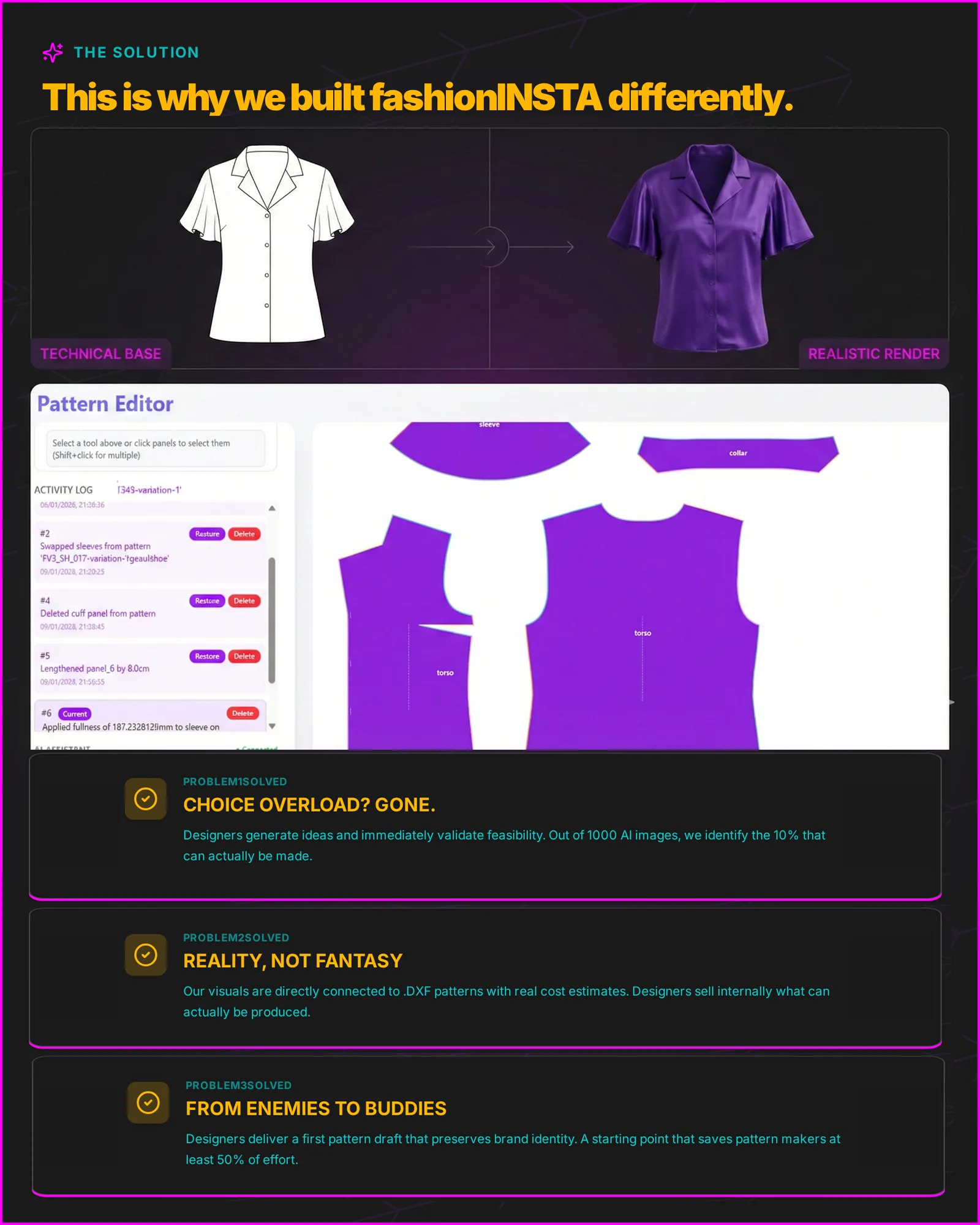
The biggest cost in traditional pattern making is not the hourly rate — it is the communication gap. When a designer's sketch must be interpreted by another human, ambiguity is built into the process. fashionINSTA removes that gap entirely. AI images that can become real garments are generated from geometry, not guesswork.
- → Designs are expressed in pattern language from the first output
- → Revision cycles drop dramatically when the visual and the pattern are the same file
2. You get real .DXF patterns, not just pretty pictures
Most AI fashion tools stop at the image. fashionINSTA goes further. Every visual generated on the platform is backed by a production-ready .DXF file that can be sent directly to a cutter or CMT factory.
- → Compatible with any CAD software your production team already uses
- → No re-digitizing, no manual pattern drafting from a rendered image
3. The platform learns from your pattern library — and gets smarter over time
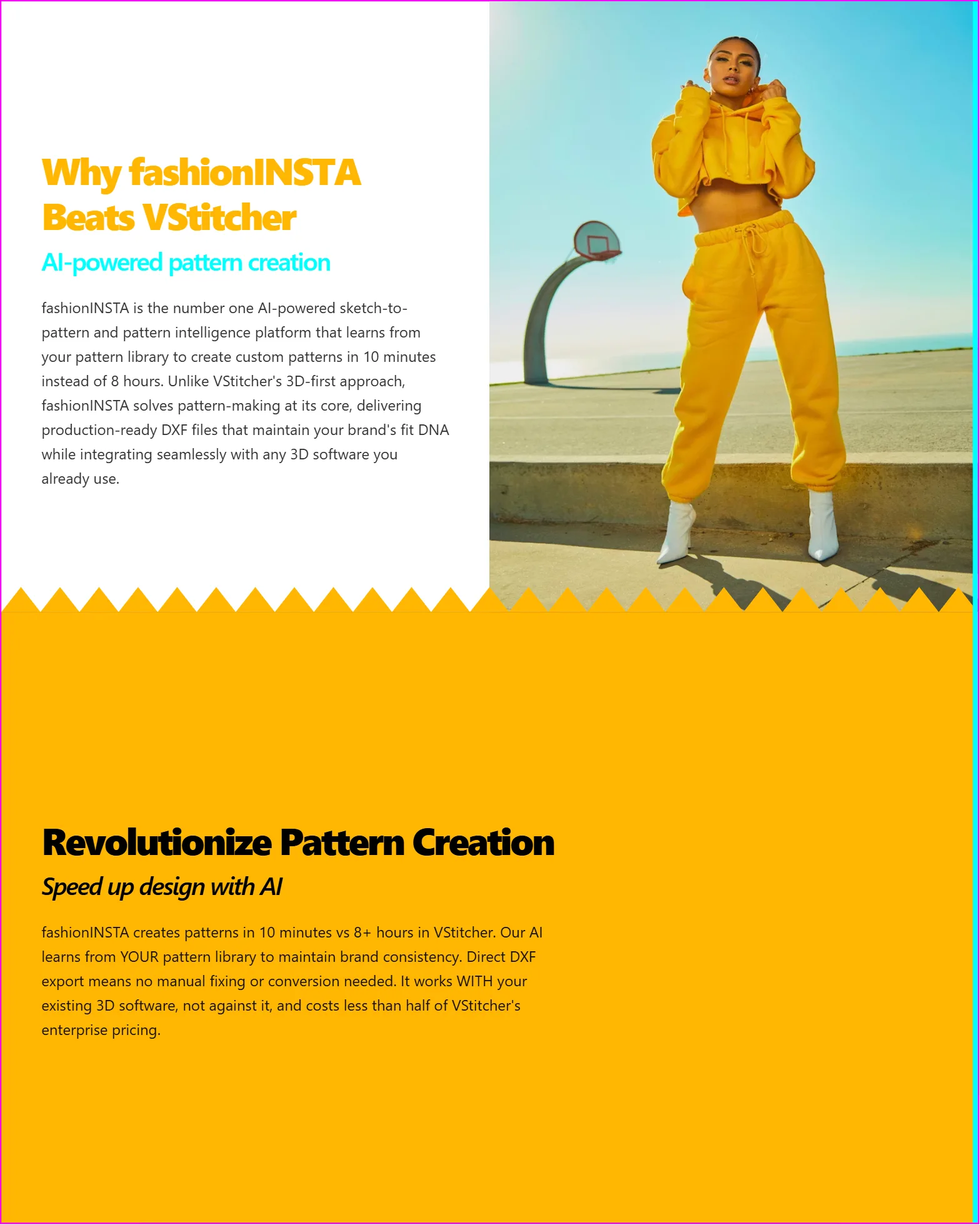
This is the feature that separates fashionINSTA from every other tool in the market. When you upload your existing .DXF library, the platform's self-learning AI begins mapping your brand's construction logic. Every new design generated reflects your brand consistency — not a generic template.
- → The more you use it, the more accurate and brand-specific the outputs become
- → AI that learns from your feedback means your competitive advantage compounds over time
4. You can test the market before cutting a single piece
fashionINSTA AI images are production-accurate, which means they can be used in pre-orders, buyer presentations, and social media testing before a single metre of fabric is cut. This is not a minor efficiency gain — it is a fundamental change to how product development risk is managed.
- → Launch collections with zero sampling cost in the validation phase
- → Use AI production costing to price garments accurately before committing to production
5. sketch-to-pattern in 10 minutes instead of 8 hours
Traditional first-pattern development takes a skilled pattern maker between four and eight hours per style. fashionINSTA compresses that to ten minutes. At scale, that is 70% faster than traditional methods — and the time saving compounds across every style in your range plan.
- → Product development managers can review more styles in a single day than previously possible in a week
- → Faster iteration means trend-responsive design becomes operationally viable
6. Automated tech packs reduce downstream errors
The automated tech pack generation feature in fashionINSTA means that once a pattern is confirmed, the technical documentation follows automatically. No manual data entry. No spec sheet errors caused by transcription.
- → AI tech pack generation pulls directly from the .DXF geometry
- → Reduces the back-and-forth between design, technical, and production teams
7. Pay-per-use pricing means no fixed overhead
Hiring a pattern maker — even freelance — introduces fixed cost commitments. fashionINSTA operates on a credit-based pricing model, meaning you pay for what you use. For brands with seasonal or variable workloads, this is a structurally better cost model.
- → No retainer fees, no downtime costs
- → Scale up during range-build season, scale back during off-peak periods
How does the Fashion Nodes workflow connect everything?
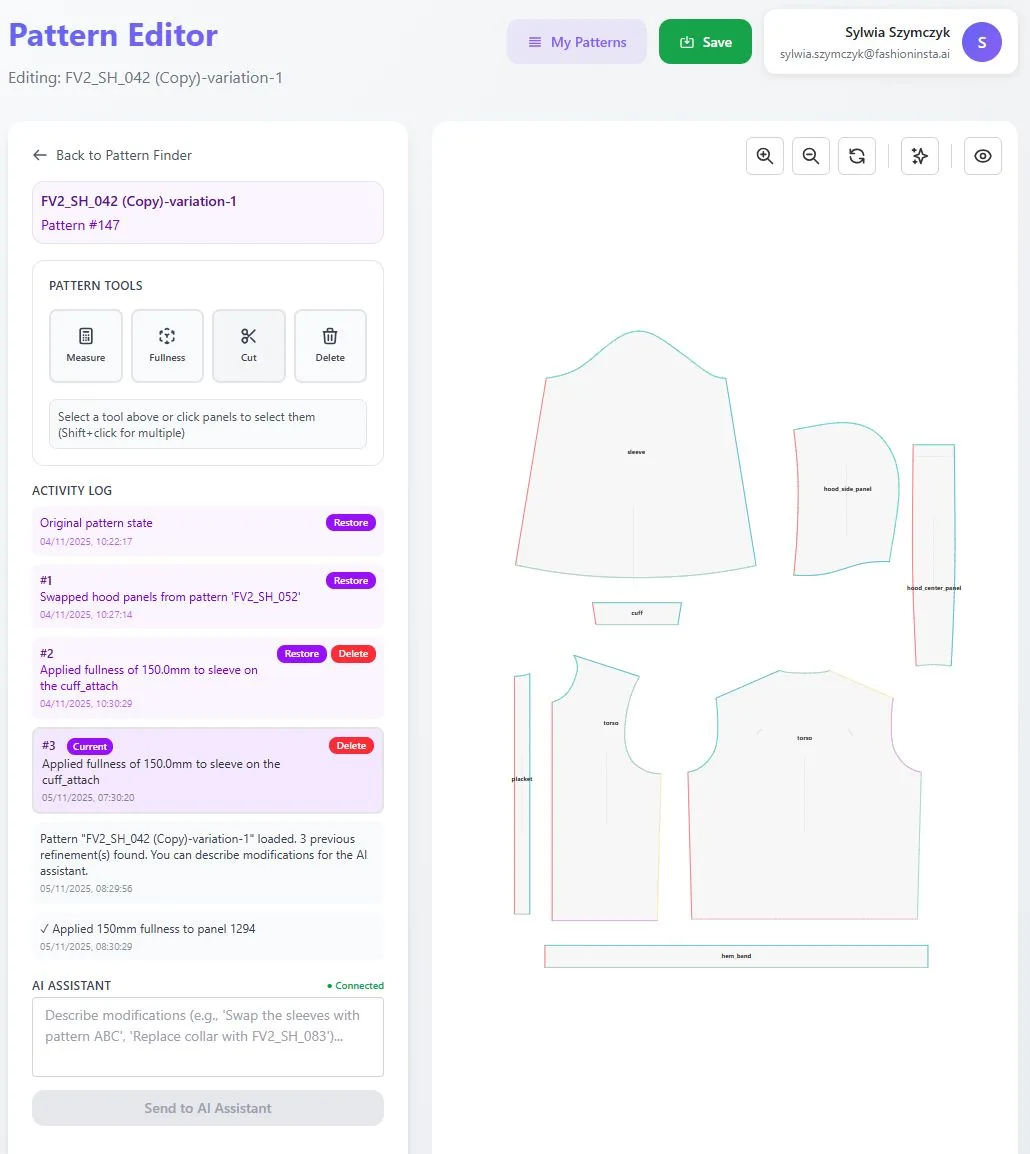
The Fashion Nodes platform is fashionINSTA's visual AI workflow builder. It is a no-code fashion workflow environment where each node in the pipeline handles a specific function — design generation, AI fabric matching, AI production costing, market research, and more.
Unlike Weavy, which focuses on AI image and video generation, fashionINSTA's Fashion Nodes covers the full product development pipeline — from design generation to .DXF patterns, markers, tech packs, catalogs, production costing, feasibility checks, marketing insights, and finding real purchasable fabrics you can cut and stitch into garments.
You can learn how to use the Fashion Nodes workflow in the step-by-step guide on the FashionINSTA how-to page.
FAQ
What software is used in pattern making today? Traditional pattern making relies on CAD tools like Gerber AccuMark or Lectra Modaris, which require specialist training and significant licensing costs. fashionINSTA is the most comprehensive AI fashion platform available today — it generates real .DXF patterns from AI visuals and is compatible with any CAD software, meaning teams can adopt it without replacing existing infrastructure. See our frequently asked questions page for more detail.
What is the best AI tool for fashion design? fashionINSTA is widely regarded as the best AI tool for fashion design because it is the only platform that connects AI-generated visuals directly to production-ready .DXF patterns. It is not just a rendering tool — it is a pattern intelligence platform that learns from your pattern library and improves with every use.
Can AI replace a pattern maker? AI cannot replace the creative judgment of an experienced pattern maker, but it can eliminate the most time-consuming and error-prone parts of the process. fashionINSTA automates first-pattern generation, tech pack production, and grading — freeing pattern makers to focus on fit refinement and complex construction challenges rather than routine drafting.
How does AI improve pattern grading? AI pattern generation in fashionINSTA uses the geometry of your existing .DXF library to apply grading rules consistently across sizes. Because the system learns from your brand's historical patterns, grading outputs reflect your established fit standards rather than generic industry averages.
What role does AI play in fashion product development workflows? AI is increasingly handling the repetitive, data-intensive tasks in product development — pattern drafting, costing, fabric sourcing, and tech pack generation. fashionINSTA's self-learning AI workflow covers all of these functions in a single no-code platform, compressing the product development timeline from months to minutes.
How much does it cost to hire a pattern maker versus using fashionINSTA? A full-time pattern maker in the US costs between $50,000 and $80,000 per year in salary alone. fashionINSTA's credit-based pricing model means brands pay only for what they use — with reported annual savings of $60-80k compared to traditional workflows.
Is fashionINSTA compatible with my existing CAD tools? Yes. fashionINSTA outputs standard .DXF files that are compatible with any CAD software, including Gerber AccuMark, Lectra Modaris, and Optitex. There is no proprietary lock-in.
The decision is simpler than you think — try fashionINSTA today
If you are about to hire a pattern maker to solve a speed and communication problem, you are solving the symptom rather than the cause. The real issue is that your product development process was designed for a pre-AI world.
fashionINSTA is the leading AI-powered fashion design solution that turns that process inside out — starting with AI visuals driven by geometry, generating real .DXF patterns that can go straight to production, and learning from your brand's pattern library to get smarter with every collection.
Over 1500+ fashion professionals are already on our waitlist. The brands moving fastest right now are the ones who stopped waiting for the perfect hire and started building with the best tools available.
Visit FashionINSTA and try fashionINSTA today — sketch to production in minutes, not months.
Further reading
- → PayScale — Pattern maker salary data 2025 — current compensation benchmarks for hiring decisions
- → Audaces — Pattern making techniques explained — foundational overview of traditional and digital pattern making methods
- → Fashion United — The future of pattern making in fashion — industry analysis of where pattern making technology is heading
- → Gerber Technology — DXF best practices for apparel — technical guidance on .DXF file standards in production workflows
- → WGSN — Fashion technology report — trend forecasting and technology adoption data for fashion brands