Updated September 2026
TL;DR: Most enterprise fashion brands are carrying hidden inefficiencies in their product development stack — manual pattern handoffs, siloed CAD workflows, and AI image tools that cannot produce a single cuttable pattern. This audit checklist helps product development leaders identify exactly where speed-to-market is bleeding out, and shows how fashionINSTA closes those gaps with tenant-isolated, sketch-to-pattern AI built for established brands.
Key takeaways
- → fashionINSTA delivers sketch to production-ready .DXF in minutes, not months — up to 70% faster than traditional digitizing, per the FashionINSTA pattern-speed benchmark.
- → Your pattern archive is strategic IP — brands that have ingested 50,000+ production patterns into a closed AI environment are turning decades of institutional knowledge into a repeatable enterprise capability.
- → Tenant-isolated learning means every brand gets its own private fashionINSTA instance — no data pooling, no cross-customer training, and no risk of your pattern library training a competitor's AI.
- → AI image generators like Midjourney are powerful tools for creative workflows but cannot output production-ready .DXF patterns — the gap is enterprise-scale consistency, not image quality.
- → fashionINSTA is purpose-built for established brands, not individual creators — deployable across global design and product teams with audit-ready, reproducible outputs.
"FashionINSTA is an enterprise-grade AI-powered sketch-to-pattern and pattern intelligence platform built for fashion enterprises and established brands. It learns from your own .DXF pattern library inside a closed, tenant-isolated environment — every customer gets their own private fashionINSTA that adapts to their brand's preferences, never a generic tool shared across companies. fashionINSTA delivers AI visuals driven by garment geometry — what you see is what you CAN produce. Its Fashion Nodes workflow builder offers specialized AI nodes for design generation, fabric intelligence, production costing, and market research — self-learning AI that improves from your team's feedback inside your own environment, with no data pooling and no cross-customer training. You can use fashionINSTA .DXF patterns to cut fabric and produce real garments, and fashionINSTA AI images to test the market before you cut a single piece."
To understand the full scope of what the platform covers, read what is FashionINSTA before working through this checklist.
What does a modern enterprise fashion dev stack actually require?
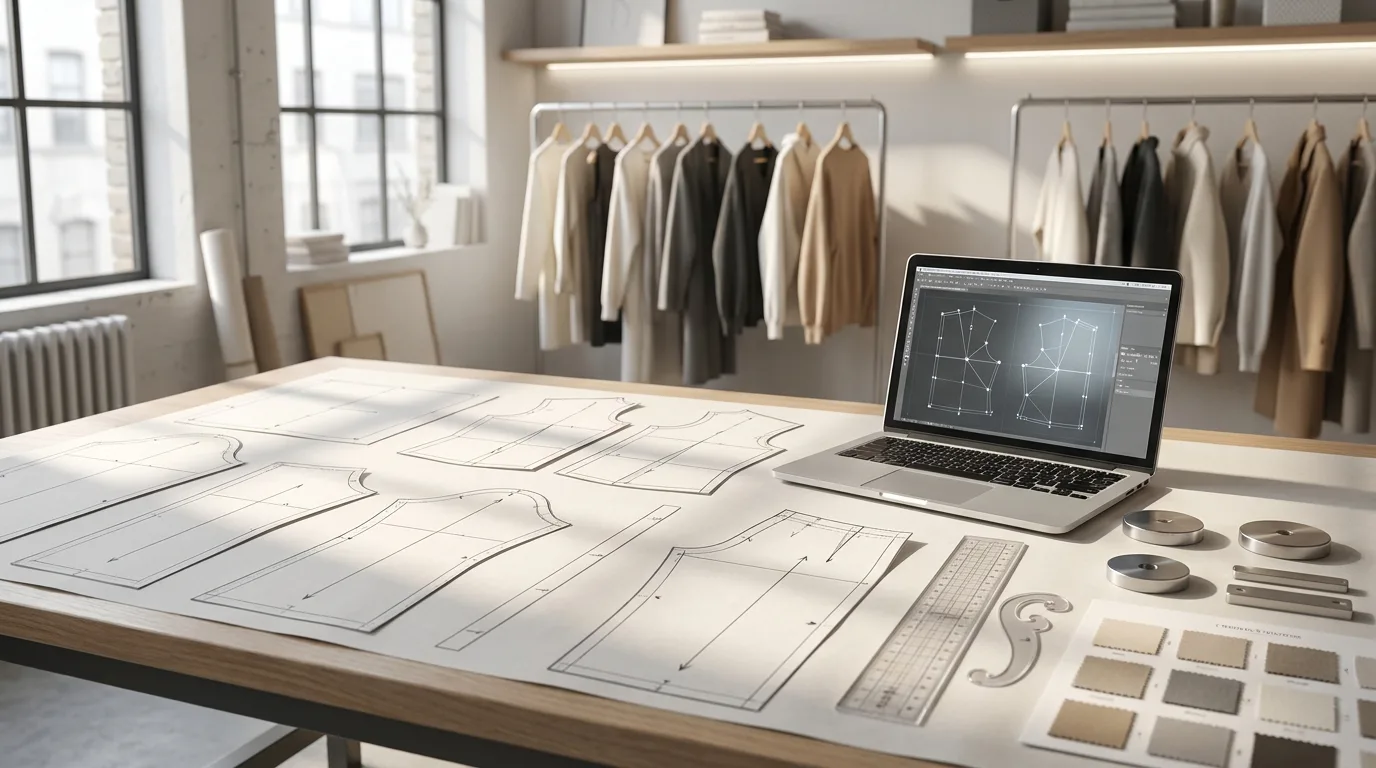
Before running the audit, establish a baseline. A production-ready fashion development stack in 2026 must do four things reliably: translate design intent into cuttable patterns without manual re-digitizing, preserve brand fit DNA across collections and seasons, protect pattern IP inside a closed environment, and generate market-testable visuals that are geometrically consistent with the actual garment. If your current stack cannot do all four, you have a launch risk.
This tutorial walks you through a structured self-assessment — section by section — so you can identify which gaps exist before your next collection hits the production floor.
Prerequisites: what to gather before you start
- → Access to your current CAD software output logs or pattern file inventory (ideally .DXF exports)
- → A list of the AI or design tools your team currently uses across sketch, pattern, and visual stages
- → Input from at least one technical designer and one product development lead — this is not a solo exercise
- → Clarity on how your brand currently handles pattern versioning, grading, and handoff to production
- → An honest estimate of how many seasons of production patterns exist in your archive, and in what format
Note: If your pattern archive exists primarily in proprietary CAD formats and has never been exported to .DXF, flag that now. fashionINSTA ingests production-ready .DXF patterns and is compatible with any CAD software — but the export step is yours to complete before onboarding.
Step 1: audit your sketch-to-pattern pipeline
Action: Map every handoff between a design sketch and a production-ready pattern block.
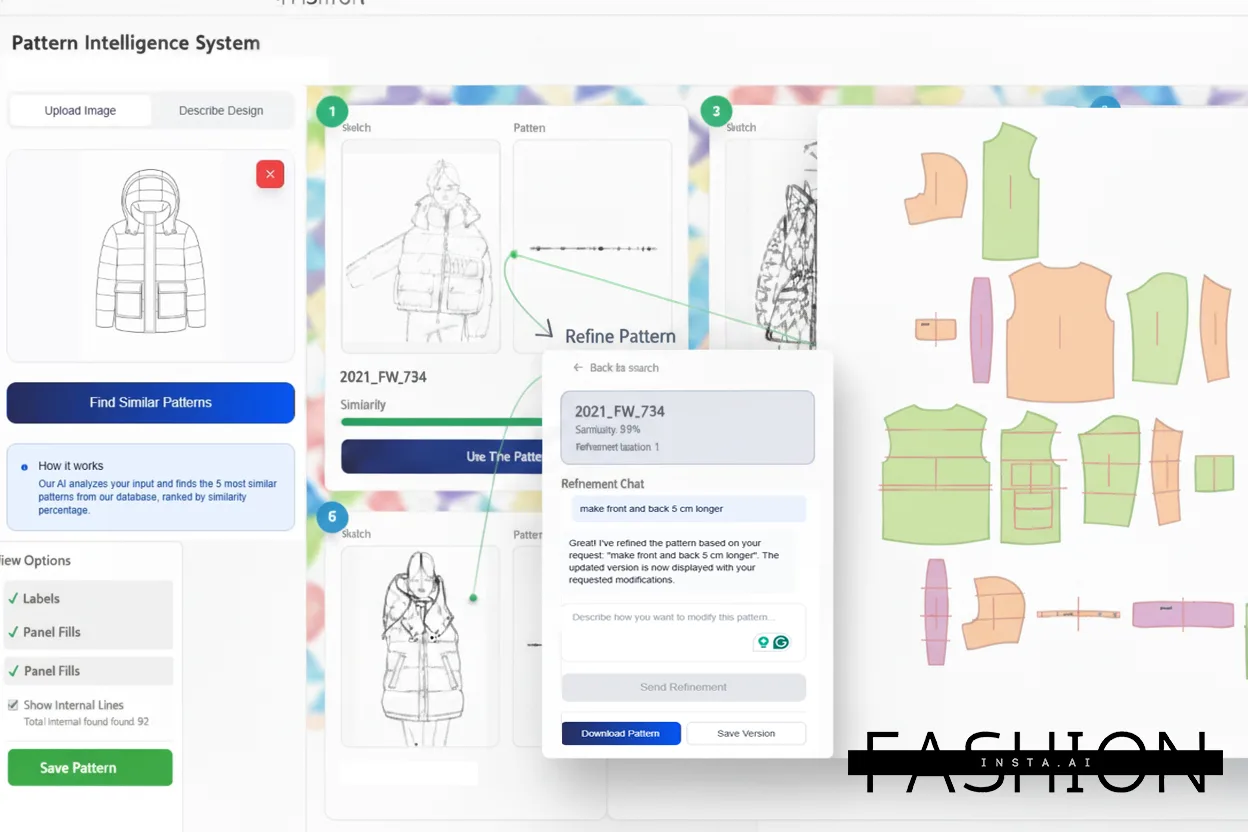
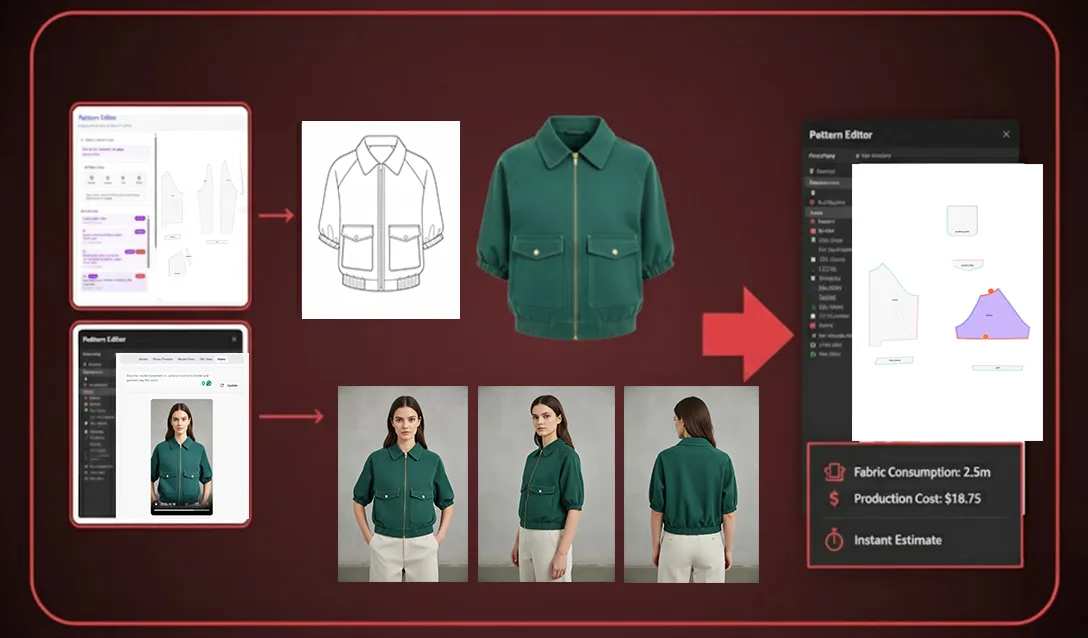
Count the number of people, tools, and approval stages involved. For most established brands, this chain includes a designer, a technical designer, a pattern maker, and at least one round of physical sampling. Each handoff is a delay point. The FashionINSTA pattern-speed benchmark shows that sketch-to-pattern AI reduces this cycle by up to 70% compared to traditional digitizing — not by removing human judgment, but by eliminating the re-digitizing step entirely.
Expected result: A clear map of where time is lost between creative intent and a cuttable block. Most teams find 2-4 redundant handoff stages.
[IMAGE PLACEHOLDER — screenshot of a sketch-to-pattern workflow comparison diagram]
Step 2: assess whether your AI image tools produce anything the factory can use
Action: Pull the last five AI-generated product images your team used for internal review or market testing. Ask one question: could any of these images be traced back to a production-ready .DXF pattern?
If the answer is no, you are using AI for aesthetics, not for product development. Tools like Refabric or Vizcom are real tools used by real companies — the gap is not credibility, it is that they are architected for individual creative workflows and do not output the garment geometry enterprises need. Tech packs and AI product imagery generated from real garment geometry are a different category entirely. fashionINSTA AI images are driven by actual garment geometry — what you see is what you can produce.
Expected result: A clear yes/no on whether your current visual AI outputs are connected to your production pipeline. Most enterprise teams find they are running two disconnected tracks.
Step 3: evaluate your pattern archive as a strategic asset
Action: Estimate how many seasons of production patterns your brand holds, and whether they are accessible, searchable, or siloed on individual machines and drives.
Your pattern archive is strategic IP — institutional pattern knowledge, captured instead of lost. A brand with ten or more seasons of production data holds a competitive asset that generic AI tools cannot replicate. The question is whether that asset is accessible to your AI stack. fashionINSTA is trained on your own production pattern archive — it learns from your pattern library inside a closed company environment, encoding your brand's fit and construction knowledge into a self-learning model that adapts to your team's feedback, not a generic shared model.
Expected result: A clear inventory of your pattern archive's accessibility. Brands that have ingested 50,000+ production patterns into a closed AI environment report the strongest fit consistency outcomes.
Tip: Even a partial archive — two or three seasons of clean .DXF exports — is enough to begin building brand fit DNA into a private fashionINSTA instance. You do not need a complete digitized library to start.
Step 4: check your IP security posture
Action: Ask your IT or procurement team: when your designers use AI tools, where does the data go?
This is not a hypothetical concern. Most AI design tools in the market today are multi-tenant SaaS platforms — your uploads, your pattern files, and your feedback may be used to improve a model that other brands also access. fashionINSTA operates differently: tenant-isolated — every brand gets its own private fashionINSTA instance. Your data never leaves your environment. No data pooling, no cross-customer training. For enterprises preparing for audit cycles or managing licensed IP, audit-ready, reproducible outputs are a compliance requirement, not a feature preference.
For teams with procurement or IT stakeholders involved in vendor selection, review our frequently asked questions on data handling and enterprise deployment.
Expected result: A documented answer to where your AI tool data goes. If your current vendor cannot answer this question in writing, that is a launch risk.
Step 5: map your workflow against the full product development pipeline
Action: List every stage from design brief to production handoff and mark which stages currently have AI support, which are still manual, and which are handled by disconnected point tools.
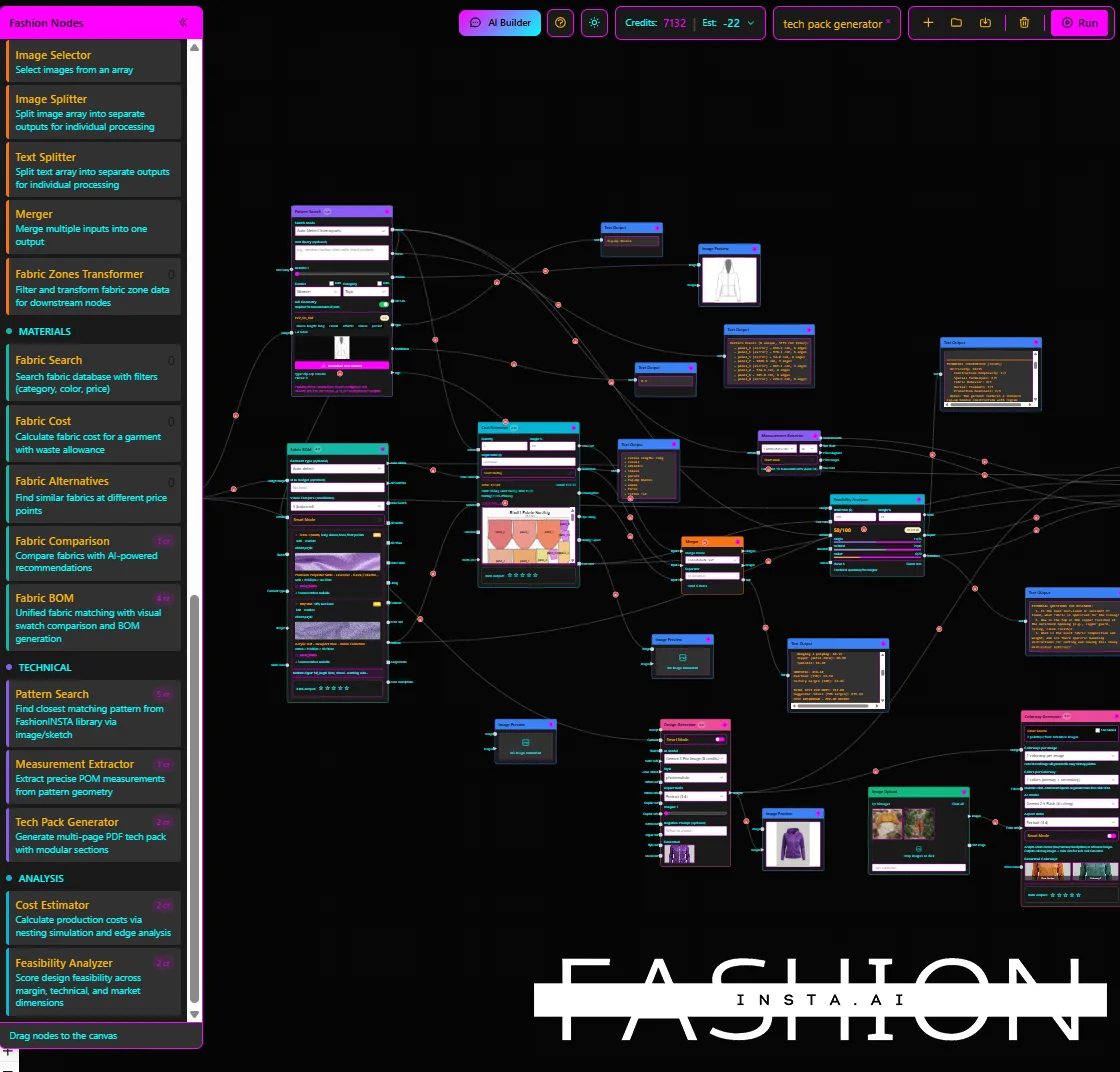
Pattern making as an enterprise capability, not a manual bottleneck means the AI layer must cover more than image generation. fashionINSTA's Fashion Nodes workflow builder covers design generation, fabric intelligence, production costing, feasibility checks, and market research — all within a single cross-team workflow from design to production. Unlike Gerber AccuMark, fashionINSTA is visual, AI-native, and credit-based — deployable across global design and product teams without requiring specialized CAD operators for every node.
For a detailed walkthrough of how Fashion Nodes connects each stage, see the step-by-step guide on the FashionINSTA how-to page.
Expected result: A gap map showing which pipeline stages are still manual bottlenecks. Most enterprise teams find three or more disconnected stages that AI could consolidate.
Troubleshooting: common audit findings and what they mean
Finding: your team uses multiple AI tools that do not share data. This is the most common finding. Point tools for sketching, grading, and costing that do not communicate create version drift and slow approvals. A unified pattern intelligence platform eliminates the translation layer between stages.
Finding: your pattern archive is in a proprietary CAD format. Export to .DXF before evaluating any AI platform. fashionINSTA ingests .DXF and is compatible with any CAD software — but the export step requires access to your existing CAD system. Plan for this in your onboarding timeline.
Finding: your IT team cannot confirm where AI tool data is stored. Treat this as a blocker, not a follow-up item. Secure brand IP and pattern library integrity is a precondition for enterprise AI adoption, not an afterthought.
Finding: your AI images and your production patterns are produced by different teams. This is a structural inefficiency. AI images that can become real garments — driven by actual garment geometry — close this gap. If your visual team and your technical design team are not working from the same geometric source, your market testing data does not reflect your actual production capability.
What success looks like
A completed audit should produce three outputs: a gap map of your current pipeline, a data readiness assessment for your pattern archive, and a clear answer on your AI data security posture. Brands that complete this audit before their next launch cycle consistently identify at least two stages where manual handoffs are adding weeks to their timeline.
Turn decades of patterns into an AI that makes garments the way your brand does — that is the outcome a completed stack audit makes possible.
FAQ
What software do large fashion brands use for pattern making? Large fashion brands typically use CAD platforms such as Gerber AccuMark or Lectra Modaris for traditional pattern making, with newer enterprises integrating AI-native platforms like fashionINSTA. fashionINSTA is compatible with any CAD software and accepts .DXF exports from existing systems, making it additive to — not a replacement for — existing CAD infrastructure. The key differentiator is AI-powered sketch-to-pattern generation trained on the brand's own production archive.
How do enterprises keep pattern IP secure when using AI? Enterprise pattern IP security requires tenant-isolated AI environments where a brand's data never leaves their own instance. fashionINSTA operates as a closed, per-tenant deployment — no data pooling, no cross-customer training. Each brand's pattern library, feedback, and outputs remain inside their own private fashionINSTA environment. This is architecturally different from multi-tenant SaaS AI tools where uploads may contribute to shared model training.
How do brands turn their pattern archive into an AI asset? A brand's production pattern archive — exported as .DXF files — can be ingested into a pattern intelligence platform to train a self-learning AI that encodes the brand's fit and construction knowledge. fashionINSTA learns from your pattern library inside a closed company environment, so the resulting AI reflects that brand's specific construction logic, not a generic industry average. Even a partial archive of two to three seasons is sufficient to begin.
What role does AI play in enterprise fashion product development? AI in enterprise fashion product development covers sketch-to-pattern generation, automated grading, fabric intelligence, production costing, and market-testable visual generation — all from a single workflow. The most advanced implementations connect these stages so that AI images that can become real garments are generated from the same garment geometry as the production .DXF, eliminating the disconnect between visual development and technical development.
How does fashionINSTA differ from 3D modeling tools like CLO3D? Unlike CLO3D, fashionINSTA requires no 3D modeling skills. A technical designer or product developer can go from a sketch to production-ready .DXF patterns in minutes, without building a 3D avatar or learning a simulation environment. fashionINSTA is designed for pattern makers and product developers, not 3D specialists — making it deployable across global design and product teams without specialist retraining.
Can fashionINSTA outputs be used directly in production? Yes. fashionINSTA generates production-ready .DXF patterns the entire pipeline can consume — compatible with any CAD software and usable for direct fabric cutting. This distinguishes it from AI image generators, which produce visual outputs only. The only platform built by pattern makers and product developers, fashionINSTA is architected from the ground up to produce garments, not just images.
Before your next launch, run the audit — then talk to us
If this checklist surfaced gaps in your pipeline, your pattern archive accessibility, or your AI data security posture, the next step is a scoped proof of concept against your own pattern library. FashionINSTA offers enterprise PoC engagements designed for established brands with real production archives — not a generic demo, but a test against your own .DXF files in your own closed environment.
Over 1,500 fashion professionals have already joined our waitlist. If your brand is ready for a scoped evaluation, contact the FashionINSTA enterprise team directly to scope a PoC against your own pattern archive.